
We have driven in the area and would like to have an imprint in my blog on the wonderful towns of my belle France, There is so much to see , doing my best, and glad found me these pictures from my cd rom vault , which now transposing in my blog for you and me, Many nice memories in town, do read my other post on it, Therefore, here is my take on the Cathédrale Saint-Gervais et Saint-Protais of Lectoure !!! Hope you enjoy the post as I.
The town of Lectoure is located in the Gers dept no 32 in the Occitanie region of my belle France,The town is in the Lomagne, a former district of the province of Gascogne having title of viscounty, nicknamed “French Tuscany”. It is 23 km from;Condom, 35 km from Agen and Auch, 96 km from Toulouse, 703 km from Versailles and 657 from my current house, The N21 road connects Limoges to Lourdes and N124 to Toulouse, the one we use to come here. Lectoure is labeled City of Art and History.
You see the Cathédrale Saint Gervais et Saint Protais upon you approach Lectoure, the silhouette of the bell tower is the most striking feature. Built all at once in 1488, and although attached to the nave of the cathedral, it is nonetheless architecturally independent. Its current height is 45 meters. It comprises five square levels of decreasing width, giving it the shape of a truncated pyramid. The clock is located on the third level. Above it is the belfry, which houses three bells. Finally, the upper platform, surrounded by a stone balustrade, offers a panoramic view. A siren stands in the center of the platform. The various levels of the bell tower, as well as the organ loft, the nave galleries, and the extrados of the vaults beneath the nave roof, are accessed by a spiral staircase located in an exterior turret at one corner of the bell tower.

The west facade, framed by two powerful buttresses terminating in gabled roofs, is remarkably simple. It dates primarily from the 15C. The portal, with its four ogee arches and prismatic ribs resting on colonnettes, was stripped of its lintel and central pillar in the 19C, replaced by a very commonplace basket-handle arch. To the right of the facade is the entrance to the City/town hall, formerly the bishop’s palace, then the private residence of Marshal Lannes, and later the sub-prefecture. Place Barton was occupied by a cemetery until the 17C now an entrance provides access to the junction of the chancel and the nave, beneath the monumental north buttress sometimes called “the little bell tower.”
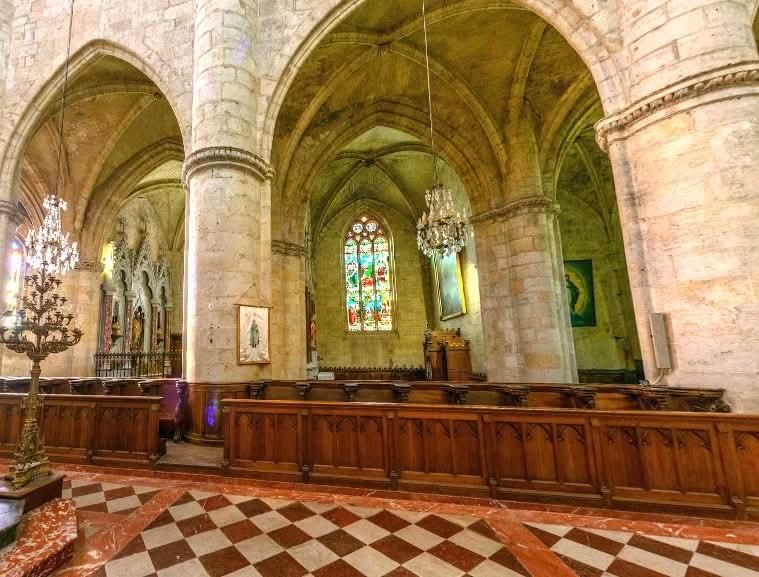
From the moment you enter in the Cathédrale Saint Gervais et Saint Protais, the nave is striking in its scale: nearly 21 meters wide, with vaults of the same height. This is a single-nave church of the southern type, with chapels between the buttresses, a design popularized by the Dominican friars after the reconquest following the war against the Albigensian heresy: a cathedral that could be fortified, a single nave allowing the preacher to keep an eye on his flock and promoting good acoustics… The chancel that follows, with its ambulatory defined by circular pillars, thus creates a striking contrast, softened by the similarity to the pillars dividing the nave bays in two. The chapels are surmounted by galleries with low arches and balustrades typical of the Lectoure region.
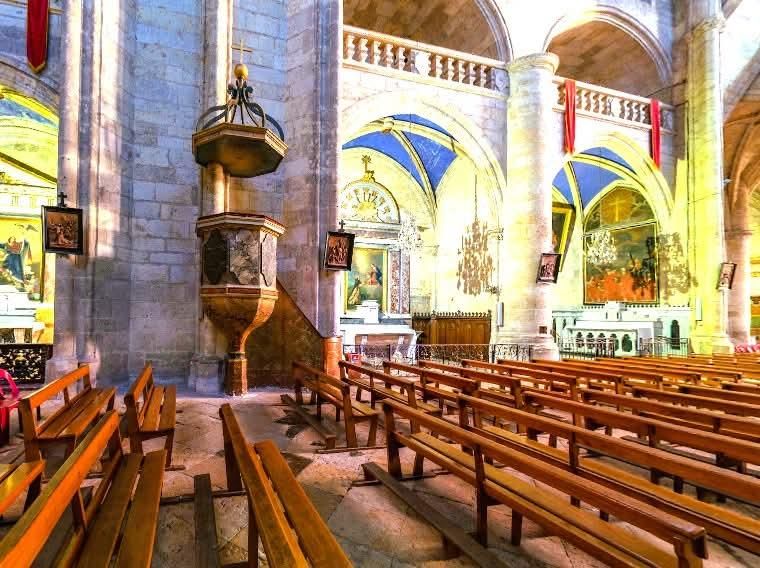
The nave chapels have ribbed vaults with sculpted and painted keystones. The first chapel on the north side is dedicated to Saint Germain. The next chapel, dedicated to Saint Louis, has an altar with a 17C altarpiece and a communion rail made of carved oak. The following chapel, the Rosary Chapel, has a gilded wooden statue of the Virgin Mary and a wrought-iron balustrade. Finally, the last chapel, entirely of gray and black marble, is the funerary monument of Claude-François de Narbonne-Pelet, Bishop of Lectoure in the 19C, with a copy of Titian’s Entombment. On the south side, from the entrance and heading towards the chancel, one can see: the Chapel of Saint John the Baptist, which houses the baptismal font and a 17C marble altar. The next chapel, Holy Cross, like the one opposite it, has a seven-panel oak balustrade carved with pilasters, caryatids, floral motifs, and a fantastical bestiary. The following chapel has an 18C altar and altarpiece. The last is the Chapel of the Sacred Heart. It is entirely adorned with painted canvases depicting the Stations of the Cross. An 18C marble altar. The chancel, whose initial plans date back to 1540, is of considerable size: 24 meters long by 11 meters wide. Its vault is higher than that of the nave, a fact obscured by the thick triumphal arch that separates them. The 36 carved wooden canons’ stalls, dating from the 17C, were reinstalled in the 19C. The ambulatory consists of nine bays: three on each side perpendicular to the axis of the chancel, a central bay, and two intermediate bays forming an approximate angle of 45 degrees. A chapel corresponds to each bay. The sacristy, located to the north of the nave is a former chapel for the canons. It is followed by a vaulted rear sacristy where the remains of frescoes still survive. The whole complex is now the Museum of Sacred Art, where numerous liturgical objects and ornaments are exhibited.
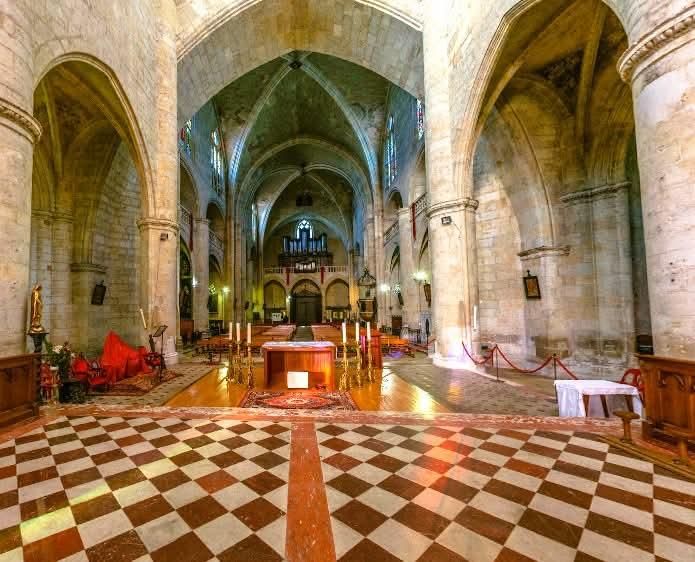
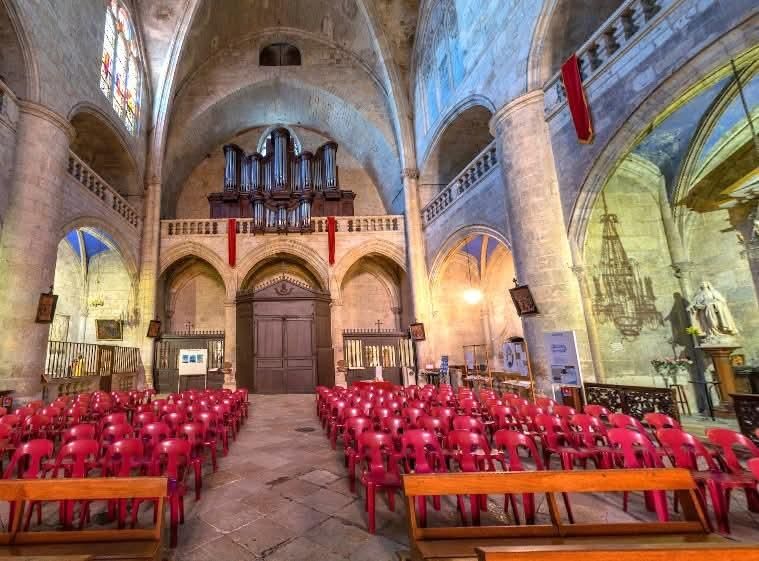
The organ is located on the gallery preceding the nave, in front of the large stained-glass window in the facade. This organ, built between 1838 and 1843, is in a post-classical style that retains 18C elements, with pre-Romantic contributions are from 1858. It was restored in 1894, 1962, and again in1987.
A bit of history I like on the Cathedral tell us that the Cathedral Saint Gervais and Saint Protais is the main religious building in the town. The cathedral was the seat of the former Diocese of Lectoure from 506 until November 29, 1801, when Pope Pius VII issued the papal bull Qui Christi Domini, attaching the territory of the Diocese of Lectoure to that of the Diocese of Auch. Since 1801, the cathedral has been the parish church of Saint Gervais and Saint Protais. The current cathedral succeeded several others. The first church documented on the present site was dedicated to Saint Thomas. Again, nothing is known of this earlier construction. Following the tragic conflicts between John V of Armagnac and King Louis XI, Lectoure was besieged. Royal troops captured the town, killed John V, and looted and burned the houses. The cathedral, located in the eastern part of the town as part of the fortifications and sheltering its last defenders, was particularly vulnerable: the façade, the bell tower, and the nave were largely demolished. For months, Lectoure, burned, demolished, and emptied of its inhabitants, was a ghost town. Then Louis XI decided to aid reconstruction and repopulation by exempting the inhabitants from taxes. This end of the 15C was a true resurrection for Lectoure. The nave, the façade, and its masterpiece, the bell tower-keep were rebuilt. Extended by a spire, it reached nearly 90 meters in height, making it one of the tallest buildings of the time. The date 1488, marking the start of construction, is still visible in the first chapel on the north side of the nave, on the lintel of the door leading to the bell tower. In 1540, the renovation of the cathedral continued by replacing the Romanesque choir and improving the nave. As in the churches of the North, an ambulatory was added to the choir. In 1561, the supporters of the Reformed religion were in control of Lectoure. They then began the systematic demolition of religious buildings. The cathedral, whose reconstruction was not yet complete, had its vaults destroyed and the south wall almost razed. Blaise de Monluc, commander of the Catholic armies, laid siege to Lectoure in September 1562. Upon retaking the town, he halted the demolition of the cathedral. In 1742, a major construction campaign was launched to rebuild the choir, the side aisles, the timber frame, and the roof of the cathedral. The French revolution had caused less damage: the 12 statues, representing the 8 prophets of the Old Testament and the 4 evangelists, were thrown down from the bell tower, and the ornaments of the portal were hammered…
The City of Lectoure on its heritage (see left column 360): https://lectoure.fr/ma-commune/patrimoine-et-histoire
The Gers dept 32 tourist office on Lectoure : https://www.tourisme-gers.com/en/ville-de-lectoure-lectoure-145895
The local Gers Armagnac tourist office on Lectoure : https://en.gers-armagnac.com/explorer/incontournables/lectoure-ville-deau-et-dhistoire/
There you go folks, a dandy area to explore and enjoy with the family, Memorable moments in my belle France, driving all over in my road warrior trails brings out sublime awesome spots with nice memorable family visits of yesteryear always remember and always looking forward to be back, eventually. Again hope you enjoy the post on the Cathédrale Saint-Gervais et Saint-Protais of Lectoure !!! as I.
And remember, happy travels, good health, and many cheers to all !!!


