
Never amazed me in my travels the beauty of my dear Spain. This is no surprise to be the 2nd most visited country in the world (UN-WTO). As we say Spain is everything under the sun , I came here to see the famous sherry, horses, and flamenco all in one, and then more see posts, The City of Jerez de la Frontera is in the province of Cadiz, autonomous region of Andalucia , and in the kingdom of Spain, The word frontera (frontier) comes from the frontier between moors nazari Granada and the Crown of Castilla during the Reconquista,The text is a translation from the parish site below by yours truly, On a passing by the church while cruising in the city. Therefore, here is my take on the Church of San Miguel of Jerez de la Frontera !!! Hope you enjoy the post as I.
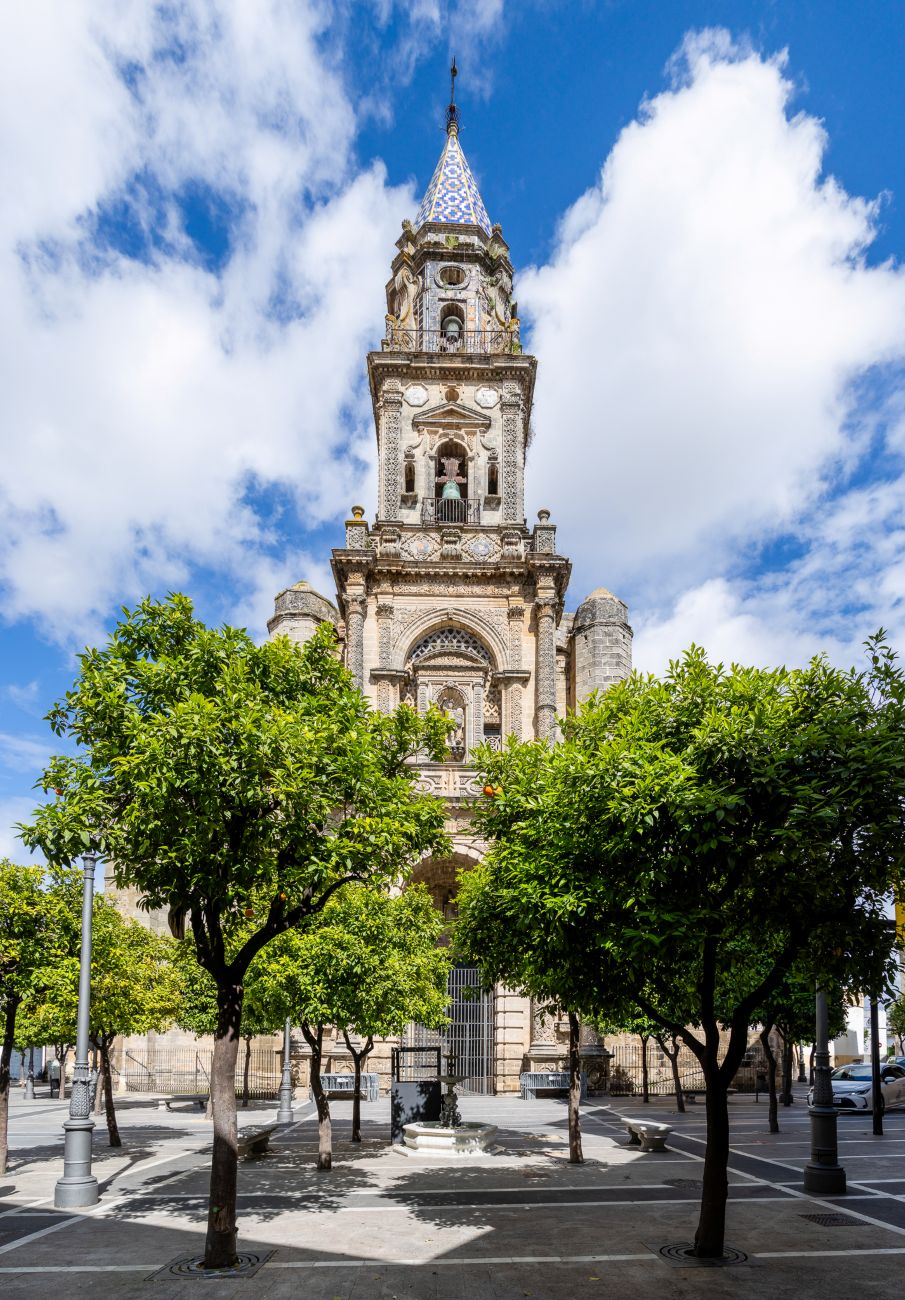
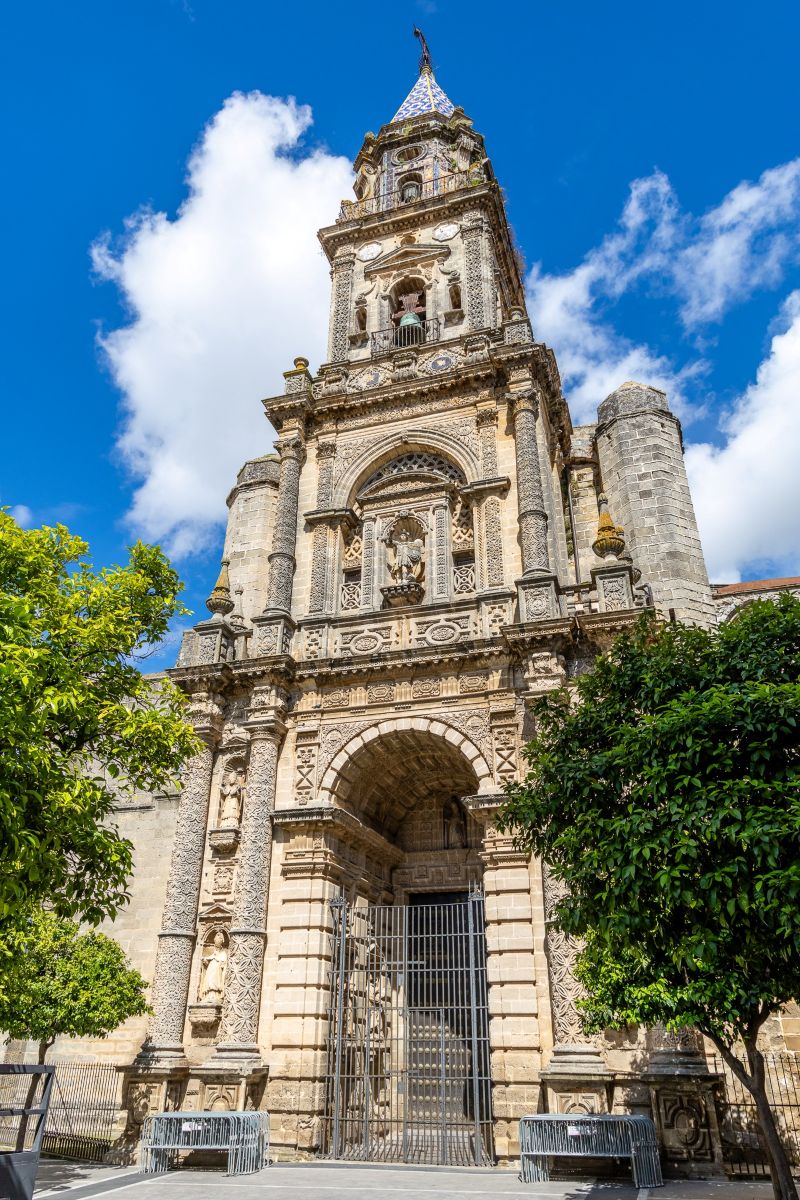
The Church of San Miguel construction began in 1484 under the patronage of the Catholic Monarchs 5Fernando and Isabel ), and continued for several centuries, resulting in a rich combination of Gothic, Renaissance, and Baroque styles. Its imposing Gothic façade, known as the Gospel Portal, and its bell tower, completed in the 18C, are particularly noteworthy. Its tower is the highest point in the city. The extraordinary tower-façade was built between 1672 and 1701. It is composed of four sections. The first forms the portico with a semicircular arch, featuring paired Doric columns in the Baroque style, and sculptures of the Latin Fathers of the Church in the spaces between them. Inside, it contains images of the Evangelists. The second section features two ornate Corinthian columns and Baroque vases; The third section features embedded pilasters, and the fourth is the octagonal part of the tower, adorned with scrolls and topped with a magnificent tiled spire. The side portals were built between 1482 and 1484. They are of the Burgundian style: situated between buttresses, the rectangular opening is framed by lateral pilasters. They are decorated with corbels and canopies; the arch is pointed, with a highly developed tympanum decorated with tracery and flanked by curvilinear gables. The Epistle portal is called the Portal of the Immaculate Conception, and the Gospel portal, the Portal of Saint Joseph, due to the Baroque images that have graced the doorways since the 18C. The portal of the Tabernacle is one of the finest examples of stone sculpture in Jerez, carved in 1739. It features Corinthian columns and statues in its entablature. The central statue depicts the Good Shepherd in a niche. On either side are two allegorical figures from the Old and New Testaments; above its pediment, Faith is accompanied by Eucharistic symbols.
The Capilla Mayor or main chapel is distinguished by its high altarpiece. The artistic style of its structure and images ranges from Mannerism to Baroque. The reliefs in the central section depict the Battle of the Angels, the Transfiguration, and the Ascension; as well as the sculptures of Saint Peter, Saint Paul, Saint James the Greater, Saint James the Lesser, and the virtues of Hope and Faith, which crown the pediment. The remaining scenes are depicted in the side sections, along with four other figures in the round: the reliefs of the Annunciation, the Adoration of the Shepherds, the Adoration of the Magi, and the Circumcision, and the images of Saint John the Baptist, Saint John the Evangelist, and the archangels Gabriel and Raphael. Undoubtedly, At the top of the altarpiece is the inscription “Quis sicut Deus” (Who is like God), an interpretation of the Hebrew word for Michael. The Chapel of the Blessed Sacrament, the great work of the Tabernacle, began in 1733. Its dimensions, splendor, and architectural complexity have led to the traditional description of it as a church within a church. It has a Latin cross floor plan, with the crossing covered by a dome on pendentives. To the left and right of the entrance are images of Saint Thomas Aquinas and Saint Bonaventure. The 18C altarpiece is a solemn baldachin framed by a large semicircular arch decorated with mirrors and rocaille motifs. At its center is the sacred tabernacle crowned by Saint Michael, and above it a contemporary sculpture of the Immaculate Conception. The ensemble is completed by the theological virtues: Faith, Hope, and Charity, and the lamp-bearing angels. At the top of the arch is a representation of the Holy Trinity.
The side Chapels are: Chapel of the Holy Crucifix, Chapel of the Incarnation, Chapel of Our Lady of the Pillar, Altar of Souls, Baptistery Chapel, Chapel of Saint Peter, Chapel of the Pavón Family, Chapel of Our Lady of Perpetual Help. The Sacristy 16C entrance features a lintelled opening supported by pilasters, above which is a tympanum depicting the patron saint of the church. The entire structure is crowned by a segmental arch. The passageway connects the sacristy to the main altar. In one of the display cases, we can see various pieces of silverware used in the worship of the Blessed Sacrament. We can also contemplate the reliquaries of the eleven thousand Virgins of Saint Ursula, whose relics were brought to this parish by the devotion of a soldier from Jerez who had fought with the Spanish Tercios in Flanders. The dome, resting on pendentives with the Evangelists, is decorated with coffers framed in slate and is crowned with an image of Christ blessing. The cherubs that adorn it, along with the images of Ecce Homo and the Virgin Mary, were created in 1733. Above these furnishings, and fitting the arches of the wall, are two canvases from the late 17C depicting The Battle of the Angels and Jesus Among the Doctors.
In 2018, its treasury was opened to the public. The Church of San Miguel boasts a large number of silver works, and their high quality, along with their varied and original designs, demonstrate the importance of the church to which they belong. Of particular note are the sets of processional crosses and candlesticks, exceptional and exquisite pieces, especially those intended for the main altar and major feast days. In the center of the room, you can see the large solar-type monstrance, commissioned by the Brotherhood of the Blessed Sacrament in 1674. Also in this room are censers, incense boats, patens, cruets, chalices, and ciboria. A painting of the Holy Face, created in the workshop of Francisco Zurbarán, is a highlight of this room.
The official Church San Miguel : https://iglesiadesanmiguel.com/
The Jerez de la Frontera tourist office on the church : https://www.turismojerez.com/en/detail-tab/glesia-de-san-miguel-1
The Andalucia region tourist office on the church : https://en.andalucia.org/listing/iglesia-de-san-miguel/16015101/
There you go folks, a dandy beautiful monument of Jerez de la Frontera. This is a must to see, me think in the whole of the City many architecturally and historically attractions, Again, hope you enjoy this post on the Church San Miguel of Jerez de la Frontera !!! as I,
And remember, happy travels, good health, and many cheers to all !!!


We were stunned by the beautful churches we saw in the small city of Jerez. What a fascinating part of the country. Maggie
LikeLiked by 1 person
Glad to read you like them always fascinating history and architecture. Thanks for stopping by Cheers
LikeLike