
Well I am happy to tell you found more pictures in my cd rom vault that should be in my blog for you and me, There have been many trip from France to/from Spain. Always memorable family trips forever in our minds ; and one of the memorable routes was along the Atlantic ocean by Hondarribia in Spain. Therefore, here is my take on the Church Santa Maria Magdalena of Hondarribia !!! Hope you enjoy the post as I.
The town of Hondarribia is in the province of Guipuzcoa in the Autonomous Community of the Basque Country, and in the kingdom of Spain, Facing the French city of Hendaye from which it is separated by the Bidassoa river facing Hendaye. It shares with them the bay of Txingudi, it occupies a strategic position on the border between Spain and France, and commands the main passage of the western Pyrénées. Together with Hendaye and Irun, it forms the cross-border urban community of Bidasoa-Txingudi. Hondarribia is called Fuenterrabía in Spanish and Fontarrabie in French. Until 1980, the official name of the town was Fuenterrabía, a name that was changed that year to Hondarribia by decision of the municipal council. Since 1989, the only official name of the town has been Hondarribia. But the Spanish continue to widely use the name Fuenterrabía and the French Fontarrabie, These are one of its two emblematic monuments that I am lucky to have pictures to share in my blog.
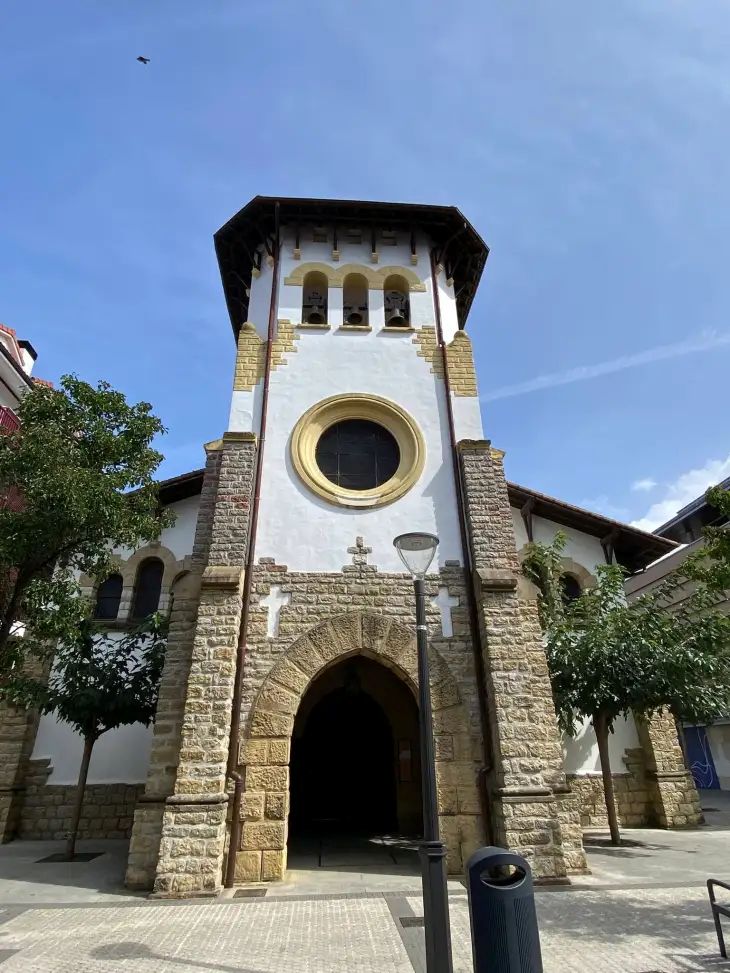
The Church of La Marina, aka Church of Santa Maria Magdalena, began construction on April 17, 1921 ,years later, on July 22, 1923, the feast day of Saint Mary Magdalene, the new chapel dedicated to her was inaugurated, It replaced an older church located in the Magdalena district. Raise your eyes and see the triptych located above the stairs leading to the choir. In the center is the Holy Family, and to the right, Saint Candida Maria of Jesus, born Juana Josefa Cipitria y Barriola in the hamlet of Berrozpe, Andoain, on May 31, 1845. She founded the Congregation of the Daughters of Jesus and was canonized by Benedict XVI on October 17, 2010. Meanwhile, another saint appears in the stained-glass window to the left. Next, there is the effigy of Saint Anthony, beneath the stained-glass windows of Saint Christopher and Saint Stephen. Below, above the image of Our Lady of Mount Carmel, patron saint of fishermen and sailors, we can see those of Saint Roch and Saint Joseph. Next to the side door is the painting of “The Virgin and Child” by Javier Sagarzazu, while above it are the stained-glass windows depicting the Sacred Heart of Jesus and the Immaculate Heart of Mary.
Completing this Epistle side are the stained-glass windows of two Basque saints, Saint Michael Garikoitz and Saint Valentine of Berrio-Otxoa, above the carving of Saint Joseph. Next to the door leading to the sacristy is “Our Lady of Perpetual Help,” an image from the old hermitage of Saint Mary Magdalene. To the left, we see the majestic image of “Our Lady of the Sacred Heart of Jesus.” Regarding this sculpture, it was formerly called the “Chapel of Saint Jerome” in the Parish Church, now dedicated to Our Lady of Guadalupe, there was an altar with three niches and different images: The image of the Sacred Heart of Jesus was placed on the altar of Saint Peter, and where that one had been, the image of Our Lady of the Sacred Heart of Jesus.
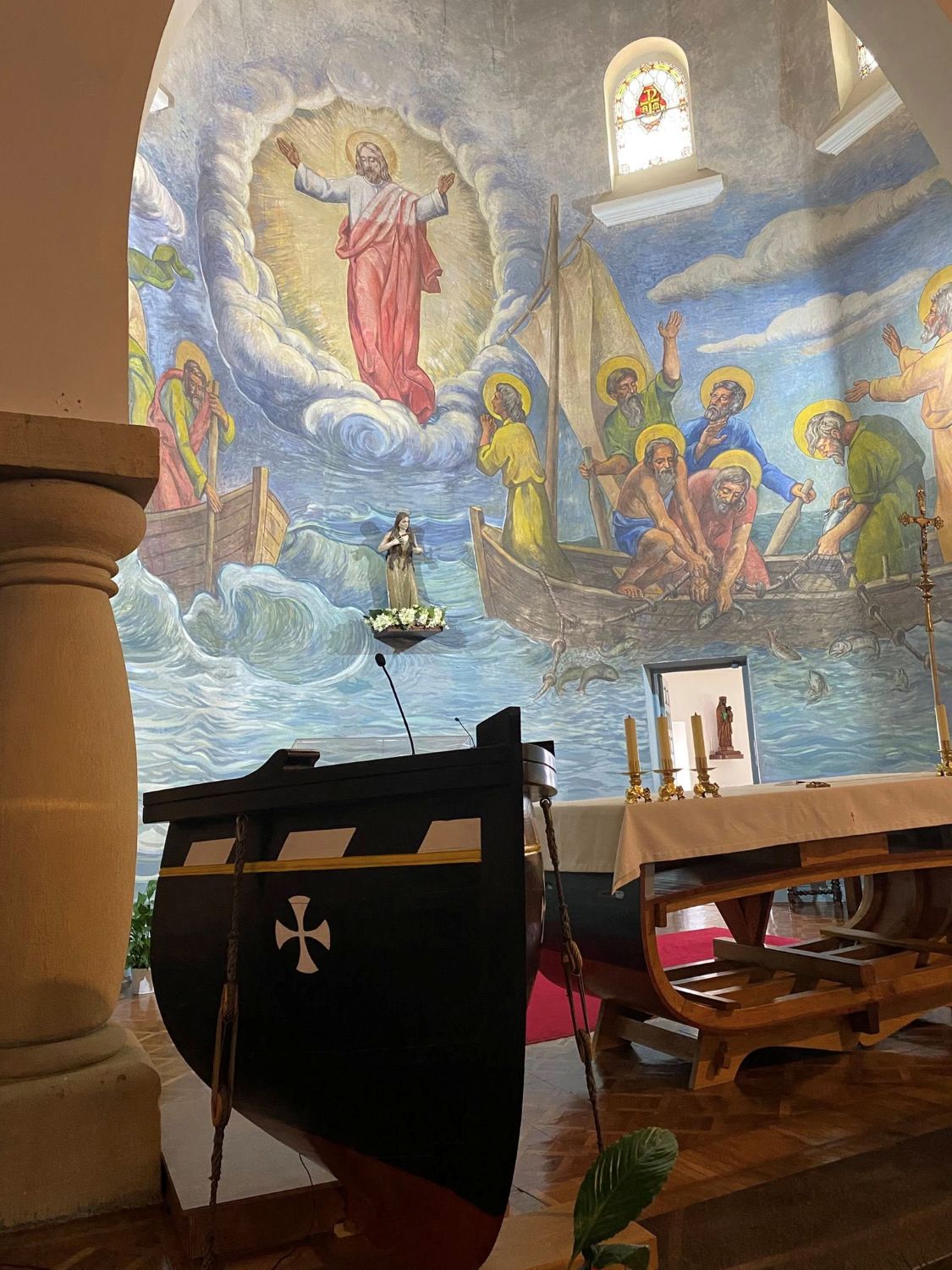
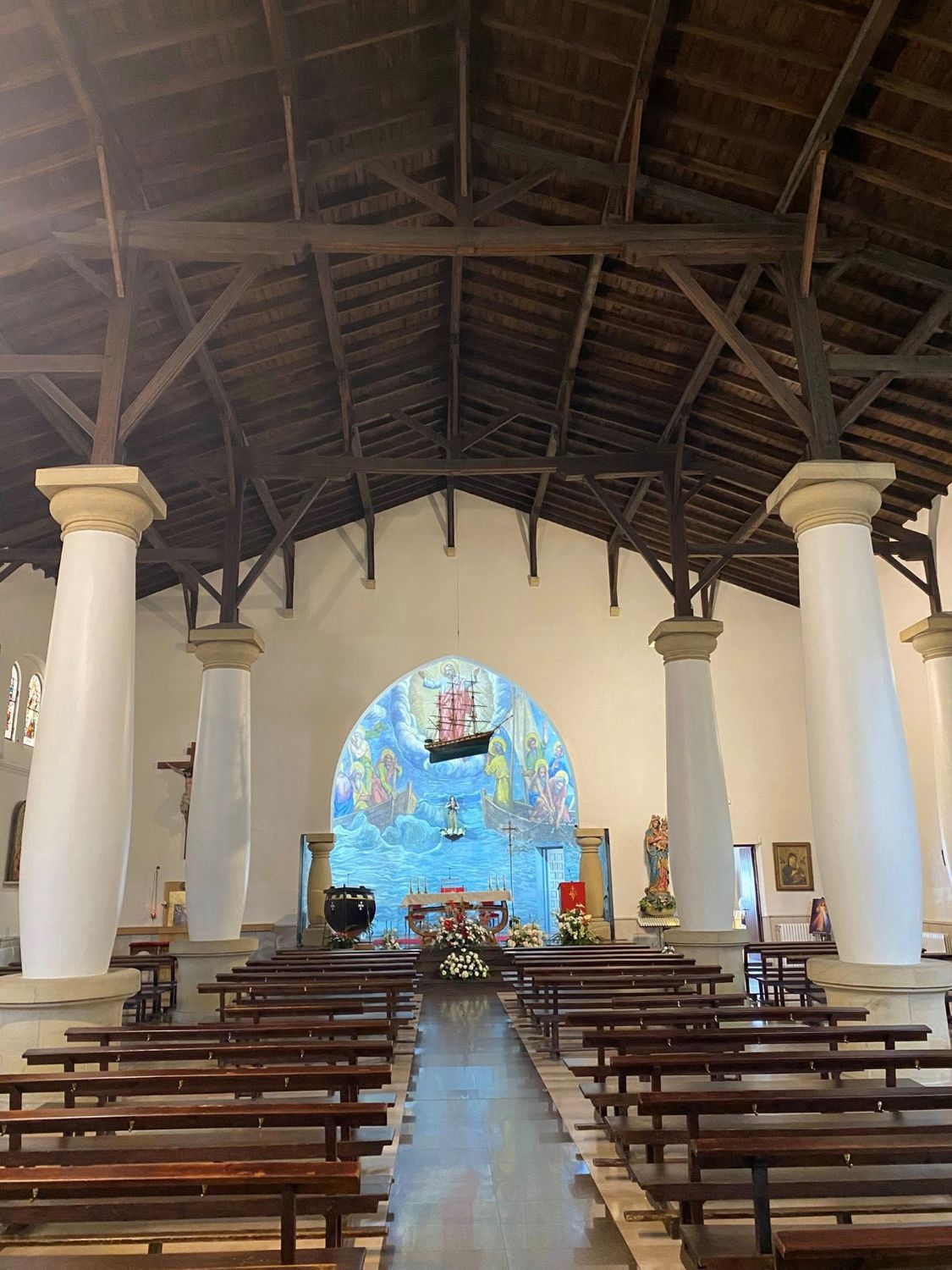
Surely the magnificent nave that seems to float in this place has caught your attention. Seafarers’ votive offerings have been common as expressions of gratitude for favors received and are preserved as reminders of times past. Now it is time to turn our gaze to the head of the church, where we notice a curious ambo in the shape of a ship’s prow and the main altar delicately adorned with nets donated by the sailors of this city. Surrounding the unique image of Saint Mary Magdalene, to whom the church is dedicated, and decorating the walls of the apse, we find the striking frescoes depicting the Miraculous Catch of Fish on the Sea of Galilee. The figure of Jesus Christ, as Lord of the Universe, dominates the scene, while the Apostles, in their boats, cast their nets as instructed by their Master, with complete faith in His Word. This scene fully represents the people of Hondarribia and reflects the immense faith of the seafaring people, similar to that of the first followers of Jesus. The work was created in 1948 by the painter Gaspar Montes Iturrioz, from Irun.
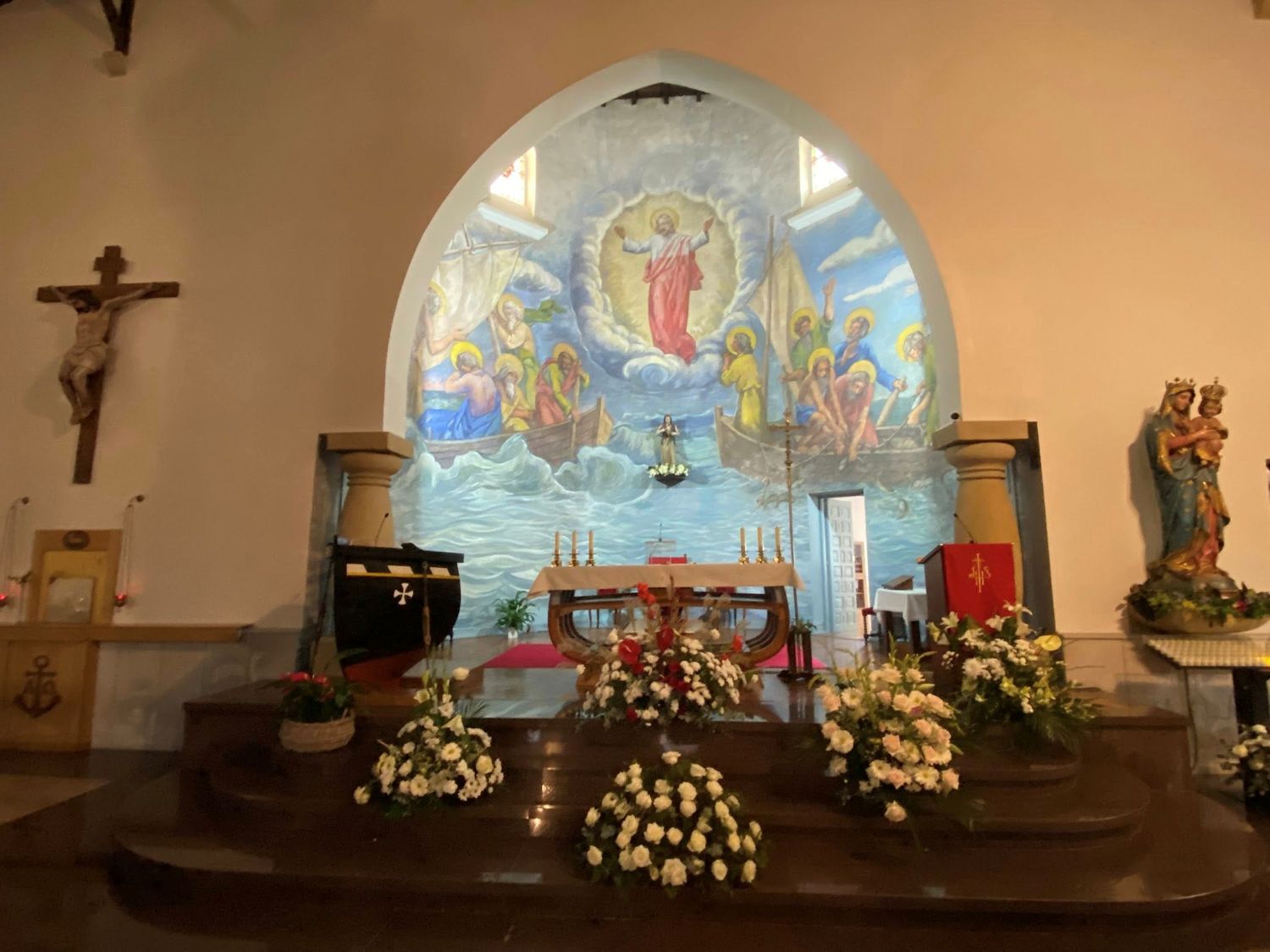
To the left, between the altar and the majestic Cross embedded in the wall, is the Tabernacle, where the greatest treasure of this church, the Eucharistic Presence of the Lord in the Tabernacle, seems to go unnoticed. We continue our visit, always in a counter-clockwise direction. In these stained-glass windows, we see Saint Catherine of Siena and Our Lady of Mount Carmel above a curious relief of the Souls in Purgatory. In the foreground, the souls in purgatory appear in a gesture of supplication, raising their gaze towards the Virgin Mary who, situated in the center of the composition, contemplates her children with tenderness and assists the purified souls as they ascend to Heaven. Next, above the carving of the Apostle Saint Peter, are the stained-glass windows of Saint Michael the Archangel and Saint Thérèse of Lisieux. Next, above the image of Saint Ignatius of Loyola, patron saint of Gipuzkoa and founder of the Jesuits, are those corresponding to two Franciscan saints; Its founder, Saint Francis of Assisi, holding Our Lord in one of his mystical ecstasies, and Saint Anthony of Padua, one of the few saints depicted with the Child Jesus in his arms. In the next group, above the effigy of the Immaculate Conception, we see the stained-glass windows of Saints Cosmas and Damian alongside the martyr Saint Lucy, patron saint of eyesight. The last group, located above the exit door, is a triptych. In its center is “The Divine Shepherdess,” to the right Saint Michael of Garikoitz, and to the left Saint Valentine of Berrio-Otxoa. Between them is a painting of “Mary Magdalene” by an anonymous artist.
The City of Hondarribia on its religious heritage : https://www.hondarribia.eus/es/arquitectura-religiosa
The Hondarribia tourist office on its heritage : https://hondarribiaturismo.com/en/the-old-quartier/
The Parrish of Hondarribia on the church: https://hondarribiaparrokia.org/la-marina/
The local Hondarribia-Irùn tourist office on Hondarribia : https://www.bidasoaturismo.com/en/que-visitar/hondarribia-a-medieval-town/
The Gipuzkoa region tourist office on Hondarribia : https://www.gipuzkoasansebastian.eus/en/things-to-do/gipuzkoa-top-ten/hondarribia
The Euskadi basque country tourist office on Hondarribia : https://tourism.euskadi.eus/en/towns/hondarribia/webtur00-content/en/
The Spain National Tourist Office on Hondarribia : https://www.spain.info/en/destination/hondarribia/
There you go folks, a dandy memorable ways of my dear France and Spain. The memories lingered and alway looking forward to be back, eventually ; worth the detour and trip on it, with the Pyrénées lurking on you! Again, hope you enjoy the post on the Church Santa Maria Magdalena of Hondarribia !!! as I.
And remember, happy travels, good health, and many cheers to all !!!


