
Well I am happy to tell you found more pictures in my cd rom vault that should be in my blog for you and me,(see posts) There have been many trip from France to/from Spain. Always memorable family trips forever in our minds ; and one of the memorable routes was along the Atlantic ocean by Hondarribia in Spain. Therefore, here is my take on the Church of Santa María de la Asunción y del Manzano of Hondarribia !!! Hope you enjoy the post as I.
The town of Fuenterrabia or in basque Hondarribia is in the province of Guipuzcoa in the Autonomous Community of the Basque Country, and in the kingdom of Spain, Facing the French city of Hendaye from which it is separated by the Bidassoa river facing Hendaye. It shares with them the bay of Txingudi, it occupies a strategic position on the border between Spain and France, and commands the main passage of the western Pyrénées. Together with Hendaye and Irun, it forms the cross-border urban community of Bidasoa-Txingudi. Hondarribia is called Fuenterrabía in Spanish and Fontarrabie in French. Until 1980, the official name of the town was Fuenterrabía, a name that was changed that year to Hondarribia by decision of the municipal council. Since 1989, the only official name of the town has been Hondarribia. But the Spanish continue to widely use the name Fuenterrabía and the French Fontarrabie, These are one of its two emblematic monuments that I am lucky to have pictures to share in my blog,
The Church of Santa María de la Asunción y del Manzano or La Marina is located in the heart of the historic town. It is a church of Gothic style with Renaissance traditions and a dark barren tower. The tower of the church that dominates the landscape of Fuenterrabía was built on the early18C. In its interior decoration there is a mural, Subida de Cristo al Calvario, or Christ risen to the Calvary painted by local artist José Echena in 1882. Inside the church there is also a small museum. Also named Santa Maria Magdalena, The church was grateful to the people of this city and visited the length of the centuries by innumerable travelers, traders and pilgrims who took moments of recognition and prayer on the way to Compostela. Its construction began in the second half of the 15C. Legends tell that the first stone was located in 1471 by the Count of Armagnac next to a diamond ring, but possibly the work came later in 1474.
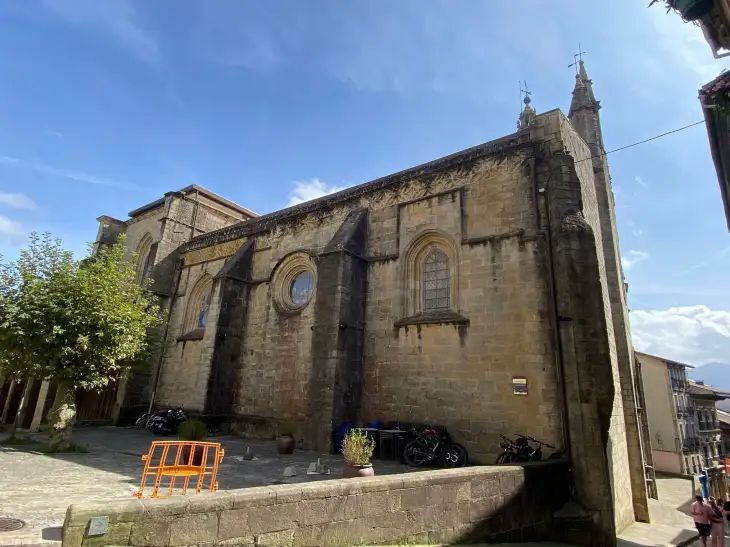
The construction of the temple coincides with a period of political and military convulsion. This is what affects the church, the modernization of the fortifications requires the transfer of material from the religious order. With it came a time of parallelization of the work who had to do with the fact that the height of the transept obstructed the military labors of the castle. A subsequent decree from Queen Isabel la Católica allowed the church to be built in conformity with the wishes of the people. Finalized the first phase of construction in 1549. The access to the sacred monument with the portraits of the apostles of Saint Peter and Saint Andrew, brothers and apostles of the Lord to take custody of the entrance. An extraordinary crucery bowl that is starchy to hold on to the heart. The medallion of the central key of larger dimensions contains the image of the Virgin with the Child. The Epístola nava, located off the main entrance. We can see the vivid Calvary on with its usual iconography; Jesus in the Cross, accompanied by his mother, the Virgin Mary and the apostle Saint John. In this set, a color portrati correspond to the Baptism of Jesus on the waters of the Jordan river. On the side wall there is the baptistery and the bautismal battery, covered with an original type, where during the generations of Hondarribia houses they received the baptism. The first is the altarpiece of Saint Anthony of Padua, one of the poor saints who represented it with the Child Jesus in his arms. The heights of Saint Antón and other saints are at each side, and in the attic you see the figure of Saint John the Baptist.
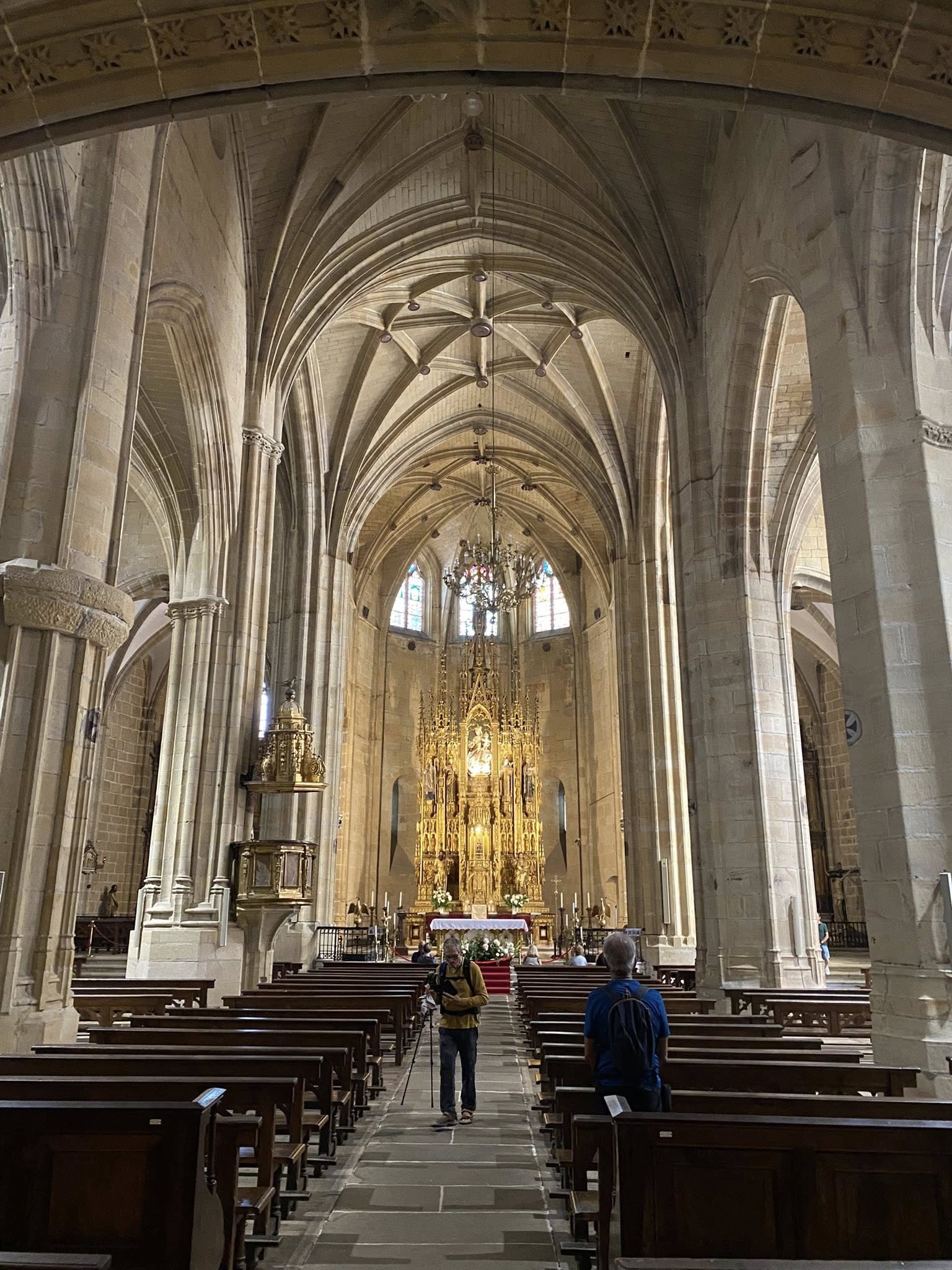
In the adjacent altarpiece dedicated to the Virgin del Pilar, it represents the scene of his appearance at the Apóstre Saint James in Zaragoza. On each side, two saints crown with the Archangel Saint Michael with the devil at his feet. We reach the head of the nave, where we discover the Baroque altarpiece dedicated to Our Lady of the Rosary, whose finely detailed and serene carving occupies the central niche of the altarpiece. Mary appears as a young mother presenting her Son and extending her right arm, offering us her rosary. The image is accompanied by figures of Saint Augustine and another saint. In the upper section, between sober columns, is the figure of Saint Dominic de Guzmán, founder of the Dominicans, escorted by those of Saint Catherine of Alexandria and another saint. The attic is crowned by the image of the Eternal Father, and two allegorical figures, Fortitude and Justice, were later placed at the ends. These are two of the cardinal virtues that complement the theological virtues: Faith, Hope, and Charity. The main altarpiece is presided over by Nuestra Señora de la Asunción y del Manzano or Our Lady of the Assumption and the Apple Tree, to whose patron saint the church is dedicated. The current neo-Gothic altarpiece was inaugurated on September 8, 1914, the feast day of the city’s patron saint. It stands out for its slender architecture and gilded polychrome and is set apart from the wall so as not to cover the windows of the apse, which face east, as is customary in Christian churches. From the east rises the sun, which is a symbol of Christ and, like Christ, illuminates us and gives us life.
The previous altarpiece was destroyed by fire, and only the delicate carving of the Ecce Homo, located in the tabernacle, and the figures of the apostles Saint John and Saint Andrew, located in the lower part of the altarpiece, were saved. The majestic Baroque-style image of Our Lady of the Assumption and the Apple Tree is the centerpiece of the entire ensemble. This work, originally from a Neapolitan workshop, arrived in Hondarribia in 1753. The Mother of God holds her son in her left arm, while in her right hand she holds an apple, a symbol that emphasizes the idea of the wisdom of the Son of God. Flanking the image of Our Lady, we can see those corresponding to Saint Prudentius and Saint Francis of Assisi on her left, while on the right we can distinguish those of Saint Teresa of Jesus and Saint Ignatius of Loyola, patron saint of Gipuzkoa and founder of the Jesuits. We continue our visit by heading to the Gospel aisle, at the head of which is the altarpiece dedicated to the Sacred Heart of Jesus. Next to the image of the Lord, we can see that of Saint Roch, who displays the wounds on his leg and is accompanied by a dog that helped him in his times of need, a sign of Providence, and who is always included in the iconography of the saint. Also featured is the effigy of Saint Sebastian, a martyr greatly worshipped in times past as the patron saint of the dying and protector against the plague.
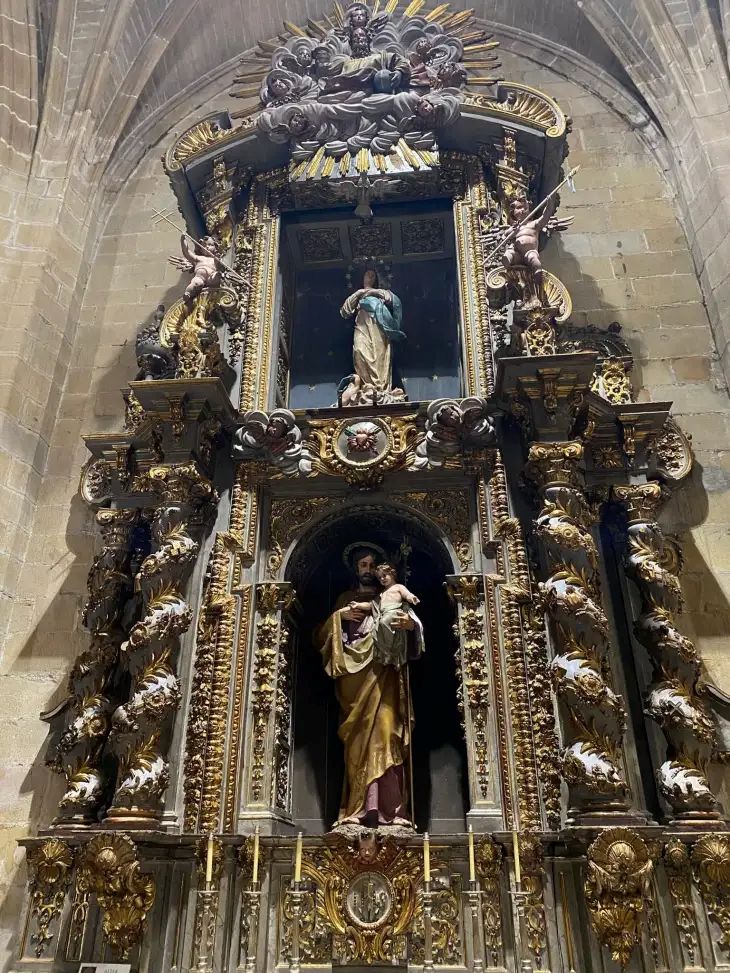
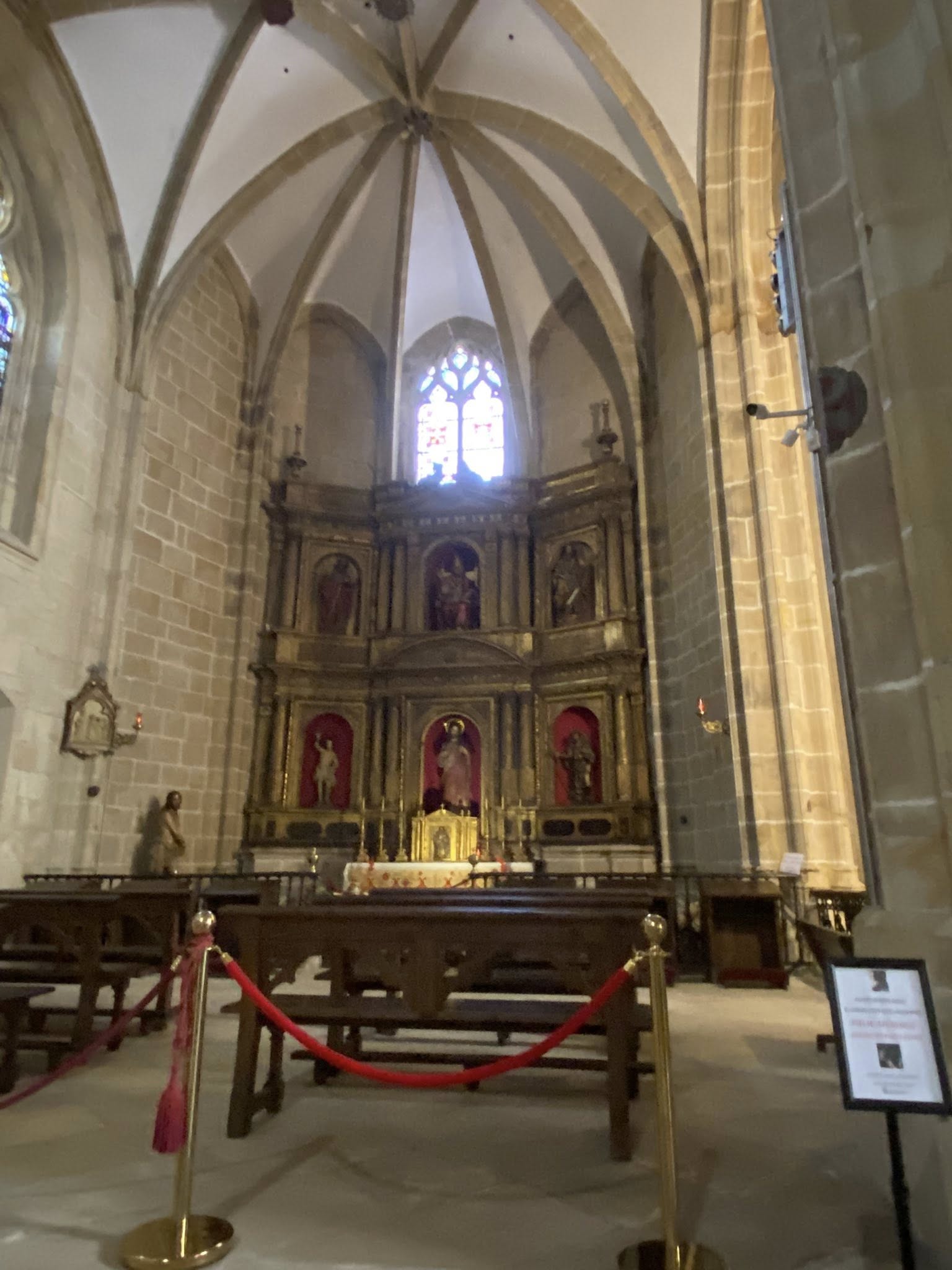
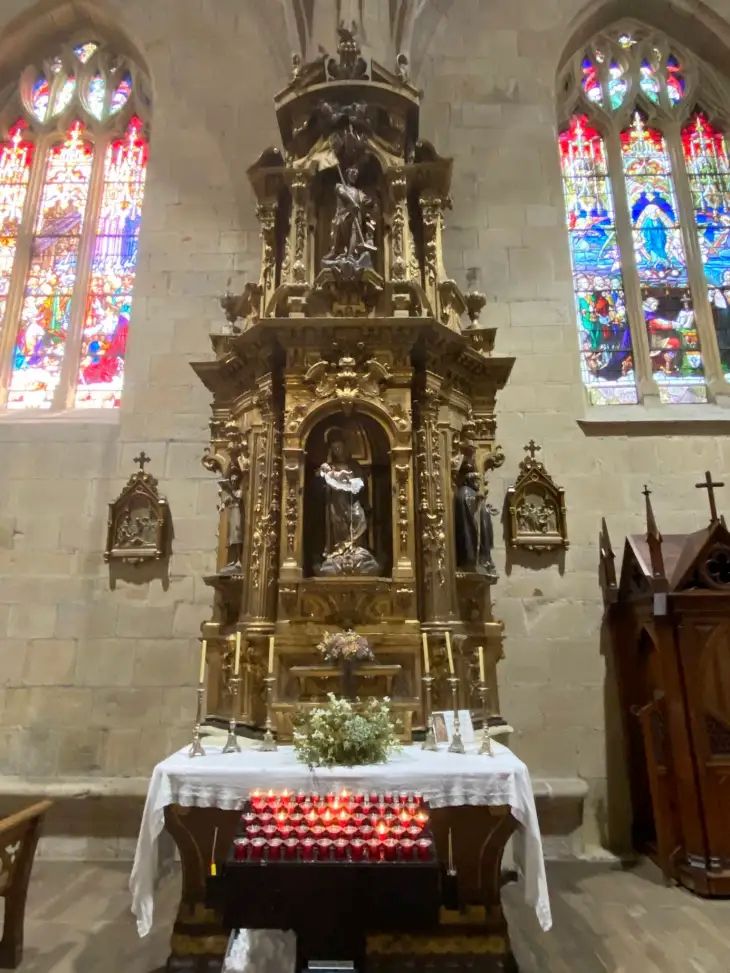
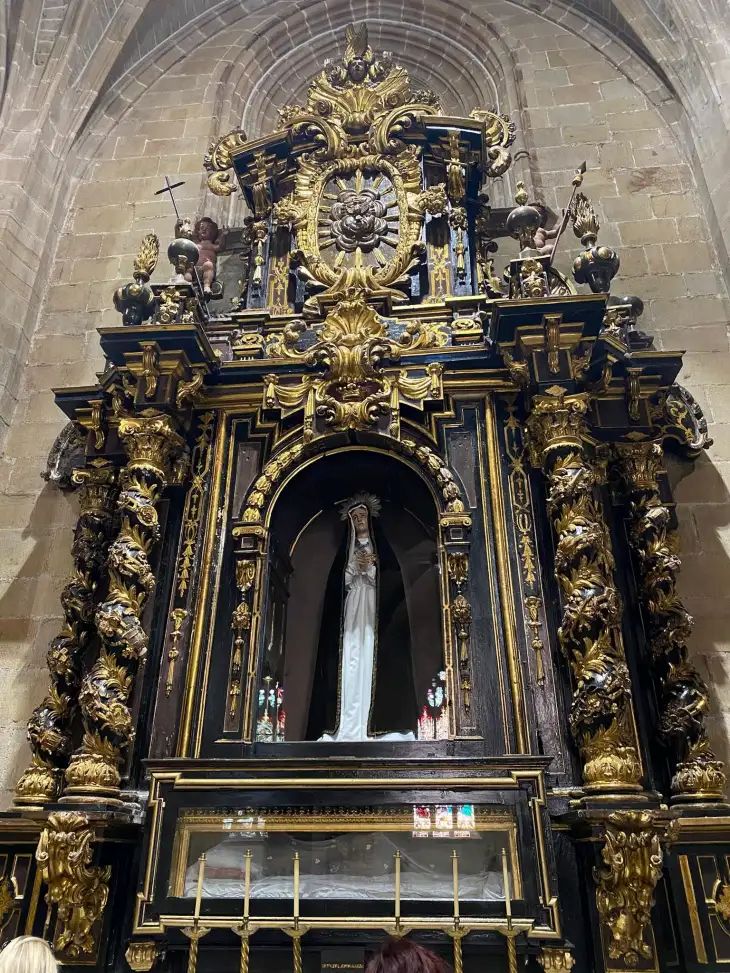
The central niche of the upper section is occupied by the image of Saint Peter, dressed as a pontiff and seated on his chair, seemingly blessing with his right hand. He is escorted by Saint Andrew with his characteristic saltire, and Saint Paul. At the foot of the image of the Sacred Heart, the greatest treasure that we can find in this temple seems to go unnoticed, the Eucharistic Presence of the Lord in the Tabernacle. Beyond the door of San Jerónimo, the oldest in the church, and a sober carving of “Christ Crucified” on a red background, we can see the Churrigueresque-style altarpieces from the early 18C, of similar design. The first of these is dedicated to the Virgen Dolorosa or Virgin of Sorrows, whose image occupies the central niche. The Mother of the Lord appears grieving before the Passion and Death of her son. At her feet is a magnificently carved Recumbent Christ with articulated arms. Both images are carried in procession during Holy Week in Hondarribia. A representation of the Holy Spirit completes the ensemble. Between Solomonic columns, the carving of Saint Joseph holding the Child Jesus in his arms presides over the altarpiece. In the upper part, we can distinguish a suggestive figure of the Immaculate Conception, while the relief of God the Father occupies the attic.
The above text was translated by yours truly from the site of the parish, The Parish of Santa Maria Magdalena on the Church Santa Maria Magdalena o de la Marina : https://hondarribiaparrokia.org/parroquia/arte-y-fe/
The City of Hondarribia on its religious heritage : https://www.hondarribia.eus/es/arquitectura-religiosa
The Hondarribia tourist office on its heritage : https://hondarribiaturismo.com/en/the-old-quartier/
The local Hondarribia-Irùn tourist office on the church: https://www.bidasoaturismo.com/en/lugares/santa-maria-de-la-asuncion-y-del-manzano-parish-church/
The Gipuzkoa region tourist office on Hondarribia : https://www.gipuzkoasansebastian.eus/en/things-to-do/gipuzkoa-top-ten/hondarribia
The Euskadi basque country tourist office on Hondarribia : https://tourism.euskadi.eus/en/towns/hondarribia/webtur00-content/en/
The Spain National Tourist Office on Hondarribia : https://www.spain.info/en/destination/hondarribia/
There you go folks, a dandy memorable ways of my dear France and Spain. The memories lingered and alway looking forward to be back, eventually ; worth the detour and trip on it, with the Pyrénées lurking on you! Again, hope you enjoy the post on the Church of Santa María de la Asunción y del Manzano of Hondarribia !!! as I.
And remember, happy travels, good health, and many cheers to all !!!


