
We have driven and walked in my eternal Paris, and would like to have an imprint in my blog on the wonderful family times we had there, There is so much to see , doing my best, and glad found me this picture in my cd rom vault ,which now transposing in my blog for you and me, This was my former worked city, so glad to post more memorable spots on it, I thank you for your readership over the years and to bear with my rants! After Paris is to rant, shout and yelled about, me think. Therefore, here is my take on the Rue de Miromesnil of Paris !!! Hope you enjoy the post as I.
The Rue de Miromesnil is located in the 8éme arrondissement of Paris. It begins at Rue du Faubourg-Saint-Honoré, near Place Beauvau, and ends at Boulevard de Courcelles. The street is named after Armand Thomas Hue de Miromesnil, a French magistrate and politician who served as a minister under Louis XVI in the final years of the monarchy as Keeper of the Seals of France. The street was opened by letters patent dated July 18, 1776, between Rue du Faubourg-Saint-Honoré and Grande-Rue-Verte (now Rue de Penthièvre). The section between Rue de Laborde and Rue de la Bienfaisance was subsequently opened in 1813 during the construction of the Roule slaughterhouse, on land belonging to the City of Paris and acquired from various private individuals. The extension of the street to Rue de Valois-du-Roule (now Rue de Monceau) was approved by a royal decree dated February 2, 1826.
Notable buildings here are at No. 6: a photograph held at the Musée de l’Orangerie in Paris shows the art dealer Paul Guillaume seated at his desk at this address. In May 1932, the famous novelist Colette opened a beauty salon in this building under her own name. By June, clients were coming to buy beauty products or have their makeup done by Colette herself. No. 8: In May 1959, Daniel Cordier, a member of the French Resistance, gallery owner, and former secretary to Jean Moulin, opened his gallery here, after having spent three years on Rue de Duras. No. 10: The painter Édouard Vuillard lived in this building with his family from October 1887 to October 1891. He set up a studio in an attic space in 1890. A painting from 1891 depicts “The Landing, Rue de Miromesnil.” In 1947, Albert Achdjian, founder of the first Armenian museum in France, acquired the building and opened the Au Tapis Chirvan gallery. From 1997 to 2000, Jean-Pierre Raynaud, under the patronage of Berdj Achdjian, created one of his major works entitled “10, rue de Miromesnil. No. 30: in this building lived Paul Cézanne fils and Hortense Fiquet, Paul Cézanne’s wife, from 1910 to 1922. Paul Cézanne fils shared the apartment for a time with Jean Renoir, his childhood friend. He participated in and helped with the production of Renoir’s films.” Hortense Fiquet died there on May 3, 1922. No. 31: small building from the late 18th or early 19th century where Grace Elliott, mistress of the Duke of Orléans, lived, then François-René de Chateaubriand in 1804. In 1910, it was the residence of Mme E. Trubert. No. 34: “At the back of the courtyard, one discovers a discreet residence: this was that of Count Adhéaume de Chevigné and the Countess, née Laure de Sade; a salonnière and a figure of Parisian high society and aristocracy from the end of the 19th century until 1914. No. 35: last private mansion on the street preserved in its original appearance, hidden at the back of a courtyard: Dr. Nicolas Marie Guiard had a private mansion built there in 1838, complete with stables. The hotel was inhabited from 1854 to 1885 by General Louis Eugène Léonce Pajol, aide-de-camp to Napoleon III. It served as a meeting place for generals loyal to Napoleon III during his exile in Chislehurst, where they prepared for his return to France. The hotel also housed veterans of the 2nd Armoured Division, who met there from 1954 to 2006. No. 50: At the time of his conversion in 1886, Charles de Foucauld, a French cavalry officer who became an explorer and geographer, then a Catholic religious, priest, hermit, and linguist, lived in this building. He had his “second lieutenant’s quarters” in this building. It was an epicurean’s apartment, with fine furniture, rare books, objets d’art of the most refined taste, and select liqueurs.
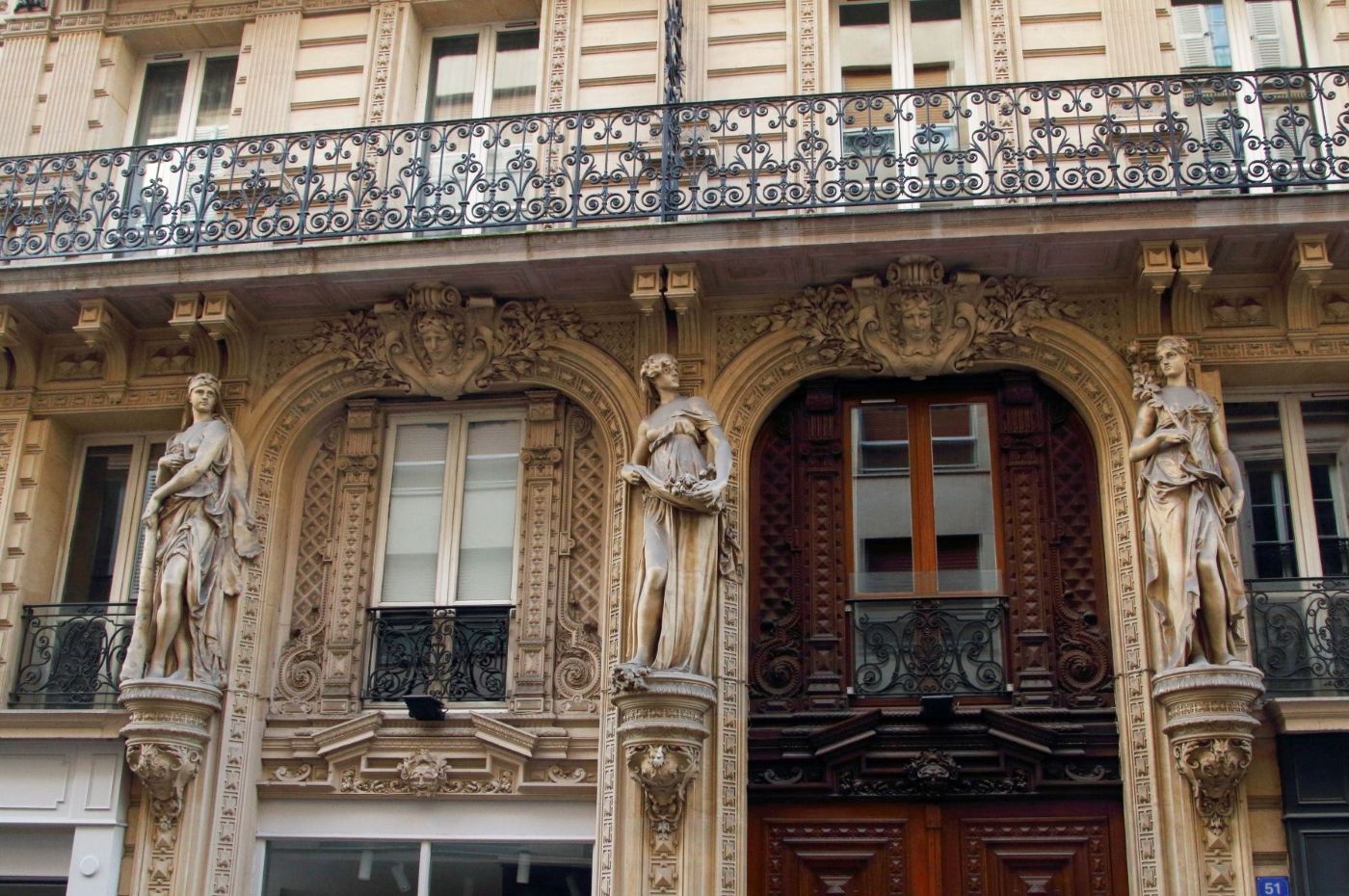
At No 51 ,this substantial apartment building was constructed in 1881. It has six stories and ten bays on its street-facing façade. The façade’s originality stems from the abundance of sculpted decoration.The pedestrian carriage entrance is decorated with three statues of women resting on imposing brackets.(see pic), The Heraclean attributes (club, lion skin) are displayed on a female caryatid, These high-quality works are by the sculptor Pierre Granet, who would later contribute to the decoration of the Pont Alexandre III. The carriage entrance is treated with the same profusion of sculptures, rustication, coffered ceilings, and mascarons on the theme of human races. The landing windows opening onto the courtyard are fitted with stained glass depicting small figures in Renaissance costume. The diamond motif is repeated on all the carriage doors.
At No. 77 (corner of Lisbon Street): Hôtel Caillebotte. Built from early 1866 to November 1867 by the industrialist Martial Caillebotte, father of the painter Gustave Caillebotte. Its memory is preserved in a painting by Jean Béraud, “An Evening at the Hôtel Caillebotte.” Gustave Caillebotte lived in this building from November 1867 to 1879, when he moved with his brother Martial to 31 Boulevard Haussmann. The building was modified in 1898 with the addition of two floors. No. 104: a private mansion built in 1898 for the lawyer Émile Straus and his wife, Geneviève Halévy, an important figure of the Belle Époque, whose salon was a rallying point for supporters of Captain Dreyfus. In the novel *The Secrets of the Princess of Cadignan* by Honoré de Balzac, Diane de Maufrigneuse lives in an apartment on Rue de Miromesnil. Gustave Caillebotte’s painting Young Man at the Window depicts the artist’s younger brother, René, looking out of the window in their apartment on rue de Miromesnil.
The Paris tourist office on the 8éme arrondissement de Paris : https://parisjetaime.com/eng/article/explore-paris-s-8th-arrondissement-a826
There you go folks, a dandy city to explore and enjoy with the family, Memorable moments in my eternal Paris, driving and walking all over in my road warrior trails brings out sublime awesome spots with nice memorable family visits of yesteryear always remember and always looking forward to be back, eventually. Again hope you enjoy the post on the Rue de Miromesnil of Paris !!! as I.
And remember, happy travels, good health, and many cheers to all !!!


