
We have driven and walked in my eternal Paris, and would like to have an imprint in my blog on the wonderful family times we had there, There is so much to see , doing my best, and glad found me these pictures in my cd rom vault ,which now transposing in my blog for you and me, This was my former worked city, so glad to post more memorable spots on it, I thank you for your readership over the years and to bear with my rants! After all ,Paris is to rant, shout and yelled about, me think. Therefore, here is my take on the Square du Temple – Elie Wiesel of Paris !!! Hope you enjoy the post as I.
The Square du Temple – Elie-Wiesel is located in the 3éme arrondissement of Paris, It covers an area of 7,965 m2, located on Rue du Temple, opposite the City/town hall of the arrondissement, not far from the Carreau du Temple ,and just a stone’s throw from the Marché des Enfants Rouges.. It was initially created in 1857, Marking the northern boundary of the Marais quartier or neighborhood, the Square du Temple – Elie-Wiesel is bordered by the Rue de Bretagne, the Rue Eugène-Spuller, the Rue Perrée, and the Rue du Temple. It formerly overlooked public baths, which were later replaced by the City/town hall of the 3éme arrondissement, on the other side of Rue Eugène-Spuller. The square is served by metro Line 3 of the Temple station.
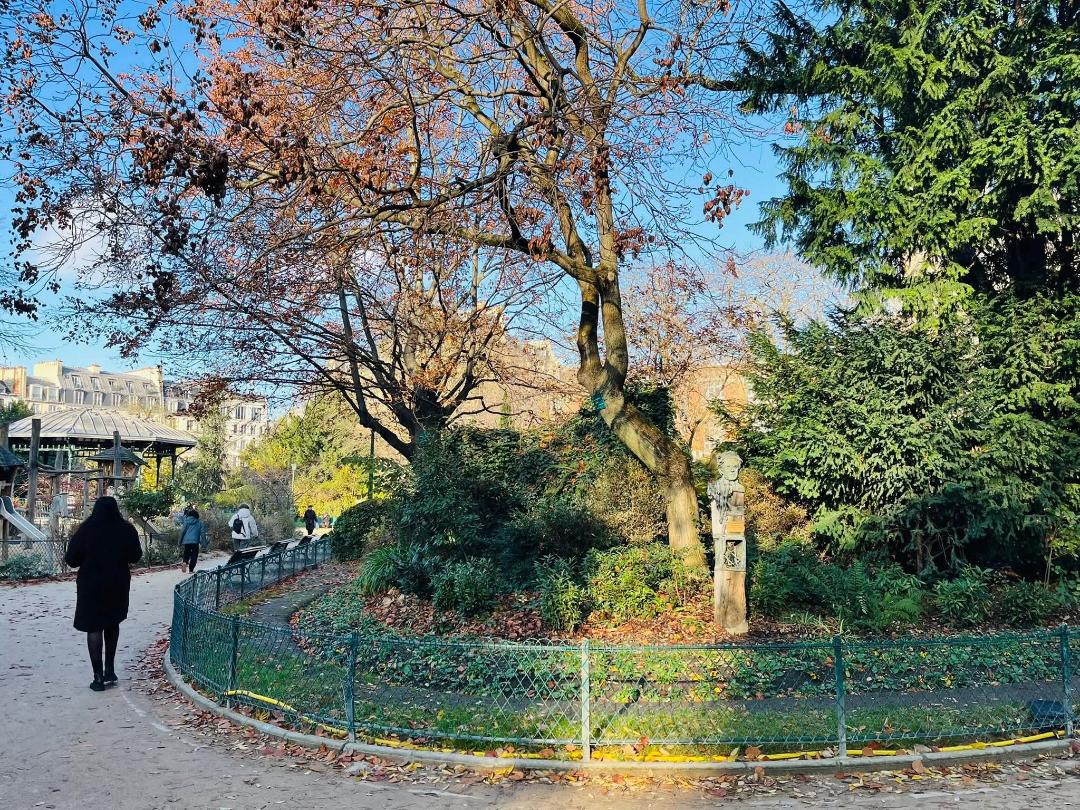
The garden includes a kiosque de musique or bandstand dating from 1900, a children’s playground, lawns (the largest of which is open to the public from April 15 to October 15), fountains, and a pond with an artificial waterfall cascading over rocks from the Fontainebleau forest. The fence surrounding the square was designed by the architect Gabriel Davioud. It is located on the site of the temple’s keep. This English-style garden is adorned with numerous exotic and remarkable trees. The current garden was designed by Jean-Charles Adolphe Alphand during Haussmann’s renovations. The horse chestnut trees are a reminder of the first horse chestnut tree in Paris: imported from Constantinople, it was planted in the Temple enclosure in 1615
The square houses two statues. A bust on a pedestal, inscribed with “To B. Wilhelm, founder 1781-1842, The French Orpheon,” above a medallion portrait and the text “To Eugène Delaporte, promoter 1818-1886.” A stone statue of the poet and songwriter Pierre-Jean de Béranger, who lived on the nearby street that was later named after him (Rue Béranger). sculpted by Henri Lagriffoul in 1953, the previous bronze statue created by the sculptor Amédée Doublemard in 1855 having been melted down during the nazis occupation in 1942. The sun’s rays shimmer in the two basins, illuminating the faces of two imposing bronze statues designed by Davioud in 1860: Agriculture and Industry by Gumery and Mercury and Music by Ottin. The Napoleonic victories of Alma (1854), Inkerman (1854), Chernaya (1855), and Sevastopol (1855) are commemorated on a solemn granite column from the Jura Mountains, not far from which you will discover a more modest bronze statue representing Marc Seguin, by Costa Spourdos (1987).
Since 2017, this garden has paid tribute to Elie Wiesel, writer, philosopher, Nobel Peace Prize laureate, and Holocaust survivor. A survivor of the Auschwitz concentration camp, he was taken in in Paris by the Children’s Aid Society (OSE), which was located in the 3éme arrondissement. A key witness to the Holocaust and a United Nations Messenger of Peace, he always expressed his gratitude to the OSE, which continues its work today supporting the most vulnerable people throughout Paris. On October 26, 2007, a memorial plaque was unveiled on the main lawn of the Square du Temple. It bears the first names, last names, and ages of the 85 little ones who never had the chance to attend school, Jewish children aged 2 months to 6 years old who lived in the 3éme arrondissement and were deported between 1942 and 1944 and then murdered in Auschwitz.
In the 18C, the Temple enclosure housed the Knights of the Templar Order, a formidable financial and political power; it was the scene of bloody repressions, as the Templars were considered heretics. The order was dissolved in 1312. The palace, then assigned to the Order of Malta, was seized as national property during the French revolution. The square occupies part of the former Templar enclosure, which was transformed into a state prison from 1792 to 1808. It was there that Louis XVI and his family were imprisoned during the French revolution. In 1809, Napoleon Ier ordered the destruction of a large part of the fortress, and the Temple tower was demolished in 1811.
The City of Paris on the square du Temple Elie Wiesel : https://www.paris.fr/lieux/square-du-temple-elie-wiesel-2425
The Paris tourist office on the square du Temple Elie Wiesel : https://parisjetaime.com/eng/culture/square-du-temple-elie-wiesel-p1027
There you go folks, a dandy city to explore and enjoy with the family, Memorable moments in my eternal Paris, driving and walking all over in my road warrior trails brings out sublime awesome spots with nice memorable family visits of yesteryear always remember and always looking forward to be back, eventually. Again hope you enjoy the post on the square du Temple – Elie Wiesel of Paris !!! as I.
And remember, happy travels, good health, and many cheers to all !!!


