
Walking in Paris, oh well many missed this sublime experience by taking underground /subway / metro a total waste, walking the streets of Paris is an experience to itself no need for more, Let me tell you about one of my nostalgic streets as worked off of it for two wonderful years in my eternal Paris. Therefore, here is my take on the Rue Saint Honoré of Paris !!! Hope you enjoy the post as I.
The Rue Saint-Honoré is located in the 1éme and 8éme arrondissements of Paris, and is one of the longest streets in the city. It connects Les Halles quartier to the Madeleine quartier/ neighborhoods , passing through the Palais-Royal and Place Vendôme areas. It is 1,840 meters long and 20 meters wide for most of its length, it now only begins, on the odd-numbered (south) side, at No 33, at the intersection with Rue des Bourdonnais, and on the even-numbered (north) side at No 40, at the intersection with Rue du Pont-Neuf. It ends at Rue Royale, on the Madeleine-Concorde axis. Beyond Rue Royale, it is extended to the Rive Droite or Right Bank by Rue du Faubourg-Saint-Honoré, with which it is sometimes confused. It is served by the rail network: at its beginning by the Châtelet, Les Halles, and Châtelet – Les Halles metro stations on lines 1, 4, 7, 11 and 14, and RER A, B and D lines, which are accessed via the “Saint-Honoré” exit, Place Marguerite-de-Navarre; in its center, by the Palais Royal – Musée du Louvre metro station on lines 1 and 7; and at its end mainly by the Concorde metro station (mine to work) on lines 1, 8 and 12, which is accessed via Rue Saint-Florentin, and also by the Madeleine and Opéra stations. The street owes its name to the Saint-Honoré chapel, erected outside the city walls in 1204 by the Cherey couple, bakers who dedicated the chapel to Saint Honoré of Amiens, the patron saint of their profession, and established it as a collegiate church from the outset. In 1913, the Saint-Honoré block, considered unsanitary, was completely demolished. The Rue Saint-Honoré is a very old street in Paris, an extension to the west of a Gallo-Roman decumanus of Lutetia. Originally, the street was a path leading to Saint-Ouen, Argenteuil, and Neuilly. It developed at the end of the 12C; during the reign of Philip Augustus. The street was part of the former 4th, 3rd, 2nd, and 1st arrondissements of Paris and passed through several neighborhoods. In 1966, the section between the Palais-Royal, the Théâtre Français, and Place André-Malraux was named “Place Colette”.
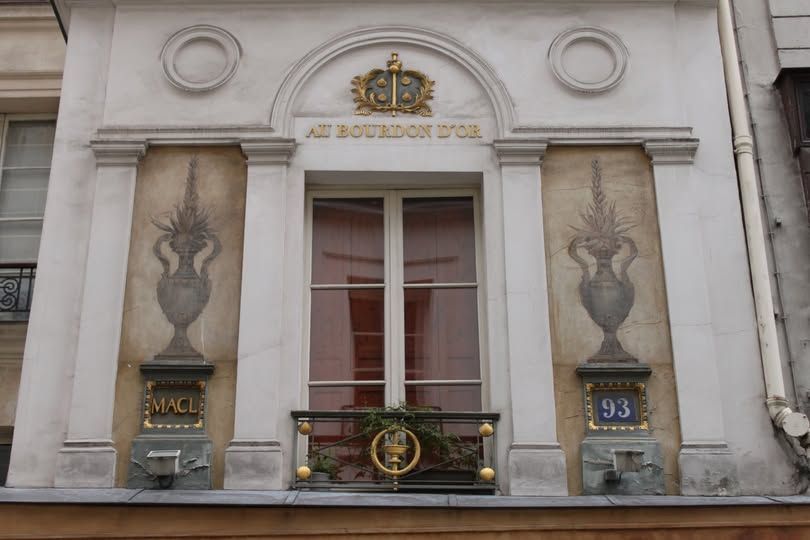
Notable buildings here with cut in of its different sections are at No. 75: residence of Napoleon Bazin, member of several republican secret societies, involved in the Quénisset assassination attempt against the Duke of Aumale, son of Louis-Philippe I, upon his return from Algeria in 1841. No. 86: residence where Ranavalona III, the last exiled queen of Madagascar, stayed in June 1901. No. 91: entrance to the Saint-Honoré village, a small commercial area where several art galleries and antique shops are located. No. 93: shop of Henri IV’s apothecary, where he is said to have received treatment after the fatal assassination attempt of May 14, 1610. The facade still bears the sign “Au Bourdon d’or” (The Golden Bumblebee),(See pic), made famous by the photograph taken by Eugène Atget in 1908. No. 96 (corner with Rue Sauval): location of the pavillon des Singes or Monkeys, the house where Molière was born on January 15, 1622. Residence of Richard Wagner during a stay in Paris in 1839. No. 111: Croix-du-Trahoir intersection, one of the busiest in Paris for centuries. Sedan chair station, created in 1639. A fountain has been located there since 1359. The one visible today dates from 1776. The arrest of Pierre Broussel, counselor to the Parliament of Paris, took place there. It would become the starting point of the Fronde rebellion to monarchy, on August 26, 1648. No. 115: in 1762, Louis Claude Cadet de Gassicourt opened a pharmacy there. Axel de Fersen bought the invisible ink there that he used to correspond with Marie-Antoinette of Austria from 1774 onwards. Jean-François Derosne and Charles Derosne received their pharmacist training there. The shop still houses a pharmacy today. On October 16, 2024, the first of the new historical panels of the City of Paris was inaugurated there. Nos. 121 to 125: location of the Hôtel d’Aligre or “Schomberg et d’Aligre”, a former 17C private mansion (now disappeared). Workshop of Philipp Wilheim Mathe, also known as Creutz or Kreutz, or Curtius, an anatomist and barber invited to France by the Prince de Conti in 1770. He sculpted wax effigies of prominent figures of the time; such as those of Necker and the Duke of Orléans, the Pope and La Fayette. No. 129: birthplace of Louis Hébert, the first French colonist of New France, born in 1575 and settled in Acadia (French North America) in 1606. No. 145: the building of the Oratory of the Louvre was built straddling the location of a section of the old rampart, leveled for this purpose in 1621, the year the first stone was laid. It is due to the rapid development of the Society of the Oratory of Jesus and Mary. During the French revolution, it became the headquarters of the Oratory Section from 1790 to 1792, then the French Guards Section from 1793 to 1795. The building was allocated by Napoleon to the Reformed Church in 1811. No. 151: the Louvre des Antiquaires shopping center, located in the former Louvre Department Stores. No. 155: Hôtel du Louvre. Upon the entry of the Versailles troops into Paris on May 21, 1871, the grand Hôtel du Louvre was requisitioned by the Belleville sharpshooters battalion and the avengers of Flourens. Napoleon Gaillard Sr., director of the barricades under the Commune, set up his headquarters in its large drawing room. The Delamain bookstore, founded in 1700 under the arcades of the Comédie Française, and transferred here in 1906, is the oldest Parisian bookstore still in operation. No. 157: opened in 1716, the tobacco shop À la Civette is the oldest still in operation in Paris. No. 161: Moroccan National Tourist Office. It occupies the former Café de la Régence, which closed in 1910. In the first Café de la Régence, located in Place du Palais-Royal, meetings were held around 1750 to finalize the Encyclopedia; it was frequented notably by Voltaire, Diderot, d’Alembert, Rousseau, Marmontel, Benjamin Franklin and Le Sage. Memorable chess tournaments had been held there since 1715. Diderot sets the beginning of his *Rameau’s Nephew*, written in 1762, in this café. This café was located on the route taken by the carts carrying condemned prisoners from the Conciergerie to the Place de la Concorde, when the guillotine was installed there. From its terrace, Jacques-Louis David sketched Danton on his way to the scaffold. In 1815, at the beginning of the Restoration, it was the scene of numerous clashes between demobilized Napoleonic officers and royalist officers. Friedrich Engels met Karl Marx at the Café de la Régence on August 26, 1844.
At No. 194: Residence of Paul Barras in 1789. Paul de Barras, known as the Viscount of Barras, then Paul Barras, a French nobleman, revolutionary politician, general of the Revolution and the Empire, who was one of the main Directors of the Republic from October 31, 1795, until the coup d’état of November 9, 1799. No. 202: One of the first halls of the Paris Opera. No. 204: The Palais-Royal. No. 161: Location in 1380 of the Saint-Honoré gate of the Charles V enclosure; the second gate of this name, also called the Gate of the Blind. It was demolished in 1636. Joan of Arc was wounded there on September 8, 1429, while attempting to storm it. No. 173: Headquarters of the newspaper Le Canard Enchaîné. No. 185: Residence of Alexandre Dumas père between 1864 and 1866. No. 203 (currently 199): Inn of the Three Pigeons where Ravaillac stayed on May 13, 1610, the day before the assassination of Henry IV. No. 209: Residence and office of Dr. Joseph Ignace Guillotin after the French revolution. He was a great humanist and one of the main authors of the Declaration of the Rights of Man and of the Citizen. He died there in 1814, having narrowly escaped the machine that unjustly bears his name. No. 211: the former Hôtel de Noailles, built in 1715 on the site of the former Hôtel Pussort (1687), which became the Hôtel d’Armenonville (1697), only a Louis XV style facade remains. Purchased in 1712 by the widow of Marshal Anne-Jules de Noailles, the second Duke of Noailles, Marie Adrienne Françoise de Noailles grew up in the Hôtel de Noailles and married the Marquis de La Fayette there on April 11, 1774. The couple made it their main residence until 1783. Marie-Antoinette of Austria came there to welcome La Fayette on his return from America on February 15, 1779. It would also be the home of Charles-François Lebrun, Third Consul, in 1802. Later, under the name of Hôtel Saint-James and Albany, it would house Francis Scott Fitzgerald, his wife Zelda, and their children in May 1921 and, in October of the same year, Sinclair Lewis, who was then working on his character “George F. Babbitt”. This hotel is also mentioned by Graham Greene in Travels with My Aunt, written in 1969. No. 216: Office of Alexandre Dumas père from 1823 to 1830. He was then working in the service of the Duke of Orléans, the future Louis-Philippe I, with whom he would later fall out. Between nos 229 and 235: location of the Feuillants convent where Jean de La Fontaine stayed for some time, hosted by Marguerite Hessein de la Sablière, known as Madame de La Sablière, in 1673. Jean Racine, Nicolas Boileau, and Charles Perrault also frequented her salon, located at the back of number 229. A splinter group of the Jacobin Club established itself there from July 16, 1791, taking the name of the location: it was the Feuillants Club, whose best-known members included La Fayette, Barnave, the Lameth brothers, Adrien Duport, Le Chapelier, Siéyès, Talleyrand, etc. Constitutional monarchists, they broke with the Jacobins over the question of the fate of Louis XVI. The royal family was held there for three days before their transfer to the Temple, following the storming of the Tuileries Palace (see post) on August 10, 1792. Nos. 247-251: vast site of the former courtyard on which the church of the Capuchin convent opened, subsequently occupied by several successive buildings and establishments: a performance hippodrome (1801) which extended to the Rue du Mont-Thabor; the Chabrand Bazaar (1834-1838) takes its name from the owner of the place who installed a café, a promenade, an orangery and established a place of entertainment called the “Winter Champs-Élysées”; the Saint-Honoré Hall (1838), also known as the “Valentino Hall,” built in place of the bazaar at the request of Chabrand, was a concert hall designed to host the Valentino concerts of the violinist and conductor Henri Valentino and the Nouveau Cirque ; initially named Arènes Nautiques, it is a former permanent circus building equipped with a removable water basin, built in 1886 and closed in 1926. No. 251: building (1930) housing the Mandarin Oriental Paris Hotel since 2011. No. 263: Convent of the Ladies of the Assumption where some ladies of the court retired under the Ancien Régime. It was transformed into a barracks, the Saint-Honoré barracks or the Assumption barracks, during the French revolution, in 1793. No. 286: Saint-Roch Church (see post) which witnessed the conversion to Catholicism of the Scottish Protestant banker John Law of Lauriston. On its forecourt, on May 23, 1750, a riot took place against police raids intended to populate Louisiana (USA). Among others, it contains the tomb of Denis Diderot, buried there on August 2, 1784.
The No. 300: location of the Hôtel des Trois-Pignons where François Ravaillac slept the night before he assassinated Henry IV. Nos 300 and 302: Inn of the Golden Lion, at the corner with Rue Saint-Roch. Residence of Charles de Batz de Castelmore d’Artagnan (the real Mouskeeteer). No 352: Residence, on the mezzanine floor, of Sophie de Condorcet, widow of Condorcet, born Sophie de Grouchy, sister of General de Grouchy. She had hosted one of the most progressive salons of the late Enlightenment at the Hôtel de la Monnaie, frequented by Benjamin Franklin, among others. No 370: Residence of Jeanne Poisson, Marquise de Pompadour, who held a salon frequented by Crébillon père and Voltaire. She protected the Encyclopedists. No 374: Salon of Marie-Thérèse Rodet Geoffrin, known as Madame Geoffrin, who, with her daughter Marie-Thérèse de La Ferté-Imbault, gathered Fontenelle, Montesquieu, Voltaire, Grimm, d’Alembert, Helvétius, Marmontel, d’Holbach, Diderot, and Hume there from 1749 to 1777. No 374: Residence of François-René de Chateaubriand, minister under the Restoration, in 1825. Between nos 380 and 416, the location of the Convent of the Daughters of the Conception, suppressed in 1790. Rue Duphot and Rue du Chevalier-de-Saint-George were opened on the grounds of this former convent. No. 397: address where Honoré de Balzac situated the perfume shop La Reine des Roses, owned by César Birotteau, which went bankrupt in 1819. No. 398: residence of the carpenter Maurice Duplay (then 366, rue Saint-Honoré), who housed Maximilien Robespierre (the last two windows on the left in the courtyard, on the 1st floor (2nd US)) from 1791 to 1794. Duplay subsequently participated in the Conspiracy of the Equals.Robespierre, along with Pierre-Gaspard Chaumette and Claude Fournier-L’Héritier, prepared the events of August 10, 1792, there. The cart that took the Incorruptible to the guillotine on July 28, 1794, stopped in front of this house, which had been smeared with butcher’s blood by a child. The house was the property of the former convent of the Daughters of the Conception. No. 422: location of the Saint-Honoré gate of Louis XIII’s city wall (the third one), built in 1634 and destroyed in 1773. Louis XIV made his return to Paris through this gate to subdue the princes and the parliament on October 21, 1652.
The Paris tourist office on the Rue Saint Honoré : https://parisjetaime.com/eng/transport/rue-saint-honore-p1966
The Paris tourist office on Paris Centre (arrond 1-4) de Paris : https://parisjetaime.com/eng/article/explore-the-centre-of-paris-a846
The Paris tourist office on the 8éme arrondissement de Paris : https://parisjetaime.com/eng/article/explore-paris-s-8th-arrondissement-a826
There you go folks, another wonderful sublime walk of my eternal Paris, The Rue Saint Honoré was near my job for two years working right next to it and walking it always, memories forever ! Again, hope you enjoy the post on the Rue Saint Honoré of Paris !!! as I.
And remember, happy travels, good health, and many cheers to all !!!


One of my faves too
LikeLiked by 1 person
Thanks to agree and stopping by Cheers
LikeLiked by 1 person