
This is again another dandy monument in my eternal Paris. I have done quite a bit of walking in Paris, and never stop amazing me of its abundance of architecture and historical sights that not only are known but also unknown to most. This is another beauty that needs to be seen more, me think ; glad to have found new pictures in my cd rom vault that should be in my blog for you and me, The text is from the below links and wikipedia, Therefore, here is my take on the Church Notre Dame de Lorette of Paris !!! Hope you enjoy it as I.
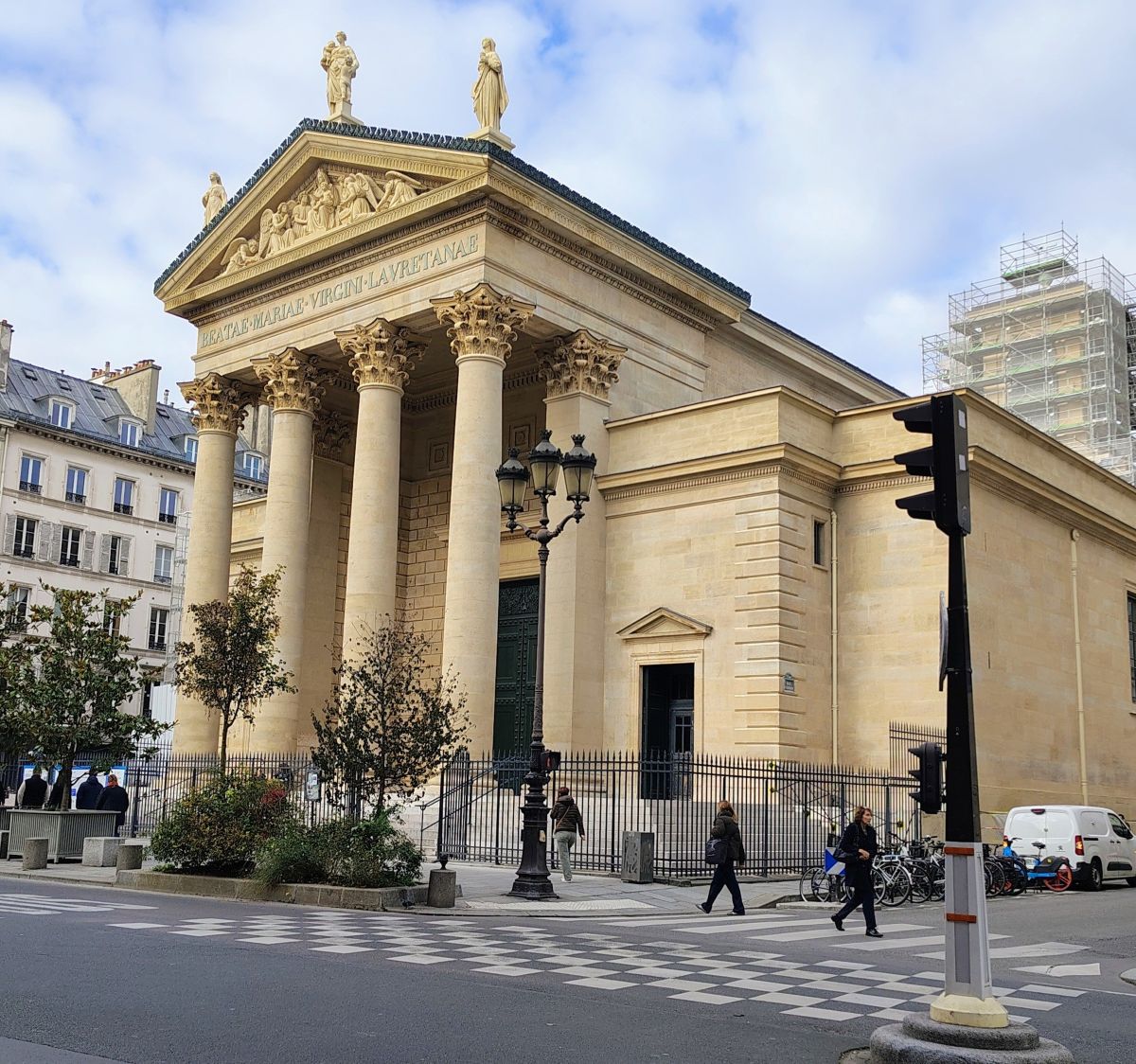
The Church Notre-Dame-de-Lorette is located in the 9éme arrondissement of Paris, This church was built between 1823 and 1836. In 1871,in a neo Classic style dedicated to Notre Dame de Lorette, Alfred Caillebotte, brother of the painter Gustave Caillebotte, was one of its priests. It is truly marvelous! The church is bordered by the Rue de Châteaudun, onto which its facade faces, the Rue Saint-Lazare, the Rue Fléchier, and by the Rue Bourdaloue. It is served by a metro line 12 ,Notre-Dame-de-Lorette station, and bus lines 26,43,and 74 arrêt/stop Carrefour de Châteaudun.
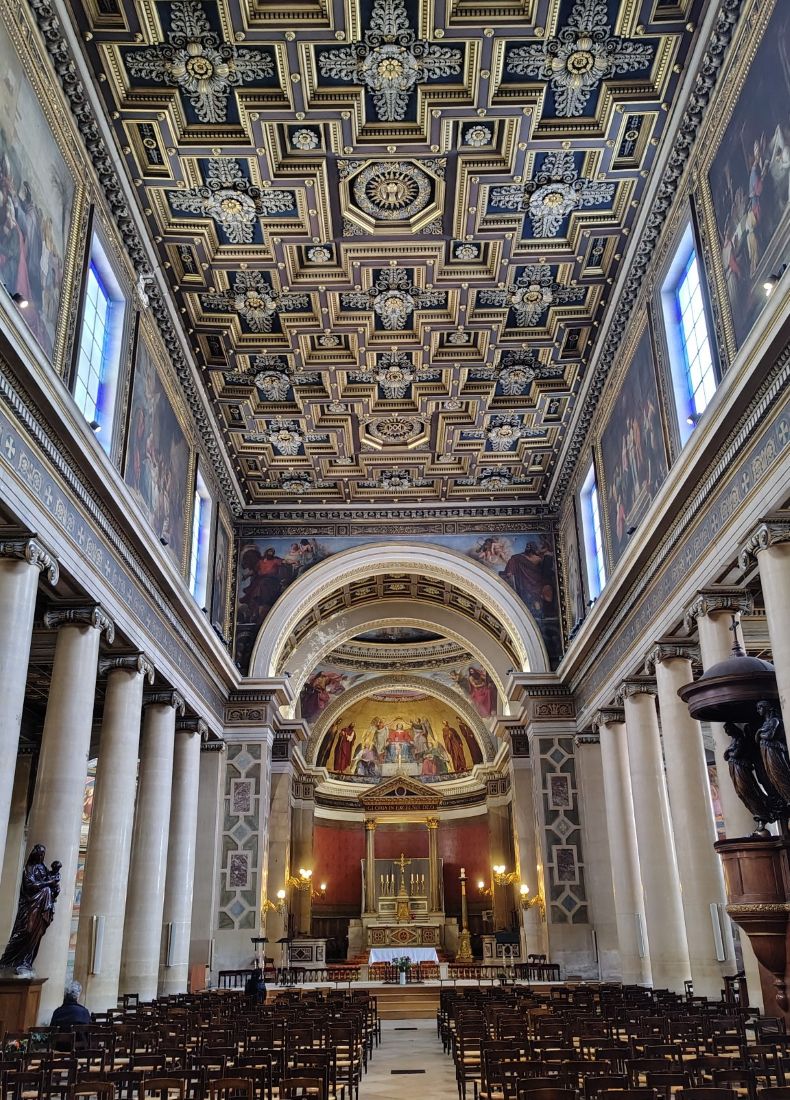
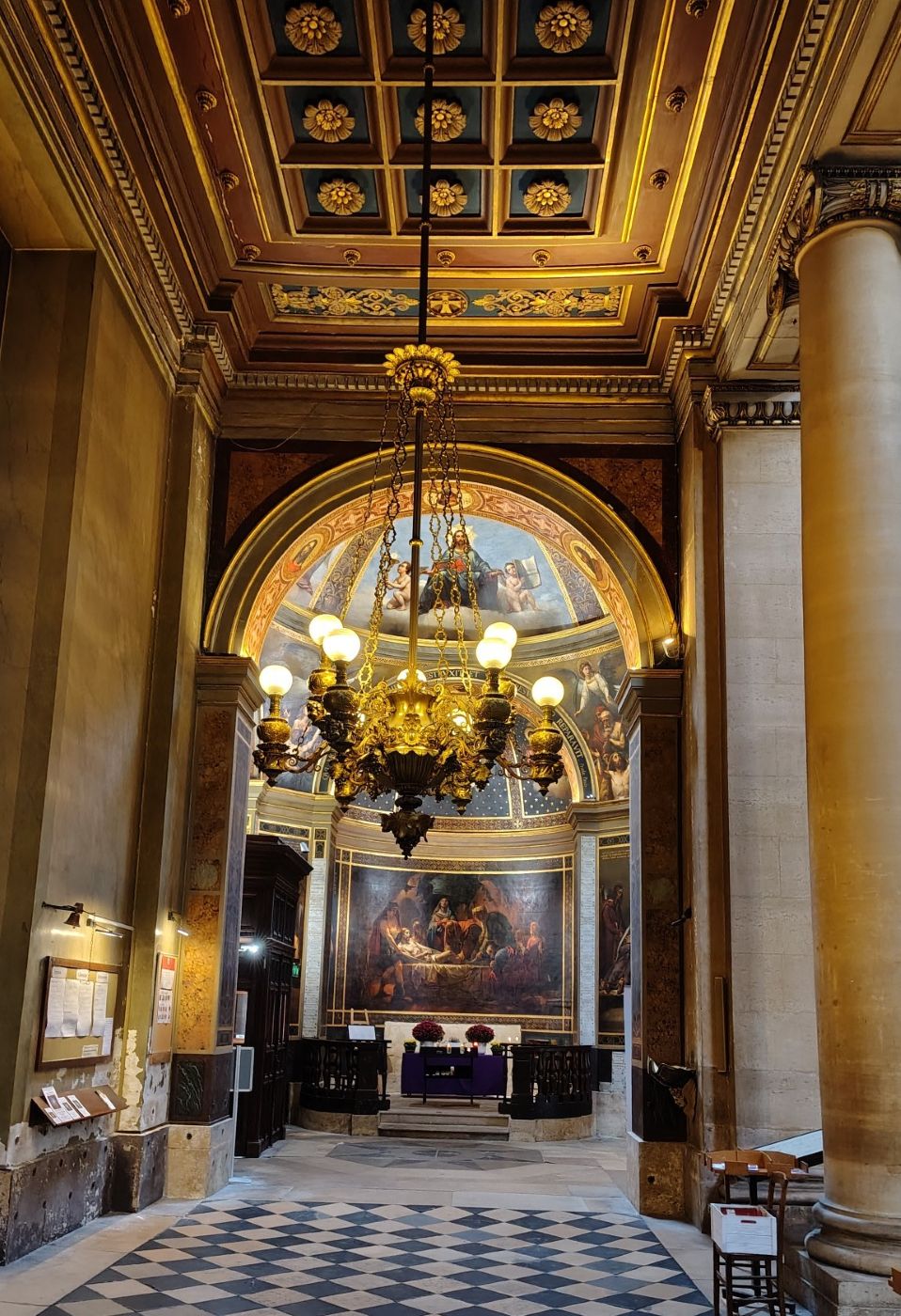
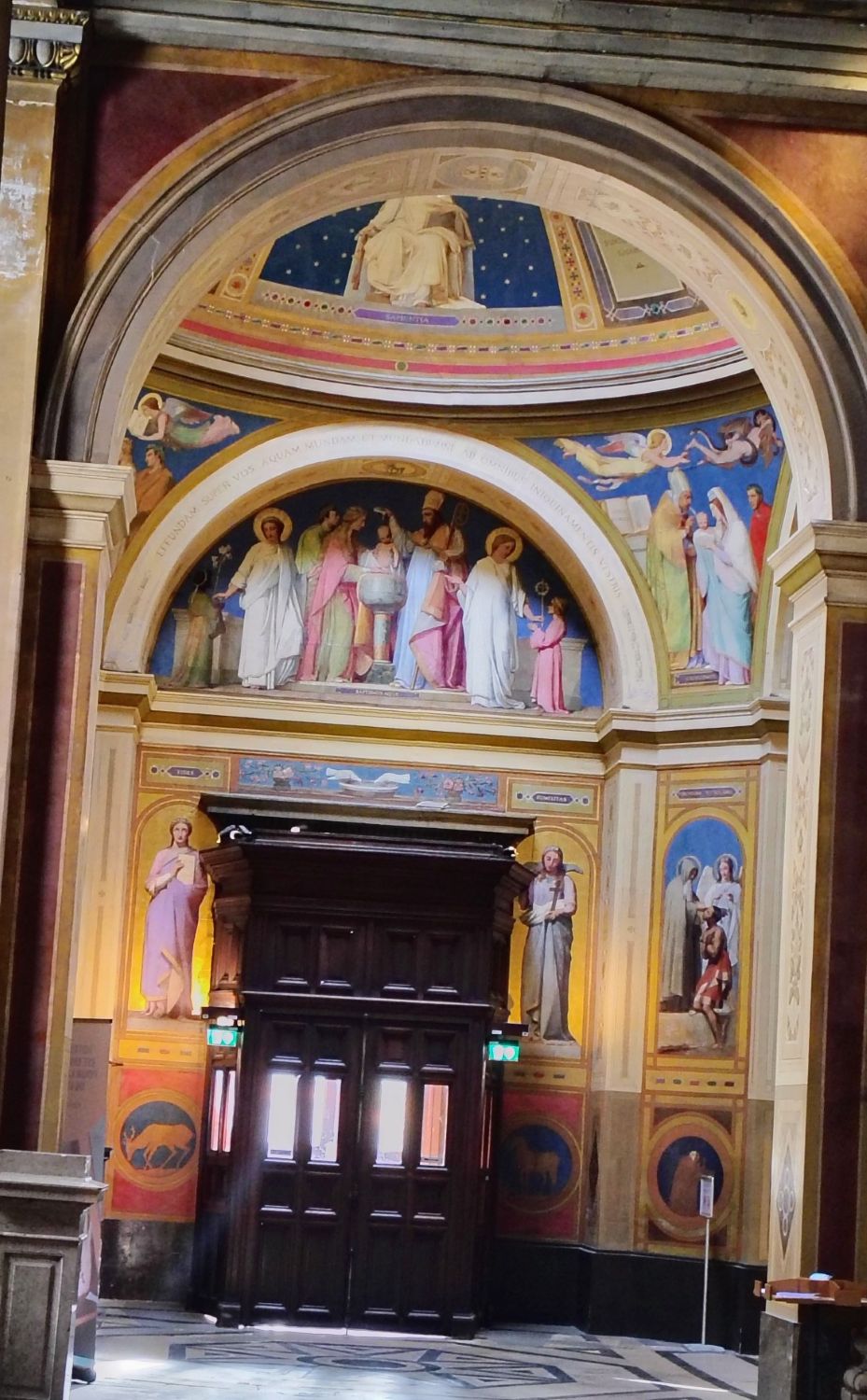
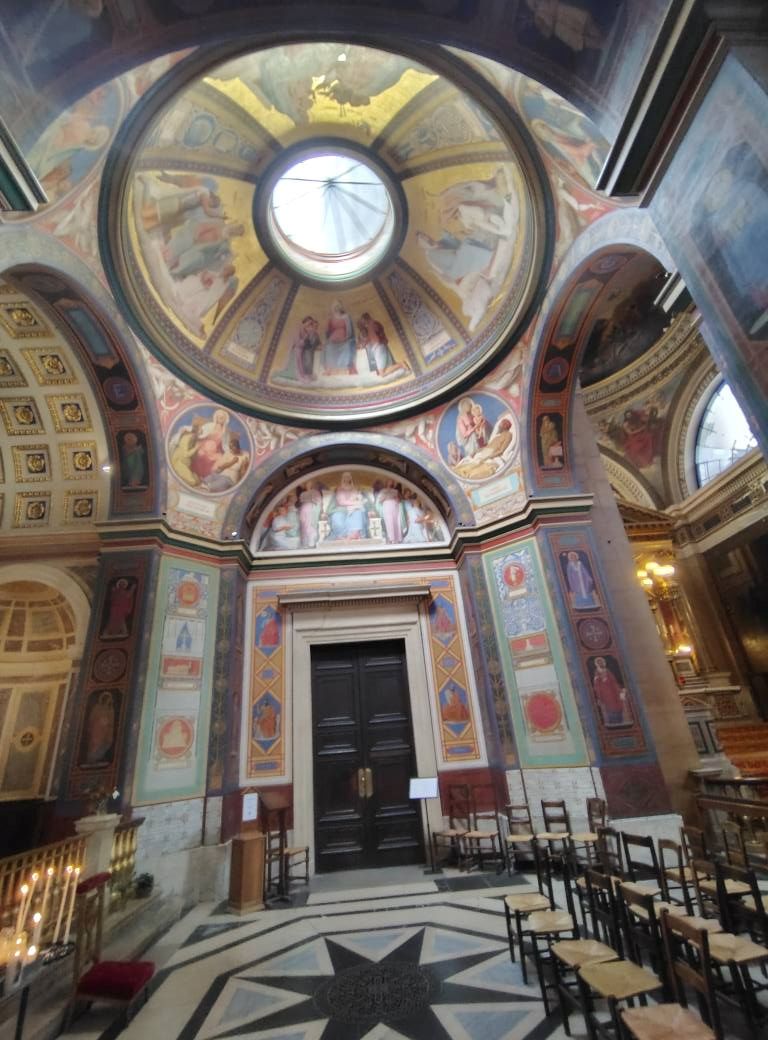
The wall decorations are painted directly onto the walls, and are superbe. The layout is a classic basilical without a transept visible from the outside. The facade features a pediment depicting four angels paying homage to the Virgin and Child. Above the pediment, statues reminiscent of ancient acroteria represent the three theological virtues: Charity in the center, assisting two children; Hope with the anchor; and Faith with the chalice and host. The motto “Liberty, Equality, Fraternity” above the main entrance was added in 1902. Four chapels, corresponding to the four important sacraments in the life of a Christian, flank the nave. The Chapel of Baptism is to the right upon entering, followed by the Chapel of the Eucharist, the Chapel of Marriage, and the Chapel of the Sacrament of the Sick. A cycle of paintings depicting the life of the Virgin Mary is visible in the upper part of the nave. The majority of the iconography is drawn from apocryphal writings. The technique used for the church’s fresco cycle is encaustic painting, an innovative solution that provides greater longevity in a very humid environment prone to saltpeter damage. The only stained-glass window visible in this church is that of the oratory. It depicts the Assumption.
Its name refers to the Holy House of Loreto, the house of Mary in which, according to Christian tradition, she was visited by the Holy Spirit to give birth to Jesus. According to a legend from the late 15C, the Holy House was supposedly transported by angels to Trsat in Croatia, then to Ancona and Recanati in the Italian Marche region, and finally to the hill of Loreto in Italy. The very name Loreto is the French version derived from the Latin lauretum, which designates the laurel hill on which the sanctuary of the Madonna was built starting in 1294 and which probably refers to another name for the Aventine Hill, one of the seven hills of Rome. The sanctuary contains the original house of Mary, and until the Napoleonic spoliations, it contained the relics of the Blessed Virgin. Under Napoleon III, the meaning derived from the legend that concludes the Crusades in the Holy Land gradually faded, and the term “lorette” eventually came to designate a novice courtesan, in contrast to the term “lionne,” which designated an established courtesan, like La Païva. Indeed, in the parish of the church, there were many “small houses” in the 19C.
A bit of history tell us that a first chapel was built for the inhabitants of Les Porcherons on Rue Coquenard, later renamed Rue Notre-Dame-de-Lorette ,and today Rue Lamartine. This is near the intersection of Rue du Faubourg-Montmartre (the northern part of this street having been renamed Rue Notre-Dame-de-Lorette) and Rue des Porcherons, now Rue Saint-Lazare. The current number 54 Rue Lamartine occupies the site of the church entrance. The date of the chapel’s founding is unknown, but it was built by 1646, as a confraternity was established there that year. The chapel, sold as national property in 1796, was destroyed. The City of Paris repurchased the Saint-Jean-Porte-Latine chapel, built around 1760 at nos 60-62 on Rue du Faubourg-Montmartre and destroyed in 1846, to establish the worship of Notre-Dame-de-Lorette. In 1821, the decision was made to build the current church. The foundation stone was laid on August 25, 1823, during the reign of Louis XVIII, and construction was completed in 1836 under Louis-Philippe. On May 13, 1871, during the Paris Commune, the church was transformed into a barracks for the National Guard, known as the Châteaudun barracks, in one part, and into a prison for those refusing military service in another part.
The official parish Notre Dame de Lorette : https://www.notredamedelorette.org/
The Fondation Avenir du Patrimoine à Paris ( Future of Heritage Foundation in Paris) on churches see ND de Lorette : https://www.fondationavenirpatrimoineparis.fr/nos-chantiers-restauration-eglises/
The City of Paris on the Church Notre Dame de Lorette : https://www.paris.fr/lieux/notre-dame-de-lorette-3737
The Paris tourist office on the Church Notre Dame de Lorette : https://parisjetaime.com/eng/culture/eglise-notre-dame-de-lorette-p1252
There you go folks, this is wonderful and worth the detour me think while in Paris. Do come to see this off the beaten path monument of my eternal Paris. Again, hope you enjoy this post on the Church Notre Dame de Lorette of Paris !!! as I.
And remember, happy travels, good health, and many cheers to all !!!

 Paris1972-Versailles2003