
I am back at you on my eternal Paris, never a dull moment in the most beautiful City in the world, This is the big one in Paris , good and bad for many things, and yours truly have gone thru it day and night ,always with nice family memories. This is a huge park and not seen it all ,so could only find me a picture in my cd rom vault of a business meeting that took the picture for you and me, Oh yes this is in the 12éme district or arrondissement of Paris, Therefore, here is my take on the Bois de Vincennes of Paris !!! Hope you enjoy the post as I
The Bois de Vincennes is a wooded area with numerous infrastructures occupying the site. Apart from Paris, seven neighboring towns are located around the perimeter of the Bois de Vincennes. Starting from Paris, located to the west of the park, and going clockwise, are Saint-Mandé, Vincennes (see post), Fontenay-sous-Bois, Nogent-sur-Marne, Joinville-le-Pont, Saint-Maurice, and Charenton-le-Pont. It has an area of 9.95 km2, the largest green space in Paris, with 500 hectares actually wooded.
Seven metro stations are located near the edge of the Bois de Vincennes. The metro line 1 serves Saint-Mandé, Bérault, and Château de Vincennes (its terminus); line 8 stops at Porte Dorée, Porte de Charenton, Liberté, and Charenton – Écoles. On the RER A, Vincennes station is located near the northwest edge of the woods. Furthermore, the A2 branch runs along the northeast and east sides of the Bois de Vincennes, stopping at Fontenay-sous-Bois, Nogent-sur-Marne, and Joinville-le-Pont stations. Several bus lines cross the woods or run along its perimeter, such as lines 46, 77, 112, 114, 115, 118, 124, 180, 201, 210, 318 and 325 of the RATP bus network.
The Bois de Vincennes has four lakes: the Lac de Gravelle, originally fed by a pumping station from the Marne in Joinville, currently by the waters of the Seine, serves as a reserve for the other lakes via streams; the Lac des Minimes, fed by the Joinville river, has three islands, including that of the Yellow Gate; the Lac Daumesnil, the largest, fed by the Gravelle stream. It also has two islands, the Ile de Reuilly and the Ile de Bercy, accessible by bridges. Near its banks are the Pagoda of Vincennes and the Tibetan Buddhist temple of Kagyu-Dzong (see post) and the Lac de Saint-Mandé, also fed by the Gravelle stream. The lakes and streams are artificial, their bottoms are cemented to ensure their watertightness.
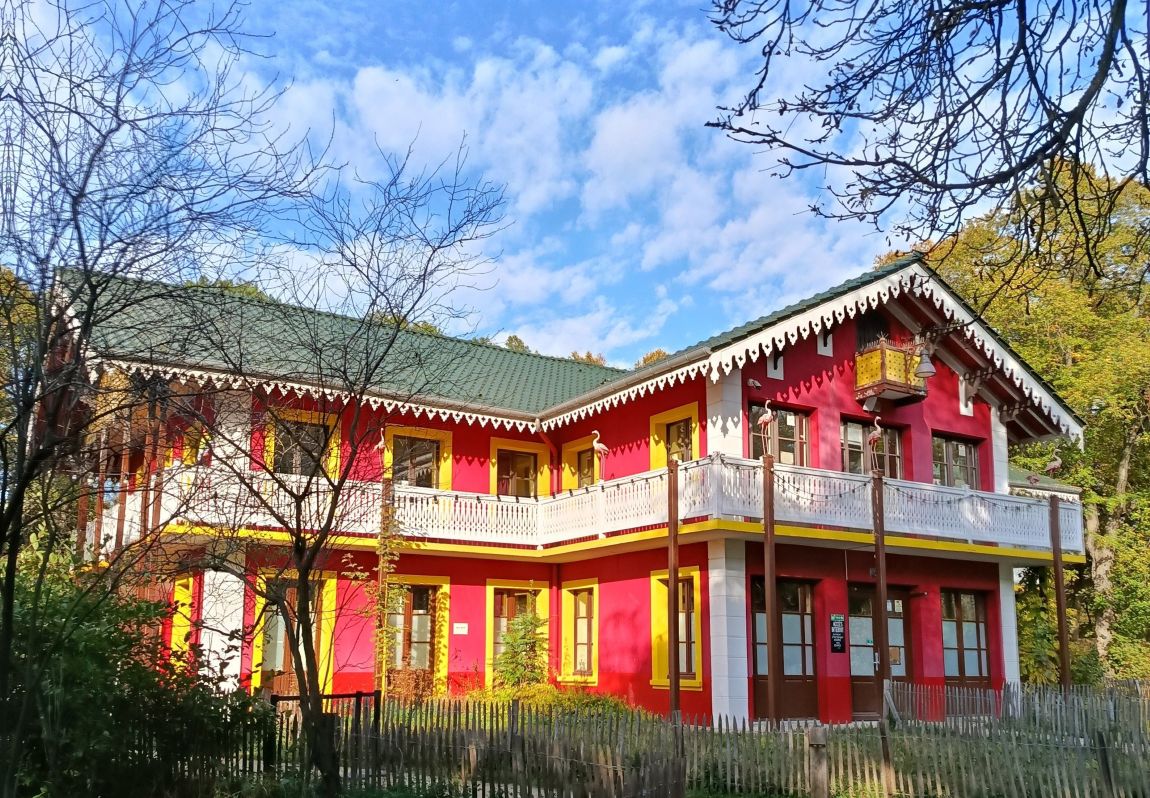
The Chalet de la Porte Jaune on the Île des Minimes in the heart of the Bois de Vincennes, aka Rosa Bonheur à l’Est, located at 12 Avenue de Nogent ,12éme, The Chalet de la Porte Jaune is the newest addition to the open-air restaurants or guinguettes, opening in July 2021. The Porte Jaune or Yellow Gate gave its name to the Route de la Porte-Jaune. The Chalet de la Porte Jaune offers catering services for corporate events, cocktail receptions, and aperitif dinners. This space can accommodate all types of corporate events thanks to its versatile layout. The official Rosa Bonheur : https://rosabonheur.fr/
Several facilities use the Bois de Vincennes area such as the Floral Park, the Paris Zoological Park (access via the Porte Dorée metro station), the racecourse at the Hippodrome de Vincennes, the Château de Vincennes (see post) (access via the Château de Vincennes metro station), the Fort de Vincennes, which houses various organizations of the Ministry of the Armed Forces, the National Institute of Sport, Expertise and Performance (INSEP), the Bayard-UCPA equestrian center, the Du Breuil school, the Paris farm, the Tropical Agronomy Garden, created for the 1907 Colonial Exhibition (access via the Nogent-sur-Marne station), the Vincennes pagoda, (see post) Buddhist temple on the banks of Lake Daumesnil, in the former pavilions of Cameroon and Togo of the Colonial Exhibition of 1931. Its grounds also include the Tibetan Buddhist center of Kagyu-Dzong (access via the Porte Dorée metro station), the Cartoucherie de Vincennes, bringing together eight theaters or artistic creation workshops, including Ariane Mnouchkine’s Théâtre du Soleil, the Jacques-Anquetil velodrome, known as La Cipale (access via the Liberté metro station), the Carnot district of the Republican Guard cavalry regiment.
A bit of history I like tell us that the Bois de Vincennes is a remnant of the forest that covered the area around Paris in ancient times. In the 11C, it was a wood near the confluence of the Marne and Seine rivers, unsuitable for cultivation. The oldest document mentioning the Bois de Vincennes is Charles the Bald’s confirmation of an exchange between the Bishop of Paris and the Abbot of Saint-Maur, dating from 848. All documents after 980 indicate the wood as royal property, although the circumstances surrounding its entry into the royal domain are unknown. When Hugh Capet established his residence on the Île de la Cité, it became his hunting ground. It subsequently remained for the exclusive use of the kings of France. In 1183, under Philip Augustus, it was enclosed by a 12 km long wall. It remained surrounded by a wall for six centuries until its removal under the Second Empire. The park was then enlarged by acquisitions of plowed land and vineyards of around 100 hectares in 1274 on the site of the current towns of Saint-Mandé and Saint-Maurice, in 1375 to the east as far as the Marne river, and 21 hectares towards Saint-Maur. A new fence was built around this extension. Several royal manors, such as the Château de Vincennes, were built nearby. According to legend, it was in this wood that Saint Louis dispensed justice under an oak tree.
Louis XIV, who frequented the woods at the beginning of his reign for hunting parties or Masses at the Minimes convent, decided to enlarge it in 1659 by acquiring agricultural land mainly in the territory of Saint-Maurice, this part being called the “false park” and to the east, and a new enclosure was built in 1667 from Saint-Maur to the half-moon of Saint-Mandé surrounding the newly acquired areas. After this enlargement, the park included 5 enclosures which surrounded: the old park before enlargement; the acquired lands “false park”; the warren; the Petit Parc adjoining the castle and the Parc de Beauté on the site of the old Château de Beauté. It was entered through 7 gates, each with a guardhouse: Porte de Vincennes near the castle at the end of the road traced from the Place du Trône; Porte de Fontenay to the north at the site of the current Place Moreau David in Fontenay-sous-Bois; Porte de Nogent at the site of the current Place du Général-Leclerc in Nogent-sur-Marne; Porte de Saint-Maur at the site of the current Rue Jean-Mermoz in Joinville-le-Pont near the bridge; Porte de Charenton, approximately at the corner of the current Avenue de Gravelle and Rue du Val d’Osne in Saint-Maurice; Porte de Saint-Mandé at the site of the current Avenue de la Pelouse in Saint-Mandé; and Porte de Bel Air, at the intersection of Chaussée de l’Étang, the current Avenues de Liège and Bel Air, giving access to the Ménagerie. A roadway lined with a double row of elms leading to the Arc-de-Triomphe du Trône was created, currently Avenue de Paris, Avenue de la Porte-de-Vincennes and Cours de Vincennes.
Later abandoned by Louis XIV in favor of Versailles, the wood, which had largely become wasteland, was redeveloped from 1731 to 1739. The part of the old wall enclosing the wood before the extensions of 1659 was destroyed in 1731, leaving only that encompassing the new perimeter; and a network of sixteen avenues around star-shaped crossroads was laid out. Most of these avenues still exist, notably the Allée Royale, the Route Dauphine, the Route de Bourbon and the Route de la Pyramide after the reconstruction of part of the network in the 1980s following the departure of the army which had caused it to disappear. A large terrace bordered by an 80-meter-wide avenue overlooking the Marne Valley, overlooking the village of Saint-Maurice by 30 meters, was created in 1740. This reforestation is commemorated by an obelisk or pyramid installed in 1734 at the Pyramide crossroads. The park was open to the public from the middle of the 18C and became a popular place for walking with the opening of balls and open-air dance halls. A 16-hectare plot of land, “Le Clos d’Orléans”, on a site currently located between Rue du Clos-d’Orléans, Rue de Joinville in Fontenay-sous-Bois, Rue de Fontenay in Joinville and the RER A line, was granted in 1780 to the Duke of Orléans to organize horse races. A stable, a saddlery, and stands were built on this walled site where most of the trees had been felled.
Outbuildings of the Bois de Vincennes were sold as national property during the French revolution such as the 17 hectares of the Petit Parc and the Enclosure des Minimes in 1796, and the Clos d’Orléans in 1803. However, the wood was declared inalienable as “formerly Crown property” by a law of September 29, 1791. A firing range was installed in 1791 on the Allée Royale, the first part of the immense military range that extends across the central part of the wood, cleared by the army during the July Monarchy, the Second Empire, and the Third Republic. In 1808, Napoleon I decided that the Château de Vincennes would be an arsenal, and Vincennes became an important military center with a garrison of 1,200 men from the Imperial Guard. The wood was damaged in 1789 and 1790 by the felling of the inhabitants of the surrounding villages, then during the siege of Paris in 1814 and by the allied armies in 1815. During the Restoration, Louis XVIII tried to restore it to its pre-Revolutionary state. Trees were replanted, forest rangers were recruited and the park underwent a revival. In the July Monarchy, the firing range was shifted to the east in 1838, as the south-eastern projection axis ended at the newly built Esquirol Hospital. The military domain was extended and the cannon mound became the new target. A program to fortify Paris was launched in 1840, including the construction of the New Fort, the Gravelle Redoubts and the Faisanderie Redoubts. In 1855, Napoleon III extended the military domain to the east of the artillery firing range by razing 110 hectares of woodland, which removed the forest paths in the center of the wood. Firing mounds for the infantry were created there. Vincennes became a garrison town. The wood was still heavily affected in 1870 and 1871 by the destruction of plantations in front of the fortified walls of Paris and between Nogent and Joinville, then by wood cutting for heating the troops stationed there and Parisians during the siege of Paris and the Commune.
The city of Paris was then called upon to contribute. The Bois de Vincennes was granted to it in 1860. But administratively it remained in the towns of Vincennes, Fontenay-sous-Bois, Nogent-sur-Marne, Joinville-le-Pont, Saint-Maurice, Saint-Mandé and Charenton-le-Pont. It was only officially attached to the 12éme arrondissement by the decrees of April 18, 1929. Most of the events of the 1900 Summer Olympics were contested in the Bois de Vincennes, the castle returning in 1934 to the town of Vincennes (see post). The International Colonial Exhibition of 1931 was partly built in the Bois de Vincennes and notably allowed the construction of the Palais de la Porte Dorée and the Vincennes Zoo. The Cours des Maréchaux was opened in 1931 between the Fort Neuf and the castle. In 1973, the construction of the A4 autoroute removed the Faisanderie redoubt and reduced the wood by around 10 hectares. Administratively, however, it is part of the 12éme district or arrondissement , and the quartiers or neighborhoods of Picpus and Bel-Air, and it is the Paris City Hall which ensures its maintenance, plantations and decides on concessions and establishments,
The City of Paris on the Bois de Vincennes : https://www.paris.fr/lieux/bois-de-vincennes-6598
The Paris tourist office on the Bois de Vincennes : https://parisjetaime.com/eng/culture/bois-de-vincennes-p1017
More on the Paris tourist office on the Bois de Vincennes : https://parisjetaime.com/article/bois-de-vincennes-a918
The Val de Marne dept 94 tourist office on the Bois de Vincennes : https://www.tourisme-valdemarne.com/incontournables/bois-de-vincennes/
The City of Vincennes on the Bois de Vincennes : https://www.vincennes.fr/bois-de-vincennes
There you go folks, another nice daytime park garden to enjoy in sublime Paris, The bois de Vincennes is huge need to be back ,eventually, Again, hope you enjoy the Bois de Vincennes of Paris !!! as I,
And remember, happy travels, good health, and many cheers to all !!!


