
I like to tell you again about my road warrior trails in my belle France. Again, found me some pictures in my cd rom vault that should be in my blog for you and me, I like to do justice to Calais in a small way as stop by on my way to England in the eurotunnel, Therefore, here is my take on this is Calais !!! Hope you enjoy the post as I.
The City of Calais is located in the Pas-de-Calais department no 62 in the Hauts-de-France region of my belle France. The City is the seat of the Greater Calais Terres et Mers urban community, which is spread across 14 towns. Facing England, it is, with its port, France’s leading passenger port and the Channel Tunnel, the main French city connecting it to Great Britain. The city, like Caudry (see post) in the Nord department (no 59), is known for its lace. It is located on the Opal Coast, on the edge of the Strait of Dover which marks the boundary between the English Channel and the North Sea,The Channel Tunnel, (see post) whose continental access is located in the neighboring town of Coquelles, provides access to England. Calais is also on the route of several highways/motorways such as the A16 autoroute, which connects the Paris region to the border with Belgium via Beauvais, Amiens, Abbeville, Boulogne-sur-Mer and Dunkirk, and the A26 autoroute which connects Calais to Troyes via Arras, Saint-Quentin, Reims and Châlons-en-Champagne. The A216 highway, aka the rocade portuaire or port ring road is 3 km long and connects the east of Calais and the port to the A16 and A26 autoroutes interchanges. Furthermore, European Route 40 starts in Calais and ends in Ridder, making it the longest European road in existence. It is at 38 km from the English coast, 40 km from Dunkirk, 36 km from Boulogne-sur-Mer, 108 km from Arras, and 156 km from Caudry from where we came out to the D643 road dir Beauvois-en-Cambrésis , same road changes to D2643 road continue around Cambrai ,and the same road changes back to the D643 into the Pas de Calais dept continue to bear left onto the Canal de la Sensée along the Digue du canal continue and bear left into the Canal du Nord road cross it and continue on Rue du Bias continue past Arleux where bear left onto the D47 road or Rue Salvador Allende continue,then bear right onto the D135A road bear left passing Estrées onto the D44 road continue to Vitry en Artois which becomes the D40 road and continue bearing left by Méricourt on the D262 road into Lens along the train station continue bearing left onto Route de Béthune continue same road becomes the D943 road into Béthune bearing right into the Route Nationale or D937 road continue go in circle by the Canal d’Aire à la Bassée continue with the canal on your left hand side into Guarbecque continue with canal on your left hand side passing along the Canal de Neufossé then cross over this canal onto the D157E3 with the canal on your right hand side onto the D197E1 road continue passing by the City center of Wittes bearing right on the D943 road again, passing by Rue de la Pierre, Racquinghem and continue same road going into Arques along the Canal de Neufossé continue around Saint Omer on the D928 road to get back bearing right onto the D943 again, continue after Wolphus bear right onto Rue du Petit Coin alongside the A26 autoroute on your left hand side crossing it by Les Attaques and continue on the D943 road continue entering Calais on the D119 road or Bd Victor Hugo bearing left onto Bd la Fayette and we parked past the Grand Théâtre on street parking Rue du Vauxhall, The scenic route later going to the euro tunnel to London (see post),
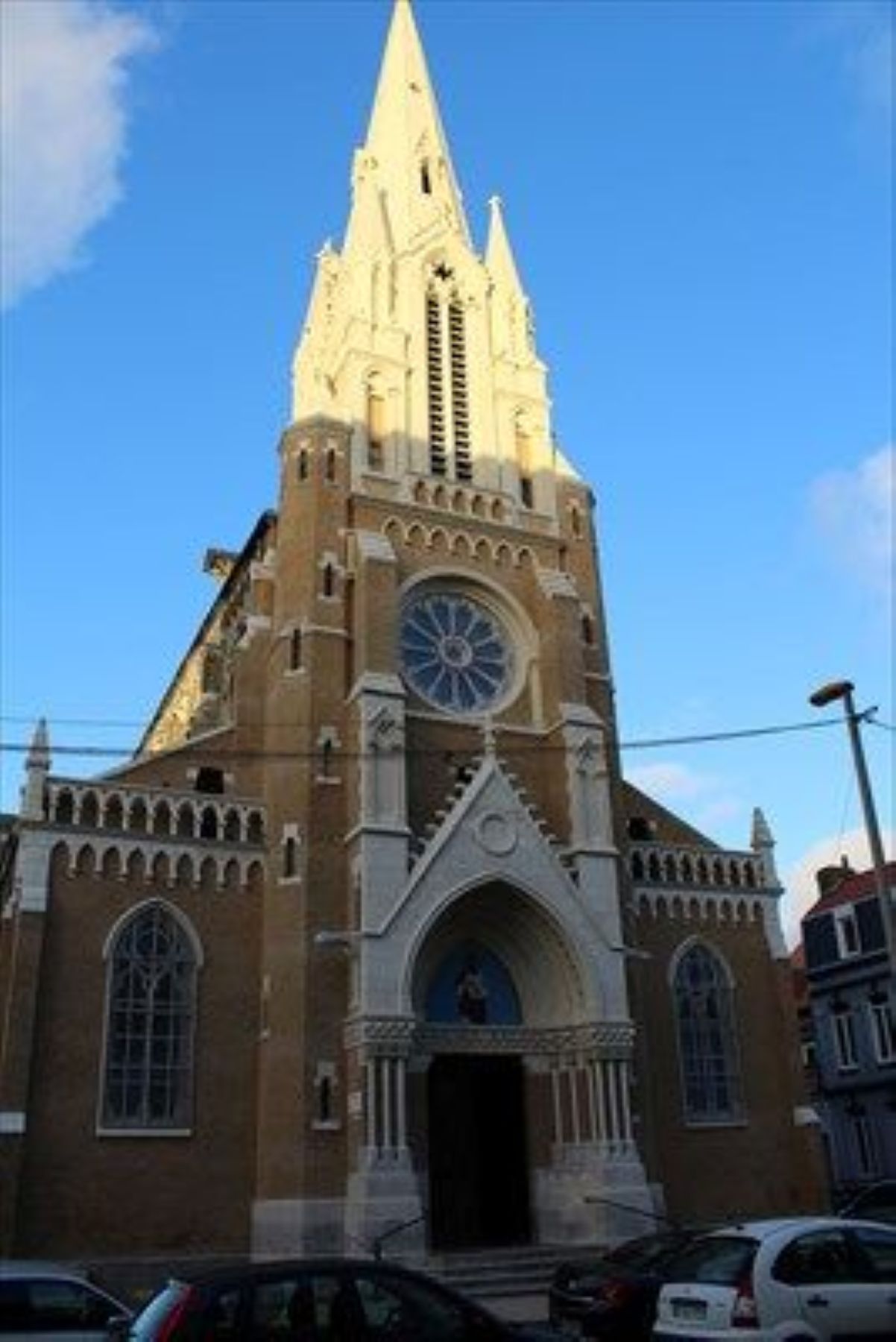
The Church du Sacré Coeur or of the Sacred Heart, construction of the church began in 1867 and continued in 1877. It was completed in 1892. It is located on Rue du 11-Novembre. The western façade features a central bell tower spanning the entire width of the nave. This is marked on the ground floor by a gabled portal raised by three steps, marked by a pointed arch, and surmounted by a painting depicting Jesus. Above the portal stands a rose window. The bell tower is crowned with slatted windows and a spire.
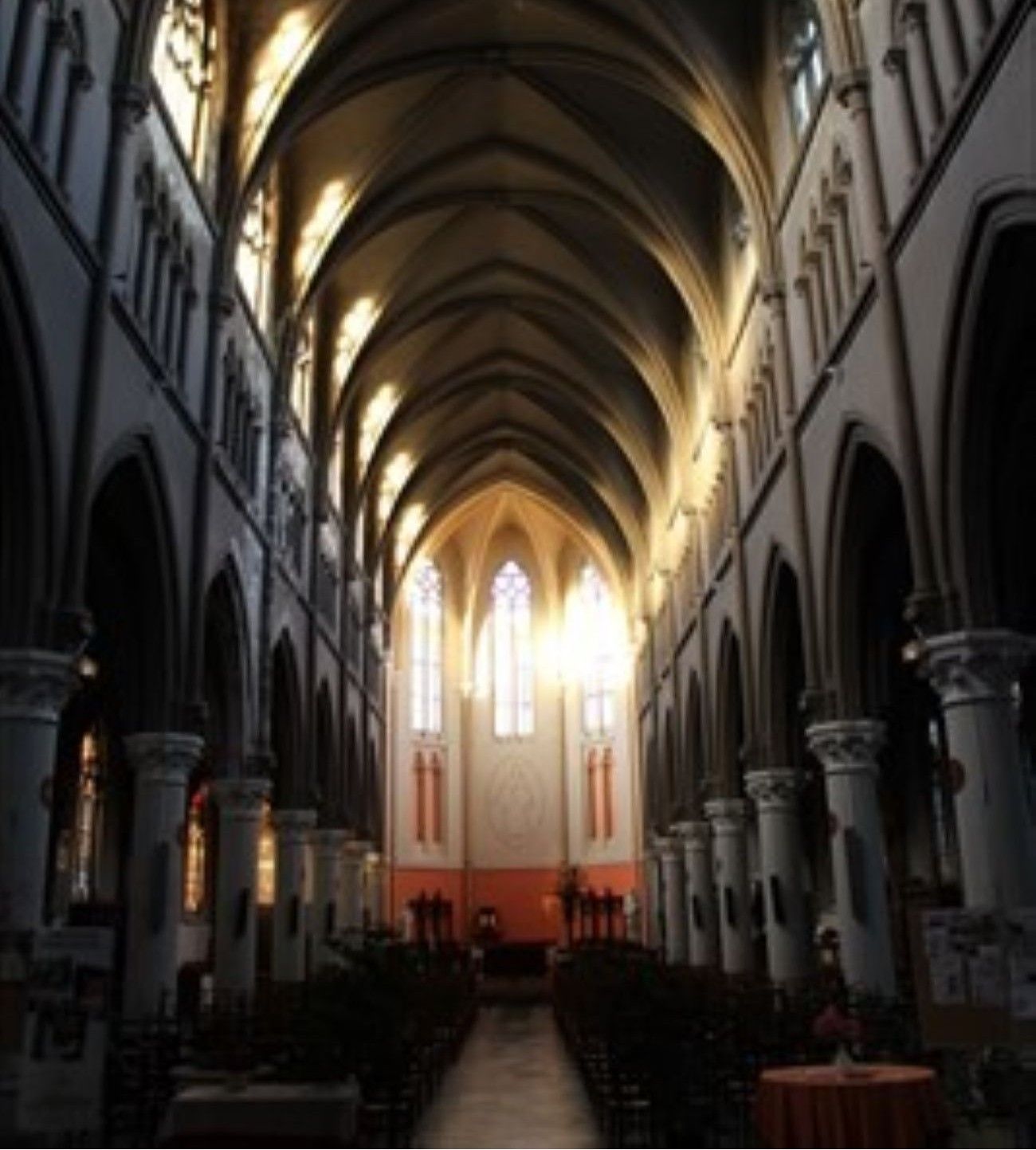
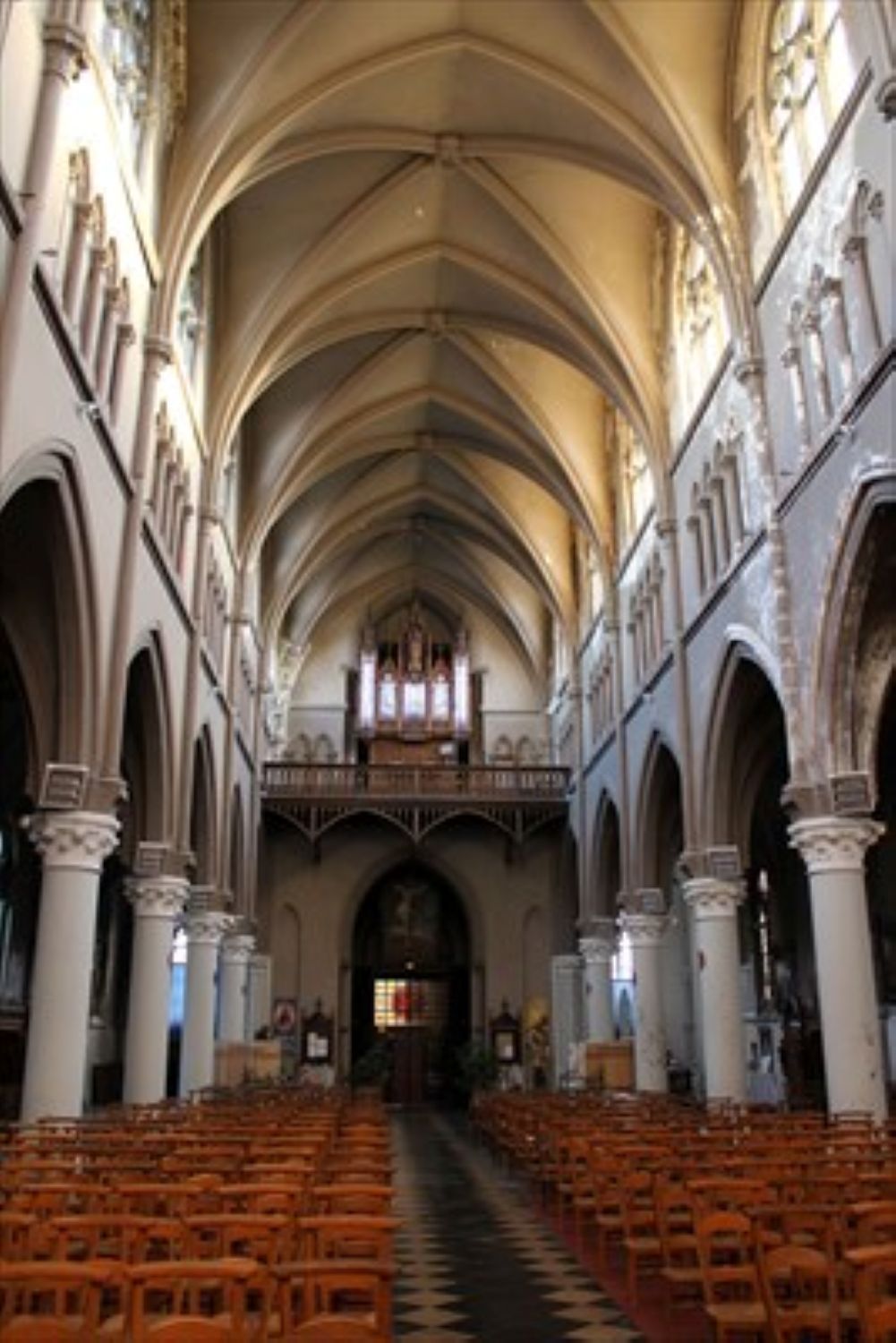
The Church du Sacré Coeur has eight bays and its nave is flanked by two side chapels. It features a large neo-Gothic organ. The nave is joined by two side aisles with eight pointed arched bays that illuminate the nave, as well as an openwork upper floor with pointed arched bays. It is supported by nine buttresses. The nave is marked by fourteen granite columns, which form a series of pointed arches that separate the nave from the side aisles. The church is painted in a light tone with a solid color. It is crowned with ribbed vaults that mark a rhythm in the nave, The three-sided chevet is pierced by five lancet windows. It notably features a large sacristy pierced by several rectangular bays and two doors. The entire church is covered with a gable roof except for the bell tower and the chevet, which have a rounded hipped roof.
Other things to see and they are many with more time are the tour du Guet or watchtower, dating from the 13C, is one of the oldest monuments in Calais. The Place d’Armes is one of the largest squares in the city, it adjoins the Watchtower. The citadel, dating from the 16C, was built from 1560 on the foundations of a medieval castle itself built in 1229 by Philippe Hurepel, Count of Clermont-en-Beauvaisis. The city gate or Hermitage, also called the Royal gate or Neptune gate; Boulogne gate, also called the emergency gate; citadel with its curtain walls and ditches, and the half-moon defending the entrance to the city, beyond the citadel canal; Fort Risban ,although there is much speculation about its origins, perhaps linked to the plan to conquer England drawn up by Emperor Caligula around the year 40, the first recorded mention of its existence dates from 1346: the troops of Edward III discovered the impregnable fortifications of Calais and decided to build a small fort here to prevent any supply by sea, with the aim of reducing the town by famine. the Calais North lighthouse built in 1848, electrified in 1963. the Louis XVIII column: a column commemorating the landing of Louis XVIII in Calais in 1814 ; the City/town hall: a building with a concrete structure built from 1911 to 1923. The underground crypt under the belfry dates from the 14C. Notre-Dame Church dating from the 13-14-15C , in the very distinctive Tudor style. The Neo-Gothic Saint-Pierre Church built on Place Crèvecoeur between 1863 and 1870. Fort Rouge (17C). Fort Nieulay (17C). The Burghers of Calais, a bronze sculpted group by Auguste Rodin, inaugurated in 1895 in front of the City/town hall. The Calais Museum of Fine Arts. The International City of Lace and Fashion, a former 19C factory, converted into a museum. The 1939-1945 Memory Museum, command post of the Navy during the nazis Occupation and transmission center for the entire northwest region of France.
A bit of history I like tell us that with its proximity to England makes Calais a strategic military location. The city’s history is marked by several sieges: the first in 1346 during the Hundred Years’ War, when King Edward III of England chose Calais to land in France (the city then came under English control), a second in 1436 when Philip the Good, Duke of Burgundy, attacked the English in an attempt to liberate Calais, and then a final one in 1558 when France finally succeeded in recovering the city, which had remained under English occupation for more than two centuries. In 1595, Calais was captured by the Spanish, who returned it two years later. Calais was spared from the Great War or WWI despite several German raids that caused some damage. The town was awarded the Croix de Guerre 1914-1918 by decree of 25 August 1919. The destruction suffered during the WWII was heavier. Calais, besieged twice in 1940 and 1944, became a “forbidden zone”, as the nazis feared a landing of Allied forces in Pas-de-Calais. The town was 73% destroyed. The town was awarded the Croix de Guerre 1939-1945 on 11 November 1948. The opening of the Channel Tunnel (Eurotunnel) in 1994 gave new life to the town, bringing jobs, businesses and new road and rail infrastructure. The town was nevertheless affected by the crisis of migrants wanting to reach England at the beginning of the 21C.
The Calais tourist office on its heritage : https://www.calaisxxl.com/en/sejourner/a-voir-a-faire/histoire-et-patrimoine-de-calais/?CoordonneesCommune=calais
The City of Calais on its heritage (see découvrir Calais) :https://www.calais.fr/
The Pas de Calais dept 62 tourist office on Calais : https://www.visitpasdecalais.com/opal-coast/seaside-resorts-on-the-opal-coast/calais-the-gateway-to-the-channel/
The flower towns and villages of France on Calais : https://villes-et-villages-fleuris.com/les-communes-labelisees/parcs-et-jardins-calais/25082
The Hauts de France region on Calais (a bit of info) : https://www.tourisme-en-hautsdefrance.com/decouvrir/les-departements/le-pas-de-calais/
There you go folks, another wonderful spot in my road warrior trails of my belle France, This is architecture, history and a lot more ; one of the gems of the Pas de Calais, worth the detour , me think, Again, hope you enjoy this unique post on this is Calais !!! as I
And remember, happy travels , good health and many cheers to all !!!

 Paris1972-Versailles2003
I had a brief afternoon in Calais years ago when coming back to France from England. Don’t recall visiting the church, but I did take a stroll around the city, and it was pleasant!
LikeLiked by 1 person
Glad you enjoy it. Yes we stop with extra time on our coming and to England. Thanks for stopping by . Cheers
LikeLiked by 1 person
I visited Calais properly for the first time this summer after having passed through many times. I was so impressed, it’s a lovely place. Definitely one I’ll visit again and I’m now keen to explore more of Northern France.
LikeLiked by 1 person
Absolultely its one of the off the beaten paths of my France but worth the detour, glad you like it and thanks for stopping by Cheers
LikeLiked by 1 person