
Once again looking back into my cd rom vault found me several pictures not included and they should in my blog for you and me. There are some nice towns in the Loire valley, the findings are endless ,I had the opportunity to visit thie quant picturesque small town with a nice history. Therefore, here is my take on curiosities of Rochefort sur Loire !!! Hope you enjoy the post as I.
The town of Rochefort-sur-Loire is located in the Maine-et-Loire department, no 49, in the Pays de la Loire region of my belle France. Its position on the Loire Valley has made it an important crossing point in history. It is an agricultural and wine-growing town with vineyards in Chaume or Coteaux-du-Layon, Premier Cru Chaume. Two main roads cross the towns of Denée, Chalonnes-sur-Loire on, the D 751, and Savennières, Val-du-Layon, and Beaulieu-sur-Layon,on the D 106. The A87 Angers-Cholet autoroute is 8 km away, in the town Beaulieu-sur-Layon. The town is located 17 km from Angers and 3 km from Savennières, 114 km from Tours, 77 km from Nantes , and 203 km from my current town from where we came along the D103 dir Plumergat ,then continue same road becomes the D308 road and D150 road to connect with the D779 road by Grand Champ continue to Plescop and take the D135 road dir Saint Avé continue bearing left onto the D775 road dir Questembert/ Redon get off bearing left onto the D114 by Allaire continue connect again with the D775 road dir Redon bear rigtht and continue same road dir Guéméne-Penfao here bordering its City center bear right onto the D125 road dir Marsac sur Don thru City center bear right onto D124 road dir Nozay, go thru City center and bear right onto the D2 road dir La Meilleraye-de-Bretagne where same road becomes the D18 road dir Riaillé continue same road dir Pannecé City center bear left onto the D9 road by La Bourdiniére farm bear right onto the D22 road continue dir Maumusson continue bear right at Loireauxence to the D10 road dir Launay but in previous town bear right on same road to bearing left onto the D22 road dir Le Saint Sauveur continue crossing over the A11 autoroute continue dir Ingrandes-le-Fresne-sur-Loire crossing the D723 road on the D6 road over the Loire river bear left onto the D210 road bordering the Loire river on your left hand side going thru City center Mauges-sur-Loire getting on the D751 road continue past Chalonne sur Loire continue to City center Rochefort sur Loire and the church, A very scenic route of yours truly the road warrior !.
The Church Sainte Croix or Holy Cross is from the 13C to the 16C, This church belonged to the Ronceray Abbey of Angers, donated by the Count of Anjou in the 11C. The Romanesque church and abbey buildings were razed around 1840 to allow the reconstruction of a large neoclassical church, and again in 1880 in an eclectic style. The impressive bell tower probably dates from the 16C.
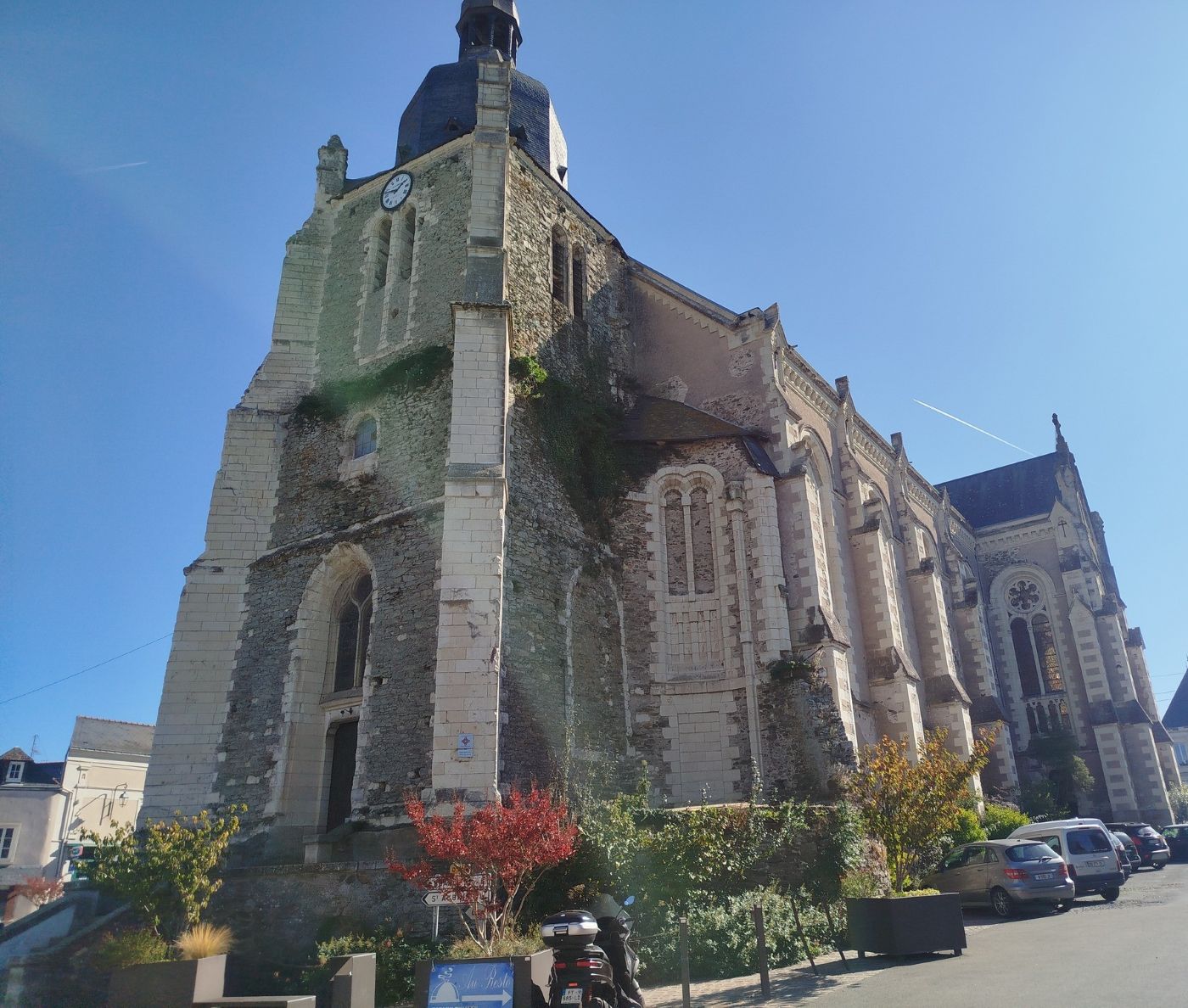
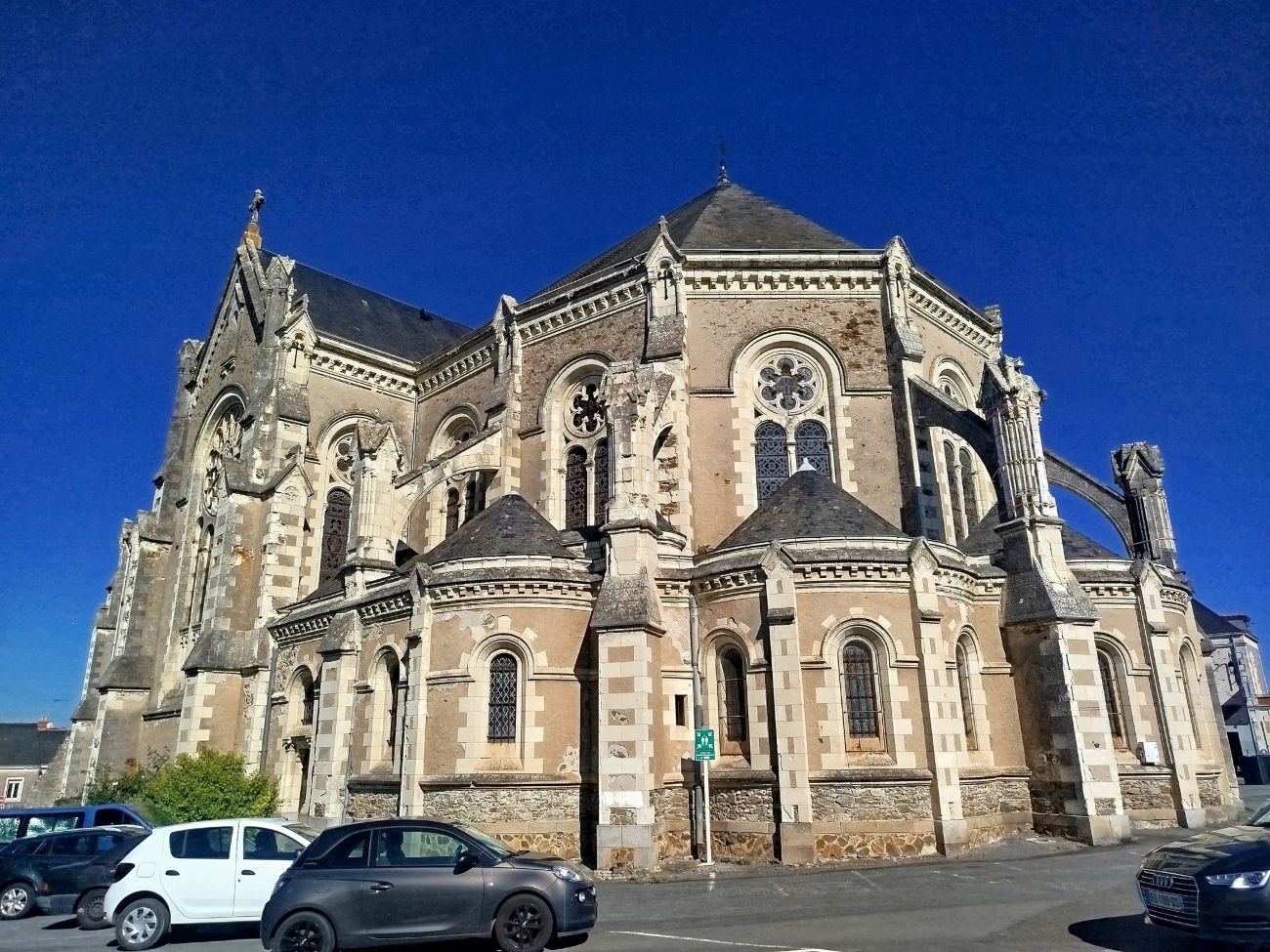
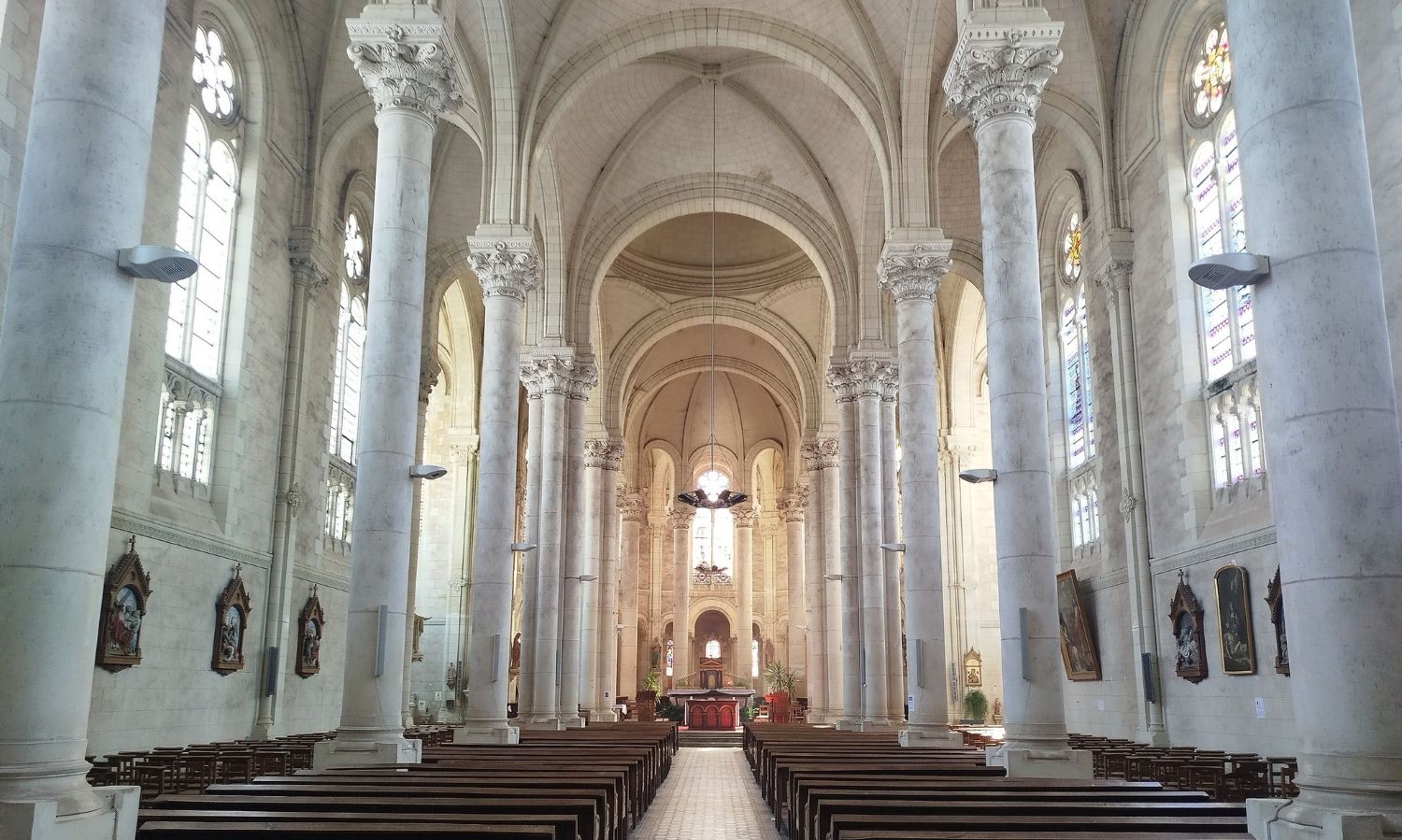
At the beginning of the 19C, the old Church Sainte Croix , which had witnessed the French revolution, was in very poor condition. In 1843, a restoration began, which proved to be highly flawed. In fact, three churches survived this century: the oldest probably survived the French revolution; then a poorly executed renovation and expansion, based on the same principles, in the 1840s, and finally, the one we know today, from 1875.
Other things to see are three castles that made up the original city of Rochefort: Dieusie (12C), Saint-Offange (13C) and Saint-Symphorien. The Corniche Angevine, with panoramas over the Loire and Layon valleys, and the hamlets of La Haie-Longue and Ardenay; the manor known as Château du Pilory from the 15-16C and 18C; the Voie au Chemin-des-Loges manor from the 16C; the residence known as Logis du Martreau from the 13C; the Saint-Symphorien Chapel from the 18C; the house on the Place Sainte-Croix from the 15-16C; the house on Rue de la Grande-Cour from the 18C; the house called Cour de Pierre from the 15-16C and 18C; the house on Rue Haute-du-Martreau from the 18C, and two houses on Place du Pilory from the 16-17C.
A bit of history I like tell us that it was further down in the valley that the original village was formed. Rochefort was initially a fortified village, then a fortified castle, some remains of which remain on the rocky prominence Rupes Fortis, which later became Saint-Offange, named after the latter occupants. The town of Rochefort was created around the year 1000 by Foulques Nerra, around the lordship of Cour-de-Pierre, which belonged from 1037 to the abbesses of Ronceray d’Angers. Rochefort was attached to the county of Anjou by Foulques Nerra in the 11C. At the time of the Plantagenets, in 1214 John Lackland made Rochefort his base of operations to besiege the castle of Guillaume des Roches at La Roche-au-Moine. He was soon defeated by the royal troops of Prince Louis ,the future Louis VIII, son of Philippe Auguste. In 1562, during the Wars of Religion, one of the Huguenot leaders, Captain de Saint-Aignan, known as Desmarais, settled in Rochefort Castle and resisted the royal troops of the Duke of Montpensier. Captured, he perished on the wheel. Most of the province of Anjou refused to recognize this Huguenot king, except for Angers and Saumur. In several towns, such as Segré, Baugé, Beaupréau, and Chalonnes, the Leaguers refused to rally to the new king. Thus, Rochefort was besieged to dislodge the Saint-Offange, who were holding the Loire river crossing. Once peace had been restored, King Henry IV repurchased the place. He had the fortified castle demolished in 1599, as well as the small fortified village located on a nearby rocky plateau, the Motte Saint-Symphorien. It was so unimportant that its parish was merged in the 13C with that of Sainte-Croix. During the administrative reorganization that followed the French revolution, the department of Maine-et-Loire succeeded the province of Anjou. In 1793, an insurrection broke out in the Mauges, the War of the Vendée. (against the French revolution), aka wars of the west, The following year, one of General Turreau’s republican troops (infernal columns that killed at will), under the command of Adjutant General Jean-Baptiste Moulin, set fire to the region but spared Rochefort and Saint-Aubin, located at the time in the military Vendée. The beginning of the 20C was marked by the beginnings of aviation. In June 1908, in the fields of Grand-Prée, which are located below La Haie-Longue, the aviation pioneer René Gasnier made flights with airplanes of his design. In 1941, Jean Bouhier, established as a pharmacist in Rochefort, decided to bring together poet friends around the publication of a magazine Les Cahiers de Rochefort. It was at his home that this group of young artists from the West met quite regularly, breaking with the literary conformism of the time. Created in the midst of the Nazis occupation, this movement was a reaction to the national and traditional poetry advocated by the Vichy regime. During the Occupation, the nazis army settled in Rochefort in 1940, 1942 and 1943.
The town of Rochefort sur Loire on its heritage : https://www.rochefortsurloire.fr/page/monuments
The Parish of Saint Maurille en Loire et Layon on the church : https://stmaurilleenloireetlayon.diocese49.org/histoire-et-patrimoine/#saintecroix
The local Anjou (Maine et Loire) tourist office on Rochefort sur Loire : https://www.anjou-tourisme.com/fr/decouvrir-lanjou/destination/loire-layon-aubance/villages/rochefort-sur-loire
The Pays de la Loire region tourist office on Rochefort sur Loire : https://www.atlantic-loire-valley.com/visits/other-monuments-and-heritage/circuit-du-patrimoine-de-rochefort-sur-loire
There you go folks, a nice walk to see some wonderful architectural historical sights in quant nice Rochefort sur Loire. Enjoy the walk, the best way to see a place. Again, hope you enjoy the post on the curiosities of Rochefort sur Loire !!! as I.
And remember, happy travels, good health, andn many cheers to all !!!


