
We have driven in the area and would like to have an imprint in my blog on the wonderful towns of my belle France, There is so much to see , doing my best, and glad found me these pictures in my cd rom vault which should be in my blog for you and me for the memories forever, Therefore, here is my take on this is Vouvant !!! Hope you enjoy the post as I
The town of Vouvant is located in the Vendée department no, 85 in the Pays de la Loire region of my belle France. A formerly important medieval stronghold, it still retains a large part of its fortifications. In fact, I should be back is loaded with wonderful monuments so noted to come back eventually, The town of Vouvant is crossed by the departmental road, RD31, running from Saint-Hilaire-des-Loges to Chantonnay. The latter bears several names as it passes through the town such as Rue de la Filée, Rue de la Visitation, Place de l’Église, Rue du Duc d’Aquitaine, and Rue du Château Neuf. Two other departmental roads serve the town before joining the RD31: the RD89 from Puy-de-Serre and the RD30 crossing the town which merges with the RD31 as it passes through it. About 2 km from the town center, you have the departamental road RD938T linking the towns of La Châtaigneraie and Fontenay-le-Comte, The town is located 70 km from La Roche-sur-Yon,68 km from La Rochelle, 41 km from Niort, 123 km from Nantes, 413 km from Versailles, and 413 km from my current home, We came from Versailles by the N12, N10 dir Rambouillet ,and by Ablis connect with the A11 dir Chartres, Le Mans, and by Anges take exitSortie 14 on the A87 dir Erigné, Cholet to exitSortie 28 taking the D160/D27 dir Les Epesses by the town on the D11 which becomes the D752 dir Pouzauges then D67 and D938T right on D31 to Vouvant.
Passing in my road warrior mode got a glimpse and enough time to stop by on the Tour Mélusine tower , the keep of an ancient fortified castle of Vouvant. This keep, probably built in the late 12C or early 13C, is the only remaining remnant of the ancient fortified castle of the lords of Lusignan, built on the site of today’s Place du Bail. This castle was then separated from the fortified town of Vouvant by a dry moat. As with all Lusignan castles, legend has it that it was built in one night by the fairy Mélusine “from three gold stones and a mouthful of Eve.” This tower, with its height of 36 meters from the moat and its cylindrical shape, is unprecedented for the time. The tower has a square base, which indicates the height of the curtain wall that surrounded the castle courtyard, today Place du Bail.
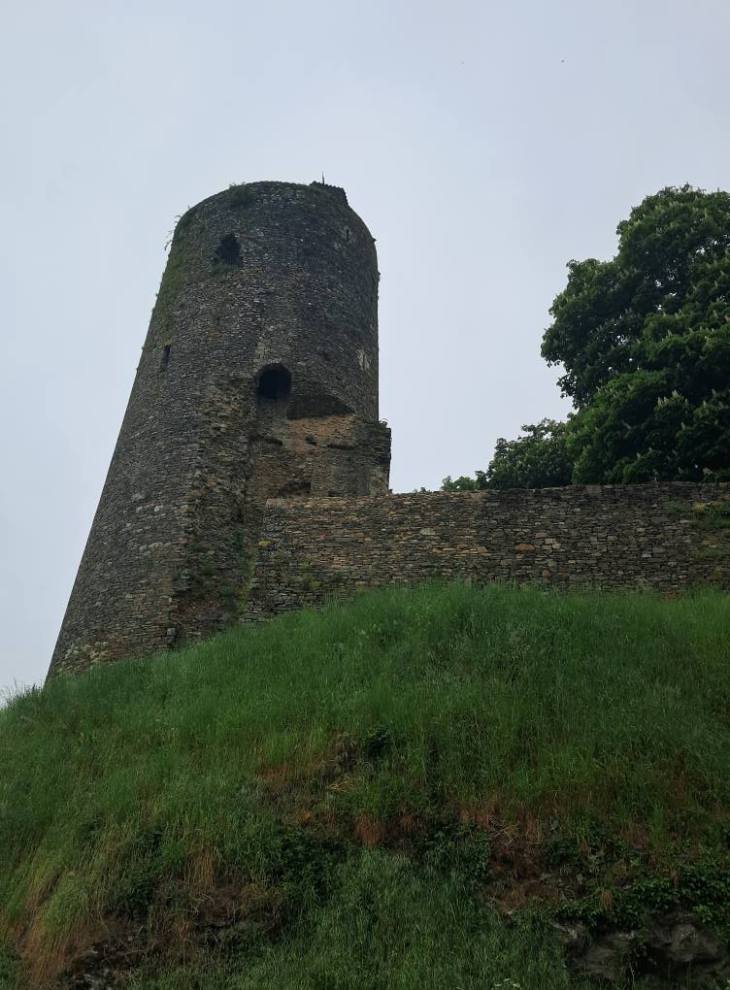
The castle’s main courtyard possibly featured a fountain erected in the 16C and composed of a granite basin supported by four limestone figures of the fairy Mélusine. The fountain, fed by rainwater, had another figure of Mélusine above the basin, holding a mirror in one hand and a comb in the other. It was this figure of the fairy who sprayed streams of water from her breasts. Only one of the four figures of Mélusine is still preserved in the grounds of the private Château de la Recepte near the town.
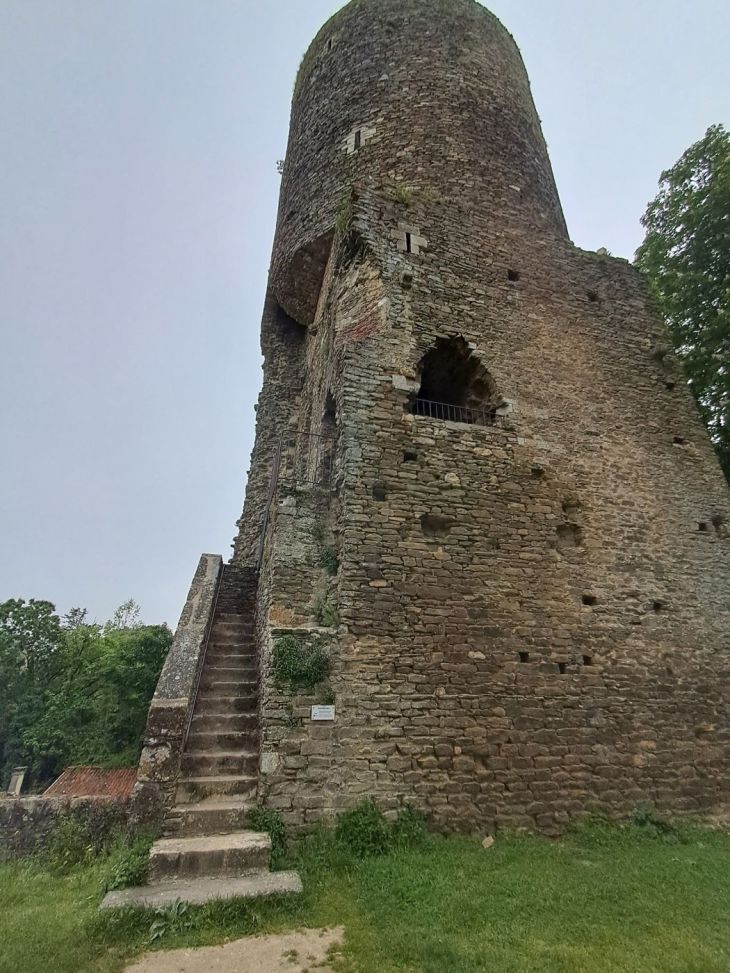
The Tour Mélusine consists of a total of five levels. A small enclosed space currently exists on the first level of the tower, now the ground floor. The entrance to the tower was on the second level. This was originally accessible by a mobile ladder or a wooden balcony, for example. The third and fourth levels are accessible via a spiral metal staircase (previously stone) and each include a domed vaulted room with a fireplace. The fourth level also has a latrine with a slanted conduit (latrines with direct drainage to the outside). The third level provided access to the fortified castle’s patrol path. The fifth and final level corresponds to the terrace at the summit, from which a breathtaking view of the fortified town, the Mervent-Vouvant forest, and the surrounding area is breathtaking.
Some of the other things to see here and as said is loaded are the Church Notre-Dame-de-l’Assomption built in the first half of the 11C in granite and schist. It is a vast construction with three naves and perhaps nine bays. The church has an architecture that is to say, austere, which does not include any sculpted decoration and which gives an impression of rigor and solidity, The Théodelin nave, part of the nave of the church dating from the 11C transformed into a place for temporary exhibitions; The ramparts that can currently be seen date from the end of the 12C or the beginning of the 13C,In the 1920s, the City/town hall was relocated to the current building located on Place de l’Église. This building, built in the 18C as the previous City/town hall on Rue Théodelin is currently the village hall. The Tour des Gardes is a defense tower flanking the eastern part of the ramparts of the fortified castle. It is the only tower in the castle that still has a room. The vaulted room of the Guards Tower is currently used by the town as a storage area. The Convent Tower, aka the Visitation Tower, is a semi-circular tower flanking the eastern part of the ramparts of the fortified town. It is one of the best-preserved towers of the enclosure , The Porte de la Poterne or, more simply, the Poterne and, sometimes called Porte Saint-Louis is the only access point to the fortified town still preserved, The towers of the Château Neuf, located at the entrance to the town, would constitute the only remains of the fortified enclosure of the Château Neuf perhaps erected in the 15C by Arthur de Richemont, Dated between the 13C and the 15C for the old parts, the old bridge of Vouvant or locally called the Roman bridge, The castle mound of Château Neuf is a feudal mound perhaps erected as early as the 11C. This defensive element made it possible to protect the castle town of Vouvant at the level of the only area not surrounded by the River Mère This mound is still very well preserved , it extends over around forty meters in circumference and has a maximum height of around 4 to 5 meters The Vouvant grotto is a reproduction of the Lourdes grotto created under the impetus of the 1958 mission. It is located on a bank of the Mère river, and is accessible by a wooden footbridge The public lavoir or washhouse, built in the 19C and restored in the 20C, was used by washerwomen until the 1970s. There are two vestiges of its use: the chimney and the cast iron tub for boiling the linen The Mélusine’s house aka the Bail House now houses the town’s tourist office. The building was constructed from local schist in 1837 on the site of part of the ramparts of the old fortified castle. Several private castles, manoirs or mansions ,old wooden houses, bridges ,and a fortress, So much will need more time here for sure, will be back eventually.
A bit of history I like (that is what I said but this one is huge need to have it for me as will be back here) : Around the year 1000, William the Great, Count of Poitiers and Duke of Aquitaine, had a castle and a church built in Vouvant, a rocky promontory located in a meander surrounded by the Mère river. The Count-Duke had a fortified castle built there on the current site of the Château Neuf or the Petit-Château, as well as a monastic complex allowing him to establish his authority over Bas-Poitou. The first mention of Vouvant is found in a written deed of donation to the monastic community of Maillezais. This deed is dated between 1016 and after March 1019. It is therefore in 1019 at the latest that the founding of the castle town of Vouvant appears to have taken place. Around 1040, the construction of the castle and town appears to have been completed. On April 7, 1074, William VIII of Aquitaine, Count of Poitou and Duke of Aquitaine, stayed at the Château de Vouvant during his visit to Bas-Poitou. In 1110, the lords of Parthenay allied with those of Lusignan and wage war against William IX of Aquitaine, Count of Poitou and Duke of Aquitaine. After two years of struggle, it was the Count-Duke who triumphed over his vassals. He thus perhaps had an authentic stone castle built on the site of Vouvant-Bourg or current Place du Bail towards the middle of the 12C. Between 1140 and 1150, the lordship of Vouvant-Bourg passed into the hands of the Lusignan family. From 1147, Sebrand I Chabot, lord of the Petit-Château de Vouvant, participated in the second Crusade under the pontificate of Eugene III. In July 1190, Geoffroy I of Lusignan left for the third Crusade on the orders of Richard the Lionheart who wished to avoid further rebellions by this lord. The Lusignans distinguished themselves during this crusade since Guy de Lusignan became King of Jerusalem while his brother Geoffrey I was named Count of Jaffa and Ascalon.
At the very beginning of the 13C, the Lusignans refused to recognize the suzerainty of the King of England and new Count of Poitou John Lackland ,son of the King of England Henry II and Eleanor of Aquitaine, whose marriage brought Poitou into the hands of the English. After being named King of France in 1223, Louis VIII undertook to seize the last possessions acquired by the English in France. In 1241, the Lusignans did not want to submit to the King of France Louis IX. Indeed, Hugh X of Lusignan refused to pay homage to Alphonse of Poitiers (new Count of Poitiers and brother of the king) during the Christmas celebrations of 1241 in Poitiers. Louis IX then besieged Vouvant in May 1242 before taking possession of the city on June 6, following the surrender of Geoffroy II of Lusignan. The castle, certainly damaged, was perhaps repaired and modified on the orders of the king. After the victory of Louis IX in June 1242, Geoffroy II of Lusignan paid liege homage to Alphonse of Poitiers at Vincennes in April 1243. By this homage to the Count of Poitiers, Geoffroy was given control of Vouvant. By letter of May 6, 1415, the King of France withdrew the status of seneschal of Poitou from John II the Archbishop and confiscated his lands of Parthenay, Secondigny, Béceleuf, Coudray-Salbart, Vouvant, Mervent, Châtelaillon, etc. Indeed, after having sided with the Duke of Berry and the Duke of Orléans in 1410, John II abandoned them in 1413 to serve the Burgundians (allies of the English). John II’s property was first given to Louis de Guyenne, Duke of Guyenne, before the latter decided to entrust it to his favorite Arthur de Richemont. On November 19, 1419, John II, the Archbishop sold his baronies of Vouvant and Mervent to the Dauphin Regent Charles VII. In 1424, Charles VII, having become King of France, disposed of the lordships of Vouvant and Mervent in favor of Arthur de Richemont, which the latter took possession of in 1427 and kept until his death in 1458. In 1458, the lordship of Vouvant fell to Jean de Dunois, bastard of Orléans. Indeed, with the death of Arthur de Richemont on December 26, 1458, the domain of Vouvant and Mervent entered the royal domain. The King of France Charles VII subsequently donated it to Jean de Dunois (grandnephew of Jean II de Parthenay-the Archbishop through his second wife Marie d’Harcourt, lady of Parthenay). The fortified city reached its peak during the Renaissance. Indeed, a powerful and prosperous city, Vouvant then reigned over numerous fiefs located in Poitou and Aunis. However, the Wars of Religion had a heavy impact on its power and beauty. During this period of religious conflict between Catholics and Protestants, the medieval city sided with the Catholics, On September 12, 1587, the King of Navarre and future King of France Henry IV stayed at the castle of Vouvant after the siege of Fontenay-le-Comte, In 1694, Vouvant returned to the Crown of France due to the extinction of the line descended from Jean de Dunois, by the death of Jean-Louis d’Orléans-Longueville, Abbot of Longueville, The old barony of Parthenay, to which Vouvant was integrated, was then reunited with the domain of the Crown, In 1778, the province of Poitou, and consequently the barony of Vouvant, was integrated into the appanage of the Count of Artois ,During the revolutionary period, a number of inhabitants of the town took part in the royalist insurrection. The Vendée army passed through Vouvant twice in May 1793. On May 16, the army attended a Mass celebrated in the Church Notre-Dame before the Battle of Fontenay-le-Comte. In January 1794, the Infernal Columns passed through the town of Vouvant. During this passage, the town suffered five to six farm fires. After the French revolution, the fortified wall of Vouvant was declassified. Following this, sections of the wall were gradually sold to individuals.
The town of Vouvant-Vendée on the legend of Mélusine : https://www.vouvant-vendee.fr/lesprit-vouvant/la-legende-de-melusine/
The town of Vouvant-Vendée on its heritage : https://www.vouvant-vendee.fr/lesprit-vouvant/les-fortifications/
The local Vendée Marais Poitevin tourist office on Vouvant : https://en.vendee-maraispoitevin.com/destination/the-petites-cites-de-caractere/vouvant-medieval-city/
The official Association Village of Painters of Vouvant : https://www.vouvantvillagedepeintres.com/qui-sommes-nous.html
The network of the most beautiful villages of France on Vouvant : https://www.les-plus-beaux-villages-de-france.org/fr/nos-villages/vouvant/
The network of small villages of characters of France on Vouvant : https://petitescitesdecaractere.com/en/explore-petites-cites-de-caracterer/vouvant
The Association Mélusine on Vouvant : https://www.accueil-vendee.com/communes/vouvant/
There you go folks, a dandy area to explore and enjoy with the family, Memorable moments in my belle France, driving all over in my road warrior trails brings out sublime awesome spots with nice memorable family visits of yesteryear always remember and always looking forward to be back, eventually. Again hope you enjoy the post on this is Vouvant !!! as I.
And remember, happy travels, good health, and many cheers to all !!!


