
This time thanks to my vast cd rom vault will tell you about a nice City that stays in the off the beaten path route but needs to be visited more. This is one monument not to miss in town, me think. Do read my other post on it and many more of the region in my blog, Therefore, here is my take on the Cathédrale Saint Étienne of Châlons en Champagne !!! Hope you enjoy the post as I.
The City of Châlons-en-Champagne is located in the Marne department no 51, in the Grand Est region of my belle France. It was also, the capital of the former Champagne-Ardenne region until its merger with Alsace and Lorraine on January 1, 2016. The best road here is the Autoroute de l’Est or A4 and D944/N44 roads,also, the D3 to L’Épine, It is located 48 km from Reims, 34 km from Epernay, 8 km from L’Épine, 88 km from Verdun, 212 km from Versailles, and 657 km from my current home, We came here from Versailles along the potager du roi, parc Balbi to end to connect with the N12 road dir Vélizy-Villacoublay, this road becomes the outer ring of Paris or A86 continue dir Sceaux,/Rungis /Créteil to connect with the A4 autoroute dir Disneyland/Metz passing by nostalgic Meaux , and Reims then bear right onto the Péage de La Veuve (toll booth) exit/sortie 24 to get onto the N44 road which takes you to City center Châlons en Champagne alongside the Marne river on your right side to Bd Victor Hugo and bear left onto Place Saint Etienne and the Cathedral ,find on street parking along Rue Saint Dominique nearby.
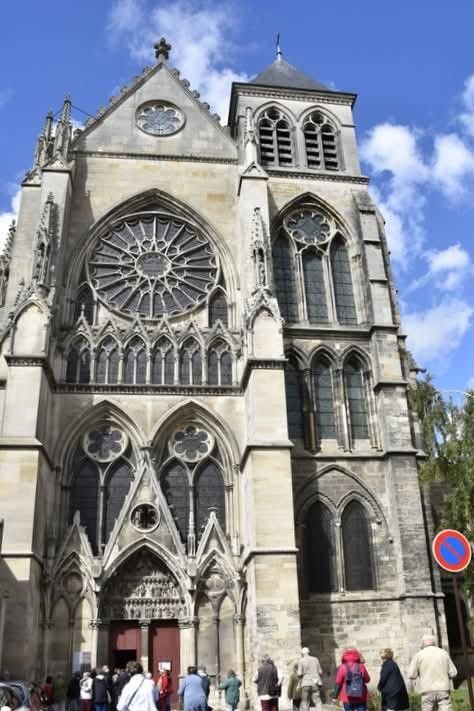
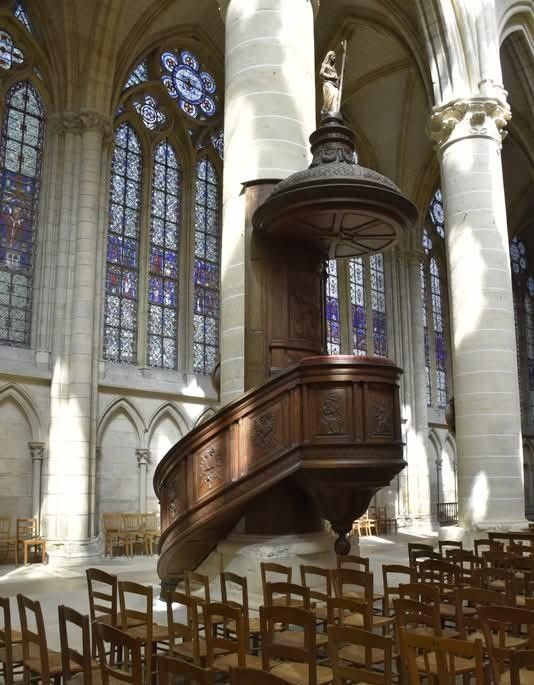
The Cathédrale Saint Étienne or Saint Stephens Cathedral has Romanesque parts from the 12C such as the crypt, and tower of the north arm whose ground floor houses a rare Romanesque stained glass window, but was rebuilt in Gothic style. The apse, the transept and three bays of the nave were completed in 1261. The radiating chapels and the ambulatory were added between 1280 and 1310. The nave was continued at the end of the 15C and the beginning of the 16C. Between 1628 and 1634, the western facade in Baroque style, and the two neighboring bays were erected. However, the original design of the nave was preserved over the centuries by successive builders, who wanted to preserve its unity. The cathedral has retained a remarkable array of stained glass windows. In the south aisles there is an interesting series of stained glass windows from the end of the 15C and the beginning of the 16C. Those in the other aisle were made in the 19C in the style of the 13C. Those in the arms of the south transept date from the 20C. A large number of engraved funerary slabs from the 13C to the 17C are inlaid in the paving or raised along the walls. They are characterized by a great elegance of design.
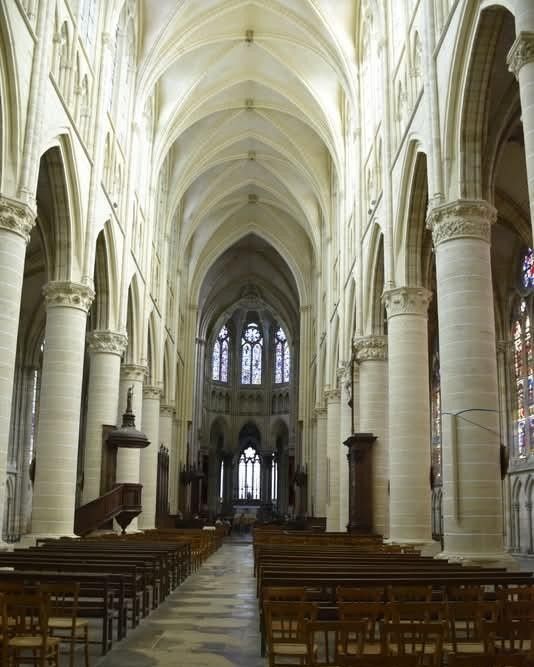
The size of the previous cathedral rebuilt in the 10C after damage caused by the Counts’ Wars and the Normans, was insufficient, and a complete reconstruction was undertaken around 1120, probably under the leadership of Bishop William of Champeaux. The reconstruction of the Romanesque cathedral began before the fire of 1138 and reached a decisive stage between this fire and the consecration by Pope Eugene III on October 26, 1147. Romanesque stained-glass windows and the baptismal font remain from this period. The Saint Stephens Cathedral was restored in the 19C. The western facade, inspired by the frontispiece of the Saint-Gervais-Saint-Protais Church in Paris (see post), consists of a three-level central avant-corps and two two-level wings. Each Corinthian-style level is separated from the next by an openwork balustrade, which extends across the entire facade. The central avant-corps is formed, on the ground floor, of double columns framing a rectangular portal whose tympanum represents a bas-relief depicting the martyrdom of Saint Stephen and which was hammered during the French revolution. The wings are decorated with pilasters and pierced by rectangular doors surmounted by mullioned windows in the Renaissance style. The monument thus presents Romanesque parts from the 12C, but was rebuilt in the Rayonnant Gothic style. The apse, the transept and three bays of the nave were completed in 1261.
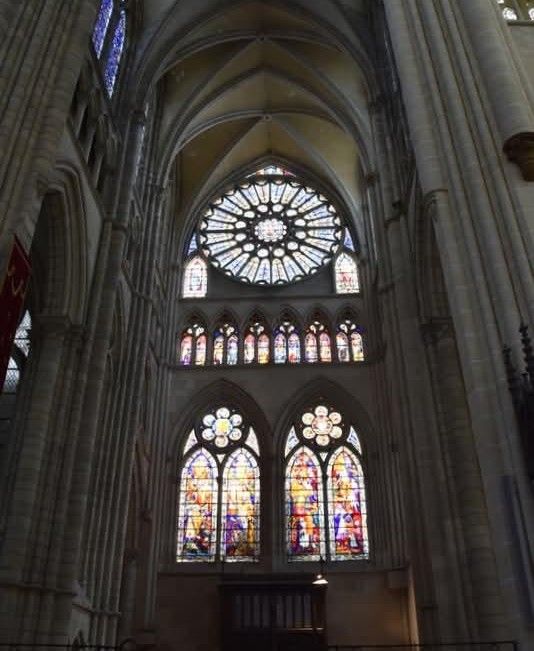
The northern transept has a wonderful stained glass window in the form of a rosary,
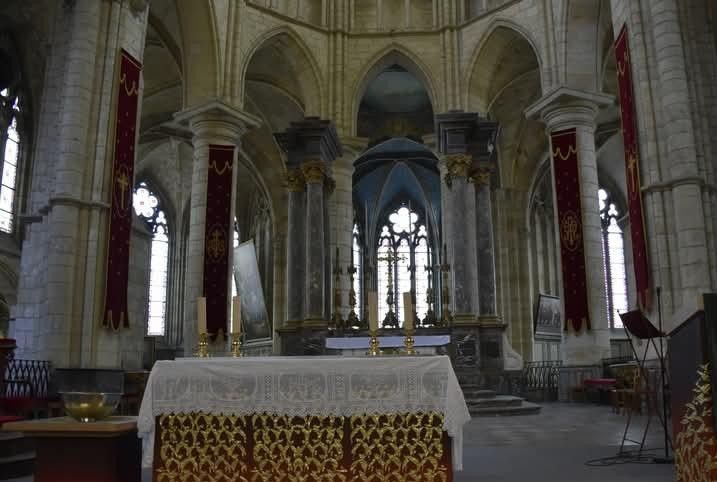
In the treasure room, there are also two host boxes and a reliquary known as Saint-Remi in enamel, a silk purse and a reliquary in the shape of an arm. From the 11C, a buckle, an element of a pastoral crozier and a box. Another crozier from the 19C. From the 12C, the silk mitre and a shoe of Malachy of Armagh, a fragment of the funerary mat of Bernard of Clairvaux. The floor paving dates from the 12C. The baptismal font are Romanesque from the mid-12C, and have lost their base. They were broken and reused in the repair of the south tower of the transept. The great organ dates from 1849, the organcase was rebuilt and enlarged in 1898. After a restoration in 1957, the organs were restored between 2000 and 2006.
In 1115, Saint Bernard received ordination here from his friend, Bishop of Châlons, Monsignor Guillaume de Champeaux. Philip of Orléans, brother of Louis XIV, married the Princess Palatine, Elisabeth Charlotte of Bavaria, there on November 19, 1671. Consecration on October 26, 1147 (during an eclipse) by Pope Eugene III. On the occasion of his brother’s marriage, Louis XIV said of Châlons Cathedral that it was “the most beautiful chapel in the Kingdom.” Marie-Angélique Memmie Leblanc, the wild daughter of Songy, is said to have had a revelation there that led her to want to become a nun. She was born around 1712 in New France in a region that later became the American state of Wisconsin and died in Paris on December 15, 1775, she was a Native American who became an Augustinian nun and a prominent figure of the Age of Enlightenment, famous for having been a feral child. Having survived ten years in the forest without using articulate language (from November 1721 to September 1731), she then managed to learn to read and write, a unique feat among feral children (a child who grew up outside or on the margins of human society). She is also the only example of a wild child to be recognized as authentic in the Vatican Archives. The Scottish philosopher James Burnett, who met her in 1765, considered her to be “the most extraordinary character of her time.” Victor Hugo visited the cathedral. He appreciated the nave but cast some discredit on the 17C spires; he noted a chapel decorated with the F of Francis I, which has since been removed. The President of the French Republic holds the title Canon ad Honores of the Cathédrale Saint-Étienne de Châlons,
The Châlons en Champagne tourist office on the Cathedral : https://en.chalons-tourisme.com/discover/10-must-sees-in-chalons/saint-etienne-cathedral/
The Blog site of the Friends of the Cathédrale Saint Etienne : https://amiscathedralechalonsenchampagne.blogspot.com/
The Catholic Diocese of Châlons on the St Stephens Cathedral : https://chalons.catholique.fr/eglises/chalons-en-champagne-cathedrale-saint-etienne/
The City of Châlons en Champagne on its heritage : https://www.chalonsenchampagne.fr/ville/services/culture-tourisme/culturez-vous/chalons-ville-dart-et-dhistoire
The Marne dept 51 tourist office (Champagne) on Châlons en Champagne : https://www.tourisme-en-champagne.co.uk/sites-monuments#path=commune/CHALONS-EN-CHAMPAGNE
The Grand Est region tourist office on Châlons en Champagne :https://www.explore-grandest.com/en/champagne/visit-chalons-en-champagne-the-grand-ests-sparkling-venice/
There you go folks, another dandy in my belle France passing by visiting and enjoying its monuments, as said this area is more than Champagne . I told you so !! We look forward to be back, eventually! So much to see in a nostalgic region of many family visits going way back in time, Again, hope you enjoy this post on the Cathédrale Saint Étienne of Châlons en Champagne !!! as I
And remember, happy travels, good health, and many cheers to all !!!

 Paris1972-Versailles2003