
Another one from my cd rom vault and family memories of our time in Triel sur Seine ,in the Yvelines dept 78 of the Île de France region of my belle France. This is in the hilly quant town bordering the Seine river which we had enjoyed. Therefore, let me tell you about the Church Saint Martin of Triel sur Seine ! Hope you enjoy the post as I.
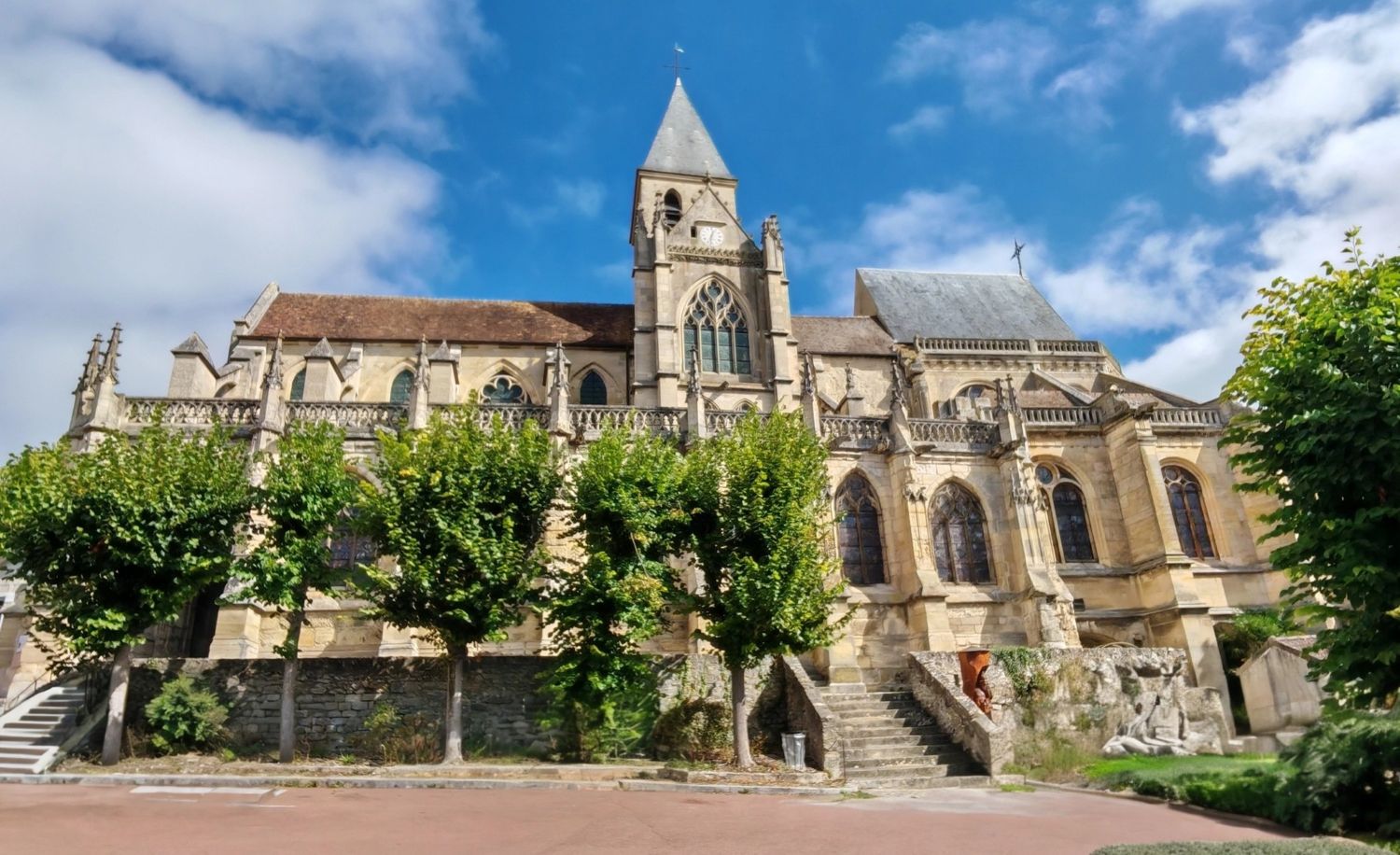
Triel sur Seine is a buckle land ends surrounded by the curveture of the Seine river as it moves towards Normandy just above Poissy not far from the A13 autoroute de Normandie. We took the D186/N186 by the Le Petit Marly up to Poissy crossed the Seine river and towards Triel sur Seine. You can take the A13 from Paris direction Rouen and get off exit/sortie 7 Orgeval take D154 road which becomes the D1 all direction Triel sur Seine. It is only 35 km from Paris. and 31 km from Versailles. Triel-sur-Seine most of it is spread over the hillsides of Hautil which dominate at 175 meters.
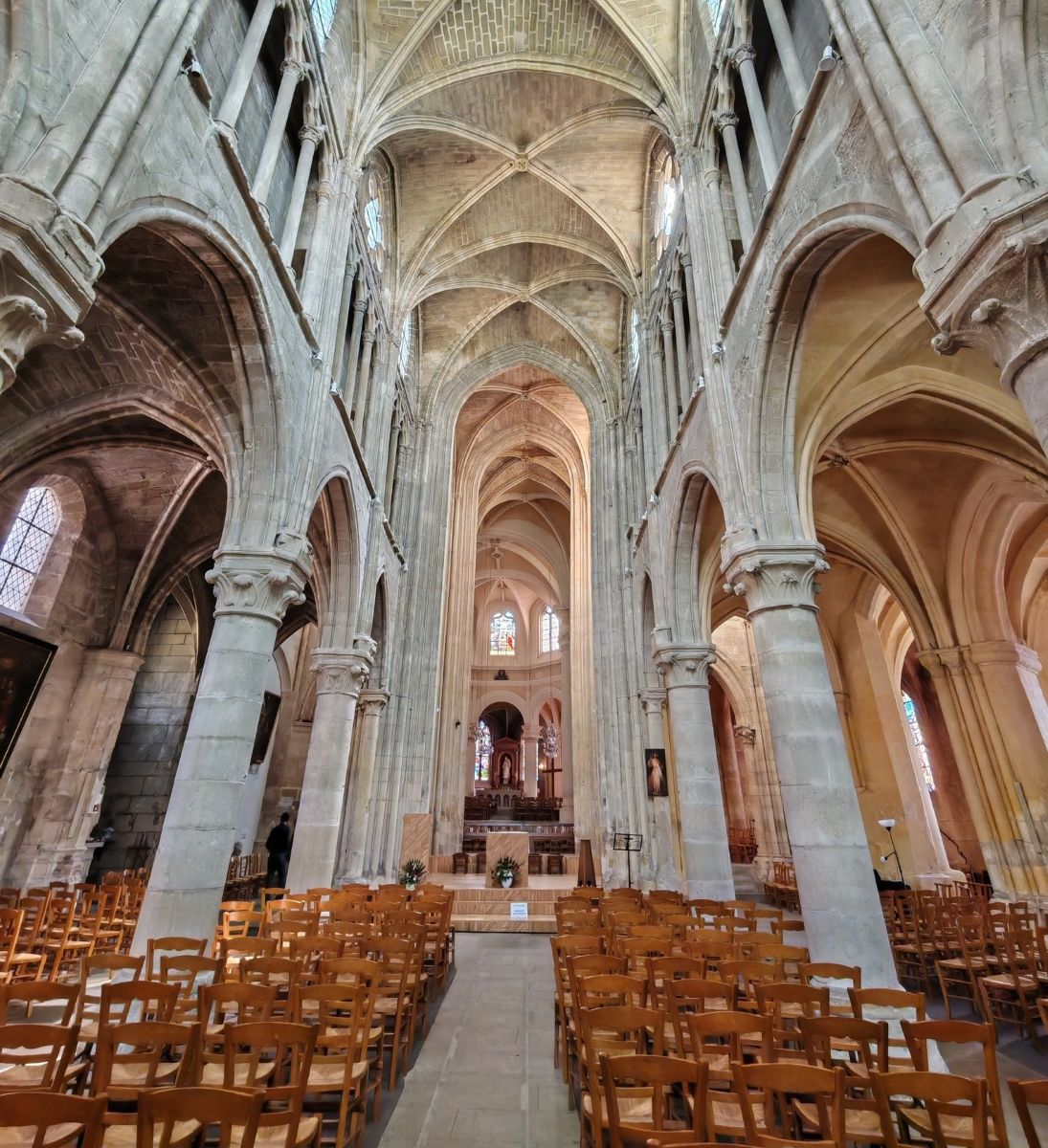
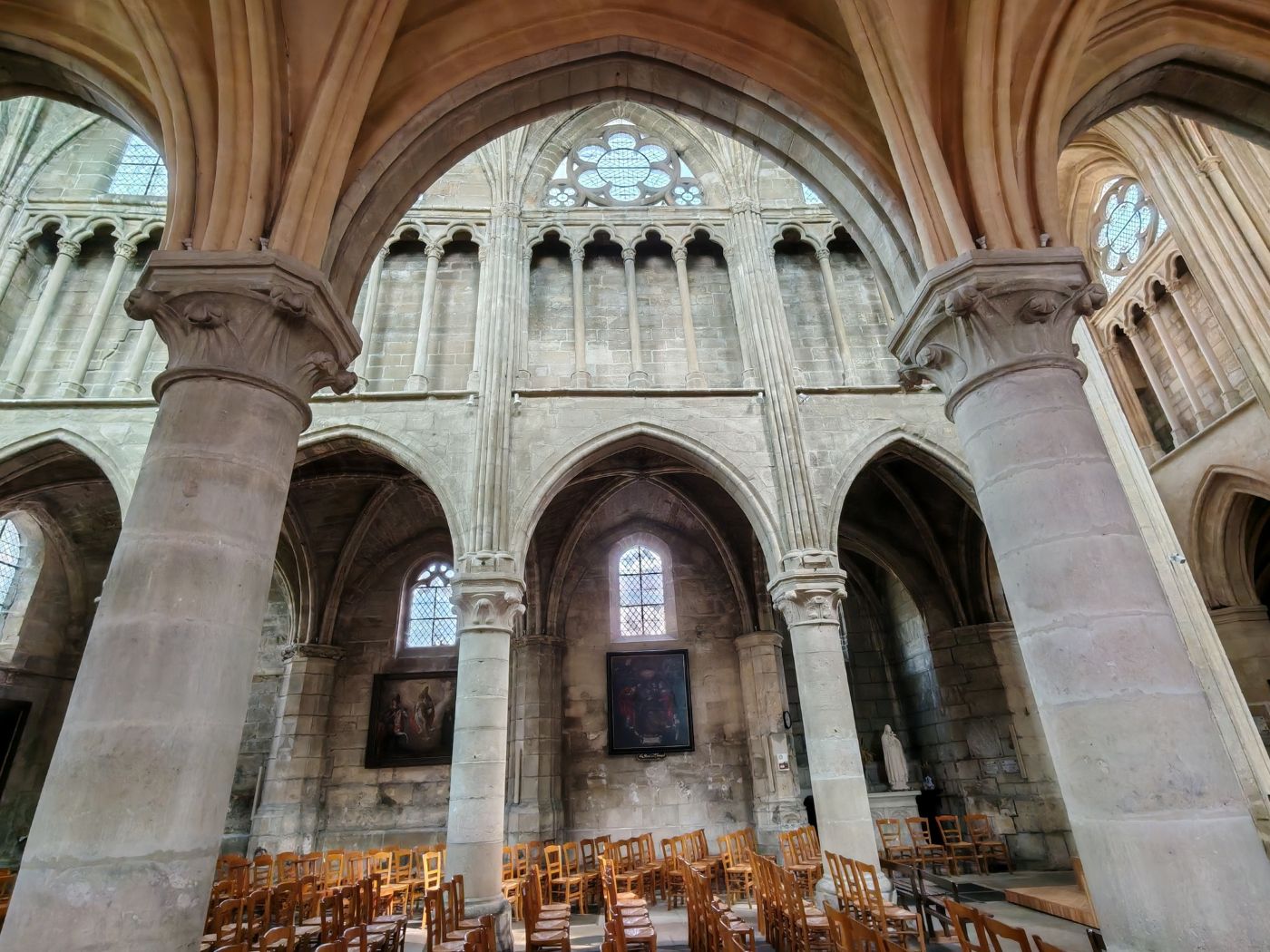
The Church Saint Martin, begun under Saint Louis in the mid-13C, rises on the foundations of an older religious building, as evidenced by the discovery of Merovingian sarcophagi that can be admired at the Museum of National Antiquities in Saint-Germain-en-Laye (see post). Of this original construction, the nave and its two side aisles, the transept, and the two bays leading up to the choir remain.
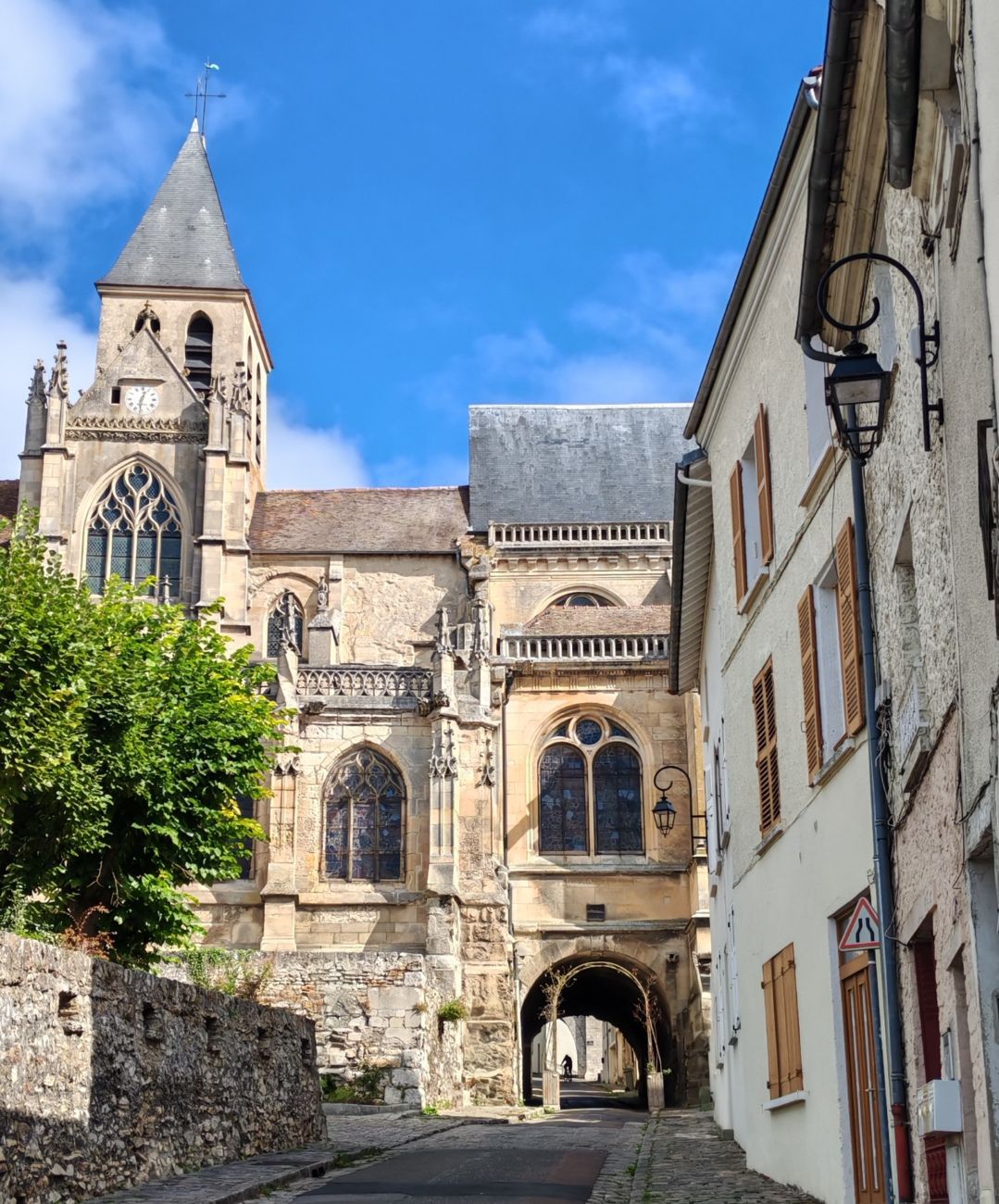
The restoration undertaken in the 16C, with the construction of the choir above the chemin du roy or royal way to provide a pedestrian passage, as provided for by royal edicts, gives it a unique character found in only two other churches in France. It is said that the Sun King, returning from hunting, attended a Mass under this vault, while remaining seated in the saddle of his horse. It should be noted, in passing, that Louis XIV’s nurse was from Triel, which may explain Louis XIV’s presence in this place. When, around the 1550s, it was decided to enlarge the eastern part of the church, it was necessary to respect the “easement” of the public utility road, known as the King’s Road (today rue Galande), the only truly passable road to reach the hamlet of Cheverchemont and the Hautil plateau. Also, after demolishing the 13C apse, it was necessary to span the road with a vault and on the other side to build a crypt to redeem the level and support the new choir. It is accessed by two doors pierced in the underground passage which passes under the church or by a spiral staircase which opens into the choir (currently closed by a slab). A semi-circular corridor, forming an ambulatory, allows one to go around it. This wide corridor is devoid of chapels and is lit by oculi. The central part of the crypt includes, in addition to the spiral staircase, a rectangular room vaulted with a transverse barrel vault divided by two arches. The crypt was easily dated thanks to its characteristic 16C decorations. There are leaf decorations surrounding a fruit, a rose window, a face, on the axial vault there is a coat of arms representing the Instruments of the Passion and on the apse there are three crescents which are the arms of Henry II. The style of this crypt is therefore completely original and must have represented a stylistic exercise to which the Renaissance builders were not accustomed.
A bit of history I like tell us that in the 1C, Saint Nicaire, a disciple of Saint Denis, resided in our region to evangelize the inhabitants of the banks of the Seine in Conflans-Sainte-Honorine and Mantes-la-Jolie, passing through Triel, proving the origins of the town. Triel is said to have taken its name from the existence of three islands formed by the course of the Seine at the point where the Roman road crossed the river. In the Middle Ages, Triel probably did not play a particularly important historical role, probably because, under the Carolingian kings, this town was part of the Comité de Meulan, which bordered both banks of the Seine, as far as Vernon. Chronicles of the time only mention the granting of Triel the status of a freed town in 1221 by Philip Augustus and the construction of the first castle in the 13C, destroyed during the French revolution.
From the 13C to the 15C, the land of Triel was part of the King’s domain. During the 17C, part of it was purchased by the Bruart family, one of the oldest “families of the robe” in France. It was during this period that James II, the last descendant of the Stuarts, in exile in Saint-Germain-en-Laye (see post), is said to have deposited considerable treasures brought from England in 1689 in Triel, including the royal crown. A countess from Scotland searched for this treasure at great expense, using explosives, for nearly fifty years. Did she finally find it ? No one knows, the enigma remains..In the 18C, Triel was a meeting place for illustrious men who met there in the house of Sieur Parnajon, King’s Counselor and Royal Provost; the jurist Treilhard, one of the drafters of the Civil Code; the member of the Convention Chamfort; Cabanis, a friend of Mirabeau; the novelist Crébillon; and the sculptor Jean Houdon, to whom we owe one of the most beautiful portraits of Voltaire.
The city of Triel sur Seine on the Church Saint Martin : https://www.triel-sur-seine.fr/1689-l-eglise.htm
The local Terres de Seine tourist office on the nearby heritage : https://www.terres-de-seine.fr/decouvrir/patrimoine/
There you go folks, really an off the beaten path town on a hilly site bordering the Seine river . Always something to see in my former Yvelines dept 78, but always worth the detour me think. Again, hope you enjoy this post on the Church Saint Martin of Triel-sur-Seine !! as I
And remember, happy travels, good health, and many cheers to all !!!

 Paris1972-Versailles2003