
The town of Sulniac is located in my beautiful department 56 of Morbihan, in my lovely region of Bretagne, and in my belle France. The bordering towns are Treffléan, Elven ,La Vraie Croix ,Theix, Questembert, Lauzac and Berric , From Vannes you take the road N166 towards Rennes, take the Kerboulard exit, towards Treffléan / Questembert / Redon (D775), then at the Penrho roundabout follow the D183. I am updating an older post and combining it with pictures taken from other posts to expand on the town of Sulniac, as before had monuments in its village of Le Gorvello. Therefore, here is my take on the curiosities of Sulniac, part III !!! Hope you enjoy the new post as I.
The town of Sulniac has preserved its ancient sunken lanes, which form a dense network of hiking trails. Between bocage and wooded moors, this trail allows you to discover, in the village of Sainte Marguerite, one of the beautiful chapels of the Vannes region and its fountain. The Sainte-Marguerite Chapel (16-18C). This rectangular chapel has wall plates date from 1593. The bell tower has a bell chamber surmounted by a metal cross. Some of the beams crossing the vault, dating from the 16C, are carved with bird heads. The polychrome wooden altarpiece dates from the 18 ; it houses the statues of Saint Mark, Saint Cornély, Saint Margaret, Saint Isidore, and the Virgin Mary. Only the south side, the best exposed, offers numerous openings: two doors, three windows, and a stone bench along the wall. There are no openings on the north side, a rounded basket-handle door with moldings on the west side. A still-visible bay at the chevet has been walled up.
The only decorative elements, sculpted heads, are found on the facade, above the entrance door and at the ridge of the roof slopes.
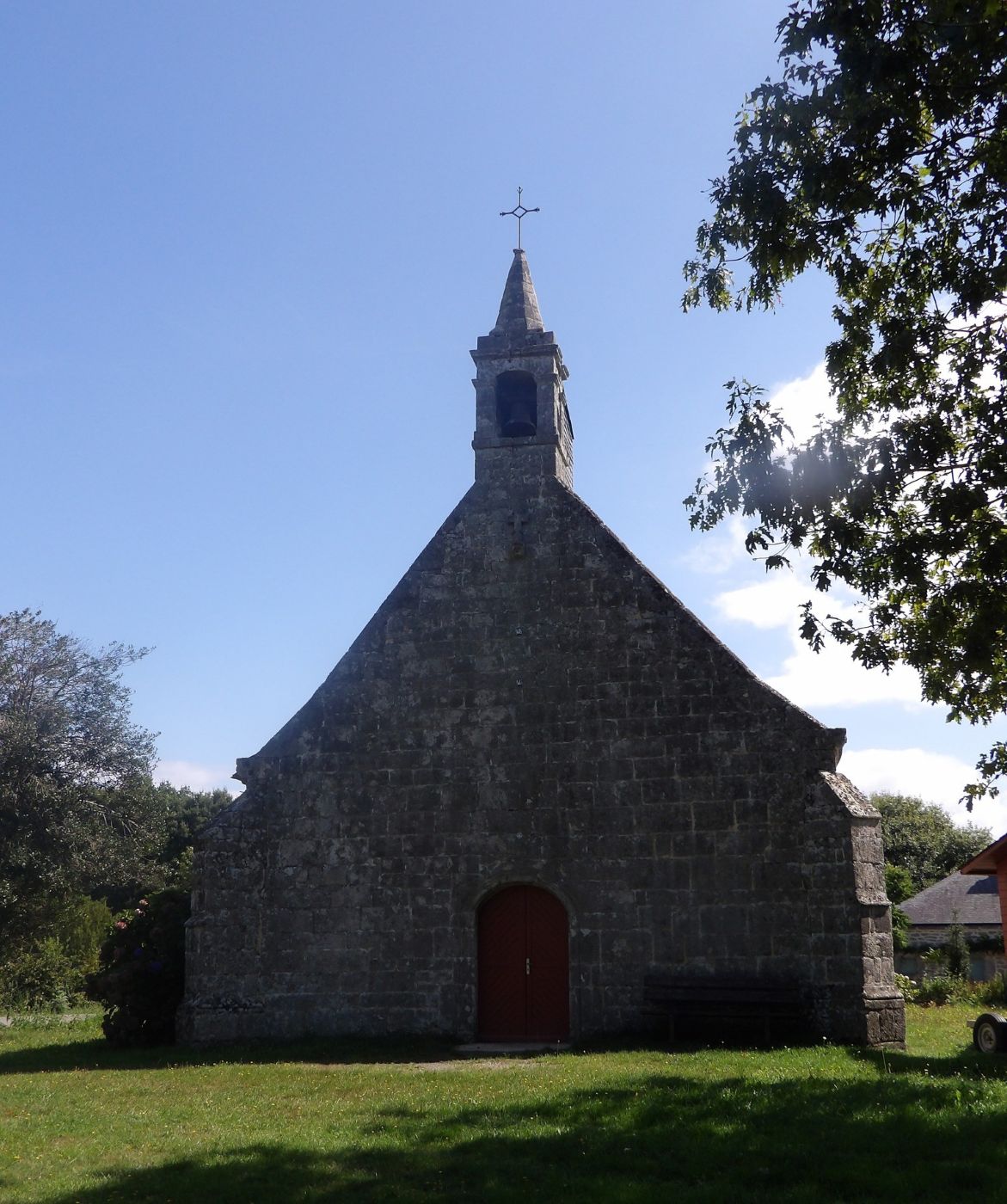
The wooden vault is painted blue, dotted with stars, in the 17C style. Resting on wall plates bearing the date 1593, tie beams support the framework. They are decorated with monster mouths. In the background, on the Laval-style altarpiece, the central statue depicts Saint Margaret dominating a dragon. The work of local artisans, this so-called parish art demonstrates the affluence of the inhabitants of Sulniac over the centuries. It was a period of peace and therefore prosperity following the Wars of Succession of the Duchy of Brittany and the Hundred Years’ War. The original chapel was enlarged, as can be seen inside, beyond the pointed arch. A very active association watches over the chapel. It is possible to contact them for a visit. Every year on the third Sunday of July, they organize the great Feast of Pardon: procession, mass, meal, and Breton dances.
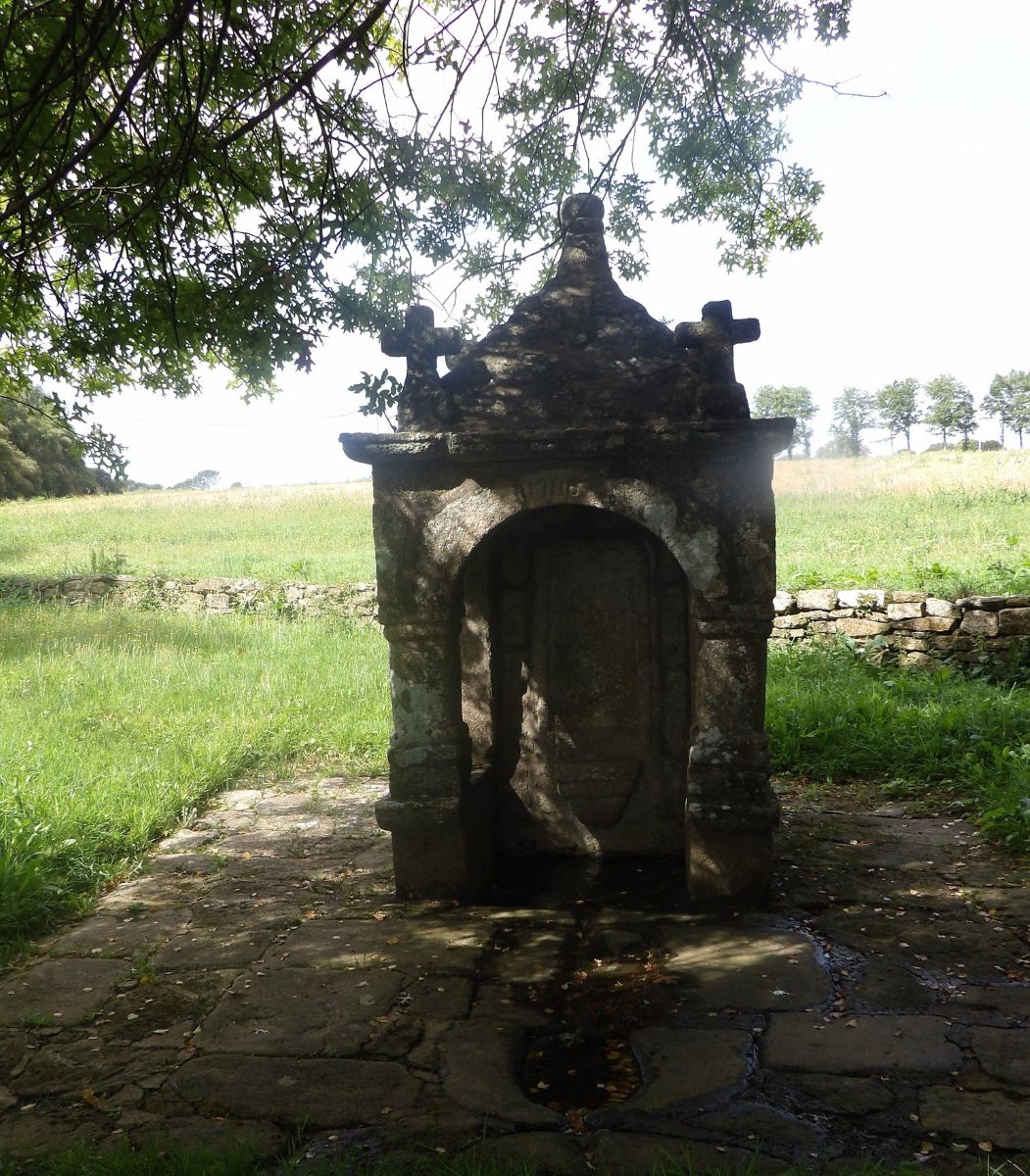
On the other side of the road, nestled in greenery, the fountain of Sainte Marguerite has the shape of a small temple, resting on two columns and surmounted by a roof with two crosses. It bears the date 1736.
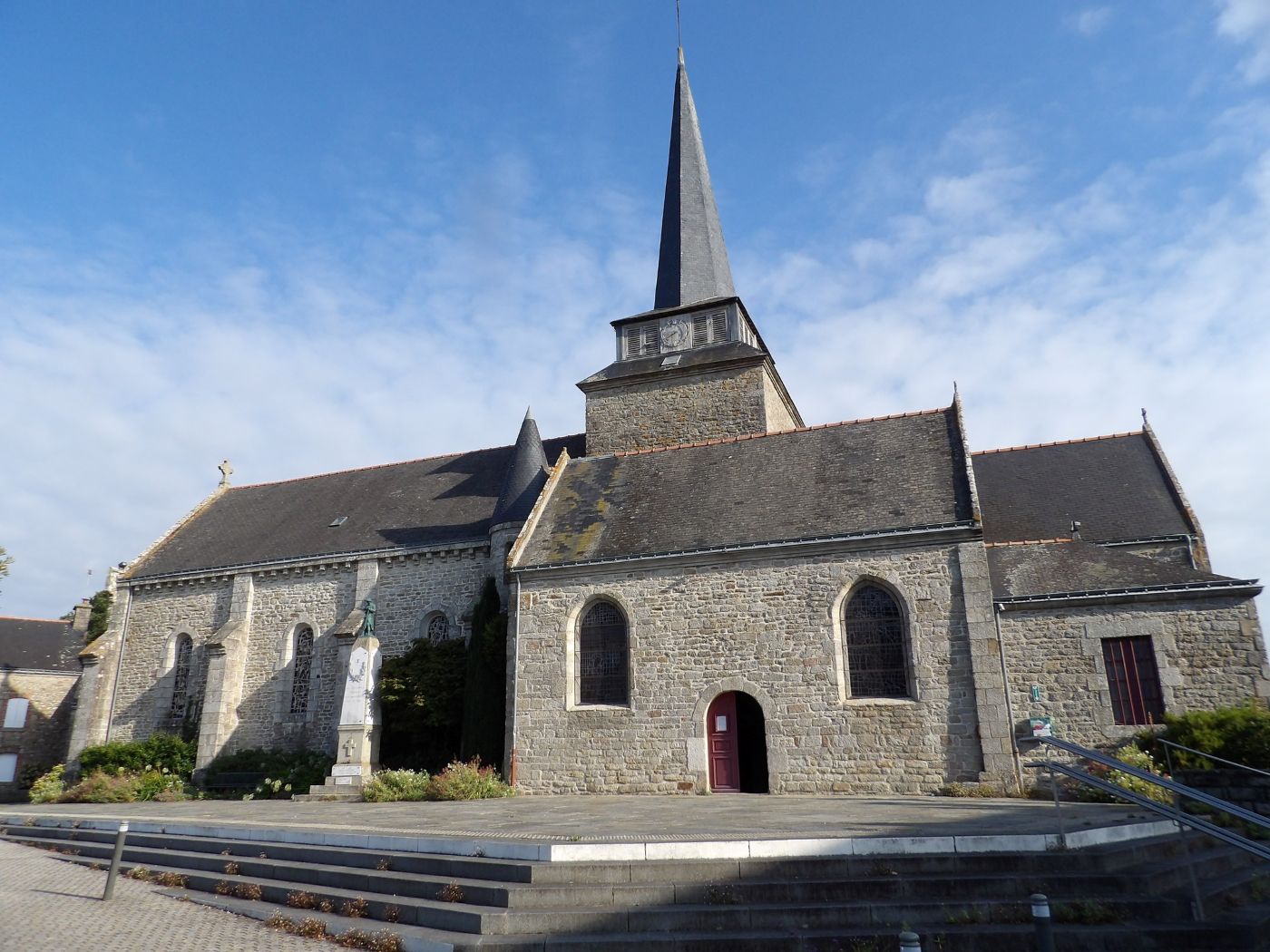
The Church Saint Pierre (see post) has been remodeled at various times. From the 11C and 12C, there remain engaged columns with Romanesque capitals at the transept crossing and the square bell tower. At the end of the 19C, the nave was rebuilt in the neo-Romanesque style, and the choir and two side sacristies were added. It is dedicated to Saint Peter of Links. The Calvary was previously located in the cemetery surrounding Saint Peter’s Church, then placed at the apse of the church. In the shape of a cross, it features, like all calvaries, a pieta on one side and the crucifixion on the other. Probably from the 16C.
Other things to see here are the Oratory of St Vincent Ferrier (17C) , The Village of Gorvello (see post). This well-preserved village exudes a special atmosphere, one can imagine what Morbihan looked like in the 17C. The Church of Saint-Jean-Baptiste (16C) and the fountain (16C) ; the Chapel of St Roch (16C) and the Cross of the Chapel of St Roch from the 19C, as well as the remains of the castle of Ferrières.
A bit of history I likr tell us that the parish of Sulniac is mentioned in 1160 under the name of Suluniac. Sulniac was once part of the lordship of Largoët or Largouët, The original parish, once encompassed the territories of Treffléan and La Vraie-Croix. Treffléan separated from Sulniac in 1790, and La Vraie-Croix in 1870. The parish of Gorvello was founded in 1160, thanks to the construction of a chapel by the Knights Templar of the Carentoir commandery. After 1312, this became the property of the Hospitallers of Saint John of Jerusalem, who inherited the commandery. From 1624, the “Temple” of Gorvello served as the parish church. In 1790, Le Gorvello was not considered important enough to become a town, and remained attached to Sulniac. Gorvello became a parish in 1820. In 1868, the free school that was created was entrusted to the Sisters of the Holy Spirit.
The town of Sulniac on its heritage : https://www.sulniac.fr/histoire-patrimoine/
The Gulf of Morbihan local tourist office on Sulniac : https://www.golfedumorbihan.bzh/explorer-vannes/decouvrir-vannes/golfe-morbihan/landes-de-lanvaux/sulniac/
There you go folks , some more interesting trips off the beaten path in my beautiful Morbihan; and is not over yet!! Plenty more to see and do here. Again, hope you enjoy this post on curiosities of Sulniac, part III !!! as I.
And remember, happy travels, good health, and many cheers to all !!!

 Paris1972-Versailles2003