
This one is a delight for me to tell you again and glad found me more pictures in my cd rom vault to share in my blog for you and me, This is one of the nostalgic parks of my eternal Paris. The parc Monceau is a treasure in Paris, Did I told you , I came here first in 2004 with local friends who wanted to ride a bike! and later on came back to tried the Vélib!! Only time in Paris for me lol! The parc Monceau is a treasure in Paris, not the biggest, not the prettiest maybe, but a wonderful collection of follies, great architecture in and out on the mansions that surrounded it and two good museums. I have come to name in my top 3 parks of Paris! Therefore, this is my take on the Parc Monceau of Paris !!! Hope you enjoy the post as I.
Ok we came first by metro Monceau Line 2. The unique entrance with crested entourage done by Héctor Guimard is located on line 2 line direction Porte Dauphine-Nation from Avenue Hoche to Boulevard de Courcelles on the edge of the Parc Monceau. The park is in neighborhood or quartier Europe in the 8éme arrondissement or district of Paris. Bus line 30 (check schedules now) also takes you here, and took it too later on from Place d’Etoile (Arch de Triomphe) on the Avenue de Wagram side dir Pigalle and stop at Monceau. I have, of course come here by car at parking Villiers. The unique entrance with crested entourage done by Héctor Guimard. The station owes its name to the village of Monceau which was a small town in the 15C.
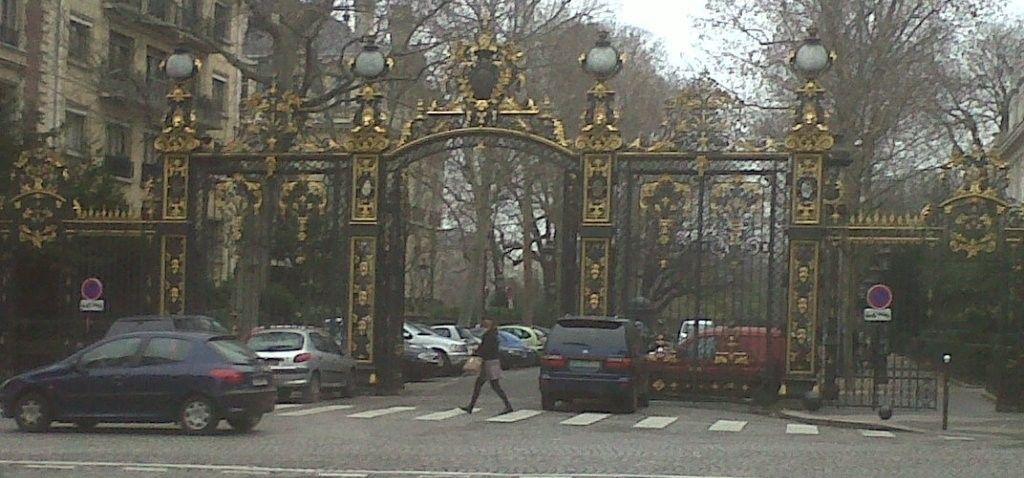
The Parc Monceau with an area of 8.25 hectares whose main entrance is near the Rotunda (see post) by Boulevard de Courcelles, an exotic garden English style park, Inaugurated on August 13 1861 by emperor Napoleon III. The park is a kilometer in circumference , a full tour of the park measures precisely 1 107 meters (bypassing the children’s playground, it takes 990 meters). The current Parc Monceau garden has entrances on boulevard Malesherbes and Avenue Hoche as well. There are other lesser entrances without grille gates such as Avenue Ruysdaël, Rue Rembrandt,Allée de la Comtesse de Ségur; Avenue de Valois and Avenue de Velazquez.
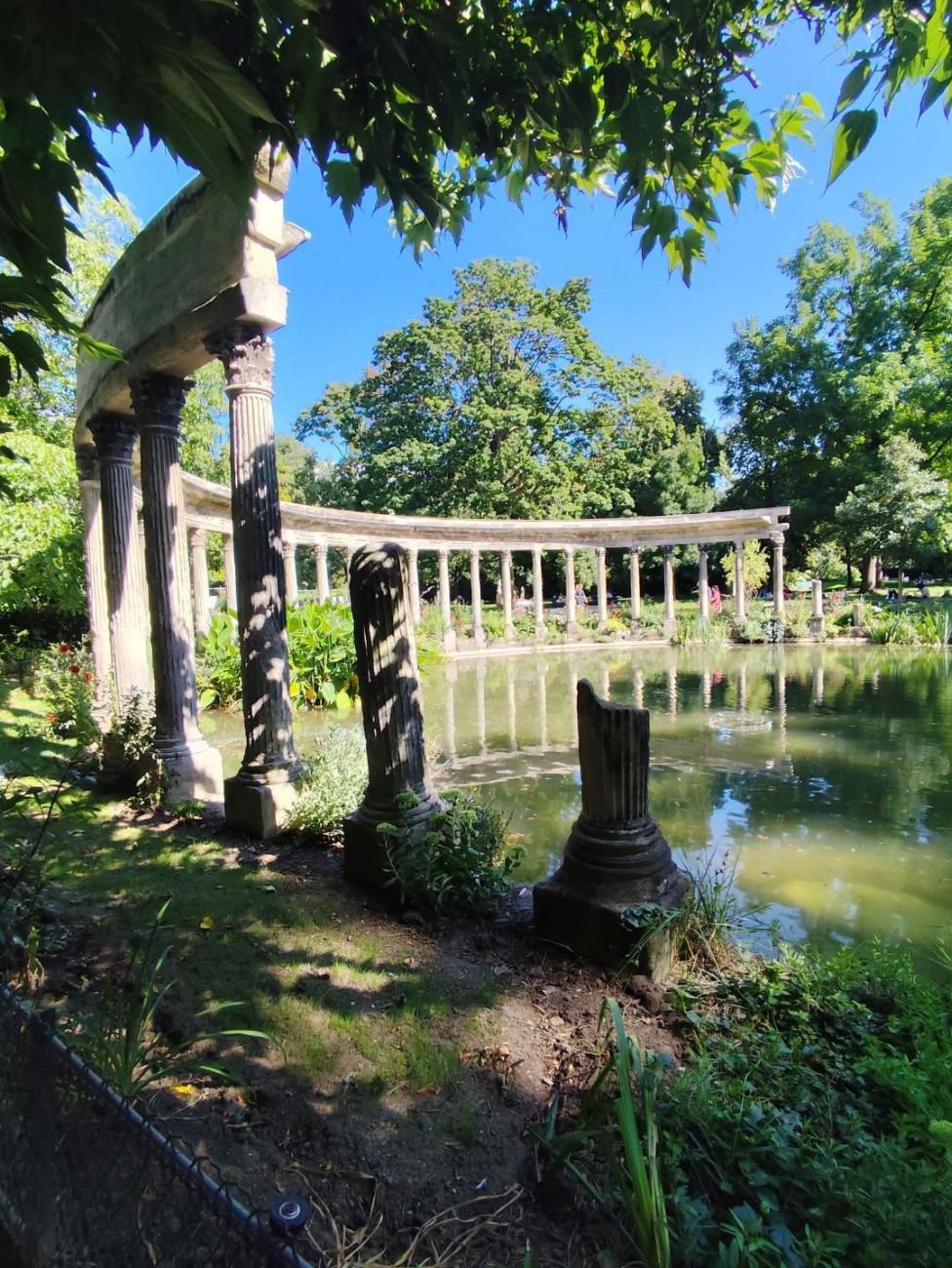
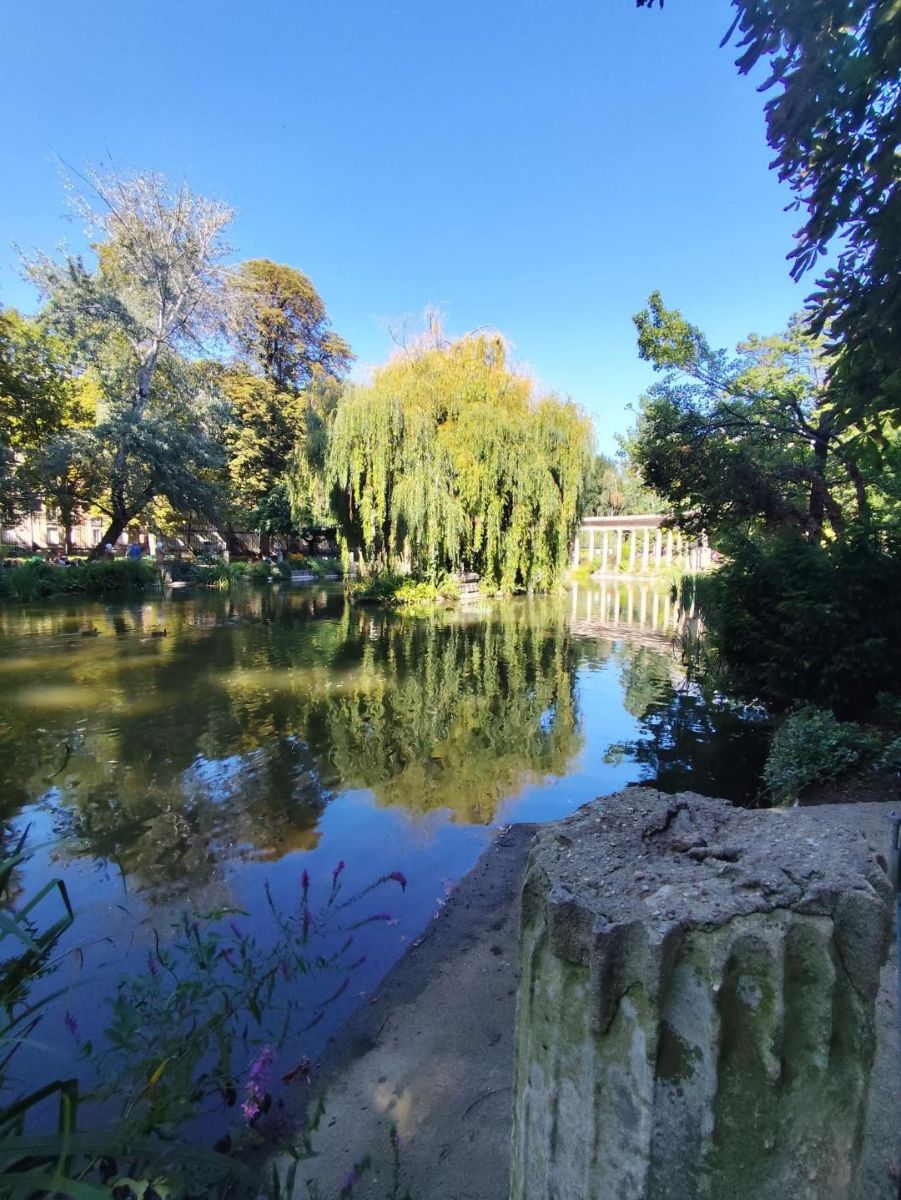
You see here the Naumachie, an oval basin bordered by a Corinthian colonnade that comes from the Valois rotunda, the funerary monument designed by Catherine de Medici in 1559 for her husband as an addition to the Basilica of Saint-Denis and destroyed in 1719; the columns were recovered and installed by Carmontelle to decorate the basin , This was the name given to the place where, in ancient Rome, a naval battle was reenacted for the amusement of the public. All inside a wonderful pretty pond.
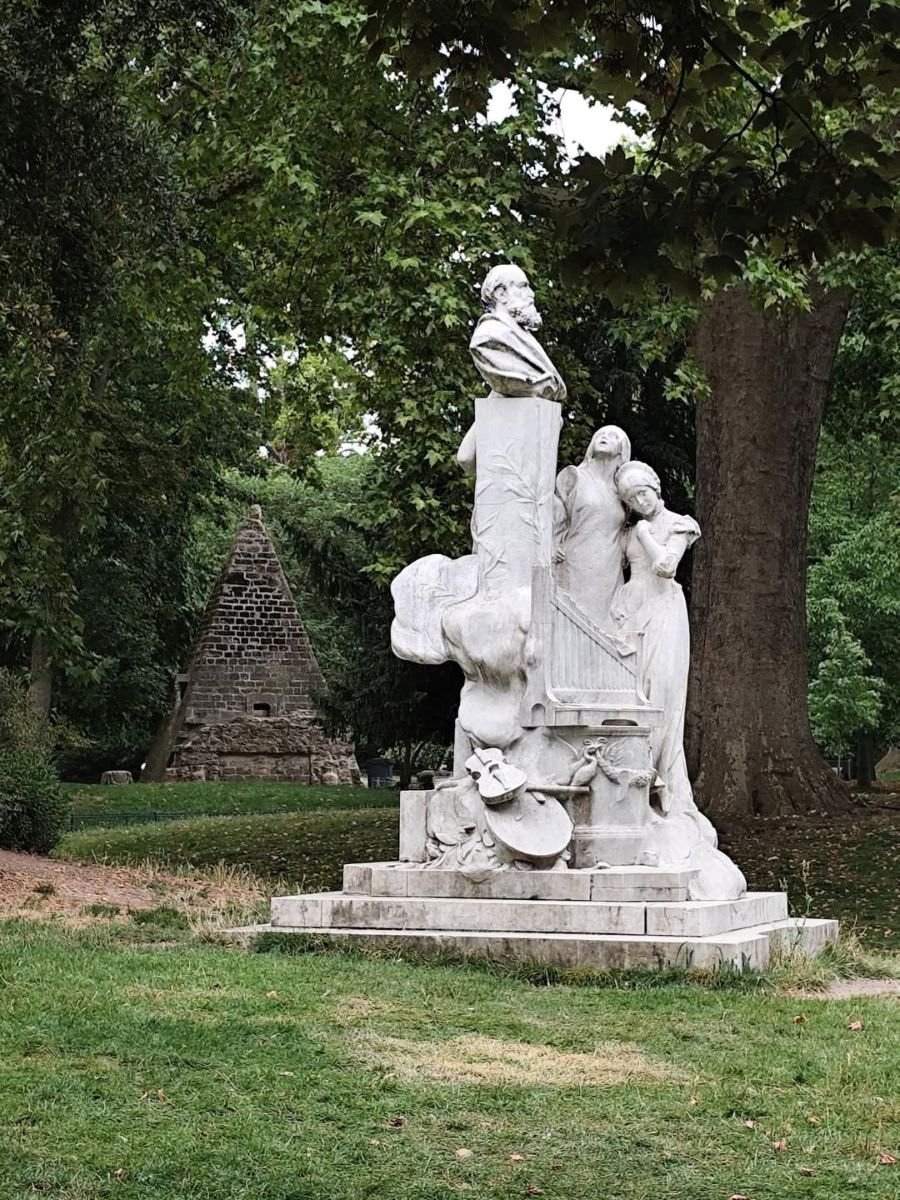
At the bend in the path, small pyramids! Of course, reconstructed, they date from the park before its development during the Second Empire (Napoléon III). This Ancient Egyptian-style building is one of the few survivors of the first park, “La Folie de Chartres.” It has Freemason symbolism, as the Duke of Orleans was the Grand Master of the Grand Orient of France. The best is the Egyptian pyramid built between 1769 and 1773, In front of it is the monument to Charles Gounod done in 1902 by sculptor Antonin Mercie, The monument is surrounded by three female figures over clouds evoquing the 3 most popular operas of Gounod;Marguerite (Faust) , Juliette (Romeo et Juliette), and Sapho;musical instruments around it you see an organ.

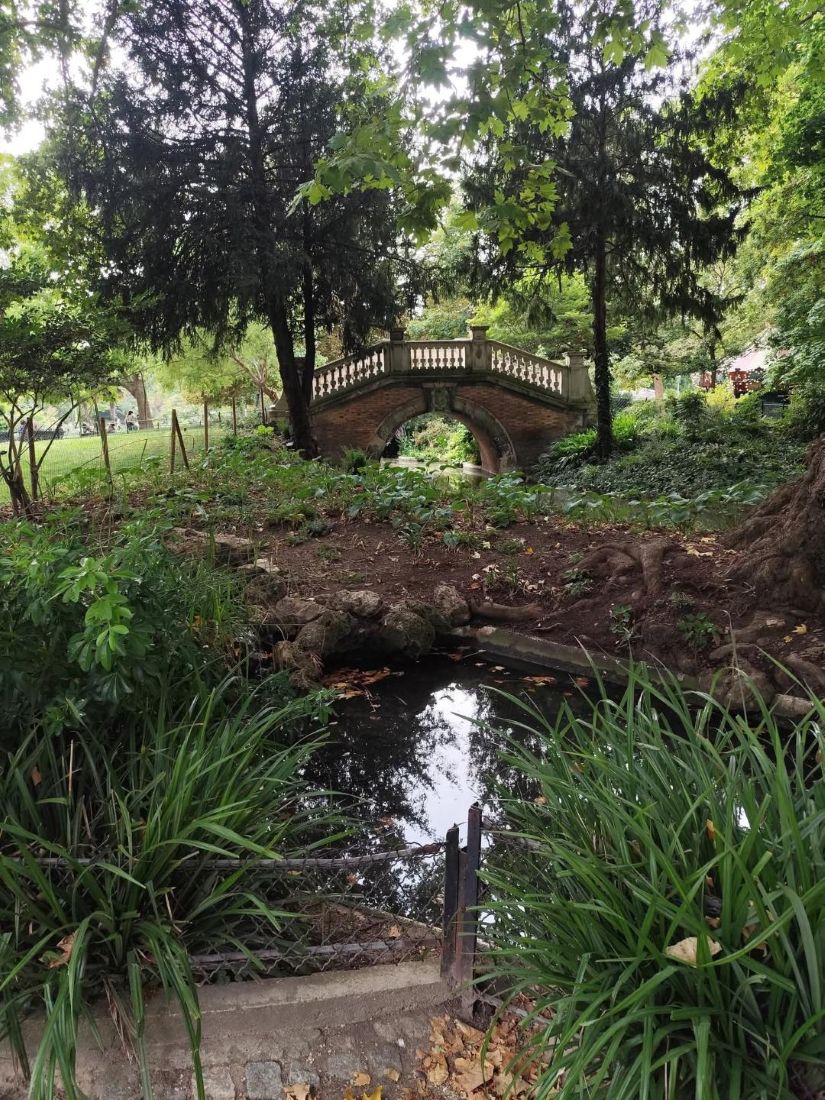
The little Italian marble bridge with its air of the Rialto of Venice, Small, completely artificial stream, it flows into the highlight of the Naumachia basin, with its beautiful colonnade. This is the lowest point. From there, the water is collected and pumped back to the top of the rock.
Nearby, stands a large Renaissance arcade style, relic of the City Hall of Paris burned in 1871 (there are also fragments of columns) The Old City/Town Hall came about because François Ier in the 16C, ordered a new building for the city of Paris. This illustrious building no longer exists today. However, the St John or Boccador’s gate of the old City/Town Hall was preserved. It was located near the Naumachia. The southern part of the monument can be dated to the 16C, under the reigns of Francis I and Henry II. The remaining part was rebuilt in the early 17C, under the leadership of Henry IV, and completed during the reign of Louis XIII.
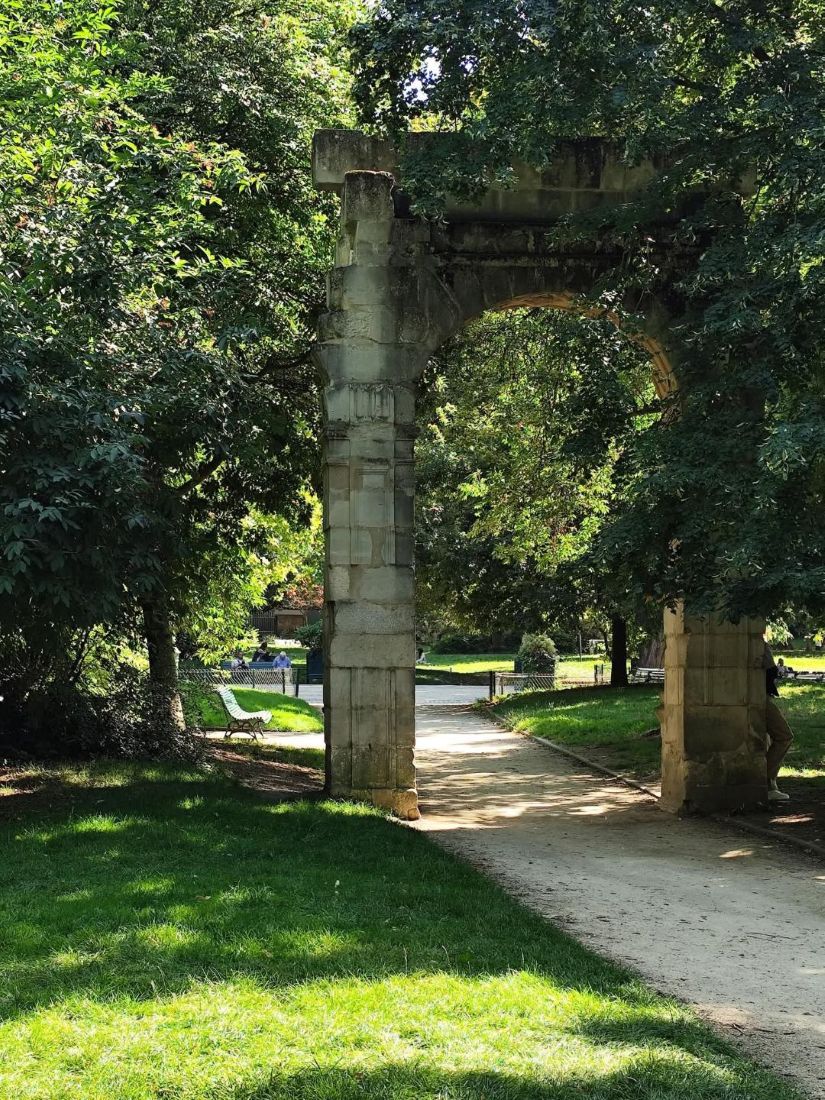
Things to see and look there are: the Naumachie, an oval basin bordered by a Corinthian colonnade that comes from a church of St. Denis destroyed in 1719. Nearby, stands a large Renaissance arcade style, relic of the City Hall of Paris burned in 1871 (there are also fragments of columns) marble statues of writers and musicians are found at the corner of the groves. The park is surrounded by luxurious buildings and private hotels. It has been painted many times including the great ones Gustave Caillebotte (1877), Claude Monet (1876), and Henri Brispot (1908). Private hotels are located along elegant shaded avenues and closed by four monumental doors. Most of these routes bear names of great 17C painters such as Avenue Velasquez, Avenue Ruysdaël, Avenue Van-Dyck, rue Rembrandt, Rue Murillo. The park is crossed by the Avenue Ferdousi, the Allée Michel-Berger and the alley of the Countess-de-Ségur. Many elements dating from Carmontelle and metamorphosed under Napoleon III remain: The colonnade that borders the Naumachie, the pyramid, the only vestige of the ancient folly of Chartres, the Renaissance arcade of the Paris City Hall destroyed in 1871, the Little Bridge, the grotto and the waterfall.
In a green setting, appear, at the corner of the groves we discover rare or exotic trees such as a sycamore maple aged over 130 years and high of 35 meters , a sumptuous purple beech, a tulip of Virginia and a plane tree of the Orient, the biggest in Paris with more than 170 years and 7 meters in circumference. The 2 charming museums, occupying 2 superb mansions of the 19C. The Museum of Nissim de Camondo which allows to plunge into the life of the great families under the Second Empire and to discover also the tragic fate of a family of great lineage of Sephardic Jews having made fortune in the bank and whose descendants will be deported and killed in Auschwitz. At the south entrance is the Museum Cernuschi (see post) a museum of the city of Paris specializing in the art and archaeology of ancient China.
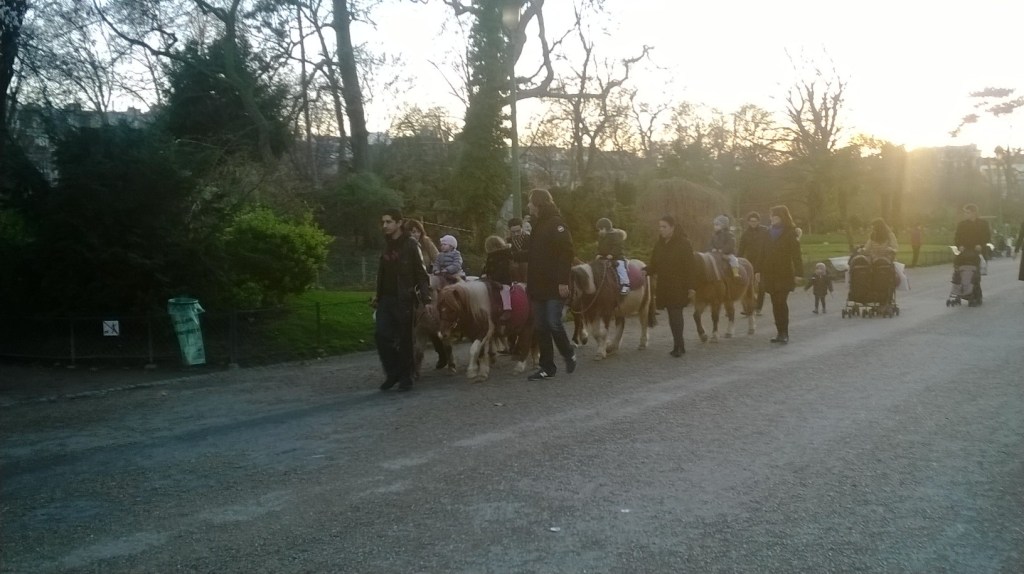
A playground for children ,a merry-go-round and swings open every afternoon, ponies on Wednesdays and weekends; clowns on Wednesdays and weekends from the lawns where it is good to run and picnic. Parc Monceau is open until 20h. and until 22h. from May 1 to August 31. Check times and dates for the playground at the city of Paris parks page below.
The Parc Monceau is adorned with marble statues of writers and musicians. The statues are on the monuments to Guy de Maupassant, Édouard Pailleron, Alfred de Musset , Charles Gounod , the statue le Jeune Faune or sort of young faun, and further monuments to Frédéric Chopin, Ambroise Thomas as well as the one call Le Joueur de billes or sort of ball player. You see the ruins gate of St Jean or city/town hall as well as many beautiful buildings around it. There remain pedestals of disappeared statues, melted under the occupation in WWII around 1942, like that of the injured Lioness done in1891 and old Bronze statues have disappeared, probably melted during the occupation of WWII in 1942 as well in order to supply non-ferrous metals. Claude Monet painted six pictures of the park, three in 1876 and three in 1878 The Parc Monceau is open every day from 7h to 22h in summer, but also 20h in winter and 21h the rest of the time,
A bit of history I like tell us that the Duke of Chartres buys land of one hectare at the Rue de Courcelles in 1768. In 1778 the future Duke of Orléans buy it and asked Carmontelle to arranged the space known as the “Folly of Chartres”. The landscape artist Thomas Blaikie enlarges this English garden where there is erected a pyramid, a pagoda and various other follies in the taste of the time. The architect Claude-Nicolas Ledoux adds in 1784, a rotunda, pavilion of the neo gothic style surrounded by a peristyle of 16 columns,there is the new General farmers running along the garden. During the French revolution, the garden was confiscated and became in 1793 national property after the Revolution, the park in a pitiful state was restored to the Orléans family. Between 1802 and 1806 the park is demolished and another pavilion built in its place, Orleans sells and then buys in 1819. A little before 1830, the Duke’s son, future Louis-Philippe, King of the French, had the “Temple of Mars” transported to the enchanted Garden of his castle in Neuilly; It is somewhat altered to become the Temple of Love (Neuilly-sur-Seine). In 1852, half of the park was allocated to the Pereire brothers and the other to the State which sold its estate to the city of Paris. The wall of the general farmers is destroyed, it remains as vestige of only the rotunda old granting offices (three other pavilions are moved to the place Denfert Rochereau, Place de la Bataille-de-Stalingrad and Place de la Nation. Indeed, it was located on the edge of the garden of the Duke of Chartres, a prince of the blood, cousin of Louis XVI. He even had to amputate to built the wall. As a result, this garden, ancestor of Parc Monceau, still in the countryside, found itself taken over by the city. This pavilion is initially made up of sixteen columns. The columns with smooth bole and upper dome were modified in 1861. Originally, guards were installed on the ground and first floors. We had left the possibility for the Duke to be able to climb on the terrace to observe the plain. In 1860, Paris annexed the territories of the surrounding towns, within the walls of Thiers. The farmers’ general wall is no longer useful and is quickly destroyed. All barriers are destroyed. Some vestiges are preserved. The Chartres rotunda is one of them. Indeed, it served for the organization of Parc Monceau. It then becomes the rotunda of Parc Monceau!
The Paris Tourist office on the Parc Monceau: https://parisjetaime.com/eng/culture/parc-monceau-p3553
The City of Paris on the Parc Monceau: https://www.paris.fr/lieux/parc-monceau-1804
This is one of the great parks of Paris, and you would do well to visit it. I have come to love it over the years and even passed by to see here each time in the city at least. The tranquil time amongt beautiful buildings and a great garden park of indeed beautiful Paris. Again, hope you enjoy this post on the parc Monceau of Paris !!! as I.
And remember, happy travels, good health, and many cheers to all !!!


Gorgeous spot
LikeLiked by 3 people
Yes indeed I still have memories of my first bike ride in Paris was at the parc lol !!
LikeLiked by 1 person
Excellent!
LikeLiked by 1 person
Thanks for stopping by Cheers
LikeLiked by 1 person
That looks like a pretty flag.
LikeLiked by 1 person
Thanks for stopping by Cheers
LikeLiked by 1 person