
This is another town close to me ; passed so many times and eventually stop in town for a look. Nice little town and warm folks. Landévennec is in the Finistère department 29 of my lovely Bretagne and in my belle France, It is located 54 km from Brest, 65 km from Quimper, 576 km from Versailles, and 154 km from my current home frome where we came,along the N165 road to exit/sortie 63 to connect with the D791 road to bear right onto the D60 road right by City center onto rue de l’abbaye, Therefore, let me tell you on this is Landevennec !!! Hope you enjoy the post as I.
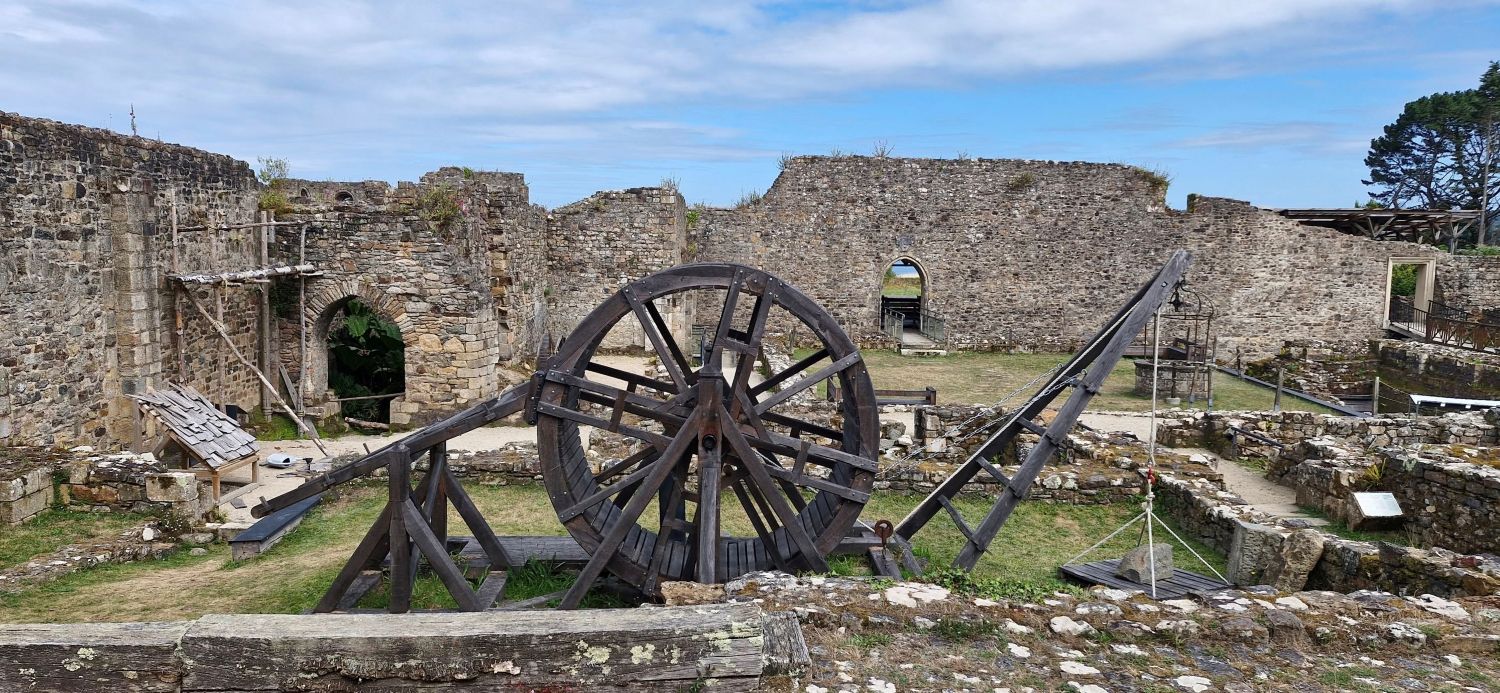
The former abbey of Saint-Guénolé is reputed to have been founded by Saint Guénolé, a monk who lived at the end of the 5C, making it one of the oldest and most important in Brittany. Abandoned in 1793 and in ruins by the 1810s, it was taken over by a new Benedictine monastic community in 1958, which built new buildings there. It is affiliated with the Subiaco Mont-Cassin congregation. Open since 1990, the museum of the former abbey, located near the archaeological site, presents to visitors the remarkable and long history of these places, notably through the exhibition of discoveries resulting from archaeological research undertaken since 1978. Since 1988, the Abati Landevenneg association has been responsible for managing and promoting the site, the garden, and the museum of the former abbey.
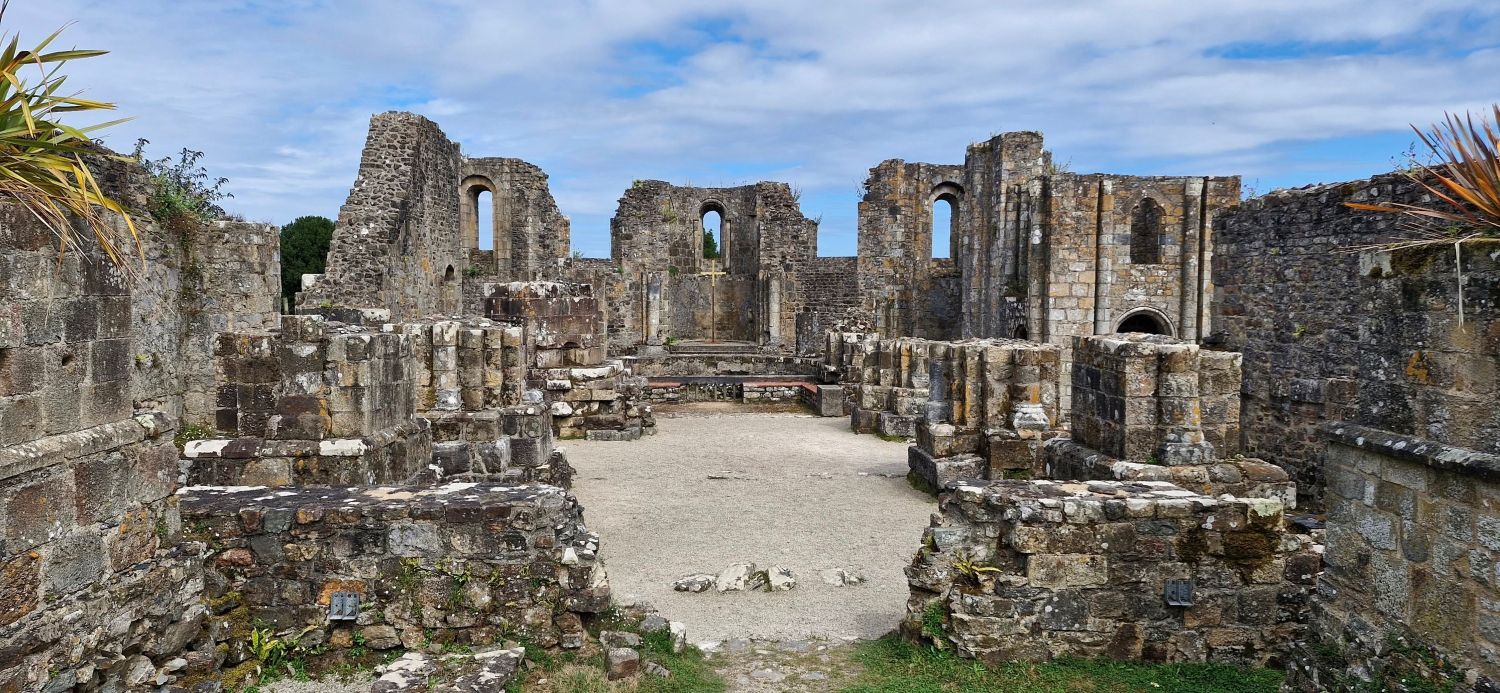
The major turning point came with the Viking raids which mainly targeted monasteries from 884. In 913, Landévennec was pillaged and then burned by the Vikings. The monks fled and, taking with them the relics, notably those of Saint Guénolé, and their manuscripts, and, after passing through Le Mans and Château-du-Loir, took refuge in Montreuil near Count Helgaud where they created in 926 a new abbey, the Abbey of Saint-Walloy, under the invocation of Saint Guénolé . Landed in Brittany, Alain fought successful battles at Dol and Saint-Brieuc in 936. He succeeded in capturing Nantes, which caused the Normans to abandon the maritime Loire. Following his victories, Alain, to whom history gives the nickname of “Barbe-Torte”, was recognized Duke of Brittany in 937. In the middle of the 10C, the monks returned and rebuilt the monastery, with the help of Riwalen I of Rosmadec, Lord of Rosmadec and Viscount of Faou, the construction of the Romanesque-style abbey church beginning in the middle of the 11C. It is also from this period that the compilation of the cartulary of Landévennec dates. The abbey was attacked many times by the English; although it sometimes resisted victoriously, in the 14C, the abbey suffered from the War of the Breton Succession and English pillaging: it was burned down in 1355 by the English, then ravaged in 1387 by the soldiers of Jean de Montfort and again in 1480 by pillagers. Faced with a relaxation of monastic discipline, and the harmful influence of the commendatory abbots, the abbey, which was attached to the Society of Brittany, was, like its other members, by a brief from Pope Urban VIII dated November 8, 1627, attached to the Congregation of Saint-Maur on September 28, 1628, which was at the origin of a spiritual and intellectual renewal. But the abbey, criticized by the Jansenists, was once again almost in ruins at the end of the 17C. From February 22, 1791, the parish of Landévennec made use of the abbey church “since there were no longer any religious there.” In 1792, the Benedictine abbey of Landévennec, where only 4 monks remained, was abandoned, the monastic community was dissolved, the library dispersed and the monastery was sold as national property. The abbey still existed in its entirety around 1810 or 1815, but its purchaser at the time set about destroying it. He established a lime kiln there and used a large part of the materials from the church and the abbey in this industry. Today, on the original site, the stratified ruins bear witness to the ups and downs of this long history, showing what remains of the Carolingian (9C),Romanesque (12-13C) and Maurist (17C) abbeys that succeeded one another on the site.
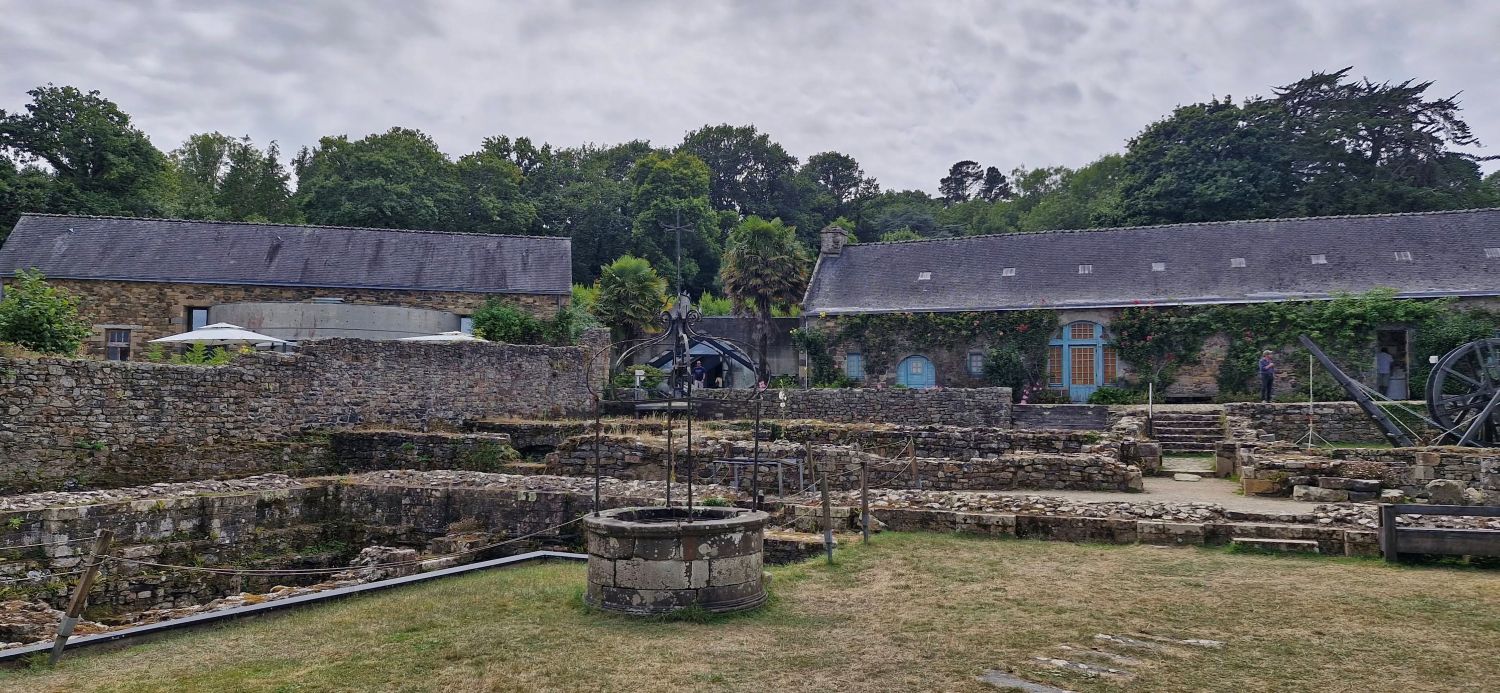
A disciple of Saint Budoc de Dol who settled with monks on the island of Lavrec, near the island of Bréhat ,Guénolé came to settle with eleven companions on the site of the Aulne estuary, first on the island of Tibidy in 482 and, three years later, in Landévennec. He gained the friendship of Gradlon, the first prince of Cornwall, a contemporary of Saint Corentin, who is considered the first bishop of Quimper (see post). This abbey, founded according to tradition around 485, followed the rule of the Scots, in the tradition of Celtic Christianity. The Irish monks, or Scots, were dressed in a tunic, often white, and a coule (hooded garment) made of thick woolen cloth, with a hood. Obedience, poverty and chastity were strictly practiced by the Breton monks. In 818, when the leader of the Bretons of Armorica, Emperor Louis the Pious or the Debonair, son of Charlemagne, came to subdue Morvan, convinced that his power came from God and wishing to unify the monastic rules, asked Matmonoc, the abbot of Landévennec at the time, during an interview at Priziac near Gourin (Menez Du / Montagnes Noires), to renounce “his Scotic customs” (the rule of Saint Columban) and to adopt for his monastery the rule of Saint Benedict. It was during the Carolingian era, in the 9C, that the abbey experienced its “golden age” for about a century. In the Middle Ages,the Abbey was an important place for the writing of manuscripts and parchments, and a copyist’s workshop. From the second half of the 9C, the learned monks of the abbey formed, under the leadership of Abbot Gurdisten, a veritable hagiographic school, drawing its inspiration partly from the Celtic tradition but adapting to Carolingian ideas and the new Benedictine standards, mastering the literary techniques characterizing the renaissance of letters of their time.
Other things to see here are the Church Notre-Dame-de-Landévennec, a small church dates from the 17C and is located to the north of the village, on the seafront. The enclosure pierced by a gate surmounted by a niche provides access to the marine cemetery which surrounds the church. The tombs arranged in espalier are turned towards the ocean. The bell tower (1659) with a chamber is without a gallery. On the gable we can see the arms of Abbot Tanguy. The latter contributed, after the troubles of the 16C, to restoring the abbey but also to revitalizing the village. The coat of arms includes the arms of his predecessor, Abbot Briant: means: “a white pigeon carrying a green branch in its beak”.Many dates are engraved inside. The date 1659 is found in the nave, the apse seems to date from 1652, the porch surmounted by a cross from 1699, the sacristy from 1740. There are very beautiful statues and a magnificent altarpiece. The Chapelle de Folgoat chapel is located about 5 km from the village, in the direction of Moulin-Mer, it nestles at the edge of a beech wood. According to legend, this chapel was built between 1358 and 1360, to receive the body of Salaün, the madman of the wood. One day in November of the year 1358, Salaün was found lifeless. He was buried near his fountain under the tree where he slept. A few days later, a magnificent lily bloomed on the tomb, and on each dazzling white petal one could read Ave Maria inscribed in gold letters. People came from all sides to see the miracle. In 1593, the royal troops who sacked the abbey did the same to this chapel. In ruins, it was Abbot Tanguy who had it restored in 1645. In 1695, the monks ceded the chapel to the parish of Landévennec. During the French revolution, the chapel was recognized as being of public utility by the town in 1792.
A bit of history I like tell us that it was attested as Landevennoch in 818, Landeguennoch in 1236. It is a place linked to Saint Guénolé, a famous Breton saint. lann means “sanctuary”; the second part is based on To-Winnoc, a secondary form of Guénolé, in Old Breton Winwaloe. Landévennec is therefore the “sanctuary of Guénolé”. Landévennec became a center of exchange and communication due to the importance of its abbey. In fact, the abbey fief of Landévennec, which included the territory of Landévennec, Argol, Trégarvan and part of Telgruc, did not date back to King Gradlon, as the monks of the 11C wrote in their apocryphal charters, but to the founder of the abbey, Saint Guénolé, who had formed it from the early days of Breton emigration (5-6C) by appropriating the land through clearing and cultivation. Landévennec used various means of communication by sea. All the ferries made it possible to cross the Aulne. The Poulben passage was served by two barges. On market days, a large barge was used to transport about twenty horses, on other days, a smaller one, for the usual passages of the inhabitants and a few horses. They went to Argol and Faou. Before 1782, there was a connection between the island of Tibidy and Landévennec. A boat was used for the cattle, and a canoe for the people. Since the 17C, Landévennec has been coveted by the Navy: lacking space in Brest in the Penfeld, ships began to be parked in the Penforn cove, near Térénez during the winter or periods of peace, the valley’s steepness forming a natural shelter. During his visit on 9 October 1666, the Duke of Beaufort (François de Bourbon ), grandson of Henri IV and Gabrielle d’Estrées, accompanied by Duquesne, a Navy officer under Louis XIV, appointed commander and sub-delegate of the intendant from 1665 to 1672, designated the Penforn cove “as a basin capable of containing the entire fleet of His Majesty afloat”. In his mind, the port of Brest became secondary. In 1683, Vauban took up the idea and planned a sort of refuge there. Landévennec Cove apparently housed the king’s squadron of forty-two ships commanded by Admiral de Châteaurenault. Only the period from 1870 to 1935 marked the presence of the Navy. Several ships anchored there, for example, while waiting to cross the Atlantic Ocean during the American War of Independence. During the Great War or WWI, the reserve almost disappeared, with all the ships being mobilized. The decline continued during the interwar period; Spanish Republican ships found refuge there in 1936. Since WWII, the reserve has slowly faded. There remain warships and fishing boats awaiting destruction. Others serve as targets for the Navy. In 1856, a naval station was created in one of the meanders of the Aulne, which Napoleon III visited in 1858, during his trip to Brittany. This station hosted reserve boats whose crews enlivened the town of Landévennec. Since then, the site has hosted many decommissioned boats of the French Navy awaiting dismantling on site or targeting on the high seas during shooting exercises. Landévennec today has suitable structures to welcome tourists and remains a haven of peace where in winter it is very pleasant to walk there.
The official Abbey of Saint Guénolé : https://www.abbaye-landevennec.fr/
The official museum of the Abbey of Saint Guénolé : https://www.musee-abbaye-landevennec.fr/
The town of Landevennec on its heritage: https://www.landevennec.fr/histoire-et-patrimoine/
The Bretagne region tourist office on the abbey museum : https://www.brittanytourism.com/offers/musee-de-lancienne-abbaye-de-landevennec-landevennec-en-2016791/
This is one of those town, you passed by but hardly ever stop. Well have done that for the benefit of my blog and my readers. Landevennec is worth the detour indeed. It is historical for sure locally and has nice architecture which I like. Again,hope you enjoy this post on this is Landevennec !!! as I.
And remember, happy travels, good health, and many cheers to all !!!

 Paris1972-Versailles2003