
We have driven and walked in my eternal Paris, and would like to have an imprint in my blog on the wonderful family times we had there, There is so much to see , doing my best, and glad found me this picture in my cd rom vault ,which now transposing in my blog for you and me, This was my former worked city, so glad to post more memorable spots on it, I thank you for your readership over the years and to bear with my rants! After Paris is to rant, shout and yelled about, me think. Therefore, here is my take on the Villa des Platanes of Paris !!! Hope you enjoy it as I.
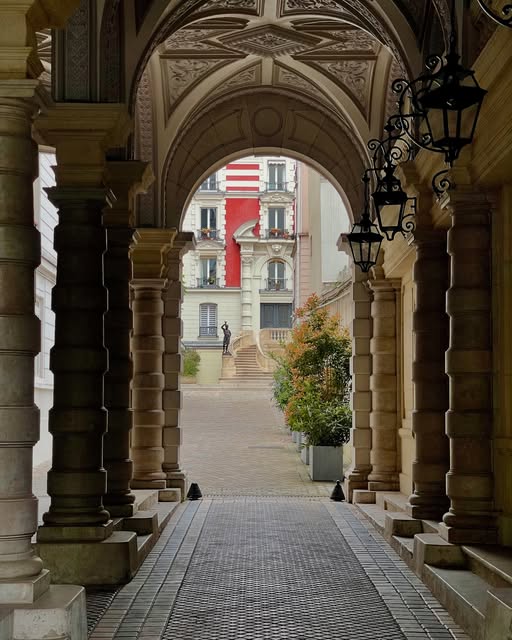
The Villa des Platanes is located at 58-60 Boulevard Clichy,and was built in 1896, an eclectic building complex. Unfortunately, visits to the Villa are prohibited; a few artists’ studios open their doors once or twice a year.,and you get the chance to go inside, I just passed in front and took a peek as private road, The Villa des Platanes is a blend of Gothic, Art Nouveau and Renaissance, the buildings is typical of the era; over-the-top and sumptuous.It turns out that the open air courtyard just beyond the stone archways comes complete with artists’ workshops and a 19C folly. You can indeed discover an incredible building with an impressive two-flight horseshoe-shaped staircase, flanked by two torchieres.What is more certain, however, is that the Villa des Platanes, whose plot extends as far as Rue Robert Planquette, formerly Rue des Tilleuls, was built on the Lucas enclosure, known at the time as La Californie. Since 1830, it has housed the Villa des Tilleuls, typical of the famous country houses or “follies” built at the time by the wealthy bourgeoisie. It is said that Marie Duplessis, the mistress of Alexandre Dumas fils, the iconic French writer of some of the greatest works of literature to be produced in France. lived there. Thus, between Boulevard de Clichy and Rue Robert Planquette, there is a succession of buildings constructed between 1860 and 1890, where nearly 400 lucky people still live today! The haven of peace is also home to several treasures related to the Paris Commune. Indeed, Montmartre was one of the last areas of resistance during the period, and the neighborhood was the scene of numerous deadly clashes during the “Bloody Week,” with the villa at the symbolic epicenter of the conflict. An anonymous artist wanted to pay tribute to the resistance fighters by decorating the buildings with several bas-reliefs depicting the events of the period.
The Boulevard de Clichy is located between the 9éme and 18éme arrondissements of Paris. Its name derives from its proximity to Place de Clichy (see post). It begins at Place de Clichy and ends east of Place de Pigalle, extending to Boulevard Rochechouart. It is at the heart of the Pigalle quartier or neighborhood and is home to numerous cabarets, the most famous of which is the Moulin Rouge (see post). Previously, it was Place de la Barrière de Clichy, renamed the Fructidor Barriere in 1793, and was part of the former Wall of the Farmers-General, erected from 1785 to 1788 and destroyed in 1860. This boulevard resulted from the merger in 1864 of the boulevards and ramparts that followed the exterior and interior of the Wall of the Farmers General. The first was called “Boulevard des Martyrs”, the second “Boulevard Pigalle” and the third “Boulevard de Clichy”. The boulevard is not straight and makes a bend at the level of Rue Caulaincourt because the Wall of the Farmers General went around the area of the Pavillon La Bouëxière. The central reservation of the boulevard, laid out as a rambla above metro line 2, is a pedestrian walkway made up of several promenades ,such as Promenade Coccinelle, between 2, Rue des Martyrs and 17, Place Pigalle; Promenade Georges-Ulmer, between 17 and 39, Rue Fromentin; Promenade Jacques-Canetti, between 39 and Place Blanche; Promenade Roland-Lesaffre, between Place Blanche and Rue Caulaincourt; Promenade Marcel-Carné, between Passage de Clichy and Place de Clichy. This site is served by metro lines 2 and 13 at Place de Clichy , by line 2 at Blanche station and by lines 2 and 12 at Pigalle station.
Other notable buildings here me think are at No. 1: The painter Ignacio Merino lived here, as did the painter Frank Myers Boggs and his family (including his son who would become the painter Frank-Will) during WWI. No. 6: The painter Edgar Degas lived on the 5th floor of this house and died there in 1917. The painter and scenographer Jacques Dupont also lived there later. No. 8: Boris Vian lived in a maid’s room on the 6th floor of this building in 1951 with his partner at the time, the dancer Ursula Kübler. No. 11: It was inhabited by the painter Eugène Leygue, then by Delcassé, long-time Minister of Foreign Affairs, who had many artists as tenants, including Pablo Picasso in 1909. Sarah Bernhardt, also renowned as a sculptor, had her studio there. 1873 to 1877, as well as Renoir between 1887 and 1890. The Swiss painter Robert Nicoïdski, in France since 1956, lived there with his wife, the writer Clarisse Nicoïdski,and the Sicilian painter Jean Calogero. No. 12: in 1887, the painter Eugène Berthelon set up his studio here, which he left in 1896. William Didier-Pouget, painter, had his studio here around 1907. Pied-à-terre of the painter Francis Tattegrain in 1910. No. 18: James Abbott McNeill Whistler painted the portrait of Joanna Hiffernan, The White Girl, Winter 1861-1862. No. 24: the actress Jeanne Fusier-Gir and the painter Charles Gir lived there and François Gir, their son, was born there, No. 62: location of the second café-restaurant Au Tambourin by model Agostina Segatori, opened in March 1885 and closed in 1887, where Vincent van Gogh unsuccessfully exhibited his paintings in 1887. Establishment frequented by many painters who exhibited there, as well as by writers and art critics. Became the Cabaret de la Butte again in 1893, then later the Cabaret des quat’z’arts. At the beginning of the 21C, the premises became a clothing and erotic goods store. No. 82: from 1889, location of the Moulin-Rouge ball, also the location of the Café Cyrano where, in the 1920s, the Surrealists met under the presidency of André Breton. No. 90: La Loco nightclub, founded by André Pousse in 1960, which became La Machine du Moulin-Rouge in 2015. No. 100: Théâtre des Deux Ânes, formerly Cabaret des Truands. No. 104: In 1883, the painter Fernand Cormon opened a teaching place there which later took the name Atelier Cormon, before becoming the Académie de la Palette. Eugène Carrière taught there, among others. No. 128 bis: Paul Signac’s studio from 1886 to 1888, where he painted Paris Boulevard de Clichy in 1886 (now at Minneapolis Institute of Art). No 130: home of Pablo Picasso in 1901.
The Paris tourist office on the 9éme arrondissement : https://parisjetaime.com/eng/article/explore-paris-s-9th-arrondissement-a828
The Paris tourist office on the 18éme arrondissement : https://parisjetaime.com/eng/article/explore-paris-s-18th-arrondissement-a832
There you go folks, a dandy city to explore and enjoy with the family, Memorable moments in my eternal Paris, driving and walking all over in my road warrior trails brings out sublime awesome spots with nice memorable family visits of yesteryear always remember and always looking forward to be back, eventually. Again hope you enjoy the post on the Villa des Platanes of Paris !!! as I.
And remember, happy travels, good health, and many cheers to all !!!

 Paris1972-Versailles2003
What is your favorite place in France? I haven’t visited Paris… The national library of France is beautiful! 😊
LikeLiked by 1 person
My favorite place? Have you read Ernest Hemingway A mouvable Feast? But he was short if travel more would need to write a second volume on all of France ::) Thanks for stopping by Cheers
LikeLiked by 1 person
I haven’t read it, but I visited his museum in Key West. “The Old Man and the Sea” is a good story.
I want to walk along the Avenue des Champs-Élysées someday. I know the famous song.
LikeLiked by 1 person
When there is a will, there is a way. Hope you can make it to the most beautiful avenue in the world :
LikeLiked by 1 person