
I am again to tell you about more streets of my eternal Paris. I have many many posts on Paris and several on the streets of the most beautiful city in the world. I have come up with pictures from cd rom vault that should be here for you and me. As always thank you for following my blog some since Nov 26, 2010. Therefore, here is my take on the streets of Paris, part XVIII !!! Hope you enjoy it as I.
The passage Molière (see post) is in the 3éme arrondissement or district of Paris, It is a pedestrian public street entrance from 157, rue Saint-Martin and ending 46 meters further at 82, rue Quincampoix. The passage is perpendicular to these two streets. The passage takes its name from the old Molière theater, which was nearby, itself bearing the name of Molière. It was also called “Passage des Sans-Culottes” under the French revolution and “Passage des Nannus” The passage is open around 1791. It was the subject of a heavy renovation between 2017 and 2022, welcoming 34 social housing and 9 shops, including the Maison de la Poésie , Exc Librairie, specialized in contemporary poetry .The nearest metro stations are Rambuteau line 11, and Étienne Marcel line 4, both at about 200 meters. Remarkable buildings here are the former Molière theater, which has become the Maison del a Poésie located at the corner with rue Saint-Martin. The Clock district is located on the other side of rue Saint-Martin, at the outlet of the passage. Not far from the Centre Pompidou, this adorable and discreet little passage with charming cobblestones is quietly joining two animated streets. There are antiques and art shops, as well as a restaurant. The Former theater openned in the 18C, it was following its closure successively transformed into a arms room, a deposit store, a ballroom, then shared by shops. Completely renovated, the room has been offering poetic shows since 1983 as the Maison de la Poésie.
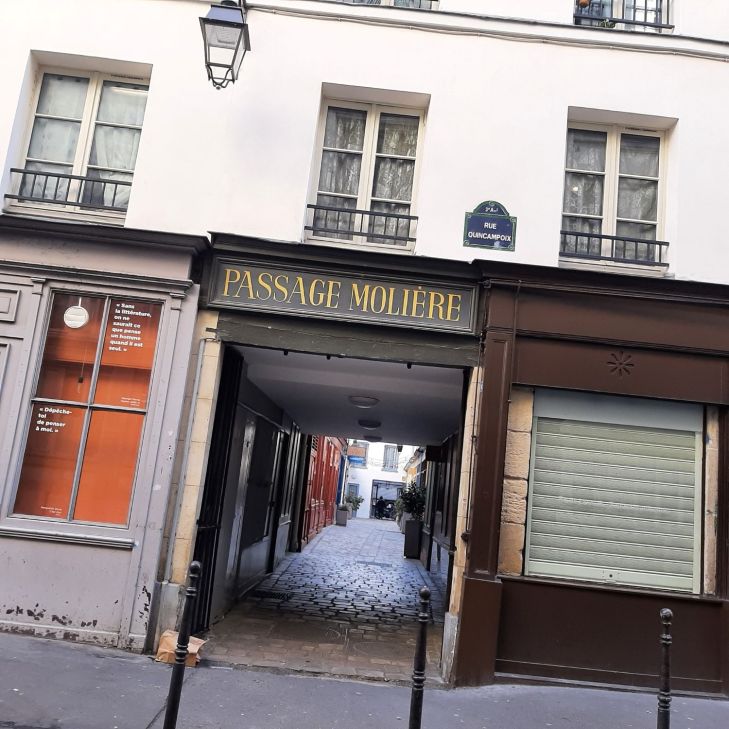
The City of Paris on the Passage Molière : https://www.paris.fr/pages/passage-moliere-vent-de-modernite-pour-lieu-historique-22275
The Paris tourist office on Paris Centre (arrond 1-4) : https://parisjetaime.com/eng/article/explore-the-centre-of-paris-a846
The rue de Monttessuy is a street in the 7éme arrondissement of Paris. It begins at 18, avenue Rapp and ends at 21, avenue de La Bourdonnais. The name of the street refers to the diplomat Gustave de Monttessuy, owner of several plots of land in the Gros-Caillou neighborhood or quartier in the 19C, who himself resided on rue Saint-Dominique. This road was opened by the City of Paris on land belonging to the Count of Monttessuy in 1857 under the name “rue Desgenettes.” By a decree of November 10, 1873, it took the name “rue de Montessuy” (with one “t”) before taking its current name (with two “t”) by a decree of February 17, 1908. See pic right resto Chez Ming with summer terraces, towards Eiffel tower
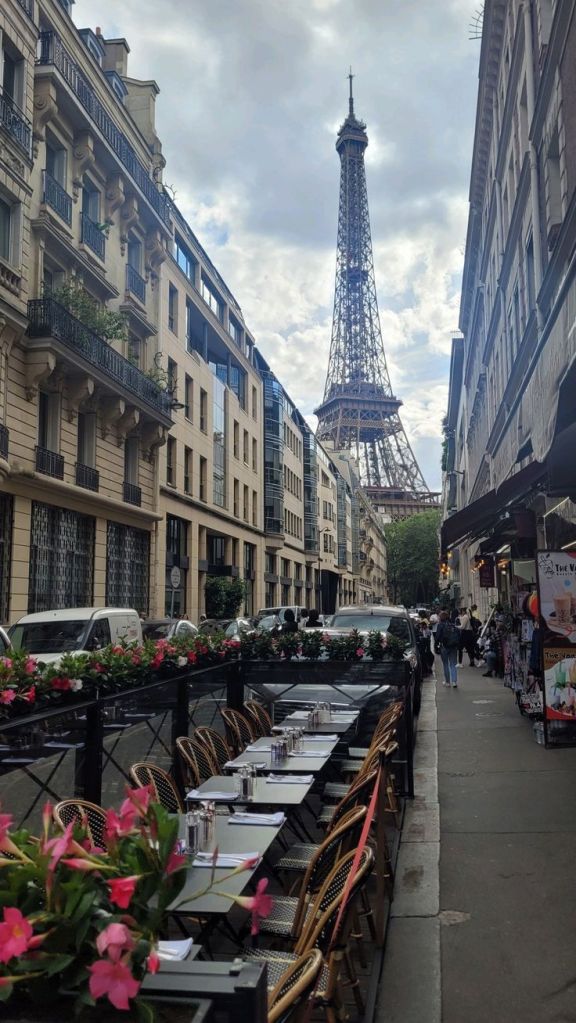
The Paris tourist office on the 7éme arrondissement : https://parisjetaime.com/eng/article/explore-paris-s-7th-arrondissement-a825
The Île Saint-Louis (see post ) is an island located on the Seine river, in the heart of Paris, in the 4éme arrondissement, in the Notre-Dame neighborhood or quartier no 16 of Paris. The Île Saint-Louis since 1725 the current name from King Louis IX, aka Saint Louis, patron Saint and ancestor of Louis XIII.The island has an area of 11 ha. It takes the form of a parallelogram of 525 meters on its long side and 250 meters on its short side, Its greatest diagonal point is from place Louis-Aragon to square Barye, reaching a little over 700 meters.
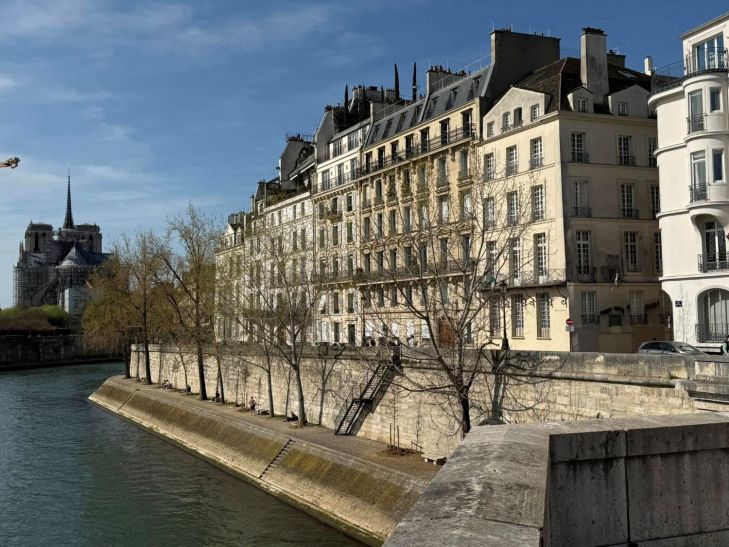
The quai d’Orléans is located along the Seine on the south side of the Île Saint-Louis in the Notre-Dame quartier or neighborhood of the 4éme arrondissement or district of Paris. Located south of the Île Saint-Louis, the Quai d’Orléans connects the Tournelle and Saint-Louis bridges; it is extended upstream by the Quai de Béthune, and downstream by the Quai de Bourbon. Overlooking the Seine on one side,(see pic back ND Cathedral ) this quay is bordered on its other side by old private mansions dating from the 17C. Today, the quai d’Orléans is a popular place of residence where film and television personalities meet. The quay owes its name to Gaston d’Orléans, brother of Louis XIII. The quay was created from 1614 to 1646. During the French revolution, from 1792 to 1806, it was called “quai de l’Égalité” before resuming its name. The quai d’Orléans is served nearby by metro line 7 at Pont Marie station. It measures 275 meters. Remarkable buildings here are at no 6,there is the Polish Library which has occupied, since 1853, a beautiful building from the 17C which belongs to the Polish Historical and Literary Society. Created in 1832 by migrants from the Russian occupier’s brutal repression of a Polish uprising. No 8 as a plaque on the facade indicates, the poet Jean de La Ville de Mirmont lived at this address from 1911 to 1914. No. 12 (and 1, rue Budé): Hôtel d’Arvers; birthplace of the poet and playwright Félix Arvers. A bronze plaque was affixed in his memory at the corner of rue Budé on July 23, 1906, the hundredth anniversary of his birth No. 16: in 1949, Roger Vadim and Brigitte Bardot lived there, In the film L’Air de Paris (Marcel Carné, 1954), no, 17 is supposed to house the lover of the young boxer trained by the character played by Jean Gabin. It appears in several scenes of the film, notably the last. Note that this is a fictitious number, as the Quai d’Orléans does not have odd numbers. In Marcel Proust’s novel Un amour de Swann or Swann’s Love, the main character Charles Swann lives on the Quai d’Orléans, which he leaves for the Rue des Acacias once he marries Odette.
The quai de Béthune is located along the Seine on the Île Saint-Louis in the 4éme arrondissement of Paris. The Quai de Béthune runs along the Seine for just under 400 meters between the Sully bridge (upstream) and the Tournelle bridge (downstream) (see pic). Two streets, oriented south-north, join it almost at right angles: the Rue de Bretonvilliers and the Rue Poulletier. This road is bordered on one side by a tree-lined sidewalk which adjoins the Seine and on the other by old private mansions dating from the 17C. This quay is named after Maximilien de Béthune, Duke of Sully, minister of Henri IV. The quay was built between 1614 and 1646, and was successively named “Quai du Dauphin,” “Quai des Balcons,” and “Quai de la Liberté” during the French revolution, before finally taking the name quai de Béthune in 1806. This site is served by the Sully-Morland metro station on line 7. Remarkable buildings here are at nos. 2 to 12 and the square located at the upstream tip of the island: site of the former Hôtel de Bretonvilliers, built from 1637 to 1640, and demolished in 1840. A curiosity, the number of buildings begins at number 12. This must be due to the fact that the former Hôtel de Bretonvilliers occupied the space between this number and the Pont de Sully. No. 18: Hôtel de Comans d’Astry or “Hôtel de Richelieu.” In 1729, it became the residence of the Duke of Richelieu, Louis François Armand de Vignerot du Plessis, grandnephew of Cardinal Richelieu. The writer Francis Carcopino, known as Francis Carco, lived at this address from 1948 until his death in 1958. Nos. 20 and 22: Hôtel Lefèvre de la Barre and Hôtel Lefèvre de Malmaison. the buildings were built in 1645 Courtyard shared with no. 22. Charles Baudelaire lived at no. 22 from March 1842 to June 1843, No. 24: building see the last vestiges of the old Hôtel d’Hesselin built from the beginning of the summer of 1640 and that of 1642 it was destroyed in June 1934 at the request of the cosmetics manufacturer Helena Rubinstein and will be replaced by a new building. The President of the Republic Georges Pompidou and his wife Claude lived there from June 1969 and died there. The actor Louis de Funès owned an apartment there. The man of letters Claude Mauriac, son of François Mauriac, lived there until his death. The portal of Étienne le Hongre is the only visible vestige of the old hotel, No. 36: Pierre Viole’s hotel, built from 1640 to 1642. It underwent restorations in the 19C by Jules Jaluzot, owner, founder of the Printemps stores. All that remains from the time of its construction is a spiral staircase. Marie Curie resided there from 1912 to 1934, and René Cassin from 1952 to 1976, as indicated by plaques on the facade. The quay appears at the beginning of Philippe de Broca’s film The Man from Rio (1964): the apartment where Agnès (Françoise Dorleac) lives, where Adrien (Jean-Paul Belmondo) comes to join her, is on the ground floor of the building at the corner of Rue de Bretonvilliers and 16 Quai de Béthune. Adrien steals a police motorcycle in front of no, 16 in an attempt to catch the car of Agnès’s kidnappers, who are fleeing across the Pont de Sully.
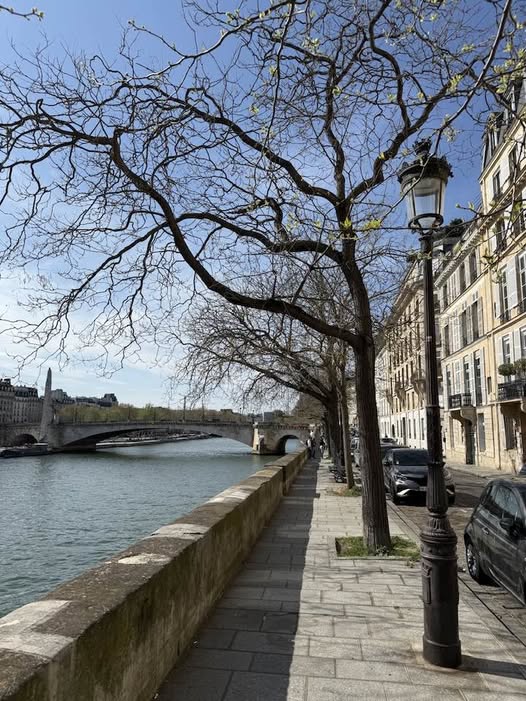
The Paris tourist office on walks in the ïle Saint Louis : https://parisjetaime.com/eng/article/discovering-the-islands-of-paris-a702
The Paris tourist office on the Ïle Saint Louis : https://parisjetaime.com/eng/transport/ile-saint-louis-p2000
There you go folks, another dandy beautiful set of glorious streets of my eternal Paris. I have criss cross them many and have many in my blog already, Again, hope you enjoy this post on the streets of Paris, part XVIII !!! as I.
And remember happy travels, good health, and many cheers to all !!!

 Paris1972-Versailles2003
I don’t think I would ever grow tired of Paris, what a special city like no other. 😎🤗✨
LikeLiked by 2 people
You are right I agree !!! Thanks for stopping by Cheers
LikeLiked by 1 person