
These monuments are the ones that keeps the wonderful architecture and history of a city today, and Paris is no difference. One of my most pleasurable moments is to visit the churches in my walks in my eternal Paris. And behold, found me new older pictures from my cd rom vault that should be in my blog for you and me . Therefore, here is my take again on the Church of Saint Germain l’Auxerrois of Paris !!! Hope you enjoy the post as I.

The Church of Saint Germain L’Auxerrois is located at place du Louvre next to the City/town hall of the 1éme district or arrondissement ncorresponding to the oldest place of worship on the right bank, known in the 6C, under the name of Saint-Germain-le-Rond. Rebuilt in the 12C and 13C, the Romanesque base of the steeple remains from the 13C. Its overall harmony, which makes it one of the great Gothic monuments of the city of Paris. The Church is located on the southeast side of the Louvre Square, facing the colonnade of the Louvre. It is served by the Louvre-Rivoli and Pont Neuf metro stations line 1 and 7 respectively. In 1859, a new building in the north to house the City/town Hall, a true copy of the facade of St Germain Auxerrois, which gives a very peculiar symmetry , using a style inspired by the late Gothic and the French Renaissance. There are the six statues representing the characters of the old Testament and the Saints, as well as the 30 other characters. The Campanile (or belfry) was built between the two facades from 1858 to 1863. The use of the stone conceals an iron structure supporting all the bells of the now famous carillon. The silhouette and some details of the belfry are reminiscent of those of the Saint-Jacques tower. It was the parish of the kings of France due to its proximity to the Louvre. In the old regimes it was know as the Parish of the Artists! It was name after Bishop Saint Germain l’Auxerrois from the region of Auxerre in Burgundy today.
The western façade of the Church of Saint-Germain-l’Auxerrois dates from the late 15C.The porch, to the north and south, ends in two pavilions housing small function rooms. The large rose window was destroyed in the 18C to accommodate the gallery organ, then rebuilt during the 19C restorations. It is the only medieval church in Paris to have a façade porch. A first porch was built in the 14C, then a second, around 1435-1439 during the English occupation of the city. Finally, a third was built around 1490. Both outside and under cover, the porch is rich in lavish Gothic decoration featuring cabbage leaves, vine branches, dragons, lizards, and fantastical creatures. These multiple sculptures have survived virtually intact since the late 15C. The niches, grouped or isolated, all house modern statues with the exception of the much-degraded one of Saint Francis of Assisi. That of Saint Mary of Egypt is a modern copy of the original statue, now preserved in the Chapel of the Virgin.
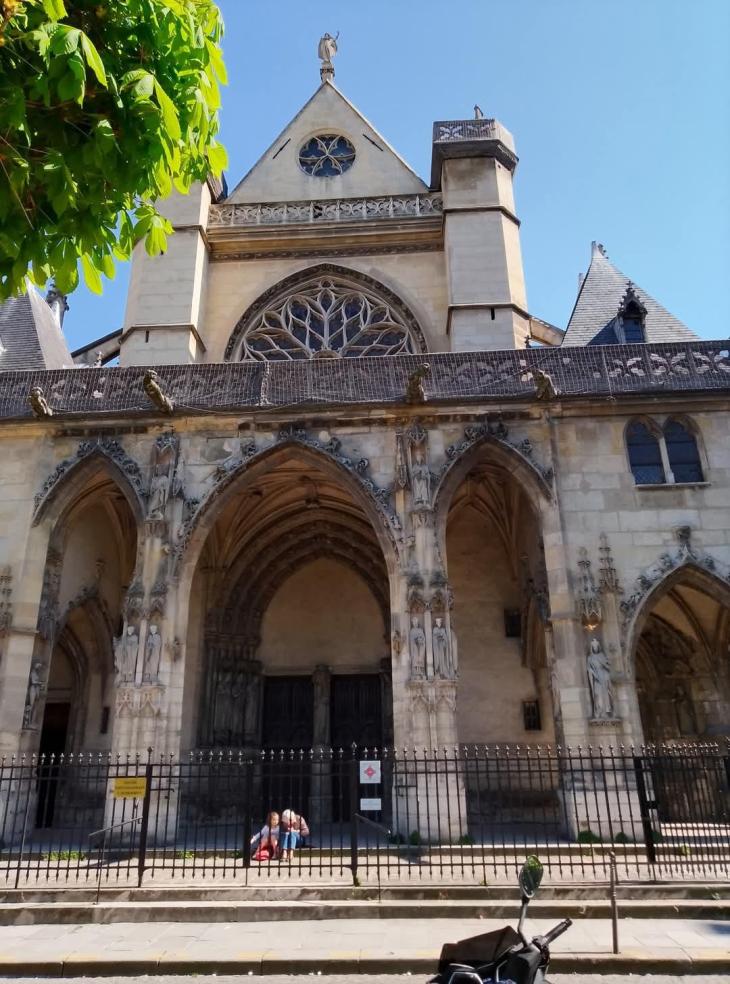
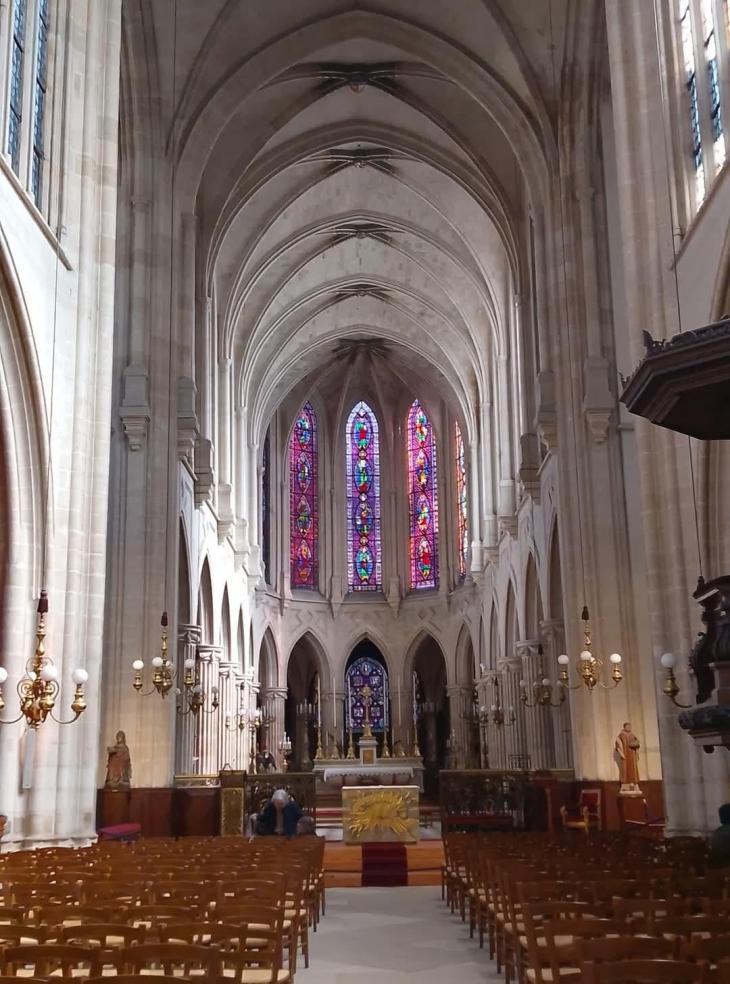
The church’s high altar dates from the 19C. In the 18C, the cylindrical piers were fluted, the capitals carved in the shape of a garland, and the spandrels hollowed out. The parish website states that the crucifix and candlesticks were a gift from king Charles X in 1826. The king, who lived in the Tuileries, was a parishioner of Saint-Germain-l’Auxerrois.
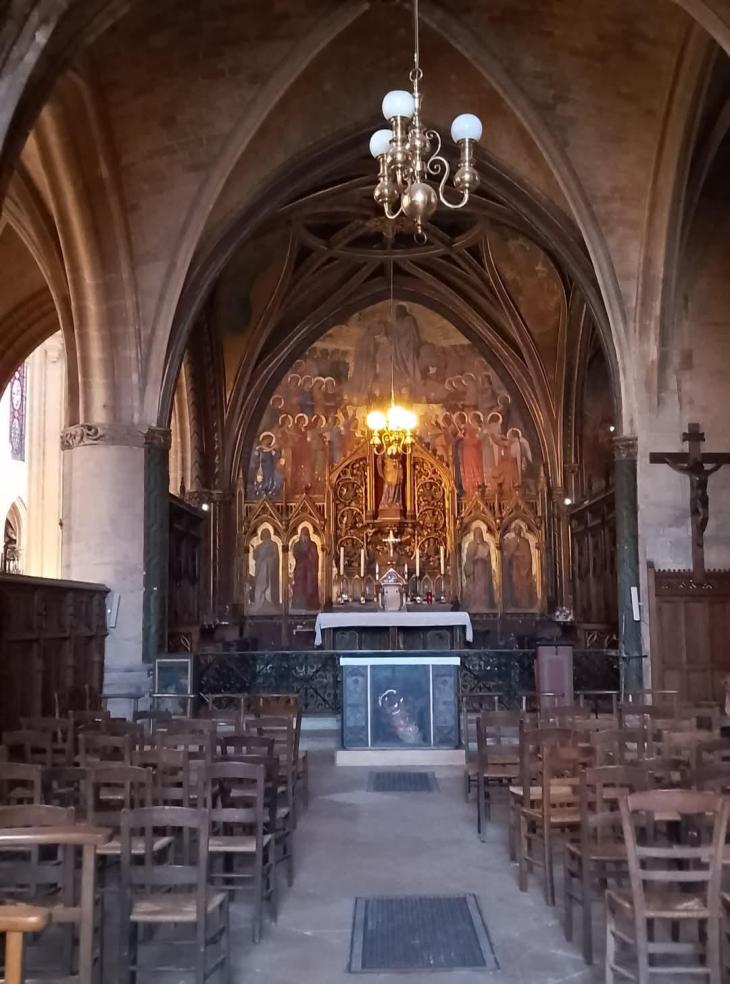
The Chapel of the Virgin is located at the entrance of the church on the South side; It corresponds to four former 16C chapels gathered during the 19C. It presents the peculiarity, on the one hand to be isolated from the southern collateral by a woodwork, and on the other hand, unlike most of the other churches, not to be in the central axis of the church at the end of the apse. Its decoration dates back to the 19C, but there are several more anciently reported statues. It features a beautiful mural composition in the Italian Quattrocentro style, depicting the Assumption, and the Coronation of the Virgin. The altarpiece, designed by Eugène Viollet-le-Duc, features an original Tree of Jesse carved in wood. The kings of Judah are each wrapped in a vine branch rich in leaves and vines. The canopy above the Tree houses a Virgin and Child attributed to the 14C Champagne School. This chapel houses the church’s two oldest statues: a 13C Saint Germain of Auxerre and a 15C polychrome Saint Mary of Egypt. Under the porch, only a copy of this statue can be seen. Mary of Egypt is depicted with the three loaves that, according to the Golden Legend, she took into the desert where she did penance for several years after leading a dissolute life.
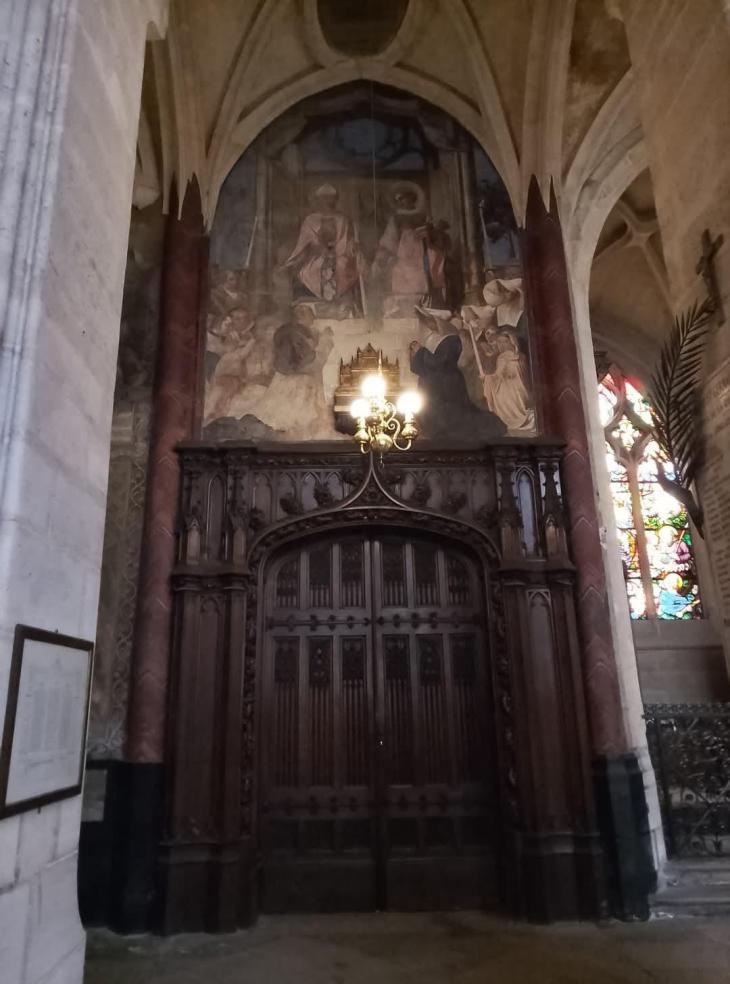
The door of the old sacristy with frescoes under the protection of Saint Germain and Saint Vincent above the door , gilded wooden representation of Saint-Germain l’Auxerrois, ex-voto of the restoration of the church from 1836 to 1845. The glorification and charity of Saint Martin of Tours sharing his cloak with a poor man at the gates of Amiens, illustrating the words of Christ: “Date et dabitur vois” or Give and it will be given to you.
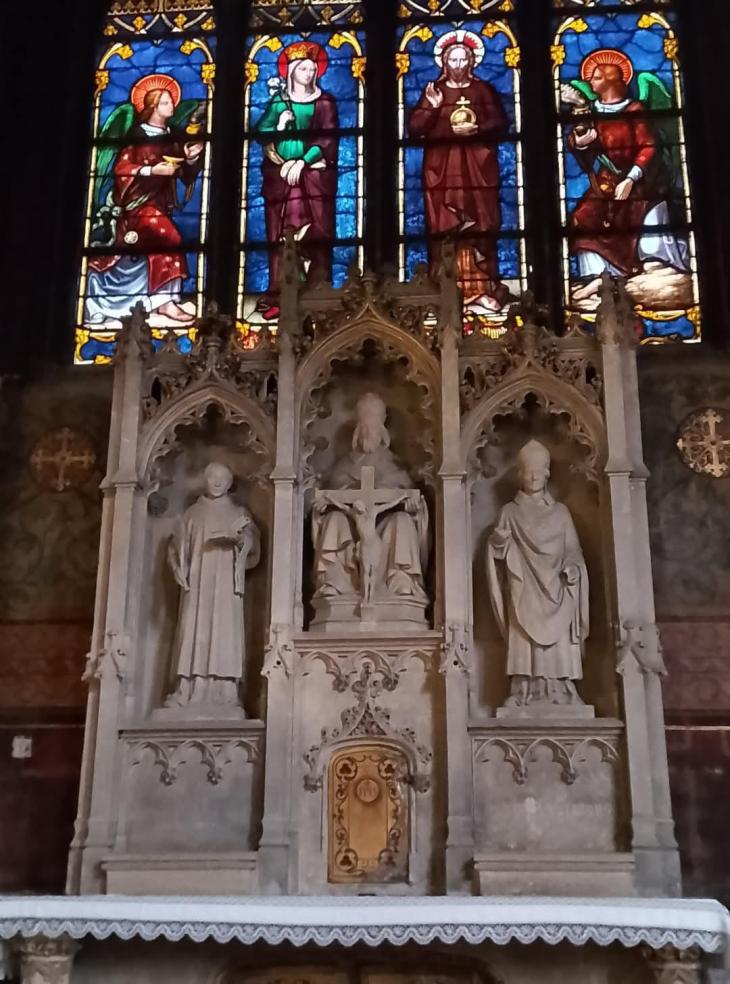
The Chapel of the Patron Saints had in the past many burials, including a vault for those who, having no particular burial, had obtained the right to be buried in the Church. During the redevelopment of the chapel in 1841, many coffins were found. The Chapel of the Patron Saints or Chapel of Saint John the Evangelist. Altarpiece from the 19C French School. Saint Vincent and Saint Germain, patron saints of the parish, surround the Trinity.
The work bench was made in the 1680s based on a design by Charles Le Brun. The non-cylindrical pillar that separates the first aisle from the second to the north . In the tympanum of the work bench, two angels surround a crown that receives two palms of martyrdom.

Inside you will see a monumental Flemish wooden altarpiece dating from the early 15C is located in the Chapel Notre-Dame de Compassion . It is a gift from the Comte de Montalivet, Minister of Louis-Philippe. The first register is divided into five scenes: one recognizes from left to right, the marriage of the Virgin, the Nativity of Christ, the Dream of Jess, the Adoration of the Magi and the presentation at the temple. The upper register represents more classically the ascent to Calvary, the Crucifixion and the descent of the Cross. These last three scenes can be compared to the corresponding scenes of the Passion Altarpiece exhibited at the Louvre museum.

The Chapel of Notre-Dame de la Bonne-Garde contains a stained glass window representing Saint Louis ( king Louis IX, born in Poissy, Yvelines 78 on 25 April 1214, and died in Tunisia on 25 August 1270, during the Eighth Crusade, canonized in 1297) , making justice under the oak of Vincennes , and a statue of the Holy Virgin (1812), miraculously spared during the riots of 1831.
The Chapel of the tomb (also called Calvary) was founded in 1505 by Jehan Tronson, the wealthy drapery merchant who decorated the outside of the Church with a frieze of pieces of carp. The members of this family are then buried there. Because of its rich founder, it became the seat of the Brotherhood of Clothiers who held their corporate meetings there and celebrated masses there. During the sack of 1831, the burials of his vault were desecrated.
The Chapel of Good Death (formerly called the Blessed Sacrament) is completely remade in 1841. It houses stained glass windows dating from 1859; To the right a holy stone, barefoot, the head circled with a halo, crossing on his chest his two keys; In the center, in four compartments, Saint Joseph, the Virgin, Christ and Saint Michael.
The Chapelle Saint-Landry (formerly Saint-Pierre-et-Saint-Paul), which refers to the former bishop of Paris, Saint Landry, is built between 1521 and 1522. It was ceded in 1624 to Étienne Aligre (market fame) and became the Chapel and burial place of his family. At the beginning of the 19C, king Louis XVIII deposited the heart of Joseph Hyacinthe François-de-Paule de Rigaud, Count of Vaudreuil , the great Falconer, whose body is in the family grave at Calvary Cemetery.
There is no trace of what was the great organs of the Royal Parish before the French revolution the present organ was transferred in July 1791 from the Sainte-Chapelle, where it had been built twenty years before by François-Henri Clicquot, in a buffet designed by Pierre-Noël Rousset. Last the Church has been painted by some notable painters over the years such as Claude Monet , Saint-Germain-l’Auxerrois (1867) and Jean Béraud , Première communion, work not found or credit given.
A bit of history I like tell us that the existence of the Church is attested in the 7C, at the time Merovingian. It is the burial place of Saint Landry, Bishop of Paris, died around 655 or 656. Abbé Lebeuf believes that it is necessary to attribute the first origin to a chapel, the Chapel of St. Vincent, which was built shortly after the death of Saint Germain, Bishop of Auxerre. On July 25, 754, during the reign of Pepin the Writ, the transfered of the body of Saint Germain from the small chapel was held in the chorus of the Great Church of St. Vincent, which has since been called Saint-Germain Church or Saint-Vincent and Saint-Germain presumably to distinguish the two churches consecrated to the same Saint, the last of which was named Saint-Germain-le-Rond. The oldest part is the Romanesque tower, which dates from the 12C. It was surmounted by an arrow which was shot down around 1754 and replaced by the current balustrade. In the 13C, the western portal, the choir and the Chapel of the Virgin were built. The Church is largely rebuilt in the 15C in particular , the elevation of the porch.
The Saint Germain l’Auxerrois Church became the appointed Church of the Royal family at the time when the Valois moved to the Louvre in the 14C. Parish of the Kings of France because of its proximity to the palace of Louvre, the Church is one of the oldest in Paris. It is one of the four Churches marking the cardinal points of Paris in 581. It was the parish of François Boucher who lived in rue Saint-Thomas-du-Louvre. The two daughters of Boucher and his wife Marie-Jeanne Buzeau married, the painters Baudouin and Deshays. Danton, then a young lawyer, married Antoinette-Gabrielle Charpentier, the daughter of the owner of the Café du Parnassus nearby, on June 14, 1787. At the beginning of the French revolution, after the forced return of the Royal family of Versailles to the Tuileries, the future king Louis XVII (assassinated by the French revolution) made his first communion here. Under the terror, Saint-Germain is emptied of its contents and converted into a fodder store, in printing, in the police station, in the factory of saltpeter. In 1795, Théophilanthropic cult was celebrated there. The church regains its Catholic vocation in 1802 after the Concordat. Under the First Empire, an old project of destruction of the church, in order to clear the colonnade of the Louvre by a large square in the middle of which the new bridge would succeed, is envisaged then abandoned at the beginning of the Restoration.
In the Second Empire, the Baron Haussmann once again refuses to destroy it while the Minister of State and the House of the emperor, suggests he develops a project to balance the whole thing; he asks to build a building inspired by the religious building to house the city/town hall of the 1éme arrondissement. The designed reproduces almost identically the main façade of the Church (a porch surmounted by a rose window), which is similar to buildings of that time. Between the two, it was built a flamboyant gothic campanile (or belfry) connected to both buildings by two doors of the same style, giving access to a square separating the two monuments. This architectural ensemble is built between 1858 and 1863. As we know it today. Given the proximity of the Louvre where many artists reside after the departure of the court at Versailles, the church becomes the last abode of many of them and even bears the nickname “Saint-Denis of Genius and Talent”. The church offers on the rue Arbre-Sec a curiosity; the carps of the Church Saint-Germain-l’Auxerrois. It is a frieze, carved around the central chapel, representing sections of carp (heads, bodies, tails) alternating with rosettes. According to the historian of Paris, this decoration would correspond to a specific request of the rich textile Draper Tronson who, in 1505, had financed this chapel. It is not known whether the Draper Tronson had fishmongers in his family, or if they are simply sections of carp evoking his name. Source from brochures in the Church itself.
The official Church of Saint Germain L’Auxerrois: https://saintgermainlauxerrois.fr/
The Paris Tourist office on the Church St Germain l’Auxerrois: https://parisjetaime.com/eng/culture/eglise-saint-germain-l-auxerrois-p1229
A unique site in French on tombs and burials of France with details work and wonderful pictures on the Church of Saint Germain l’Auxerrois: https://www.tombes-sepultures.com/crbst_1305.html
There you go folks, a wonderful inventory of history and architecture of Paris. One of the site to see in a gorgeous area of my eternal Paris. Again, hope you enjoy the post on the Church of Saint Germain L’Auxerrois of Paris !!! as I.
And remember, happy travels, good health,and many cheers to all !!!

 Paris1972-Versailles2003