
There are many things to see in my lovely Bretagne, and we have been to many and there are many more to be seen. However, the inland region has less frequency but is sublime and always a welcome to visit any time. We love it and will tell you a bit more so you one day can see it and love it too ok. Let me tell you a bit about this is the Ménez Hom !!! Hope you enjoy it as I.
Sainte-Marie-du-Ménez-Hom is a hamlet of the town of Plomodiern in the Finistère dept 29 of my lovely Bretagne and in my belle France, It is located at the foot of Ménez-Hom, and known mainly by its chapel, It is 11 km from Châteaulin, 23 km from Crozon, 16 km from Locronan , 24 km from Douarnenez,and 129 km from my current home, We go there by the N165, D41/D770 around Châteaulin to connect with the D887 to the village.
The Ménez Hom is a mountain in Cornouaille country, between the Alne and the terroir of Porzay, in the territory of the towns of Plomodiern, Saint-Nic, Trégarvan and Dinéault where it culminates to 329 meters above sea level. It dominates the harbor of Brest and the Bay of Douarnenez, and finishes the Montagne Noirs or black mountains. Very close to the sea about 6 km, it is one of the sacred mountains of the Armorica (current Brittany).
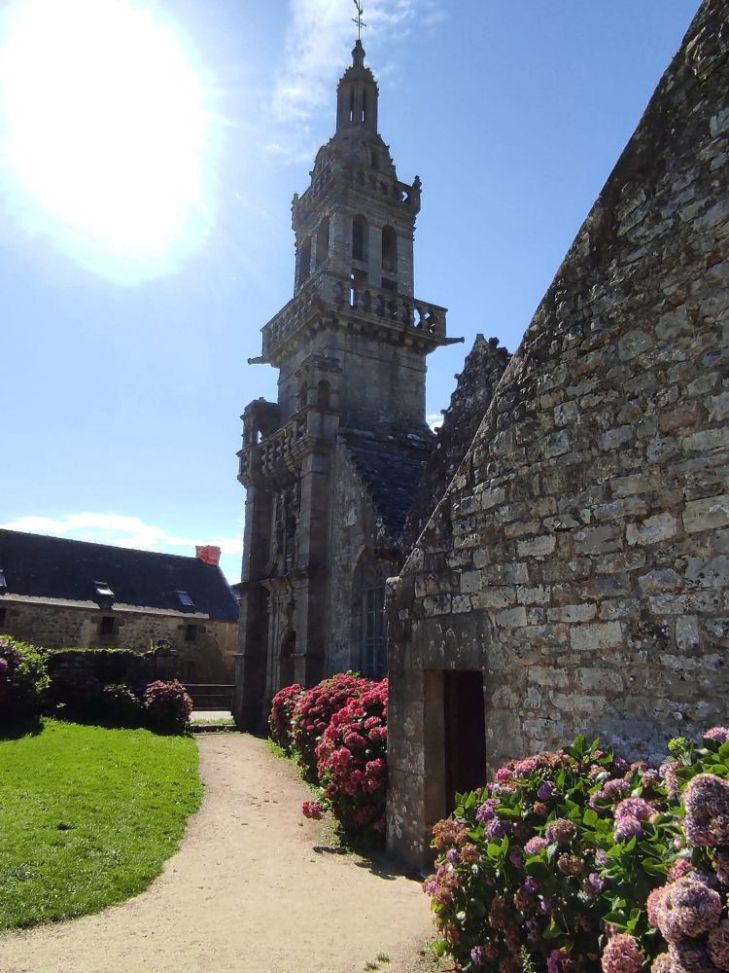
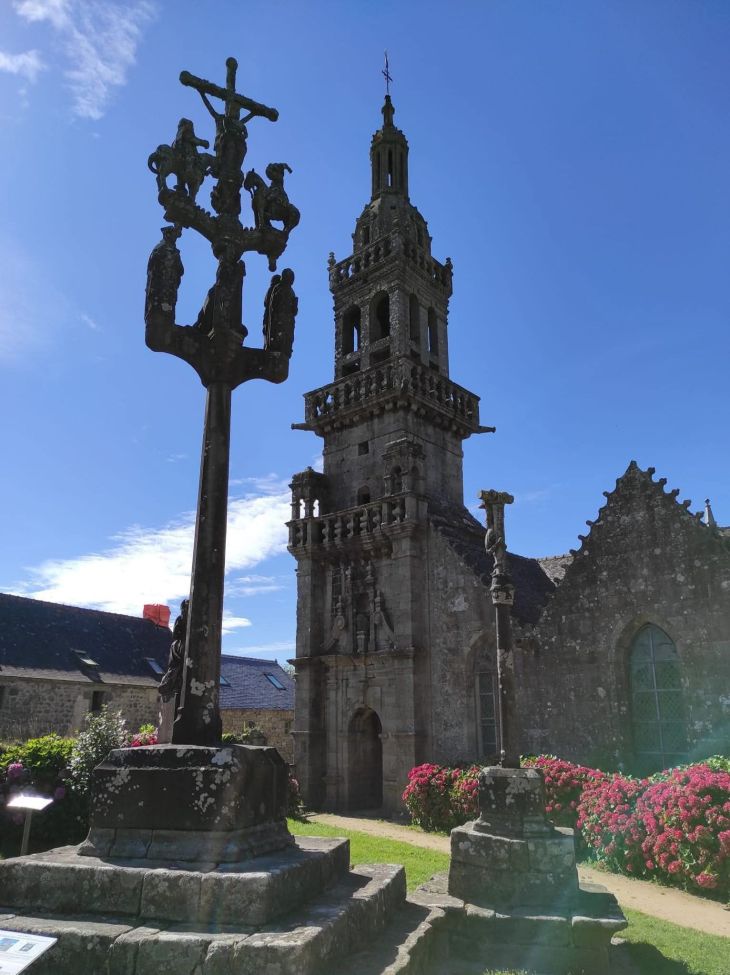
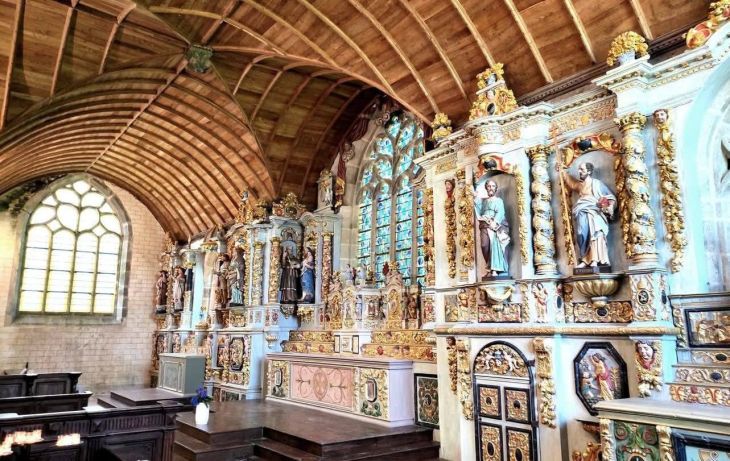
The main thing to see here other than a wonderful ride in historical lands of Brittany is the The Chapelle Sainte-Marie-du-Ménez-Hom of the 16C-18C and its parish enclosure such as Arc de Triomphe, Calvary, etc. has a parking park slightly arranged below the summit of Ménez Hom; It is accessible by a rectilinear department, the D83, which embarks on the road connecting Châteaulin to Crozon a few hundres meters after the hamlet of Sainte-Marie-du-Ménez-Hom. An extraordinary chapel, by its architectural wealth, its stained glass, its statues, and its famous altarpiece. Do not miss, the altarpiece, deployed on three scenes, one of the most beautiful in the region , beautiful sand pits and sculpted glory beams (16C) , outside, a Calvary (1544) and an arc de Triomphe (1739).
The Calvary of Croaz Rhu (“Red Cross”), also known as “Calvary of the Temple Cross”, is not far from the Chapelle de Sainte-Marie-du-Ménez-Hom. Its name refers to the red color of the Templier cross. This calvary, which would have been done before 1307 and would have been renovated in 1544, presents the sculpture of an angel showing a fabric on which the face of Christ is printed; It would be the recall of the sapshot, which would have belonged to the Templars, who would have taken it during the looting of Constantinople by the crusaders, We retained two dates for construction, 1570 and 1773. 200 years during which the chapel has continued to grow and enrich itself.
From the first steps inside, the ornaments of the 21 meters long altarpiece are striking and show great richness. In baroque style, this piece is undoubtedly the most striking the superimposed domhemel tower dates from 1663. The interior of the chapel is doubled with collateral dated 1574 and 1591. The frame of the vault is very ornate. The Arc de Triomphe with a triple arcade dates from 1730, The chapel favored the establishment of Fairs once frequented on Saint Hervé Days (June 17), Saint Laurent (August 11), from the Assumption (August 15) and the Natity of Mary (September 8) , The four taking place in Summer due to certain climate harshness of the area. It was traded with butter, eggs, canvas, animals, etc., and the transactions were taxed for the benefit of the chapel. From April to October, the chapel hosts guided tours and some concerts. To visit: from April 1 to October 31. Every day from 9h30 to 18h30, Commented visit possible on request. Located on the edge of the D 887, a road which allows access to the Crozon peninsula when you go through Chateaulin.
A bit of history tell us that the ancient history of Ménez Hom is little known. The mountain, considered sacred since prehistoric ; the legends make Ménez Hom a sacred mountain of the Celts. King Marc’h, legendary king, would have been buried in the vicinity, In 1913, a small bronze head of a Celto-Roman helmet goddess, was discovered by a farmer in the hamlet of Kerguilly ,town of Dinéault in a moor named Gorred-Ar-C ‘Hoad, 3.2 km from the summit. Around 1928, the same farmer, resuming his research, found in a cavity the rest of the body, coated with a long fold dress, bare arms with a sort of large necklace around the neck and wearing sandals. A helmet, although of the Celtic type, bore the figuration of the aiming holes characteristic of a fashionable Greek model in the Roman Empire until the middle of the 1C, as well as a very long intended to wear feathers were also there, the statue measuring a total of 70 centimeters it was compared to Athena, Minerva, Sequana and even to the representations of the Virgin. It was acquired in 1972 by the Museum of Brittany in Rennes. It is likely to date from the second half of the 1C. A copy of the statue is in the hall of the city hall of Dinéault. Many pilgrims going to the forgiveness of Sainte-Anne-la-Palud climbed the Ménez Hom the day before forgiveness, spending the night in camp on the top and, when the day got up, they kneed and sang their first hymns, During the WWII, the nazis had observation posts and defense means at its summit. On August 18, 1944, 17th Cavalry Recognition Squadron attacked the Ménez Hom (code name Hill 330), which commanded access to the Crozon peninsula , On August 25, 1944 the 175th Infantry, which was part of the 29th division of American infantry, attacked code name Hill 103 of a fortified hill defended by the nazis, located on the heights of Cocastel. The fights last until September 3, the day when American troops finally managed to conquered it , Here, on September 1, 1944, against 15,000 nazis experienced in the fighting and commanded by General Ramcke, the Ménez Hom is taken by force by the Resistance FFI of Brittany, commanded by Commander Philippot, and Henri Birrien, of Châteauneuf-du-Faou, and raised the French flag there, On April 12, 1904 in the parking lot near the chapel, is a granite monument representing two resistance fighters and bearing an inscription to the “glory of the Finistère resistance. So that Vive la France 1940-1944 ”. In September and October 1943, American and British airmen were hidden above the chapel sacristy for several weeks.
The Finistére dept 29 tourist office on the Chapelle Sainte Marie: https://www.toutcommenceenfinistere.com/culture/chapelle-sainte-marie-du-menez-hom/
The local Ménez Hom Atlantique tourist office on its heritage: https://www.menezhom-atlantique.bzh/en/decouvrir-menez-hom-atlantique/nos-incontournables/menez-hom/
The Parc Naturel Régional d’Armorique on the Ménez Hom: https://www.pnr-armorique.fr/destination-parc/nos-ambiances/montagnes/menez-hom/#
The Bretagne region tourist office on the Ménez Hom: https://www.brittanytourism.com/destinations/the-10-destinations/brest-terres-oceanes/menez-hom/
There you go folks, another sublime spot to visit very nice natural and monumental complex in one, great views of the Atlantic ocean; heavens on earth. Again, hope you enjoy this post on this is the Ménez Hom !!! as I.
And remember, happy travels, good health, and many cheers to all !!!

 Paris1972-Versailles2003