
I like to tell you again on this historical , and architectonical marvel just north of me, This is Guingamp in the Côtes d’Armor dept 22, of my lovely Bretagne and in my belle France, I have written before much on its monuments and found more older pictures in my cd rom vault ,not in my blog and they should be for you and me, Briefly, Guingamp is located 110 km from Brest and 130 km from Rennes. Saint-Brieuc, the prefecture, is 32 km away. It is about 109 km from my house, Therefore, here is again curiosities of Guingamp ,part III !!! Hope you enjoy it as I.
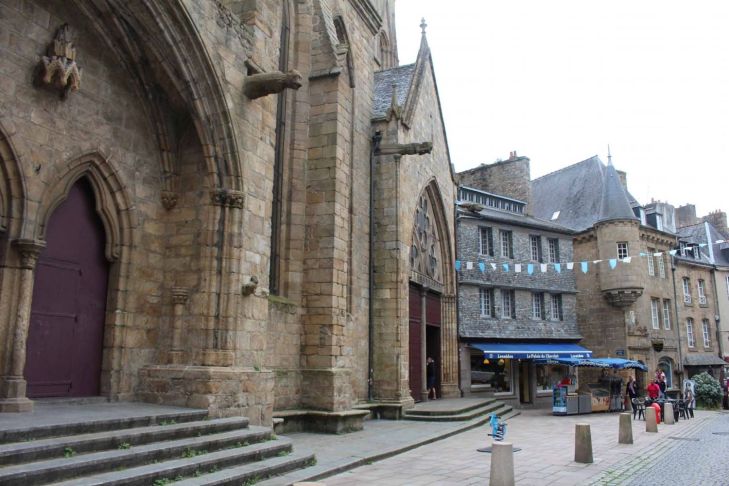
You can’t avoid the wonderful Basilique Notre-Dame de Bon-Secours, located in the heart of the historic city of Guingamp. In 1093, the count of Guingamp, Etienne inherited the county of Penthièvre on the death of his older brother, Geoffroy. Inside the walls, the old castle chapel quickly became a respected and influential parish. In the 12C, the church known today as Notre-Dame-de-Bon-Secours bore the successive terms of Saint-Pierre and Saint-Paul before wearing that of the Church of the Blessed Mary ,a place of Marian pilgrimage . It was not until 1857 to witness the coronation of the Virgin under the pontificate of Pius IX and on October 24, 1899 that a papal bull from Leo XIII erected this sanctuary as a minor Basilica. Beautiful indeed.
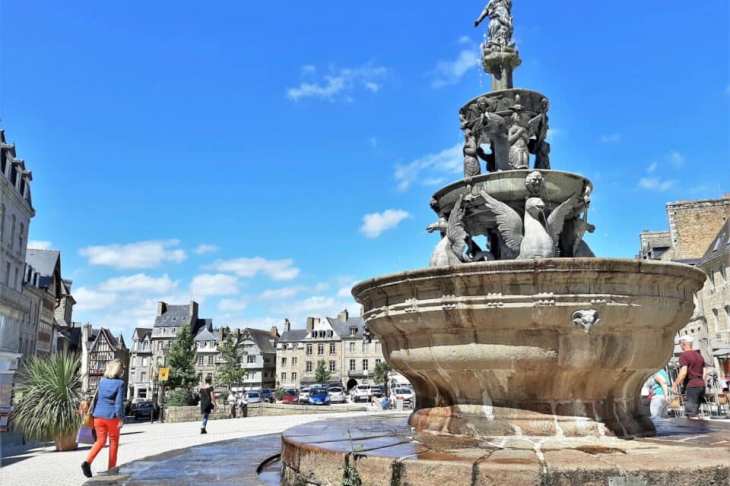
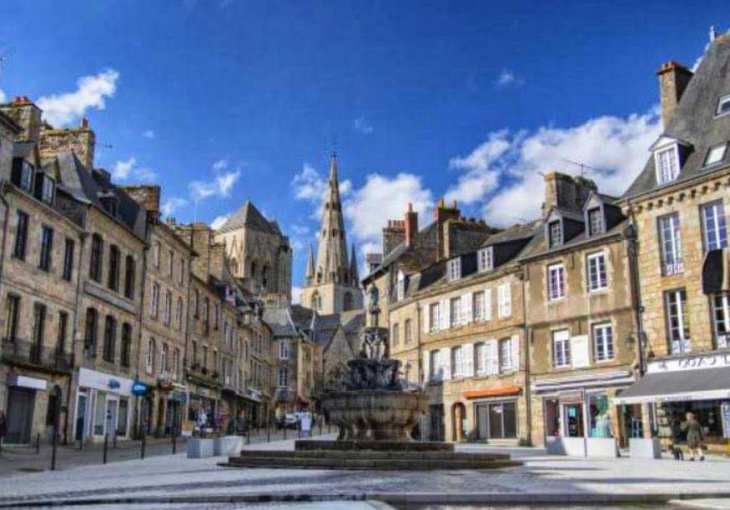
The fontaine de la Plomée at the Place du Centre in the crossroads of rue Notre Dame and rue Henry Kerfant . The term Plomée comes from the Breton word plomenn meaning “pump, fountain ” and locally “source “. The fountain was built in the 15C. In 1588, it was transferred to the top of the square and became ornamental. It was renovated in 1743 . Composed of three basins, the first in granite, the other two in lead, it is reminiscent of the Celtic triple fountains. The statue which dominates it represents the cult of the virgin mother, Dana or Ana among the Celts, the Virgin Mary in the Christian religion. Recently renovated, The term plomée comes from the Breton word “plom” meaning “lead”, metal of which it is made. This fountain became one of the symbols of the city of Guingamp, In 2003, the fountain was renovated and equipped with a closed circuit supply system.
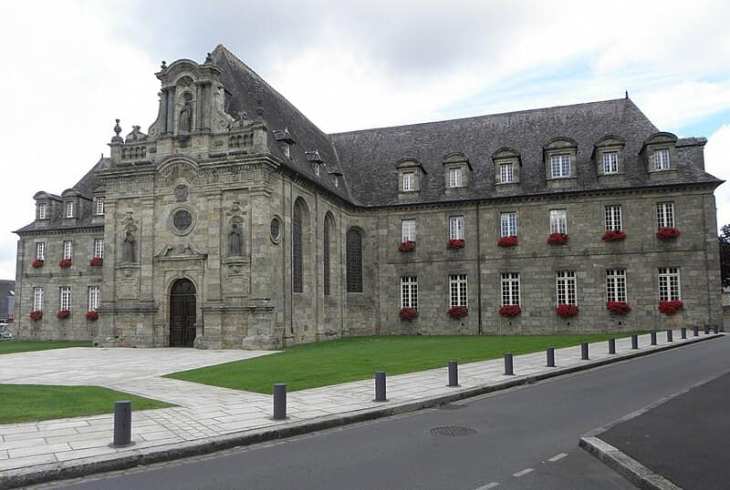
The Hôtel de Ville or City/town hall , It ,also, houses a magnificent exhibition room (Espace François-Mitterrand), The Convent was built to house the hospital nuns arrived in Guingamp in 1676. The building served as a hospital until the French revolution, a period to which it was converted to prison, and the chapel in the stable. In 1803, the former convent was returned to the nuns, but the rooms of the sick falling in ruins, a new hospice was built. The building was bought by the city in order to set up the city hall there. In 1914, the gardens were arranged in a public garden. It is located at 1 Place du Champ au Roy.
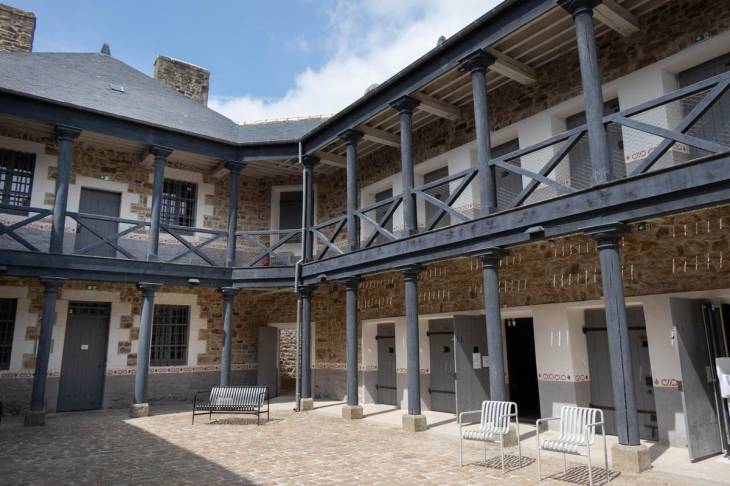
The old prison was built between 1836 and 1841 according to the model “Pennsylvanian , and is located at 4, rue Auguste Pavia. It was disused in 1951 and property of the city since 1992. The prison worked as joint penitentiary establishment between 1841 and 1931, when it officially closed. However, the prison underwent a new activity between 1941 and 1952, and 1 400 persons were again imprisoned for common law offences. Behind high surrounding walls, hides the old penitentiary center. A remarkable construction, unique in Europe, the building was bought by the city in 1992. The Renovation works to accommodate in particular the Gwin Zegal Art Center dedicated to photography.
The wooden houses of the Guingamp region were erected during the 15-16C over a hundred years by a workshop specializing in this type of construction. These generally covered an area of around 20 km. If in the Middle Ages all the houses surrounding the Place de la Cohue (currently Place du Centre) were in wood there are only a dozen of them in Guingamp, the oldest dating from the 1450s, the older of the period 1570-1580. I like to point out some all around the basilica and fountain, at no, 12, Place du Centre, the pilasters were replaced by cast iron columns at no, 31, place du Centre, house known as the Merrien Chérot prosecutor which belonged to a family of wealthy bourgeois. The house is from the end of the 15C. No, 33, place du Centre, note the ogival windows and the Saint-André ,crosses. At no, 35, Place du Centre, this is the second oldest house in Brittany. It was dated 1416 by dentochronology, At no, 39, Place du Centre, this was the oldest wooden house in Guingamp before being demoted after the discovery of the architecture of the previous house, camouflaged under a thick plaster, Lastly , at no, 48, Place du Centre ,the dimension and the care given to its construction makes it a real mansion testifying to the owner’s financial means.
The City of Guingamp on its heritage : https://www.villeguingamp.bzh/architectural/
The Friends of the Guingamp heritage sites: https://patrimoine-guingamp.net/
The Côtes d’Armor dept 22 Tourist Office on Guingamp : https://www.cotesdarmor.com/a-voir-a-faire/patrimoine/villes-et-villages-classes/guingamp/a-voir-a-faire/
There you go folks, another wonderful town to visit ,worth the detour, me think, A great road warrior ride up north of me with nice things to do and see. Again, hope you have enjoy the post on the curiosities of Guingamp, part III as I.
And remember, happy travels, good health, and many cheers to all !!!

 Paris1972-Versailles2003