
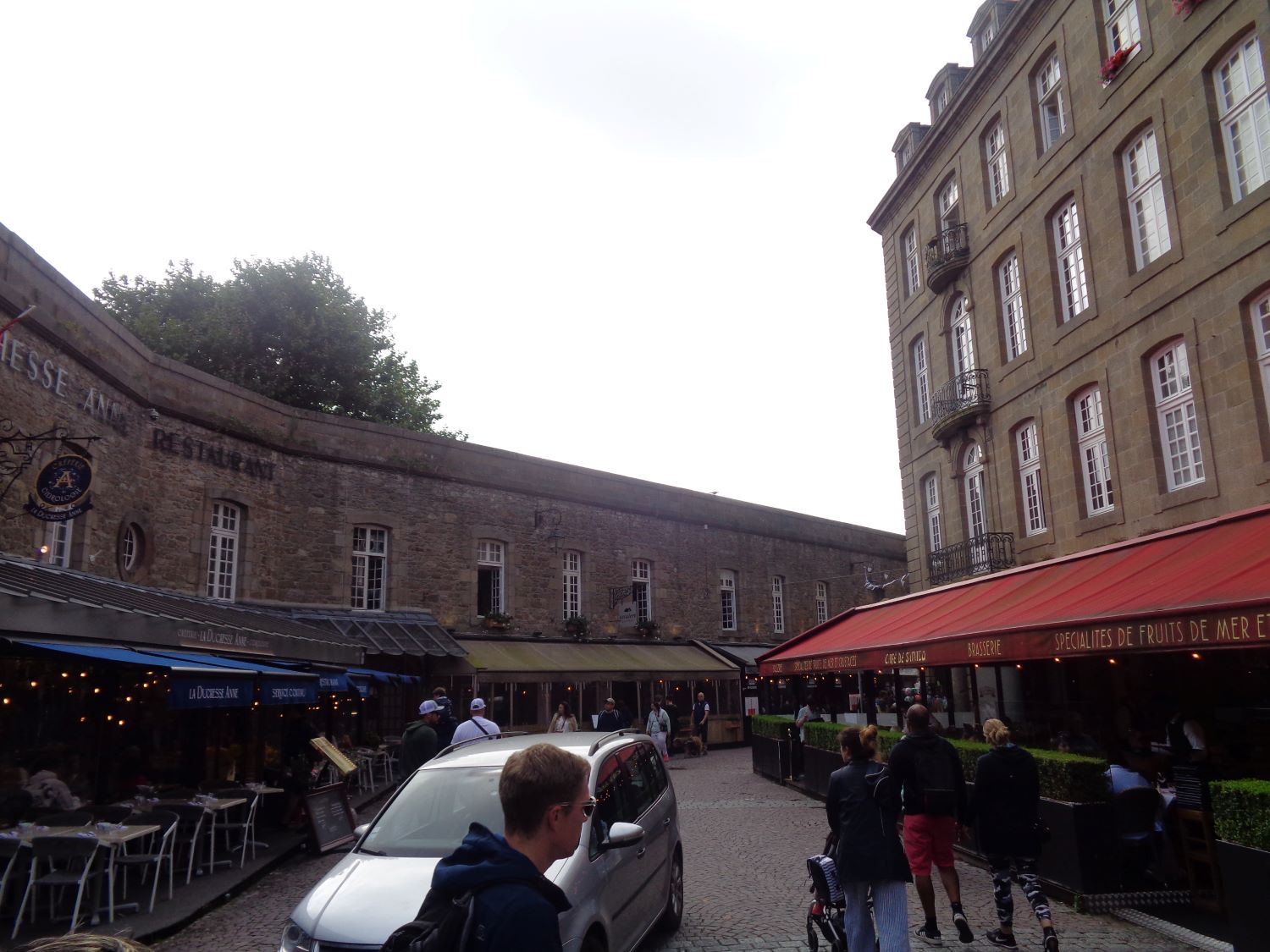
We are in summer, and we have boundless beauties in my belle France and especially in my lovely Bretagne ! I set out again to known and new territories in my road warrior mode of always that took me to neighboring departments in the north of Brittany, I came back again to the beautiful wonderful stunning corsair City of Saint Malo !!. My idea was to see old and new so I came back to do some walk warrior trails, I have many posts on the City in my blog, but this one is a repeat visit, Therefore, let me tell you about the streets of Saint Malo, part III !!! Hope you enjoy the post as I.
The Place Guy La Chambre, he was a French politician, born June 5, 1898 in Paris and died on May 25, 1975 in Neuilly-sur-Seine (Hauts-de-Seine 92) . A lawyer of profession, he was minister before and more briefly after the war, deputy of Ille-et-Vilaine dept 35 (1928 to 1942 then 1951 to 1958), mayor of Saint-Servan (1932 to 1940) then mayor of Saint-Malo ( 1947 to 1965). He voluntarily committed during the Great War or WWI and obtained the 1914-1918 War Cross, Officer of the Legion of Honor ,and Commander of the Order of Maritime Merit as Minister of the Merchant Marine, He married the singer Cora Madou in 1938, which ended her career after their marriage. He donated the Château de la Briantais to the diocesan association of Rennes at his death in 1975. A square bears its name in Saint Malo, near the Porte Saint-Vincent (gate).
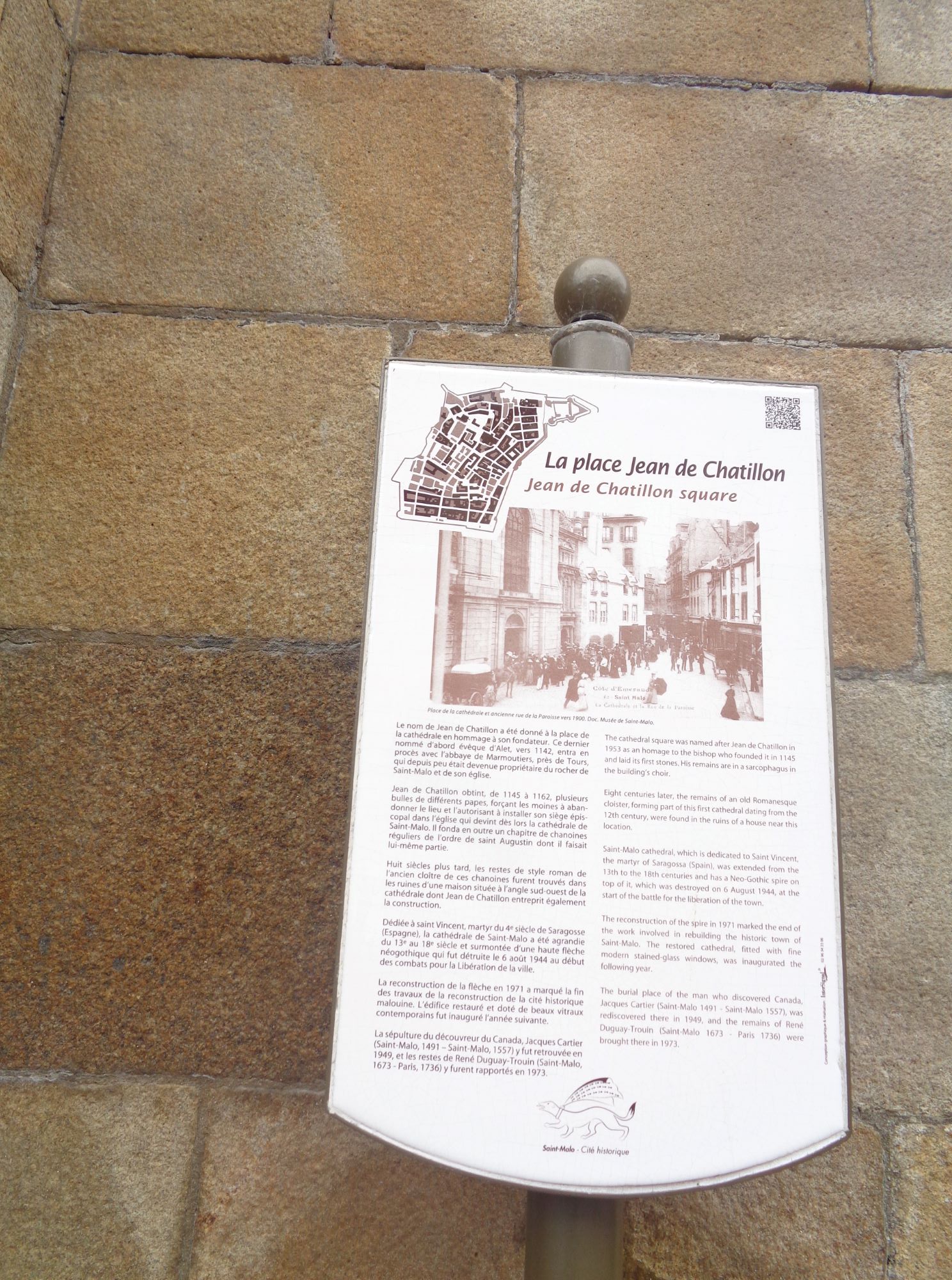
The Place Jean de Chatillon, The name of Jean de Chatillon was given in the Place de la Cathedral in homage to its founder. The latter first appointed bishop of Alet, around 1142, entered trial with the Abbey of Marmoutiers, near Tours, who recently had become the owner of the Rocher de Saint-Malo and its church. From 1145 to 1162, several bulls of different popes, forcing the monks to abandon the square and authorizing it to install its episcopal seat in the church which therefore became the Cathedral of Saint-Malo. He also founded a chapter of regular canons of the Order of Saint Augustine, of which he was himself a part. Eight centuries later, the Romanesque style of the old cloister of these canons were found in the ruins of a house located at the southwest corner of the cathedral of which Jean de Chatillon also undertook construction.
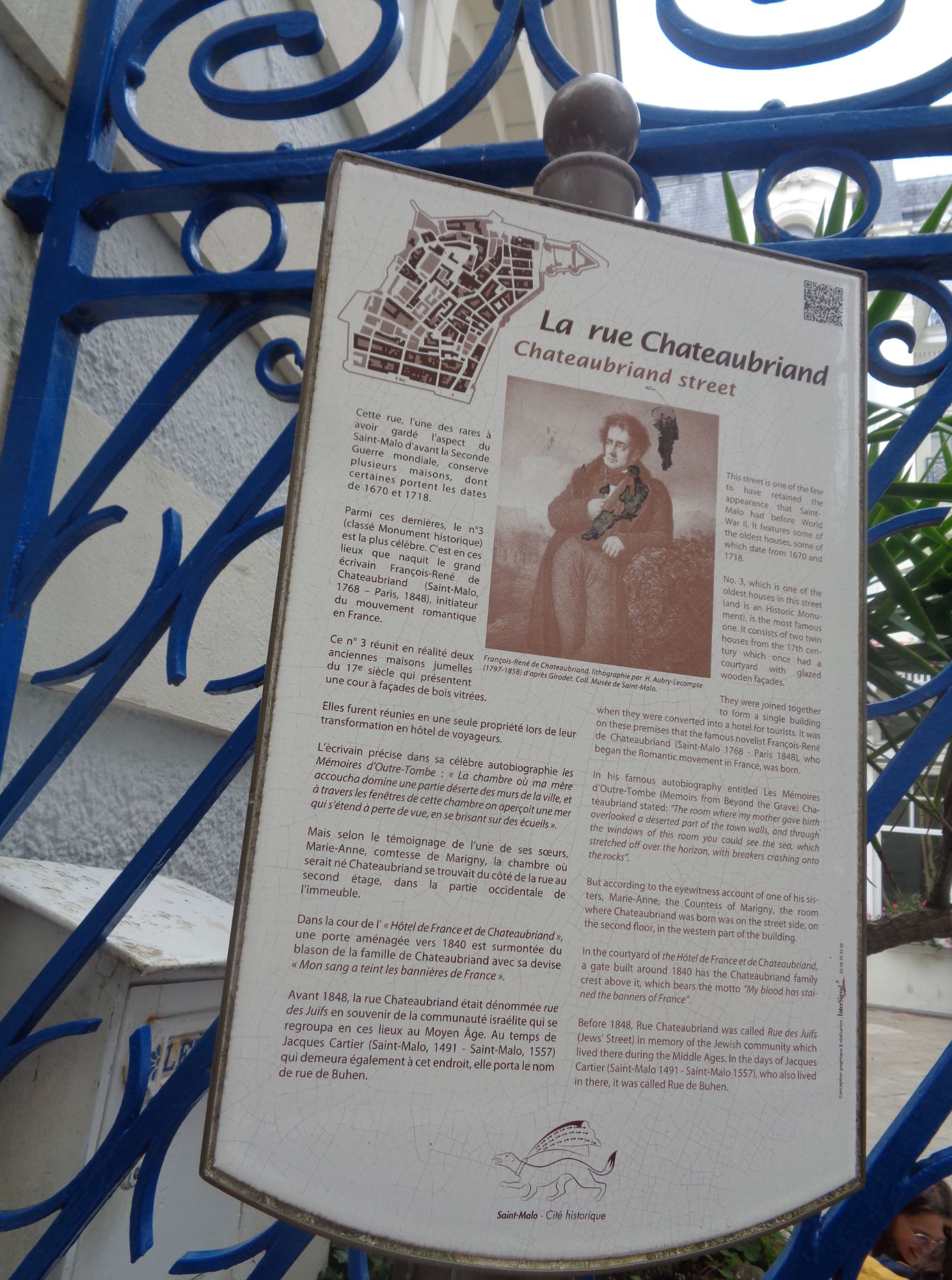
The Rue Châteaubriand, this street, one of the few to have retained the aspect of the Saint Malo before WWII, retains several old houses of Saint-Malo, some of which bear the dates of 1670 and 1718. Among these, the N ° 3 is the most famous. It was in these house that the famous writer François-René de Chateaubriand was born (see post). This n ° 3 actually brings together two ancient twin houses of the 17C which formerly presented a courtyard with glass wooden facades. They were gathered in a single property during their transformation into a passenger hotel. But according to the testimony of one of his sisters, Marie-Anne, countess of Marigny, the bedroom where Chateaubriand was born on the side of the street on the second floor, in the western part of the building. In the courtyard of the “Hôtel de France and Chateaubriand”, a door set up around 1840 is surmounted by the coat of arms of the Chateaubriand family with its motto “My blood has the banners of France”. Before 1848, rue Chateaubriand was called rue des Juifs in memory of the Israelite community which gathered in these places in the Middle Ages. At the time of Jacques Cartier who also stayed there, it bore the name of rue de Buhen.
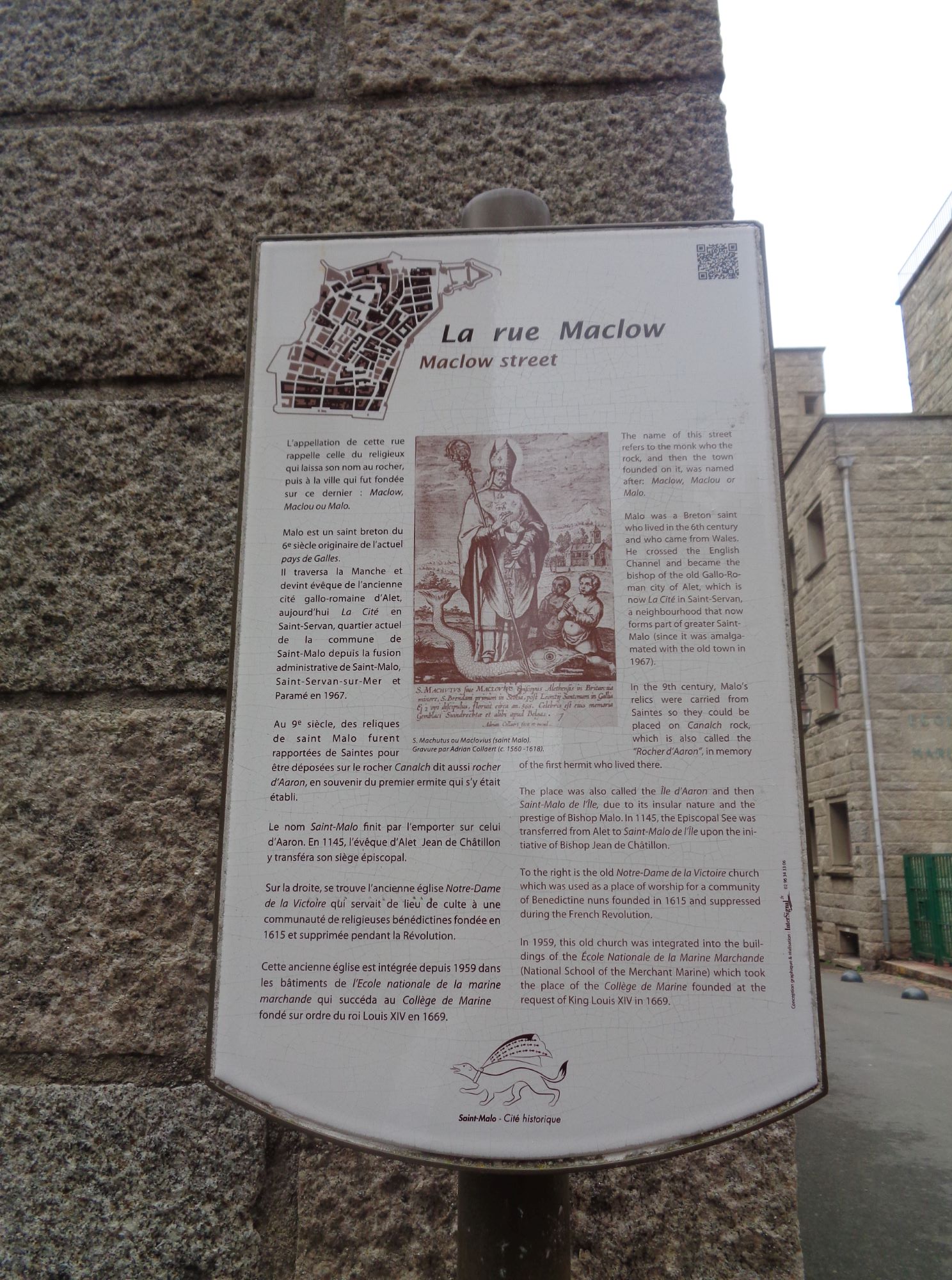
The Rue Maclou : The name of this street refers to the monk who the rock, and then the town founded on it, was named after Maclou or Malo. Malo was a Breton saint who lived in the 6C, and who came from Wales. He crossed the English Channel and became the bishop of the old Gallo-Roman city of Alet, which is now La Cité in Saint-Servan, a neighbourhood that now forms part of greater Saint-Malo since 1967. In the 9C, Malo’s relics were carried from Saintes so they could be placed on Canalch rock, which is also called the “Rocher d’Aaron”, in memory of the first hermit who lived there. The place was also called the Île d’Aaron and then Saint-Malo de l’Île, due to its insular nature and the prestige of Bishop Malo. In 1145, the Episcopal See was transferred from Alet to Saint-Malo de l’Île upon the initiative of Bishop Jean de Châtillon. To the right is the former Notre-Dame de la Victoire church which was used as a place of worship for a community of Benedictine nuns founded in 1615 and suppressed during the French revolution. In 1959, this old church was integrated into the buildings of the École Nationale de la Marine Marchande (National School of the Merchant Marine) which took the place of the Collège de Marine founded at the request of King Louis XIV in 1669.
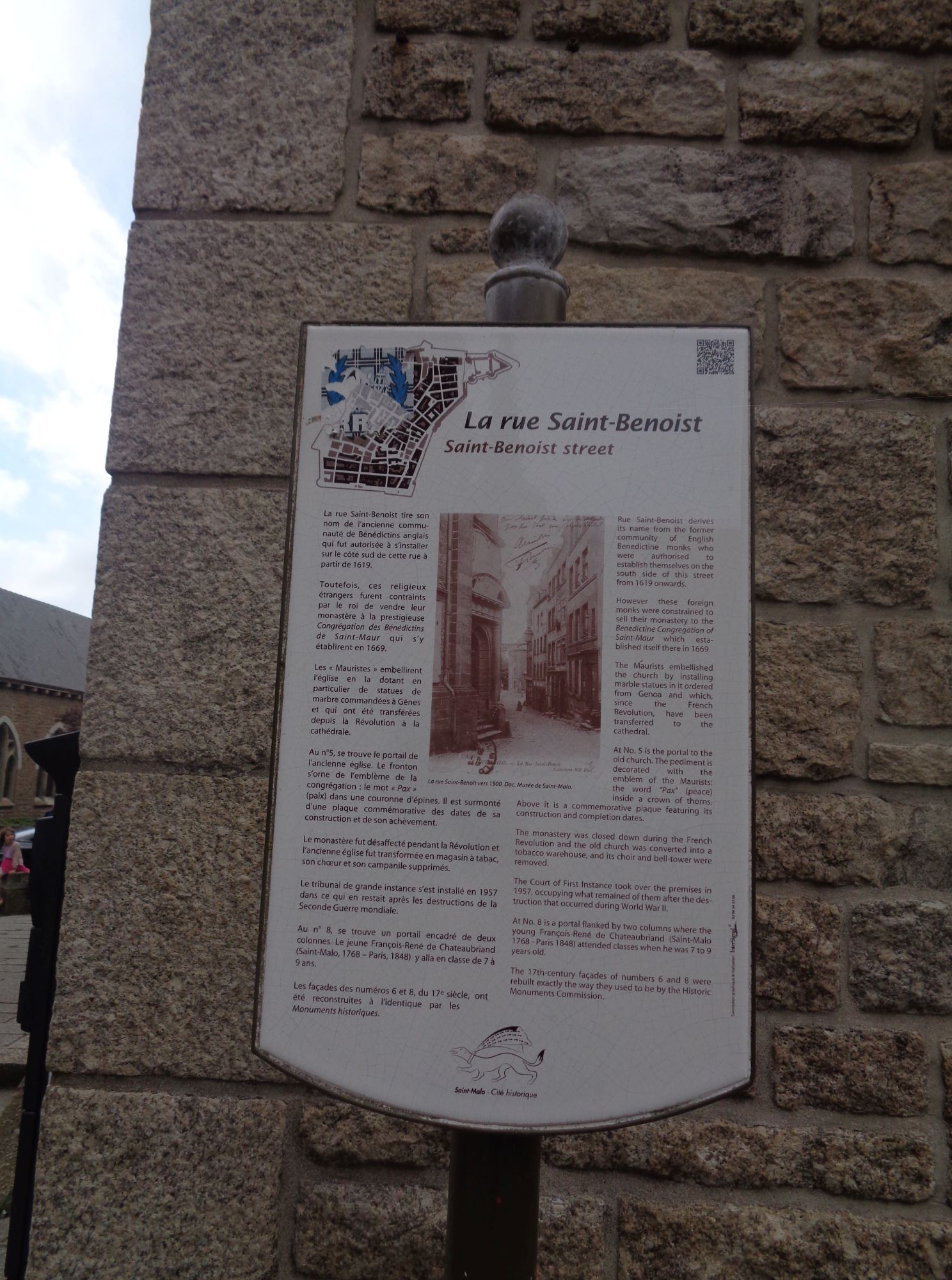
The rue Saint Benoist takes its name from the former community of English Benedictines which was authorized to settle on the south side of this street from 1619. However, these foreign religious were forced by the king to sell their monastery to the prestigious congregation of Benedictines de Saint-Maur which were established there in 1669. The “marists” embellished the church by providing it in particular with marble statues commanded in Genoa and which have been transferred since the French revolution to the cathedral. At n ° 5, there is the portal of the old church. The pediment is adorned with the emblem of the congregation: the word “pax” (peace) in a crown of thorns. It is surmounted by a commemorative plaque of the dates of its construction and its completion. The monastery was abandoned during the French revolution and the old church was transformed into a tobacco store, its choir and its campanile suppressed. The tribunal de grande instance (courthouse) settled in 1957 in what remained after the destruction of WWII. At n ° 8, there is a portal framed by two columns where the young François-René de Chateaubriand went to class, between the age of 7 to 9 years. The facades of numbers 6 and 8, from the 17C, were reconstructed identically by historical monuments of France. At No. 12 is the presbytery, which was also rebuilt. Above its portal is an alcove that contains a statue of Saint Malo in his boat.
The city of Saint Malo on tourism in general:https://www.saint-malo.fr/accueil/sortir/tourisme/
The Saint Malo tourist office on its heritage: https://www.saint-malo-tourisme.co.uk/our-8-preserved-treasures/saint-malo-le-bijou-corsaire/
The Ille et Vilaine dept 35 tourist office on Saint malo: https://www.ille-et-vilaine-tourism.com/discover-ille-et-vilaine/the-loveliest-places/saint-malo/
There you go folks, all new for you and me in my blog, This is awesome and glad back again as is one of my favorite cities , This is a place to walk and be enrich with architecture and history in the corsair city , Wonderful spots to see indeed, me think, Again, hope you enjoy this post on the streets of Saint Malo, part III !!! as I.
And remember, happy travels, good health, and many cheers to all !!!

 Paris1972-Versailles2003