
We are in summer, and we have boundless beauties in my belle France and especially in my lovely Bretagne ! I set out again to known and new territories in my road warrior mode of always that took me to neighboring departments in the north of Brittany, I came back again to the beautiful wonderful stunning corsair City of Saint Malo !!. My idea was to see old and new so I came back to the cathedral, I have many posts on the City in my blog, but this one is a repeat visit, Therefore, let me tell you about the Cathédrale Saint Vincent of Saint Malo !!! Hope you enjoy the post as I.

The Cathedral Saint Vincent is dedicated to Saint Vincent of Zaragoza, it mixes the Romanesque and Gothic styles and has been the seat of the former bishopric of Saint-Malo since 1146. The latter was abolished by the Concordat of 1801 (agreement after the French revolution), and its territory divided between the dioceses of Rennes, Saint-Brieuc and Vannes. The layout of the Cathedral of Saint Vincent is in the Latin Cross. The nave is made up of three naves. The naves retains interesting Romanesque capitals. In the ground, a mosaic commemorates the kneeling of Jacques Cartier before he left for Canada on May 16, 1535. The choir belongs to the ogive style in lance. It consists of four spans, three of which are in front of the altar and one in the back. The chapels dug into the wall that closes the apse of the altar are very original.
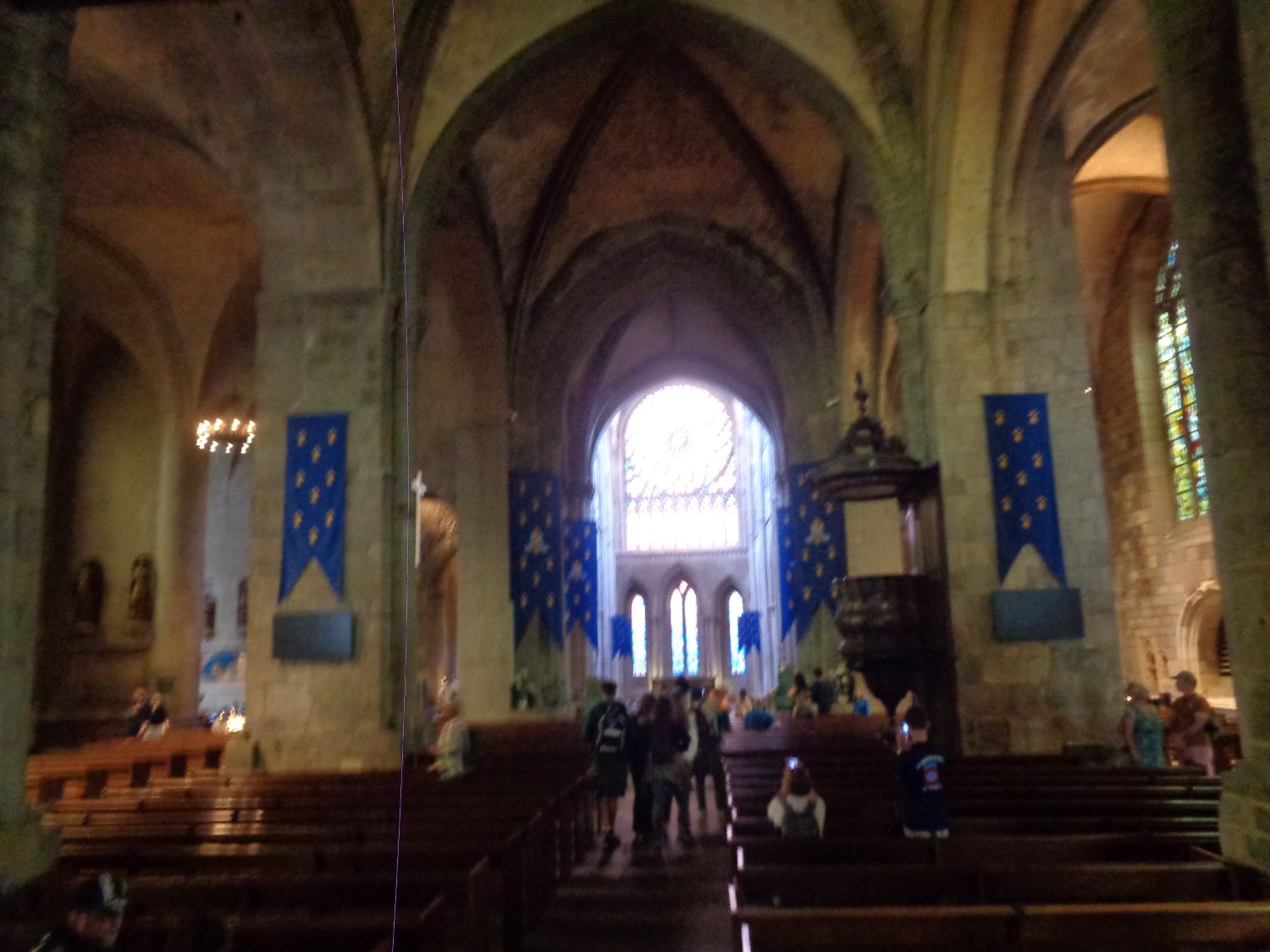
The Cathedral Saint Vincent was built on the site of an old 7C church, raised in the 9C and dedicated to Saint-Vincent-de-Zaragoza. From this period remain: part of the cloister, the nave, the crossing of the transept and a span of each of the north and south arms. The choir, slightly off-center, was rebuilt around the middle of the 13C in the Norman Gothic style. The bell tower, started in the 12C, was raised in 1422. The south aisle also dates from the 15C. At the same time, the choir also expands with three new northern chapels. From 1583 to 1607, the north aisle, now called the Saint-Côme wing, was completely redone. In the 18C, the south chapel was built in 1718, and the bell tower was raised. The most important works of this century consisted in the reconstruction of the facade.
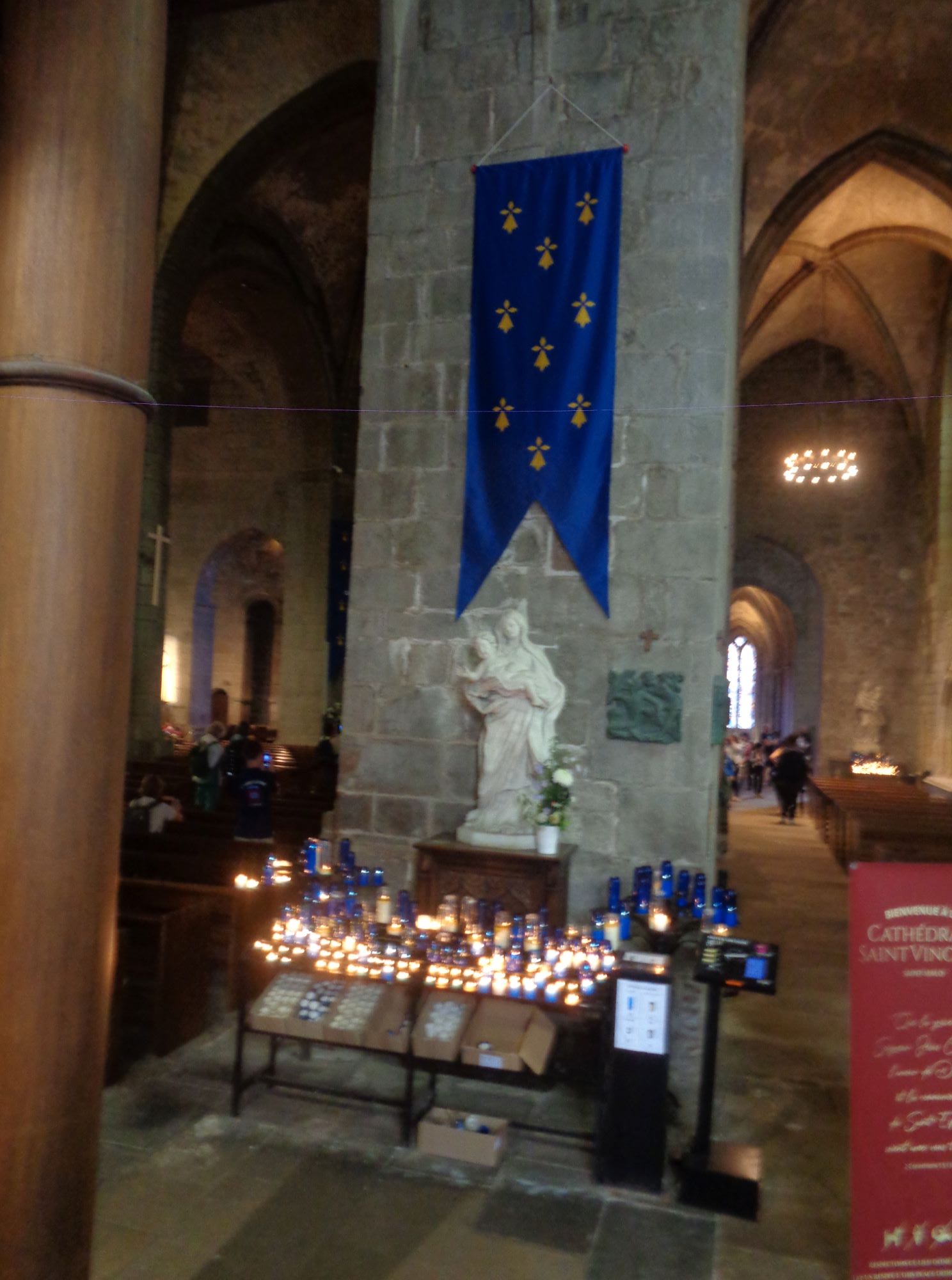

It contains magnificent figurative stained glass windows that illustrate moments in the religious history of Saint-Malo. The chapels of the north ambulatory of the choir are the refuge of the current graves of Jacques Cartier – whose burial was discovered in the cathedral in 1949 ; and of René Duguay-Trouin, whose remains were found in 1973 in the Saint-Roch Church in Paris and repatriated to Saint-Malo during the tercentenary of his birth. There are several statues , including that of the Virgin and Child, and , outside, the remains of an old Roman cloister.

A new large rosette in 1968, replaced the three bays of the bedside and restores the face of the Cathedral of Saint Vincent as it was before the English destructions of 1695. In the north collateral, at the level of the third span, a stained glass window depicts Paul Aurélien, Tugdual, Corentin, Malo, Guillaume, Samson and Patern with nine pilgrims at their feet dated from 1970. The baptismal font dates from the 18C as well as three white marble statues. The large organs built in 1977 and inaugurated in 1980. This organ replaces the one built in 1893 in Romanesque style which was destroyed in 1944. The Pulpit is from the 18C. It was put back in its place in the nave. The Sanctuary’s furnishings include a high altar, a pulpit seat and a bronze baptistery. All very nice indeed.

The baptismal font dates from the 18C as well as three white marble statues. The large organs built in 1977 and inaugurated in 1980. This organ replaces the one built in 1893 in Romanesque style which was destroyed in 1944. The Pulpit is from the 18C. It was put back in its place in the nave. The Sanctuary’s furnishings include a high altar, a pulpit seat and a bronze baptistery. All very nice indeed.


A bit of history I like tell us that the Saint Vincent de Zaragoza Cathedral has a mix architecture of Romanesque and Gothic styles. It has been the seat of the former bishopric of Saint-Malo since 1146. The latter was abolished by the Concordat of 1801 (agreement after the French revolution) , and its territory divided between the dioceses of Rennes, Saint-Brieuc and Vannes. The bishopric of Saint-Malo was created in 1146, when Jean de Châtillon, Bishop of Aleth since 1144, transferred his bishopric to Saint-Malo, a city in continuous growth at the time, which also constituted a much safer site. It was not until 1146 and the approval of Pope Eugene III that the transfer could be carried out. The monastery of Saint-Malo, founded in 1108, became the residence of the Bishop and his monastic church became a cathedral, replacing the Cathedral of Saint-Peter’s D’Aleth. The Church of Saint Vincent became the Cathedral of Saint Vincent until the abolition of the Episcopal seat in 1790 during the French revolution.
The Cathedral Saint Vincent was built on the site of an old 7C church, raised in the 9C and dedicated to Saint-Vincent-de-Zaragoza. From this period remain: part of the cloister, the nave, the crossing of the transept and a span of each of the north and south arms. The choir, slightly off-center, was rebuilt around the middle of the 13C in the Norman Gothic style. The bell tower, started in the 12C, was raised in 1422. The south aisle also dates from the 15C. At the same time, the choir also expands with three new northern chapels. From 1583 to 1607, the north aisle, now called the Saint-Côme wing, was completely redone. In the 18C, the south chapel was built in 1718, and the bell tower was raised. The most important works of this century consisted in the reconstruction of the facade.
The construction of the spire, the crowning cross of which had been placed in 1860, still dated from the 19C. The latter, destroyed by the bombardments of 1944, was rebuilt in 1987. The stained glass windows on the aisles are by Max Ingrand, those of the choir and of the transept were made in 1971 by Jean Le Moal. Latin cross plan, ribbed vaults for the chancel and the south aisle, groin vaults for the north aisle, modern roof paneling for the south chapel, middle bell tower, south facade with multiple gables, apse dish.
From this 12C Romanesque building begun on the site of an older edifice itself raised in 816, the nave, the cross of the transept and a span of the north and south crosses, as well as part of the cloister, subsist. The choir was rebuilt in the 13C. The Tower started in the 12C was completed in 1422. The south collateral dates from the 15C. Between 1583 and 1607, the north collateral was rebuilt while the north transept was enlarged and the Bell tower’s turret was built. The south transept was only partly initiated between 1623 and 1631. In 1676, the ground of the sanctuary, the ambulatory and the choir were elevated to the same level as the nave. In the 18C, the south chapel was built in 1718, and the Bell Tower was elevated and topped with a slate dome. The façade was rebuilt shortly after, in neoclassical style in 1772-1773.
The official Cathedral Saint Vincent : https://www.cathedralesaintmalo.fr/
The Saint Malo tourist office on the Cathedral: https://www.saint-malo-tourisme.co.uk/offers/cathedrale-saint-vincent-saint-malo-en-3646259/
The official parish of Saint Malo on the Cathedral : https://www.paroisses-saintmalo.fr/cathedrale/
There you go folks, all new for you and me in my blog, This is awesome and glad back again as is one of my favorite spots in the city , This is a place to stop by and know how all started in the corsair city ,A wonderful spot to see indeed, me think, Again, hope you enjoy this post on the Cathédrale Saint Vincent of Saint Malo !!! as I.
And remember, happy travels, good health, and many cheers to all !!!


