
And I again, on my road warrior indulgences in my beautiful Morbihan . This time I like to give you the Church Saint Armel of Ploërmel !!! Again, I found me older new pictures to my blog that should be in it, This is Ploërmel sitting nicely in the road N166 Vannes to Rennes by the N24, Hope you enjoy the post as I

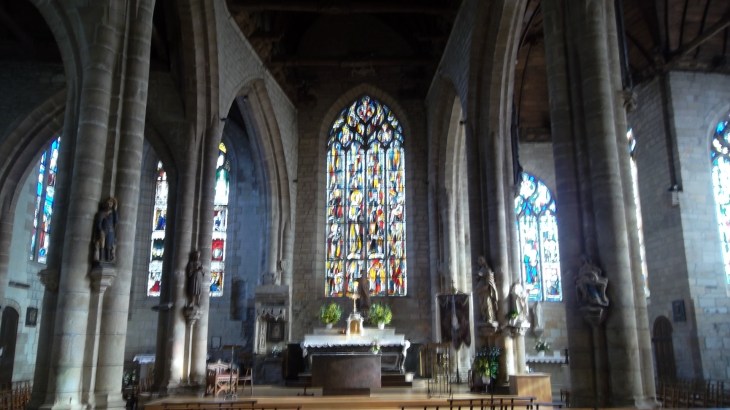
The Church Saint-Armel is the most emblematic and important monument of Ploërmel. Now holding the tomb of the Dukes Jean II and Jean III of Brittany! In the 13C, duke Jean II installed a Carmelite convent there where the dukes were buried. During the famous War of the Succession in Brittany (1341-1379), Ploërmel sided with the Montfort, who would be the ally of the English. In the 15C, Jean V made it one of the eight ducal bailiffs and increased patronage actions in Ploërmel, Tréguier, Le Folgoat, Kernascléden, etc. Still in the 15C, the city benefited from a general demographic boom, then, at the beginning of the 16C from the boom in Breton trade favored by political stability: Anne, Duchess of Brittany, was first of all the wife of kings of France Charles VIII , then Louis XII. It is undoubtedly for this reason that one took pretext of the collapse of the median bell-tower of the church, in 1508, to undertake an almost complete reconstruction of the building. This was done from 1511 and in a Gothic style, punctuated with Renaissance touches. As such, the north portal, associated with its famous west buttress, is a masterpiece of 16C sculpture. The massive bell tower, meanwhile, saw its upper half rebuilt in the 18C. As is often the case among Breton churches, Saint-Armel was built with granite for the elevations and wood for the vaults. Indeed, its large stained glass allows light to flood a nave punctuated by high arcades. The stained glass, which was among the most beautiful in Brittany, suffered greatly in 1944 (WWII), whether in the Renaissance stained glass windows or those of the 19C.

The most interesting outer part is to the north. It is there that the famous north portal stands, shining with bas-reliefs because it is there that the church opened on the commercial district and its stalls. There is now a large open space: the Place Saint-Armel .The tower, which rises to 33 meters, has a lower part that dates back to the 16C. An arrow once topped it. At the beginning of the 18C, the bell tower threatened to ruin and, in 1727, lightning finished it. The upper part is therefore demolished, which was rebuilt from 1733 to 1741. The north portal is the masterpiece of the external architecture of the church. Covered with sculptures on two levels, it is the illustration of artistic conception in the 16C. The two low-arched wooden doors are decorated with Apostles to which Saint Armel is added. On the upper level, on the pier and on the outside of the windows, you see a fairyland of sibyls, saints and prophets. Remember that the sibyls are the only pagan elements integrated into the Christian world. They received the power of prophecy from Apollo. The presence of all these characters indicates that the north portal encompasses all the times of human history: pagan with the sibyls, Old Covenant with the prophets, New Covenant with the Apostles and the saints
The tree of Jesse in the Church Saint-Armel is interesting in more ways than one. It shines above a door, in the south aisle 6.50 meters high and around 2.10 meters wide, it is often presented in tourist brochures as one of the most beautiful Trees of Jesse in Brittany – and of course it is guaranteed 16C. The vaults ceilings of the Church Saint-Armel are one of the marvels of the church. The large paneled barrel vault of the central aisle, built in the 16C, has three interesting elements: beams, sandpits and figurines. Awesome church indeed!
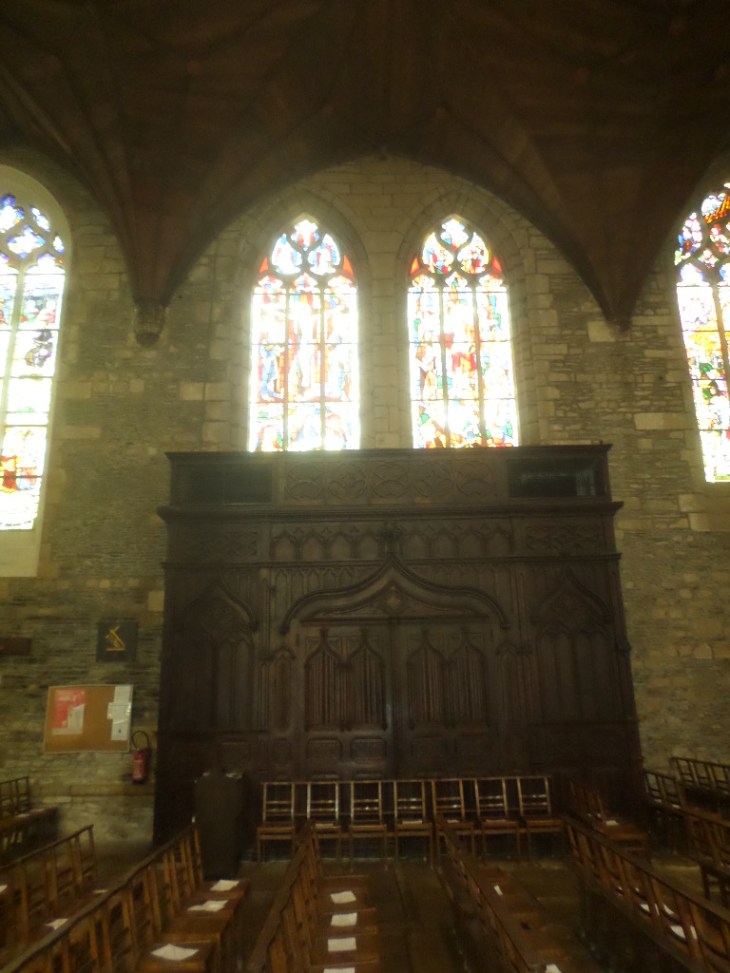
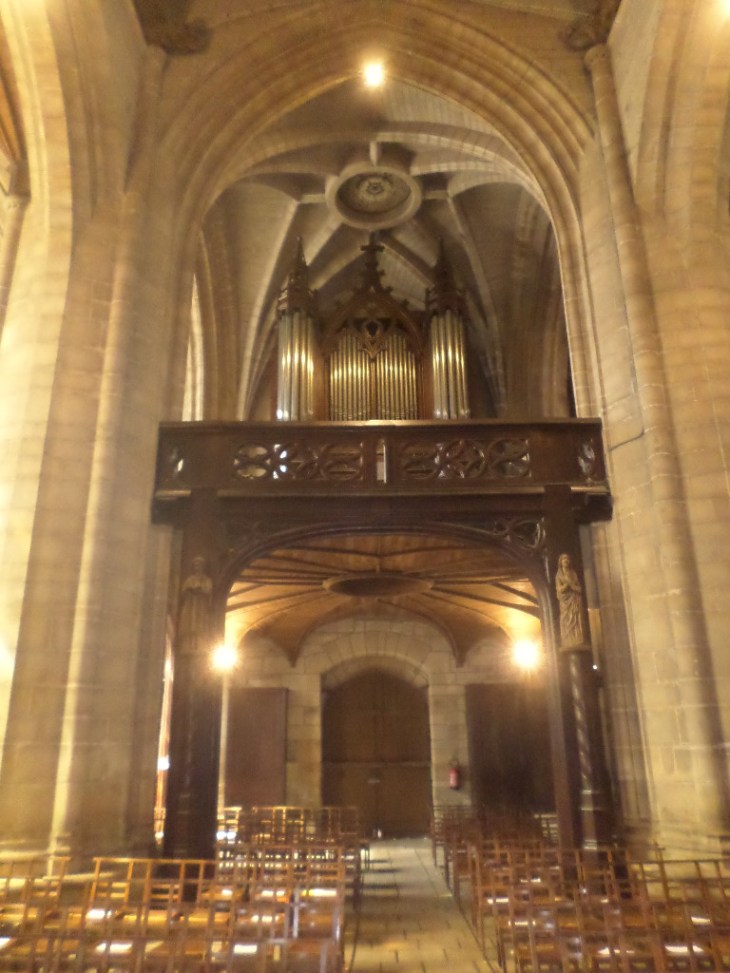
The Church Saint-Armel, founded in the 15C, was rebuilt between 1511 and 1602. The north portal, about 1530, presents scenes from the Gospel, and popular scenes. Inside, there is a wooden vault adorned with richly carved sand pits, stained glass including a Tree of Jesse , 1552, ornamentation, the tomb stone of the Dukes Jean II and Jean III and that of Philip of Montauban, Chancellor of Anne of Brittany. Originally the tombs of the two Dukes were placed in the Church of the Carmes. As the Church was destroyed by the League, the two tombs were moved to the Church of the Priory of St. Nicholas in 1591. Resettled in the new Church of the Carmes, they remained there until the French revolution. In 1790, the walls of the tombs were destroyed and the tomb was open. It was the General Council of Morbihan that restored the two tombs, in 1820, which were then deposited on a new and unique tomb placed in the Church of Saint-Armel.


The city of Ploërmel on its history: https://www.ploermel.bzh/histoire-de-ploermel/
The local Broceliande tourist office on the Church Saint Armel : https://www.broceliande-vacances.com/offres/eglise-saint-armel-ploermel-fr-2280243/
The local Broceliande tourist office on things to do and see in and around Ploërmel: https://www.broceliande-vacances.com/decouvrir/villes-villages/autour-de-ploermel/
There you go folks, another wonderful road warrior trip and plenty to do and see and eat! All in my beautiful Morbihan, in land for a change of pace from the coastal areas.Ploërmel is nice, vibrant city and gorgeous monuments Again, hope you enjoy the post on the Church Saint Armel of Ploërmel !!! as I
And remember, happy travels, good health, and many cheers to all !!!


