
We have come quite often to Nantes, a City that needs to be visited more by all. A wonderful historical city of my belle France , there are many monuments to see, many wonderful properties. I believe that this one is a must to visit in beautiful Nantes, Loire-Atlantique dept 44 of the region of Pays de la Loire, even if old Bretagne! You can always do search in my blog ot find more about Nantes. For now let me use some new older pictures in my blog with new text to tell you a bit more of the Cathédrale St Pierre et St Paul de Nantes ,part I !!! Hope you enjoy the post as I.

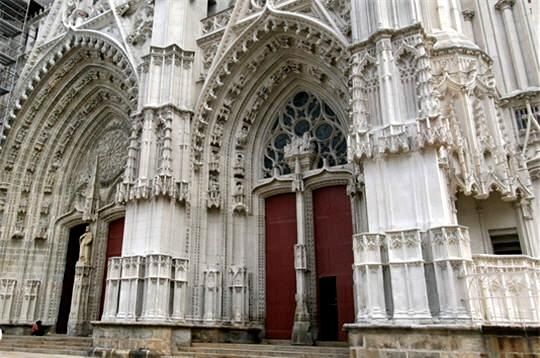
The Cathedral St Peter and St Paul has the following dimensions: A height:of 63 meters, interior mength: 103 meters; height of the nave under vaults: 37.5 meters. The facade of the Cathedral of Nantes is framed by two quite massive towers, at the top on the terrace. It presents some remarkable peculiarities, such as the presence of an external pulpit intended to preach to the crowds assembled on the square, or the organization in five gates to the richly decorated covings, three central and two lateral. The portals are dedicated, from north to south, to the affluent children (the Donatien and Rogatien martyrs), to Saint Peter, to the Last Judgement, to Saint Paul and finally to Saint Yves.
More than 1500 years of history are written around this St Peter and St Paul Cathedral, from the first pre-Romanesque cathedrals to contemporary restorations. With it unfolds the story of the first Christian communities, the epic of the Dukes of Brittany and the awareness of the heritage value of a historic monument to be completed and protected. A huge monument for Bretagne/Brittany too.
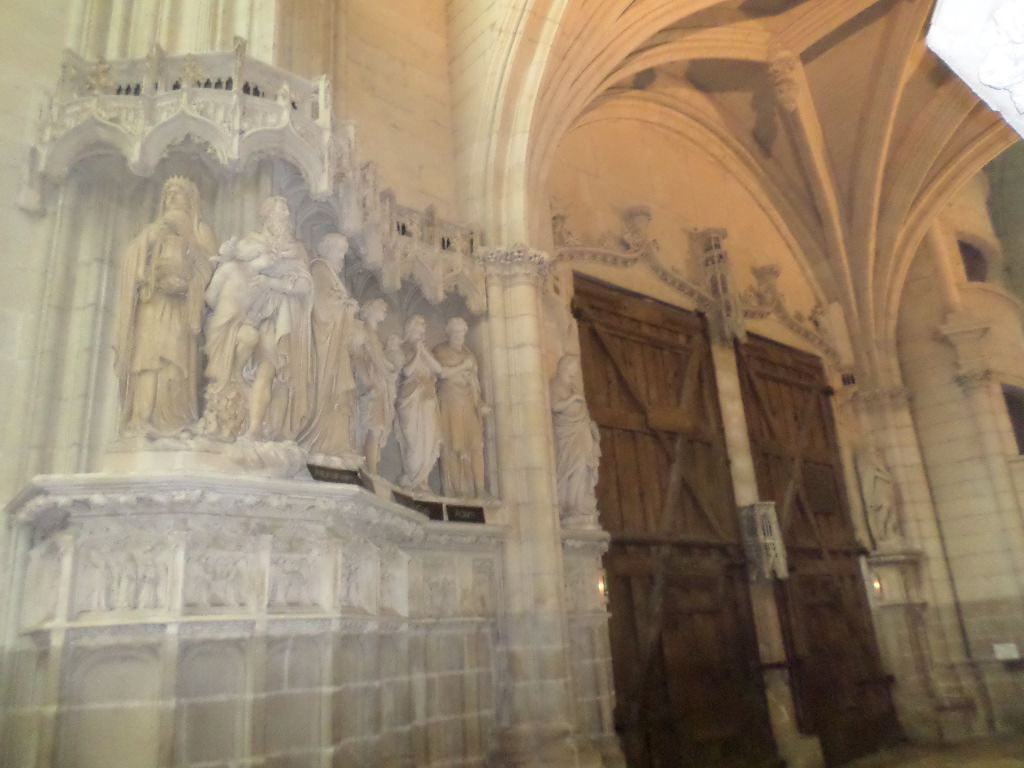
According to some written sources, a first cathedral would have been erected in the 6C. Between the 6C and the 9C, it is difficult to know what were the architectural evolutions of the pre-Romanesque cathedral. In 843, the cathedral was looted during a Viking raid ; a series of attacks ensued which ended in 936 when Alain Barbetorte, first Duke of Brittany, drove the Vikings out of Nantes, In 960, Bishop Guérech began the construction of a new cathedral whose appearance remains unknown today. It is likely that a crypt was dug under the choir at this time.
The Crypt is an 11C Romanesque style dating from the time of the second Cathedral. Endowed with pillars, it reveals the origins of Romanesque architecture. Objects of worship are exhibited there: Ciboriums, chalices, censers. A Crypt of Bishops, evokes the Bishops of Nantes by their tomb. Below, four open rooms of the 19C retrace the history of the Cathedral. The current Crypt, the only vestige of the Romanesque cathedral, was fitted out to house the bodies of Saints Donatien and Rogatien as well as some of the relics of Saint Gohard. Today, this crypt serves as a place of exhibition for the treasury of the cathedral. It is made up of works of art and religious objects, silverware, liturgical ornaments and a freestone model of the cathedral dating from 1632. The lower Crypt, for its part, was dug the end of the 19C to serve as a foundation for the new neo-Gothic choir. It hosts a permanent exhibition tracing the history of the cathedral.
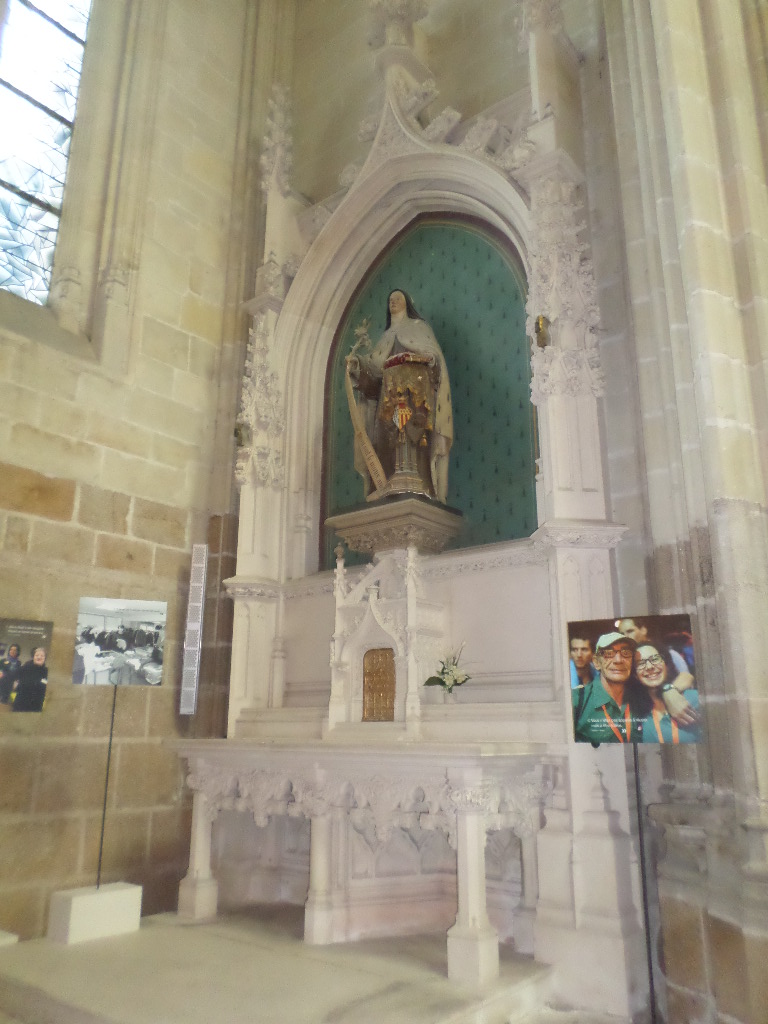
The construction of a sumptuous cathedral, reflecting the power, prosperity and ambitions of the duchy of Brittany, is fully in line with a new project. It was launched in 1434 by Duke Jean V and Bishop Jean de Malestroit. The frontispiece is made up of three portals decorated with decorations illustrating biblical scenes and characters. It is framed by two side portals dedicated to Breton saints: Donatien, Rogatien and Yves de Tréguier. Around 1520, the construction site was interrupted, due to a lack of financial means. At the beginning of the 17C, the construction site resumed, motivated by the reform of the Catholic Church and of the liturgy recommended by the Council of Trent. In 1626 the covering of the nave ,and the southern part of the transept 1642 were completed. The latter is pierced by a portal in its southern part which allows processions to cross the cathedral from south to north. A rood screen is high to hide the junction between the Gothic nave and the Romanesque choir. In the 18C, the vaults of the Crypt were destroyed in order to lower the level of the Romanesque choir. The space for the canons is thus enlarged and the faithful are closer to the altar.
During the French revolution, the St Peter and St Paul Cathedral suffered a lot of damage. It lost its original function and became a fodder store and then a military depot. Public festivals were, also celebrated there, which replace Christian ceremonies. The cathedral, already weakened by these degradations, was even more so when the powder magazine, installed in the castle of the Dukes, exploded. On December 25, 1891, the Saint-Pierre-et-Saint-Paul Cathedral was inaugurated.
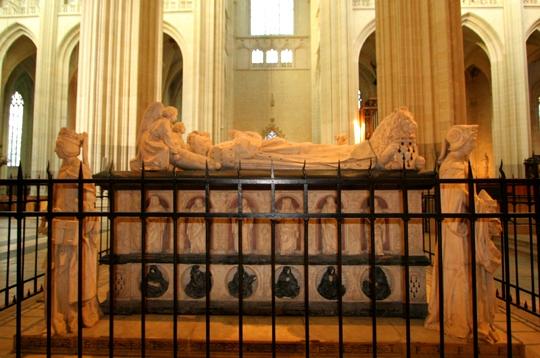
A must to see inside the Cathedral, me think are to admire the tomb and the recumbents of Duke Francis II of Brittany and his wife Marguerite de Foix (parents of Anne of Brittany) executed at the beginning of the 16C. Considered a masterpiece of French sculpture, it establishes a link between the eras (from the Middle Ages to the Renaissance) and the regions (the Italian style meets and harmoniously blends with the French style). This marble tomb, took five years to achieve (1502-1507), is decorated with the Twelve Apostles and four women who represent strength, prudence, temperance, and justice. It is installed in the Cathedral in 1817..
The Cathedral also houses the Cenotaph of General de Lamoricière, a monument erected in 1878 in papal homage to the services rendered by this child of the wealthy country.

The great Organ the documents testify to the presence of an organ in the Cathedral as early as the 15C, when the building was erected. The organ at the origin of the present instrument for the central part and dates from 1619. Ordinary ceremonies are usually accompanied by the choir organ, also known as the “small organ”, which is nevertheless the largest accompaniment organ of France.

An event of note with the Cathedral were that in front of the Cathedral, place Saint-Pierre, Nicolas Fouquet was arrested by d’Artagnan on September 5, 1661 by order of king Louis XIV. After having built Vaux-le-Vicomte (see post) and after some accusations of mishandling of money and jealousy.
The Cathedral of St. Peter and St. Paul , has some remarkable features, such as the presence of a well inside the building. In the past, water was to be fetch from this well in the Cathedral. To build the base of the pillars, granite, sturdier and more resistant to moisture than the Tufa stone, was used. The black spots are not due to the fire of 1972 but to the upwelling of the water. . St. Peter and St. Paul’s Cathedral (also locally known as St. Peter’s Cathedral It is the Cathedral of the Diocese of Nantes, seat of the Bishop of Nantes. Bringing this up as folks saw this post and maybe overlook that in the morning of July 18 2020 ,there was a fire at the Cathedral for malicious intention, with three different fires. Luckily , the fireman came in quickly and the fire was put out. Nevertheless the beautiful organs were gone completely burned as well as a portrait of the 17C. The first restoration work on the cathedral were planned for 2023 A partial reopening which does not seem possible before 2026 The Fondation du Patrimoineor heritage foundation has started a collection of funds to rebuild the organs. There still way to go to get it done: The official Fondation du Patrimoine on the Cathedral: https://www.fondation-patrimoine.org/les-projets/cathedrale-saint-pierre-et-saint-paul-de-nantes/67426
A bit of history I like tell us that the site would have been initially occupied by a Druidic temple dedicated to Janus or “Bouljanus
. Subsequently, three Christian religious buildings preceded the present Cathedral on the same premises: A basilica built in the 4C, A first Cathedral, built in the current of the century and a second Romanesque Cathedral, built in the 11C. The current Cathedral is built on the site of the latter, gradually absorbing it. The construction of the present Cathedral is under the impetus of the
Duke of Brittany Jean V and Bishop Jean de Malestroit, who lay the first stone in 1434. The central gate that adorns the façade is completed in 1481, for the great masses. King Henri IV crossed it in 1598, when she passed through Nantes to sign the Edict of Tolerance or Nantes. If the façade was completed at the end of the 15C, the towers were only in 1508; The nave and the collateral were also done at the beginning of the 16C, but the Gothic vault of the nave, the southern arm of the transept and the buttresses were completed in the 17C . During the French revolution, the Cathedral was used as a military observation post at the Siege of Nantes in 1793. A 10-meters-high wooden tower is built on the south tower, and surveillance is ensured by means of a telescope. Military decisions are made based on the information obtained here. During this period, it was transformed into an arsenal and a stable, then a departmental decree of 1794 formally devotes it to the celebration of public feasts The cathedral is threatened with destruction in 1796, and it is envisaged to extend the Rue du Département (now Rue du Roi-Albert) straight line to the Rue Brutus ( now Rue Prémion) facing the castle. The intervention, as an expert, by Mathurin-Julien Grolleau, avoids the destruction of the Cathedral. The demolition of the walls to the east of the city allowed the completion of the Cathedral in the 19C;: the north arm of the transept and the bedside were undertaken in 1840, the old Romanesque choir was shot down from 1876 and the old tower of the transept crusader in 1886. The Chandeliers of the nave are made around 1870. After 457 years of work, the Cathedral was finally inaugurated on 25 December 1891.
The official St Peter and St Paul Cathedral of Nantes: http://cathedrale-nantes.fr/
The Nantes tourist office on the Cathedral: https://www.levoyageanantes.fr/en/places/cathedral-saint-pierre-and-saint-paul/
This is a huge task more can be written about the cathedral so will let you read even if in French, more of this wonderful monument of Brittany and France, The Heritage Foundation of France on the Cathedral :http://patrimoine-de-france.com/loire-atlantique/nantes/cathedrale-saint-pierre-saint-paul-4.php
There you go folks, do visit Nantes ,and the St Peter and St Paul Cathedral is a must, you will be glad. Again ,hope you enjoy the post on the Cathédrale St Pierre et St Paul de Nantes ,part I !!! as I.
And remember, happy travels, good health, and many cheers to all !!!


