
This set is one of the wonders of my lovely Bretagne, deep rooted in traditions. We have visited most, some more pics than others but all wonderful. This one is up the alley from my house ,about 120 km. It is located in the village of Saint-Jean-Trolimon, in Pays Bigouden, and in the bay of Audierne, which it dominates at a height of 30 meters. This is in the Finistére dept 29 of my lovely region of Bretagne,and my belle France. Therefore, let me tell you a bit on the Chapelle Notre Dame and Calvary of Tronoën !!! Hope you enjoy the post as I
It is situated 28 km from Quimper, 9 km from Pont-l’Abbé , 6 km from Plomeur, 103 km from Brest, 583 km from Versailles, and 120 km from my corrent home from which we came along the D33 road dir Landevant to connect with the N165 expressway dir Quimper and get off at exit/sortie 52 Pont l’Abbé long loop to connect with the D365 road thru next roundabout continue dir Pont l’Abbé same road now Avenue du Morbihan then Bd Flandres Dunkerque 1940 then Bd Louis Le Guennec then big loop continue dir Pont l’Abbé now Bd de Poulguinan and the D785 road continue crossing the Odet rive on the Pont de Poulguinan on next roundabout bear right onto the Route de Pont l’Abbé passing by Plonéour-Lanvern the road becomes the D2 road on next roundabout bear right dir Saint Jean Trolimon on the Route de Saint Jean Trolimon then becomes Route de Pont l’Abbé and Rue de Pont l’Abbé same road passing thru center of the village of Saint Jean Trolimon bear right on the Rue du Cap Sizun or D57 road continue then left turn on Rue de la Croix , see panel for the Chapelle de Tronoën continue becomes Route de la Mer continue on Route de Tronoan to the Chapelle Notre Dame de Tronoën,
The Chapelle Notre-Dame-de-Tronoën is a 15C pilgrimage chapel and the Calvary, It is the oldest of the seven great Calvaries of Bretagne. The date of construction is between 1450 and 1470, according to what can be deduced from the characters dressed according to the fashion of the time of the King of France Charles VII. It consists of a rectangular base of 4.50 meters by 3.50 meters , two superimposed friezes separated by a drip edge, surmounted by three crucifixions: Christ and the two thieves. The structure and the majority of the sculptures are in Scaër granite, with the exception of three scenes (Visitation, Nativity and the Three Kings) carved in Kersanton which has better resisted the weather.
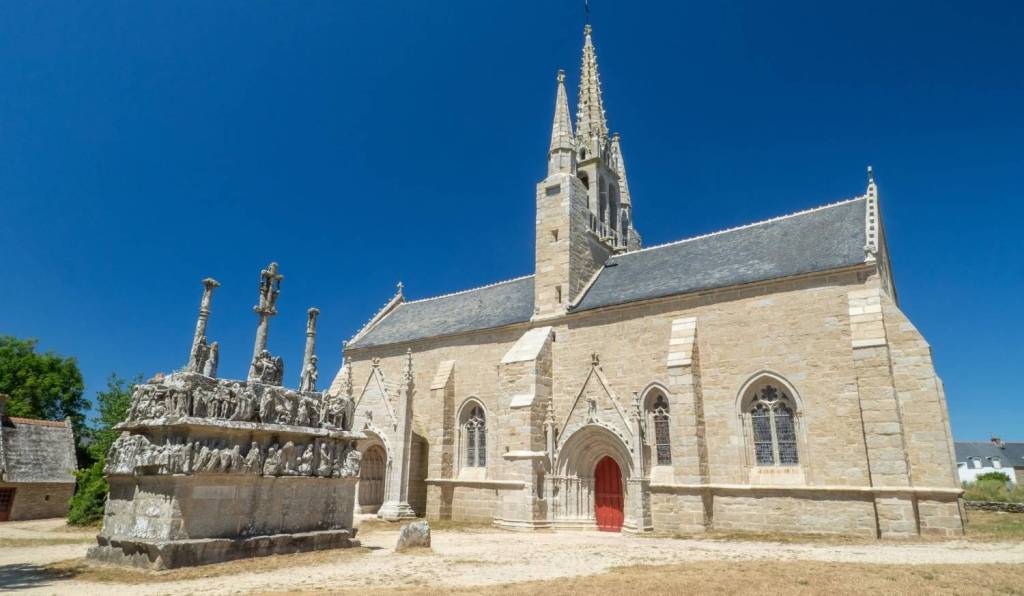
The wonderful thing to see here me think is the Calvary, It is the oldest of the seven great Calvaries of Bretagne. The date of construction is between 1450 and 1470, according to what can be deduced from the characters dressed according to the fashion of the time of the King of France Charles VII. It consists of a rectangular base of 4.50 meters by 3.50 meters , two superimposed friezes separated by a drip edge, surmounted by three crucifixions: Christ and the two thieves. The structure and the majority of the sculptures are in Scaër granite, with the exception of three scenes (Visitation, Nativity and the Three Kings) carved in Kersanton which has better resisted the weather. The tour of the Tronoën Calvary begins at the lower right corner of the eastern face, with the opening scene: the Annunciation. The subsequent scenes follow from left to right, in the conventional direction of reading. I will give a brief description,
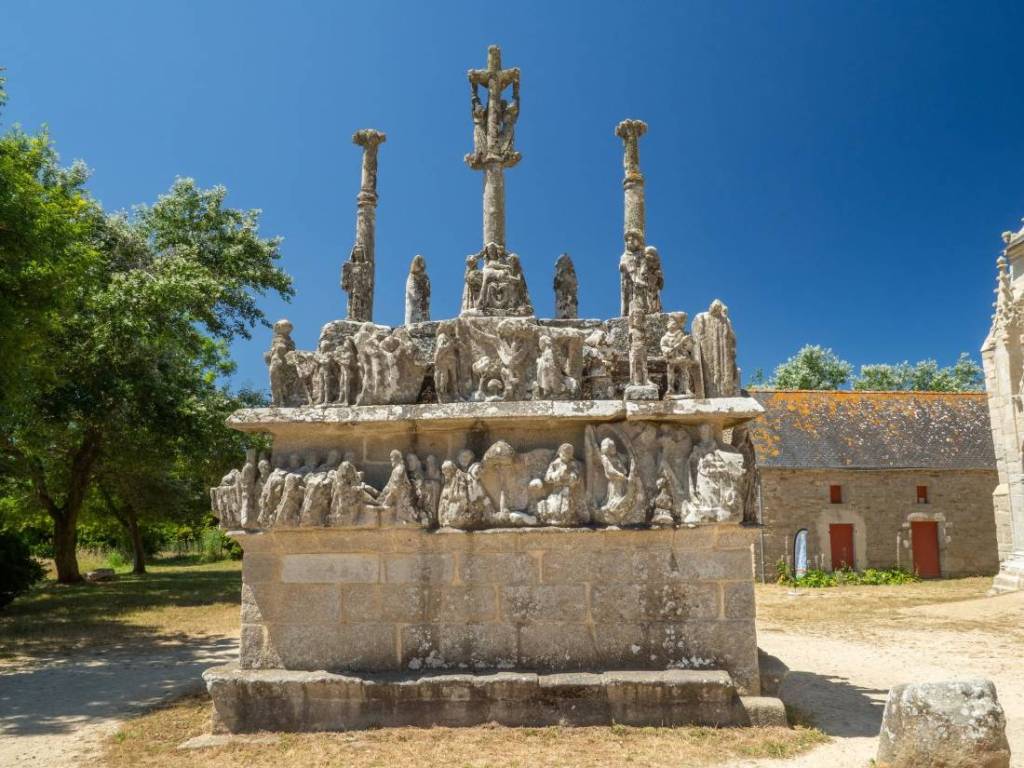
The Annunciation: The Virgin stands before a lectern holding holy books. The words spoken by the Archangel Hail Mary, full of grace…,and Mary’s response Behold the handmaid of the Lord; let it be done to me according to your word are inscribed along the coils of two long scrolls unfurling from the two figures. The Visitation: Mary visits her cousin Elizabeth, who is pregnant with Saint John the Baptist. Elizabeth welcomes her by touching her abdomen, recognizing Mary as the mother of the Messiah. Mary’s hairstyle is arranged to clearly reveal her ear the very point through which she received the divine announcement. Christ entered Mary through her ear, carried by the Archangel’s words. The Nativity: The Virgin lies within the manger , which is constructed as a simple wattle enclosure ,a rough interlacing of branches as described in the second chapter of the Gospel of Luke. The Virgin lies there with her breast exposed, a detail drawn from the apocryphal Gospel of Pseudo-Matthew to signify her virginity. Christ, already depicted as a grown child, points toward the scene of the Mocking in the register above, a premonitory allusion to his Passion, which Mary accepts with a gesture of offering, her arms extended and palms open. Jesus faces forward, already manifesting as Christ the Savior, and holds the orb of the world in his left hand.
Adoration of the Magi: the three kings arrive bearing their offerings. The Swooning of the Virgin Mary, supported by Saint John: this group includes the holy women, Mary (mother of James the Less), Mary Salome, and Mary Magdalene along with the apostle John. Presentation at the Temple: five figures are present Joseph, leaning on his T-shaped staff; Mary, presenting the infant Jesus to the high priest Simeon, who is dressed as a bishop; and, behind him, Anna the Prophetess . These two elderly figures represent the Old Law. Baptism: here, the scene is unusually depicted twice, separated by the figure of Saint Sernin, who wears the tunic of Christ. With his left hand, Saint John lightly touches Christ’s elbow in a gesture of familiarity. The Judgment of Pontius Pilate: on one side, Pilate and his servant; on the other, Jesus, flanked by two guards. Crucifixion: Christ on the cross inclines his head to the right, the side from which the Church will be born, emerging from the wound inflicted by the lance. Three angels blood-bearers carry four chalices, collecting the Precious Blood flowing from the wounds of the crucified Christ. A fourth figure, in a gesture of compassion, lifts Christ’s hair and crown of thorns at the top of the cross. The return of Christ in glory the Parousia, recalls the origin of sin and the redemption brought about by Christ and Mary, the second Adam and the second Eve, who preside over the resurrection of the dead. To the right stands a tree with Adam and Eve on either side, around which a serpent possessing a woman’s body and a human head coils in a spiral. The Resurrection marks the restoration of time, which had been diverted by Adam’s transgression, and the beginning of the reconciliation of humanity with God. Christ, triumphant, brandishes his cross like a banner of victory over death as he emerges from the tomb, startling two men who stand before him, their palms open and arms outstretched. The washing of the feet and the transmission of earthly authority to Saint Peter represent an act of humility through which Christ affirms his human nature.
I will then come to the Chapelle Notre Dame of Tronoën, rectangular in lay out with 25 meters long and 12 meters wide, consists of a main nave, two times two bays separated by a powerful diaphragm arch which supports a three-spired bell tower, a side aisle and a flat chevet, The bell tower dominates the bay of its 30 meters, placed in the center of the chapel, supported by the diaphragm arch. A central chamber of bells pierced by six arcades receives the octagonal spire and four pinnacles at the corners frame openwork pediments of small bays and oculi. The economic prosperity of the reign of the Duke of Brittany Jean V allowed the construction of a multitude of sanctuaries encouraged by the mendicant orders from the end of the 14C.
The fountain of devotion is located below the chapel , along the road that leads to the sea, the source is marked by an aedicule consisting of a niche surmounted by a pediment. It feeds a freestone washhouse and a pond.Reconstructed in 1995, the sacristy attached to the western gable and aligned with the chapel’s side wall features a rectangular floor plan. It can be accessed via a basket-handle arched doorway on the south side, or through an interior door located at the far end of the chapel’s northern side aisle.
Other things to see here are the Calvary and chapel of Saint-Evy, dedicated to Saint Evy who may be the same figure as Saint They or David of Menevia. This 17C chapel is situated near the village of Kerbascol, within the enclave of Gorré-Beuzec. On the north wing of the structure, there is a chalice carved into the granite, along with the date “1660.” A fountain is located at the corner of the nave and the south wing. The parish church is dedicated to Saint John the Baptist. The Kerfilin Calvary, erected in 1505, was toppled by a storm in 1970; its cross has since been restored to its original state. In 2021, it was repainted to reflect its original colors.
A bit of history I like tell us that the village is known for its role in the Bonnets Rouges or Revolt of the Red Caps, that took place in Brittany in 1675. It was within its territory at the chapel of Notre-Dame de Tréminou that one of the peasant codes was discussed and adopted. The revolt was against the high taxes of king Louis XIV
The Bigouden country local tourist office on the chapel calvary of Tronoën : https://www.destination-paysbigouden.com/en/what-to-see-and-do/history-heritage/chapelle-et-calvaire-de-tronoen-1503827
The Seven Great Calvaries of Bretagne on the Tronoën: http://www.7calvaires.fr/saint-jean-trolimon/
The village of Saint Jean Trolimon tourist office on the chapel and calvary of Tronoën: https://www.tronoen.net/le-site-de-tronoen/
The village of Saint Jean Trolimon on its history : https://www.saintjeantrolimon.fr/la-commune/histoire/
There you go folks, another gem hugely tradition in my lovely Bretagne ,and a must to see when in the region. The Chapel Calvary of Tronoën is beautiful and surely worth the detour. Again, hope you enjoy this post on the Chapelle Notre Dame and Calvary of Tronoën !!! as I
And remember, happy travels, good health, and many cheers to all !!!


My pleasure, thanks
LikeLike