
As I have mentioned several times, have many posts on my capital city of Vannes in my blog, A cornupia of wonderful places to see and things to do, feel free to browse, This time will do a new post with older pictures on the streets of Vannes,it is superbe to walk its medieval streets, and we love it, going km after km sightseeing on foot. We by now know Vannes by heart but it never amazes me to see so much beauty in its architecture and history untouched by the times. Let me tell you about the streets of Vannes, part II !!!. Hope you enjoy it as I.
The Place du Général de Gaulle is the street of the préfecture government building where the main body of employees are but not the one the public go to, This is just opposite the ramparts where I have several posts, The préfecture building is exactly at 10, Place du Général de Gaulle. The square was created during the construction of the Hôtel de Préfecture in 1863. It was formed according to old plans on the site of part of the gendarmerie barracks, formerly the Jacobins convent, and rue du Roulage, street opened in 1776. It is concomitant with the opening in 1863 of the rue Alain Le Grand, its outlet on the Garenne. Archaeological excavations, undertaken in 1999, during the renovation of the square, have brought to light vestiges of the Gallo-Roman era. By 15, place du General de Gaulle you have a nice above ground parking,
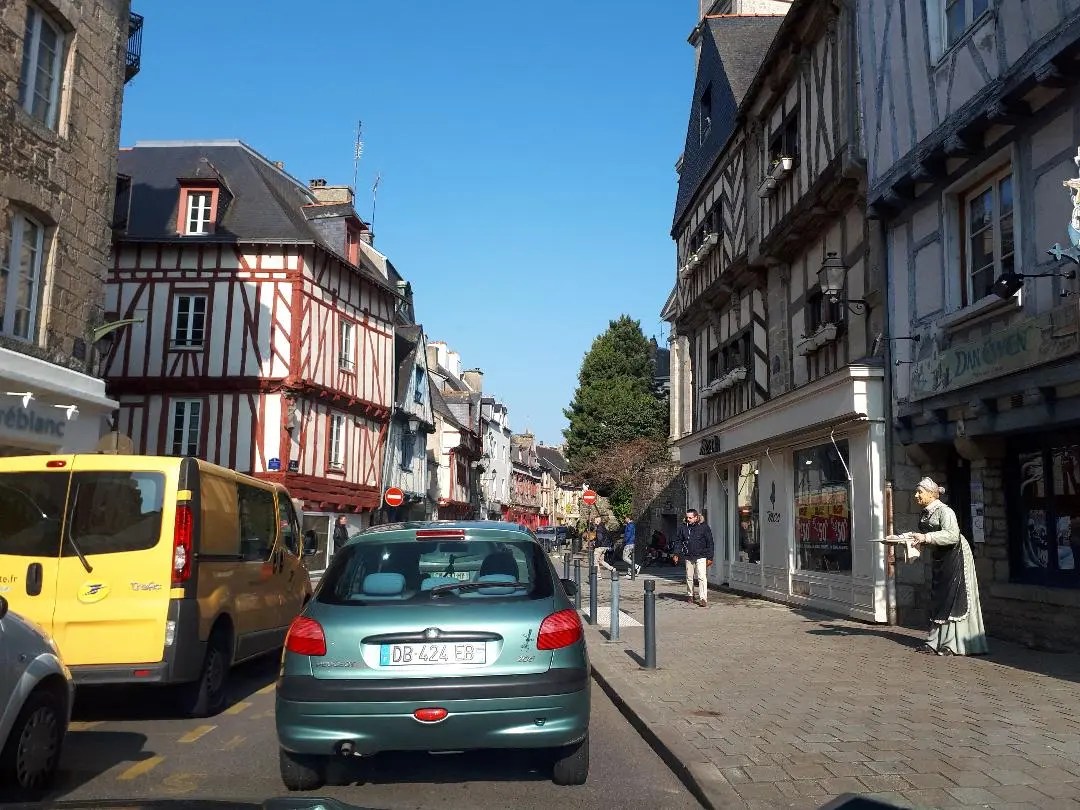
An anecdote here is that Charles de Gaulle came here from a day visit to Rennes in 1944, when Brittany was not yet completely liberated from the Nazis who still held the pockets of Lorient and Saint-Nazaire, Charles de Gaulle, head of the Provisional Government of the French Republic made another trip to Brittany from July 20 to 23, 1945. This trip included the following stops: Saint-Brieuc, Morlaix, Brest, Quimper, Lorient, Auray, Vannes and finally Saint-Nazaire, a little over two months after the definitive liberation of the Morbihan. He was accompanied by four ministers: Raoul Dautry, Minister of Reconstruction and Urban Planning, René Mayer, Minister of Transport and Public Works, Louis Jacquinot, Minister of the Navy, and finally René Pléven, Minister of Finance.
Some spots we have been and nice enough to post here are the bagel local specialists,Le Bagel Ouest at 15 Place du Général de Gaulle , and nice quant bookstore of Archipel des Mots, at 21 Place du Général de Gaulle.
The rue Alain le Grand created through the former garden of the Saint-Nicolas hospital, now the Claret garden, according to the plan of Marius Charier drawn up in 1861, to open up the new préfecture. Connecting street between the prefecture and the Garenne gardens. One nice example here is at 5 Rue Alain le Grand, This building was built between 1894 and 1906. It has a metal frame (Baltard type construction) and a T-shaped plan. of limestone (tuffeau), bricks, cast iron. Beautiful illustration of industrial art.(see post).

The rue de la Monnaie is a very old street where the mint was located from 1237 to 1488 and which from the cathedral descends to Place Lucien Laroche, The street is bordered by an old stripped plot where half-timbered corbelled houses were built. A project was taken up in 1860 and corresponds to a new north-south breakthrough, partly completed, to join the station to the port by crossing the rue du Mené and the center. In addition to the opening of the rue Billault and rue Victor Hugo, this breakthrough includes the widening of the rue de la Monnaie which sees the demolition of the old houses and the construction of new buildings. Some interesting half timbered houses here are at 5 rue de la Monnaie house rebuilt in the first part of the 20C on the site of an old half-timbered house of which there is a declaration made in 1677 for Guillaume Guitton, Sieur de Sourville and Dame Marguerite Billy, his wife, acquired by his parents in 1661. The house was built in alignment with the street on an old plot, and forms an L-shaped plan. At 3 rue de la Monnaie house built in the 16C. There is a declaration made in 1677 for Paul de Tredazo, knight, lord of Keriscouet and where it is mentioned that it was formerly called Maison Gueho, probably from the name of its previous owners.On the second square floor, the elements of old framework , crossbowman, leg and blocket are still visible indicating that the building had only one square floor originally and that it was raised in ancient times. , perhaps in the 17C, during the exile of the Parliament of Brittany to Vannes, caused great housing needs. In addition, the simple and modest fireplace on this same floor is a type of 15-16C attic floor fireplace as well as the wood used for the realization of this second square floor are of less strong section; which tends to prove an elevation of the house. The staircase has been redone on the site of the old staircase which was screw according to an oral information. The house was plastered in the 19C. The building is the subject of an enlargement at the rear in the rear courtyard on the first floor only. The ground floor has been modified. The exterior entrance steps to the house bear a date of 1889 which is not yet explained: it may be a reused stone. The main half-timbered body, gabled and corbelled, is double in depth, consisting of two rooms per level. Single-span house on a masonry base with 2 square floors and an attic floor with basement. The frame has regular posts with side reliefs and a spandrel cross of Saint-André. The front door of the house is on the side and gives access to a corridor in place on about half of the building and at the bottom of which the staircase starts. At 10 rue de la Monnaie house built at the beginning of the 20C (dated by the current cadastre as 1920) on the site of a garden or passage visible on the cadastre of 1844 and adjoining the house erected at the bottom of a much older plot. The reform of 1677 attached to this file corresponds to the building which was built in the rue de la Monnaie and which was demolished during its enlargement.
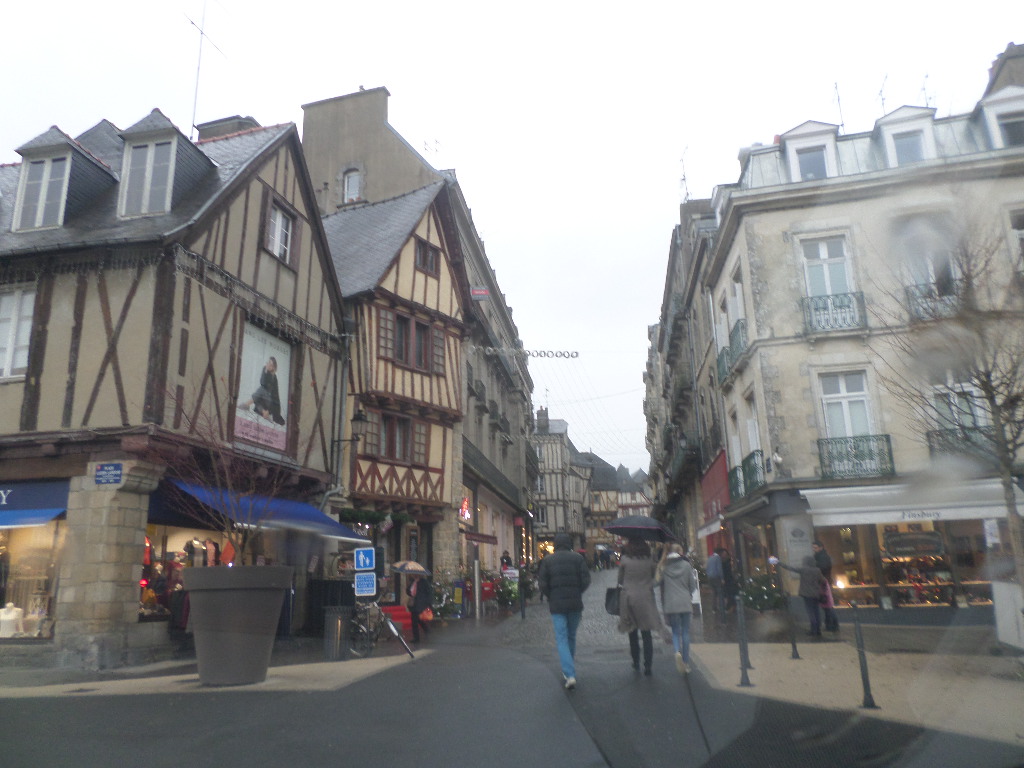
Some of the nice business we have stop by are the coffee grounder Brûlerie D’Alré at 11 rue de la Monnaie, and the always reliable L’Occitane en Provence, at 10 rue de la Monnaie.
The rue du Bienheureux Pierre-René Rogue ,the history tell us that in the rentier of 1455, the part corresponding to the rue du Bienheureux Père René Rogue was the street of “lapaticerie” and of the “Leterie” at a certain time. This corresponds to the activities of the inhabitants of the street in the Middle Ages. In the 17C, research showed that the street was occupied by external students of the Saint-Yves college (middle school), This explains its name, Rue Latine, before its current name. It is a street that still contains many medieval stone and timber-framed dwellings. These dwellings underwent extensive alignment work in the 19C, which led to the removal of corbels and stalls when wooden shop fronts were installed. A good example is the house at No. 3 with a gable end on the street, built on a narrow plot with a courtyard and well. The courtyard is separated from the street by a boundary wall pierced by a chamfered round-arched door. It is a half-timbered house with corbels preserved only for the slate-lined gable. The house has two square floors and an attic floor that connected to the neighboring house via a valley in the roof, all on a stone base. The house still has a wooden staircase with balusters and an old fireplace with columns on a drip wall upstairs. The facade includes a two-story lean-to gallery. The other facade features the famous round busts of Vannes et ces Femmes or Vannes and his wife (see post).
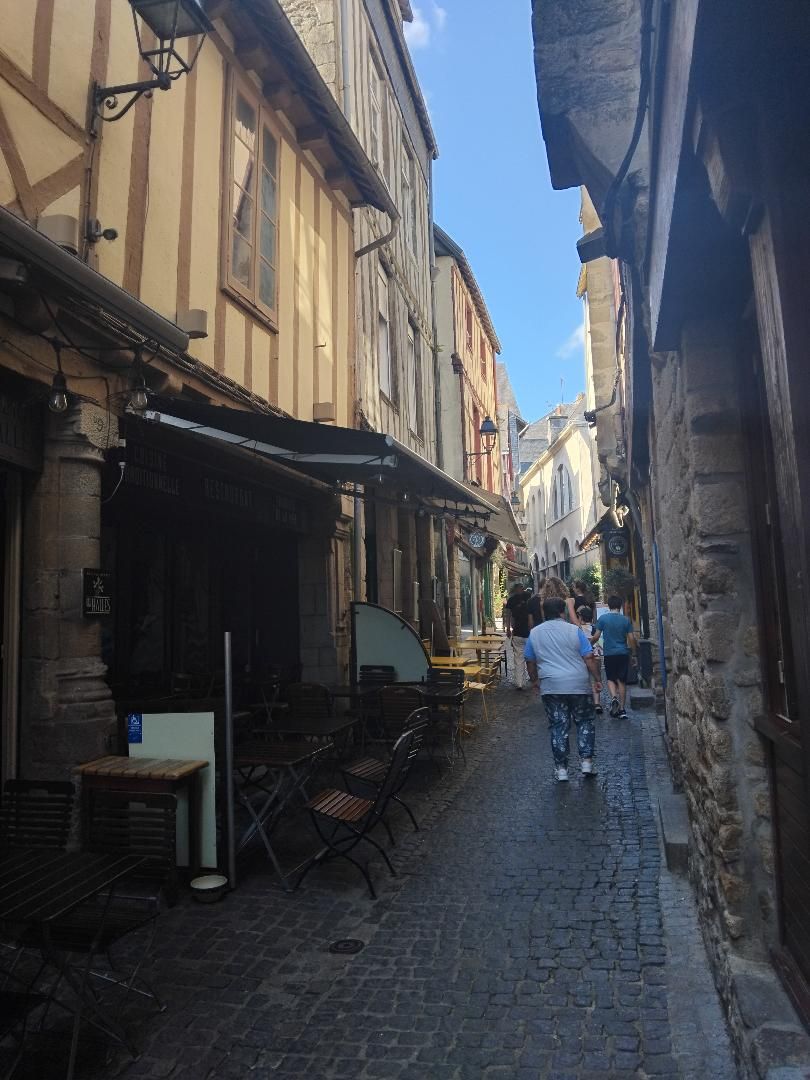
I need to tell you who is name for this street a very vivid story that you can actually see inside the St Peter’s Cathedral in Vannes, (see posts), Pierre René Rogue was born in Vannes on June 11, 1758, on Rue de la Monnaie (near Place des Lices). He was baptized that day at the cathedral. His father died while traveling and never saw his son. His mother moved to 31 Place des Lices. At 17, he completed his brilliant studies at the Collège St. Yves (now the Collège Jules Simon). In 1776, he entered the Grand Séminaire (now the Foyer du Mené). To reach the cathedral, the Porte St. Jean was opened for the seminarians. This seminary has been entrusted to the Vincentians Congregation of the Mission since 1702.This community of priests is responsible for the parish of Notre Dame du Mené. On September 21, 1782, Pierre René Rogue was ordained a priest in the church of Notre Dame du Mené. He became chaplain of the Women’s Retreat. He entered the Congregation of the Mission (disciples of St. Vincent de Paul) on October 25, 1786. In 1787, he was appointed professor of theology at the Vannes seminary. On December 16, 1790, under the inspiration of Pierre René Rogue, Bishop Amelot summoned his diocesans to Sainte Anne d’Auray (see posts) to ask them to obey the Pope rather than the State. The priests of Vannes therefore refused the oath. On February 14, 1791, the superior of the seminary was forced to leave Vannes, and Pierre René replaced him. On February 28, the bishop was arrested and imprisoned. On April 30, 1791, the parish of Notre-Dame du Mené was abolished. Eight months later, on January 2, 1792, Pierre René took refuge with his mother. From then on, he gradually went into hiding. He frequently changed his address to be able to discreetly exercise his ministry. On December 24, 1795, around 21h, Pierre René was arrested while carrying viaticum to a sick person, at 9 rue Emile Burgaut, not far from the cathedral. He was immediately imprisoned at Porte Prison (see post). During his incarceration, he found the strength to give courage to his companions. Two months later, in the Notre-Dame du Mené church, then transformed into a Revolutionary Tribunal, Pierre-René was sentenced to death as a “refractory priest” on March 2, 1796. On March 3, he was guillotined on the Place de l’Hôtel de Ville, opposite the St. Yves chapel. On May 10, 1934, Pierre-René Rogue was beatified as a martyr of the Eucharist. Since then, his body has rested in the Saint Peter’s Cathedral.
The Rue Thiers, formerly rue des Douves du Port planned on the embellishment plan of 1785 to rectify the layout of the old street of the Douves du Port . The construction of the Halle aux Grains is accompanied by a vast urban project which, provides for the rectification and the recovery of the streets of the port , which will become Rue Thiers, as well as the opening of rue Autissier which will connect to rue des Bons Enfants ( today rue Richemont). This street is undoubtedly the first street that comes to mind as the longest but is only 550 meters. On February 4, 1879, a prefectural decree attributed its name to Adolphe Thiers, former president of the French Republic. Some remarkable buildings here are the Maison des Trois-Piliers or house of the three pillars at 1 rue Thiers ;it was a merchant house built in the last part of the 16C. The date of 1663 worn on the right drop wall of the second floor of the neighboring house during the elevation of the wall indicates for some of the reshuffles operated on this date it would have been an inn under the old regime (monarchy). It became the official store of Rugby Club Vannes, 1st Breton club to reach the Top 14 in 2024, Also the Hôtel Limur at 31 rue Thiers (see post) acquired by the city in 1947, transferred to the State in 1980 and recovered by the City in 1991, The Hotel , retains the name of the Limur family who owned It from 1820 to 1947.It houses today, the Architecture and Heritage Interpretation Center (CIAP).
The rue Thiers starts really by the Hôtel de Ville and bordering the old town of Vannes. It’s a street full of shops, restaurants and passes by the Place de la République. It ends at the traffic circle or rond point du Port on the harbor or Le Port of Vannes. The Hôtel de Ville or City/Town hall, is located on Place Maurice Marchais, was built between 1880 and 1886. This part really faces rue Thiers. The rue Thiers ends at Place Maurice Marchais. The other part of the municipal services of the town is in the municipal administrative center located rue Joseph Le Brix ,diagonally across the street !. The rue Thiers starts really by the Hôtel de Ville and bordering the old town of Vannes. It’s a street full of shops, restaurants and passes by the Place de la République. It ends at the traffic circle or rond point du Port on the harbor or Le Port of Vannes. The Hôtel de Ville or City/Town hall, is located on Place Maurice Marchais, was built between 1880 and 1886. This part really faces rue Thiers. The rue Thiers ends at Place Maurice Marchais. The other part of the municipal services of the town is in the municipal administrative center located rue Joseph Le Brix ,diagonally across the street !
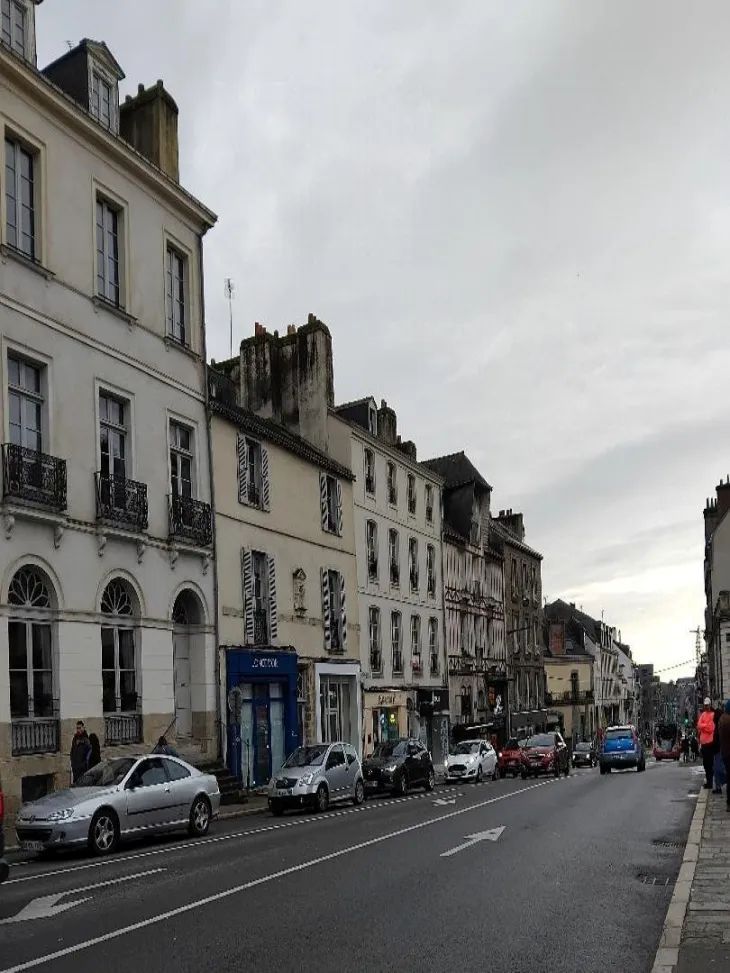
Some interesting things to see on rue Thiers (see posts) are :1 rue Thiers : Merchant’s house built in the latter part of the 16C. The date of 1663 worn on the right gutter wall of the second floor of the neighboring house during the elevation of the wall indicates for some of the alterations made on this date such as the demolition of the rear room and development at each level of a corridor between the spiral staircase and rooms and construction of an additional body posterior to the neighboring house, and others the construction of this house. The house belongs in the regards and the reformation of the royal domain of 1684 to the heirs of the “nobles Pierre Les Moyne” merchants on the port. It would have been an inn under the Ancien Régime.
3 rue Thiers is the former Chapelle des Ursulines or Chapelle de la Sainte Famille or Holy Family within the walls of the Saint-François-Xavier middle /high school. The chapel, placed under the name of the Holy Family, was built between 1688 and 1690 to serve the Ursuline convent. This convent was built between 1627 and 1670 to accommodate a community of nuns from Tréguier. The convent, except the chapel and the sacristy, was sold during the French revolution, later it was erected an oratory in the chapel in 1802 . From the convent, burned in 1949 and largely rebuilt, only this chapel remained, transformed into a library on two levels. Only the facade has retained its 17C appearance.
4 rue Thiers, is the headquarter of the Maison des Plus Belle Baies du Monde or house of the most beautiful bays in the world founded at Vannes (which includes the Gulf of Morbihan).
18 rue Thiers : House probably built in 1880 for Joseph Bernard, roofer, on the old ditches cut into gardens between the bastions of Brozillay and Haute-Folie. According to the archives, the house is built on the same plot as the neighboring house and by the same presumed family-sponsor. The rear outbuildings indicate the existence of a business at this location, probably that of the owner. In 1913, its known that the house is the headquarters of the General Coffee Warehouse Co.
31 rue Thiers, Hôtel de Limur. The construction of the Hôtel des Douves , former name of the Hôtel de Limur, probably begins around 1685. By 1748, begins the long and chaotic destiny of the Hôtel de Limur. It was acquired by the City in 1947, ceded to the State in 1980 and recovered by the City in 1991. It retains the name of the Limur family who owned it from 1820 to 1947
The City of Vannes on the house Rue Thiers: https://www.mairie-vannes.fr/maison-1-rue-thiers
The city of Vannes on its heritage : https://www.mairie-vannes.fr/decouvrir-le-patrimoine-vannetais
A nice phone book of streets of Vannes, very useful indeed :https://www.annuaire-mairie.fr/rue-vannes.html
There you go folks, I told you walking is best anywhere and in Vannes city of older days it is heavens. The streets of the city are full of history and with great looking architecture as evidence by my many posts on Vannes in my blog. Again, hope you enjoy the streets of Vannes, part II !!! as I
And remember, happy travels, good health, and many cheers to all !!!

 Paris1972-Versailles2003