
And I continue my journey into wonderful travel corners of our world with my family, many nice memories, today more than ever. I am updating this older post with new text/links for you and me, This is the fortified city of Hennebont in my beautiful Morbihan dept 56 of my lovely Bretagne and in my belle France. Therefore, here is my take on the Church Saint Caradec of Hennebont !! Hope you enjoy the post as I
I went back to one of my favorite towns to spent the day on secondary roads. Hennebont is a nice fortified city with ramparts by the river Blavet. I live less than 30 minutes by car from it so it’s a natural weekend gateaway for us. I took the scenic road D768 direction Quiberon, (you can take it from the voie express or freeway of the N165) but at Plouharnel just before crossing the isthmus to Quiberon peninsula you take the road D781 direction Erdeven/Lorient continue following direction Lorient until you see the sign for Hennebont, take the second traffic circle into Hennebont Centre and you come right underneath the viaduc into the center of town, centre ville or downtown. Do read the individual posts on the things to see here!
The Church Saint Caradec is located at the foot of the former motte-and-bailey castle in the Old Town or Vieille-Ville at the intersection of Rue Saint-Caradec and Rue du Guiriel, The parish has been documented since the 13C. The current church dates primarily to 1777 (the foundation stone was laid on April 17, 1777 and is characterized by a sober, austere style. It was later expanded through renovations and the addition of side chapels and side aisles during the late 19C, and early 20C. The adjacent cemetery contains an ancient yew tree nearly 400 years old as well as a tomb traditionally attributed to Saint Caradec, a Welsh monk and evangelizer who died on April 13, 1124.
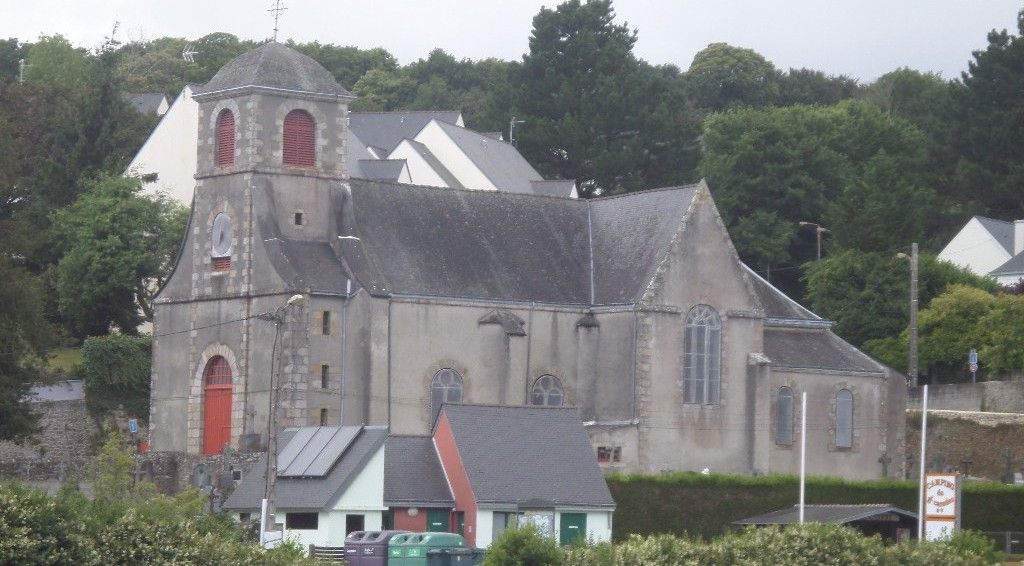
The Church Saint Caradec is located at rue Saint-Caradec, on the right bank of the Blavet river. The parish created by Henri d’Hennebont to satisfy the population living in the old town around the castle, seat of Kemenet-Héboé, a large lordship at the time .In 1901, the last restructuring added choir aisles and vaults. Inside, rarely accessible since it has been closed for at least 10 years, we would see an ex-voto in painted wood and a statue of Saint Isidore in polychrome wood, dating from the 18C. The neighborhood preserves multi-story dwellings dating from the 18-19C, mostly finished in pastel-colored render and featuring windows framed by shutters.
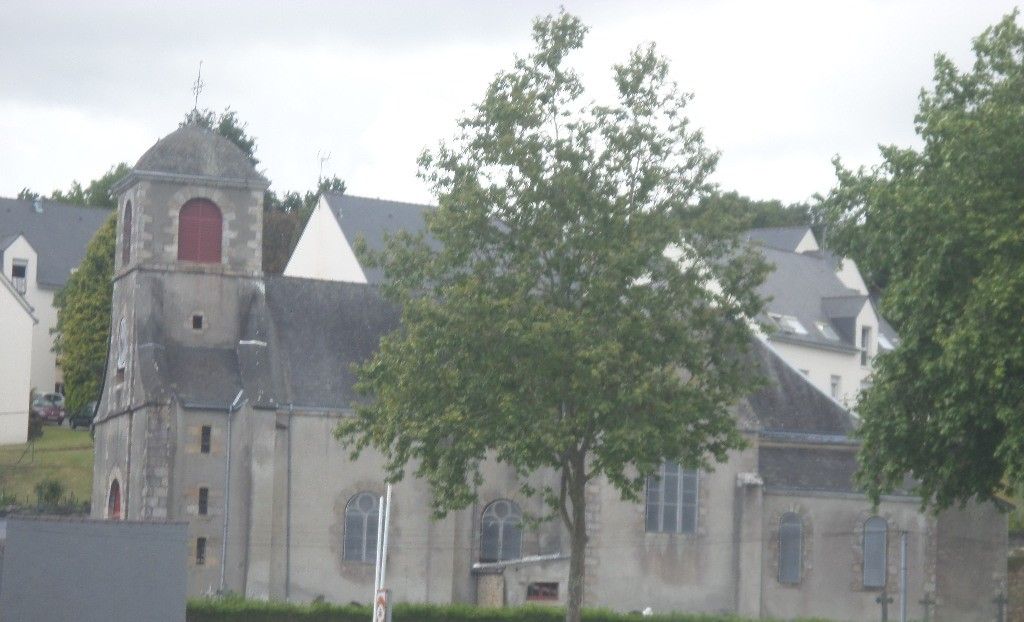
As an anecdote,i t was in this church, in December 1936, that the funeral of Prince Albert II of Monaco’s great-grandfather, Count Maxence de Polignac, took place; he has been interred since 1936 in the family vault in the cemetery adjacent to the church. It is through one of the Count’s sons Pierre, born in 1895 in Hennebont, who completed his early education in Lorient, that Prince Albert II traces his lineage to the Polignac family. On March 19, 1920, in the Cathedral of Monaco, this native of Hennebont married Charlotte Grimaldi, the legitimized daughter of the future Louis II.
A bit more on Saint Caradec tell us that there have been several figures known as Saint Caradec or Saint Carantec often conflated over the course of history who are semi-mythical Breton saints not officially recognized by the Catholic Church. One such figure, Caradoc, was born into an illustrious family in the county of Brecon, Wales, and lived during the 12C. He served as a harpist to King Rhys. Having fallen out of favor over a trivial matter, he chose to turn toward God, entering service at Llandaff, where he received the clerical tonsure. Thereafter, he played his harp solely for God. He spent some time at the church of Saint Teilo, before becoming a hermit near an abandoned church dedicated to Saint Cenydd or Saint Kinède. Eventually, his reputation for holiness reached the Archbishop of Menevia ,the Bishop of St David’s, who ordained him as a priest. He then withdrew with a few companions to live as a hermit on Barry Island, in the county of Glamorgan. By order of the Archbishop of Menevia, he and his companions moved to the monastery of Saint Ismael or Ysam in the land of Ross ,likely in County Galway, Ireland, a territory that had been annexed from the ancient Britons by the English. Following the miraculous healing of Richard Tankard, a powerful English settler, through Caradoc’s prayers, the monastery received both protection and endowments.
He died on Sunday, April 13, 1124, and was buried in the church of St David in Menevia. Years later, his body was discovered to be incorrupt and was subsequently translated with due solemnity.
The city of Hennebont on its religious monuments, see church: https://www.hennebont.bzh/decouvrir-hennebont/patrimoine/decouvrir-hennebont-au-fil/hennebont-au-fil-du-sacre/
The local Lorient South Brittany tourist office on Hennebont: https://www.lorientbretagnesudtourisme.fr/fr/immanquables/hennebont/
The Bretagne region tourist office on Hennebont: https://www.brittanytourism.com/destinations/the-10-destinations/southern-brittany-morbihan-gulf/hennebont/
There you go folks, you can easily spent a full day here, on your way to the beaches or the other wonderful towns of magical beautiful Morbihan dept 56. Kenavo!! (Breton language means Au revoir, Goodbye). Again, hope you enjoy the post on the Church Saint Caradec of Hennebont !! as I.
And remember, happy travels, good health, and many cheers to all !!!


