
And here I take you again,way north of me to the tip in the peninsula of my lovely Bretagne. One of the off the beaten path towns of the Finistére ,and seldom over look for its distance from the mainstream. However, it is worth a detour for its sea and Breton traditions. I have to say this was the main reason came here and i am a proud donor since 2008 ! I took new pictures from my trip this week that should be in my blog for you and me, Therefore, let me tell you on the Abbaye Notre Dame des Anges of Landéda-Aber Wrac’h !!! Hope you enjoy the post as I.
The town of Landéda is in the Finistère department no 29, of my lovely Bretagne region ,and in my belle France. A coastal town on the English Channel coast, in the heart of the Côte des Légendes, Landéda forms a peninsula between two abers, Aber-Wrac’h to the north and Aber-Benoît to the south, the very jagged end of which itself forms the Sainte-Marguerite peninsula. It has 15 km of coastline, The town of Landéda has several islands in its municipal territory such as Île Guénioc Island, located 2 km from the coast, it is approximately 400 meters long and 160 meters wide at its widest point. Guénioc Island is of great interest due to the numerous archaeological remains preserved in a remarkable way. The presence of cairns containing dolmens, the construction of which is estimated at 4,600 years BC (Neolithic), makes this place among the oldest monuments in Europe Île Garo, Île Roch’Avel where the remains of a galgal, a megalithic tumulus, remain Île Tariec iit bears the name of Saint Tariec and was inhabited, having its chapel and cemetery. In 1842 the island was cut in two by erosion accelerated by sand extraction, hence the Grande Tariec and Petite Tariec, the two current islets; Île Cézon is accessible at low tide and is part of a group of well-known islets. The fortifications of Fort Cézon surrounding it were built by Vauban from 1694 and then transformed over the centuries until WWII, during which 17 blockhouses were erected., and Île Stagadon , located at the entrance to Aber-Wrac’h, is administratively part of the town of Plouguerneau. The islands opposite Aber Wrac’h, also called the Lilia Islands archipelago, Île Wrac’h and its lighthouse. Île Venan, Île Vierge . Île Terc’h or Erc’h (aka Île aux Americans).Île La Croix , Île La Malouine. Île Enez Vihan. Petites îles Vrac’h, Île Leac’h Venn ,and île Valan.
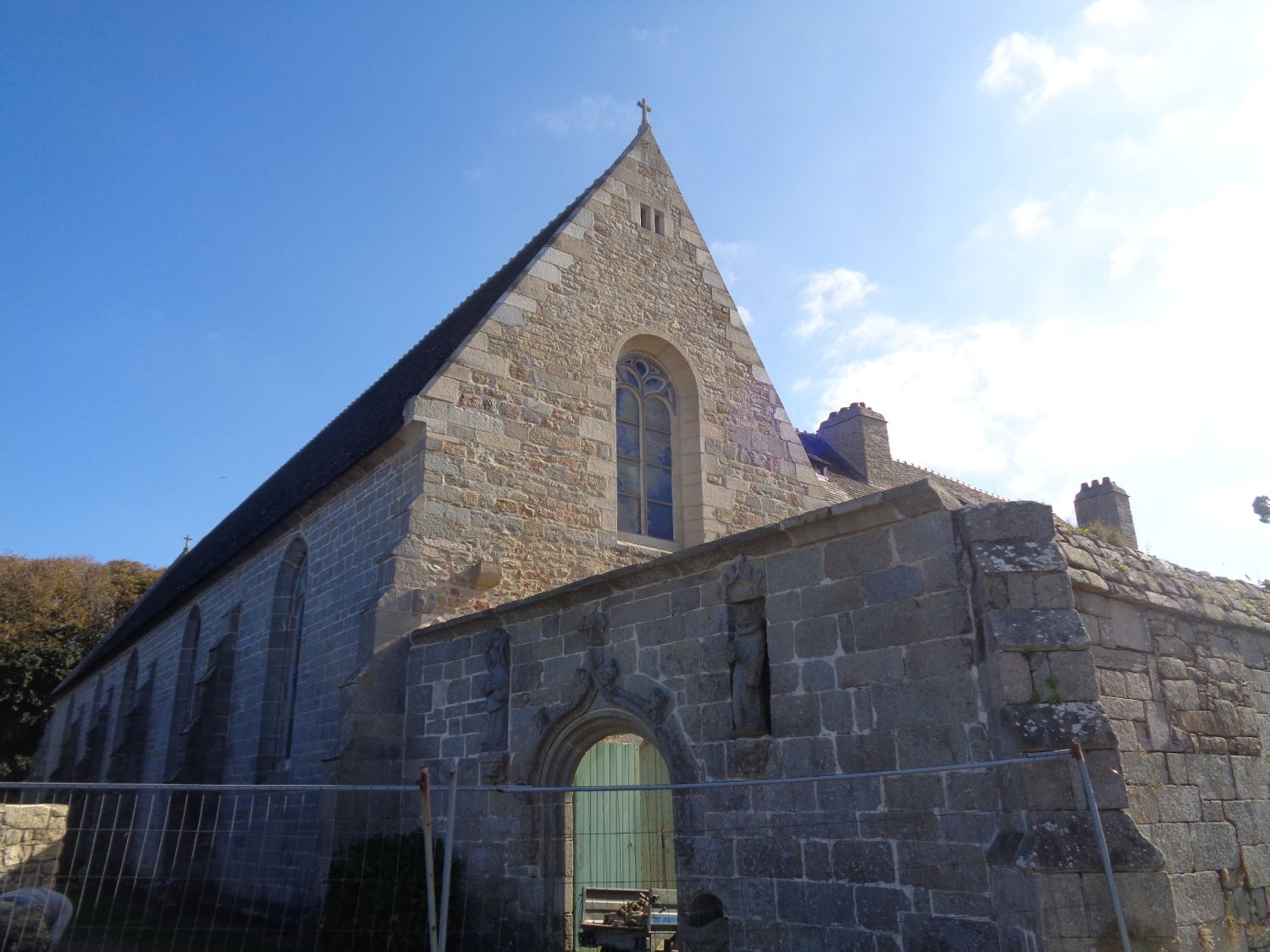
The Abbaye Notre Dame des Anges or the Abbey of Our Lady of the Angels is an exceptional monument, a testament to Breton art and culture from the early 16C. Currently undergoing renovation, its quality bears witness to the wealth and power of Tanguy du Chastel, Lord of Trémazan, Captain of Brest, and its founder. Surrounded by its original enclosure, overlooking the plage des Anges beach, its gardens, its woods, its spring, and its pools form a unique site that has been preserved for 500 years. The Abbey of Angels is a half-millennium-old Franciscan convent, wonderfully located on the banks of the Aber Wrac’h yet little known. Founded in 1507 by Tanguy du Chastel, occupied by a community of Observants, replaced in 1643 by Recollects, the convent experienced prosperity followed by a long decline in the 18C before sinking, like so many others, into the revolutionary turmoil. The use of the convent buildings as an inn in the mid-19C, then their transformation into a residence saved most of it from ruin. The cloister and the chapel were less fortunate; converted into a warehouse, the latter slowly deteriorated before its roof collapsed in 1917. In the year 2000, Robert and Chantal Tétrel became the owners of the premises and set about resolutely saving the former convent. An association was created to promote and enhance the site.
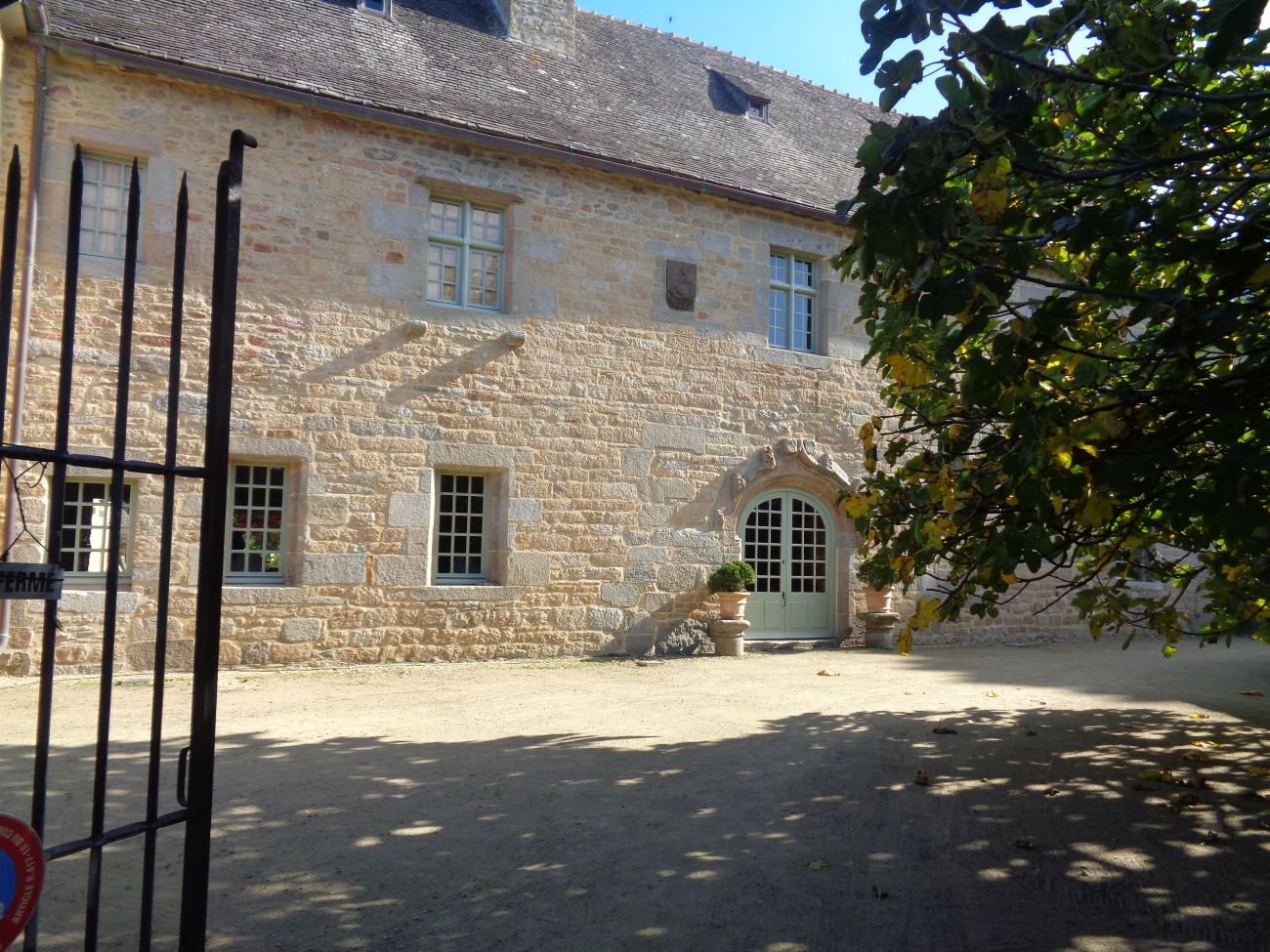
At the dawn of the 12C, Francis of Assisi, a cloth merchant by trade, renounced worldly life to serve Lady Poverty in humility and joy. Neither a priest nor a monk, Francis first became a hermit, soon joined by a few companions who became the Franciscans. In Brittany, concerns about poverty and humility prompted some of the Observant Friars to seek out isolated sites within their foundations, thus following the tradition of the Celtic hermits. Convents were then established on islands close to the coast. By the 15C, friars had already been established on Île Vierge for some time. Subsequently, they gradually returned to dry land. It became good policy to establish one’s importance and ensure the salvation of one’s soul to contribute financially to the establishment of a Franciscan community on one’s territory: this is what Tanguy du Chastel and his wife Marie du Juch did at Aber Wrac’h in 1507. The Hôtellerie des Anges in 1649, the convent is usually inhabited by eighteen religious and welcomes others who come to recover their health when they are sick. Built on land belonging to the Kermavan family, which became Carman in the 18C, the former Notre-Dame-des-Anges convent was built over a period of 80 years. The first authenticated stone was laid on the fourth Sunday after Easter in 1507, the last was probably laid in 1586, a date inscribed on one of the arches of the south barn. Access to the convent was via along the bay from the harbor of Aber Wrac’h. A first piece of land located outside the walls offered a long stone bench which allowed visitors to wait for the doors to open. Visitors entered through a door decorated in the style of the period, with cabbage leaves, a holy water font and two niches which, since 2009, house a Saint Mary of the Angels and a Saint Francis. One then entered the gatehouse from where it was possible to go to the chapel, the guesthouse or the convent areas. A little beyond, the surrounding wall was pierced by a cart door and a small pedestrian door, since closed, used for ordinary activities. In their center was the cloister, in the shape of a square, a symbol of perfection, and its fountain, a sign of purification. To the north of the cloister, in the extension of the gatehouse, stands the convent chapel, with a length of 116 feet; to the east is the Chapel of the Dead where the dead were watched over, especially those who died at sea, who were numerous in this region; then a prison was established, no doubt for the rebels of this harsh country, and the chapter house, the community meeting place. To the south are the refectory, the kitchen and the office. These two buildings, east and south, have now disappeared. Left unused in the 19C, they gradually fell into ruin due to lack of maintenance. Upstairs there were about twenty cells for the choir brothers and several study rooms. To the west, the hostel closes the fourth side of the cloister, with at its end, on the ground floor, the infirmary and two rooms. Also 93 feet long, it included on the first floor several dormitories and reception rooms to accommodate visitors. The cloister ran under these three buildings and was covered with a canopy along the chapel. Solid quadruple columns marked its corners, while double columns punctuated its sides, supporting the weight of the buildings.
The arms of Tanguy du Chastel, the founder of the convent, are by far the most represented. His most imposing heraldic decoration appears on the keystone of the large bay of the church located on the East side. It is based on the design of the great arms of the du Chastel family. Inside the convent church, two tombs, located on either side of the nave, attract attention. On the left, we see the tomb of the Coum family, recently rebuilt. Hervé du Coum and his brother François probably joined forces with Tanguy du Chastel for the construction of the Convent of the Angels On the right, we can see the more discreet Barbu de Tromenec burial place, identifiable by its coat of arms “gold with an azure braid” On July 9, 1791, following the suppression of the religious community and the sequestration of its property, the district agents carried out an inventory of the abbey’s furniture that the monks had had to leave. The following year, from June 4 to 6, 1792, the revolutionary administration carried out a detailed inventory of the abbey’s property. A month later, on July 23, 1792, the property was awarded, as National Property (confiscated) ,All the works and manuscripts of the rich library have disappeared. Only one of them has been found to date: it is a Bible displayed in a glass case at the Léon Museum in Folgoët.
The official Abbey Notre Dame des Anges : https://www.abbayedesanges.com/
The local Abers tourist office on the Aber Wrac’h : https://www.abers-tourisme.com/decouvrir-les-abers/aber_wrach/#section02
The Abers country site on the port of Aber Wrac’h : https://www.paysdesabers.bzh/services-et-demarches/peche-et-nautisme/port-de-laber-wrach/
The town of Landéda on its heritage : https://www.landeda.fr/decouvrir/
There you go folks, another dandy with very nice views of the channel and beautiful secluded creeks and beaches we like it. This was a sentimental trip to see it and already, looking forward to be back, eventually. Again, hope you enjoy this post on the Abbaye Notre Dame des Anges of Landéda-Aber Wrac’h !!! as I.
And remember, happy travels , good health, and many cheers to all !!!


