
Looking back on my cd rom vaults found me a couple pictures that should be in my blog for you and me, Part of my road warrior trails in my northern neighboring dept 29 that is full of wonderful places of architecture,history,and traditions of always, This village of Sibiril is located in the Finistère department 29, in my lovely region of Bretagne, and in my belle France, Therefore, this is my take on this is Sibiril and its castle !!! Hope you enjoy this post as I
The village of Sibiril is 11 km from Roscoff, 26 km from Morlaix, 57 km from Brest, and 164 km from my current home from where we came on our way to Roscoff by the N165 expressway dir Quimper then Brest but get off at the D18 road dir Roscoff but get off at by Sizun on the D764 for a couple km and bear right into the D30 road dir Landivisiau where connect with the D69 road get off at roundpoint by Plougoulm on country road continue passing the D10 road continue see panels bear left into the Castle, This road and the D768 and D58 can get you here as well going into the country roads.
The main thing to see here is the Château de Kérouzéré castle, the only 15C fortress open to visitors in Finistère. This castle was built between 1425 and 1458 by Jean II de Kérouzéré, cupbearer to the Duke of Brittany, Jean V. Following the marriage of Joseph de La Lande de Calan to Agnès Audren de Kerdrel on May 21, 1912, the castle became the property of the de la Lande de Calan family. Restorations were carried out in the 20C by the de la Lande de Calan family, who are the current owners. Since 2024, Guénolé de Calan has been organizing the development of the castle’s activities, with guided and self-guided tours, open-air cinemas, and medieval festivals.
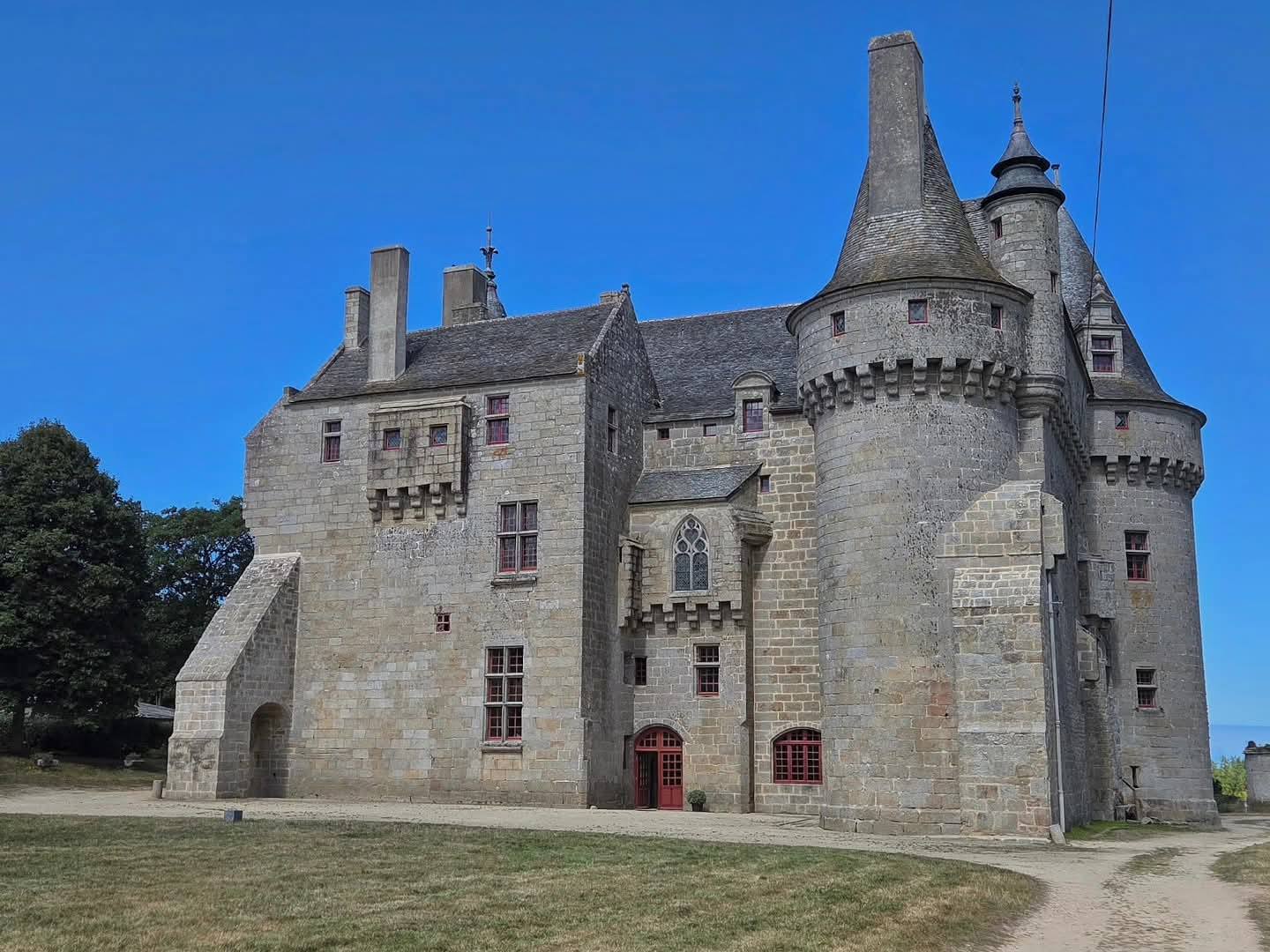
The Kérouzéré Castle consists of a two-story dwelling and an L-shaped attic floor. It is built of granite ashlar and roofed with slate. It is decorated with 17C paintings. The castle moat surrounding it was filled in at the beginning of the 17C. The pond was drained in 1856. The estate included a dovecote dating from the end of the 15C or the beginning of the 16C. It is a massive, square building, flanked by three round towers with crenellations and machicolations, topped with spired roofs. Its walls, all of cut stone, are over 4 meters thick. Huge rooms, a chapel, occupy its interior. Moreover, almost the entire style of its architecture shows the end of the 16C. Only the back of this castle announces older constructions. The gallery of the curtain wall which joins the two towers on this side is pierced with loopholes to put falcons.
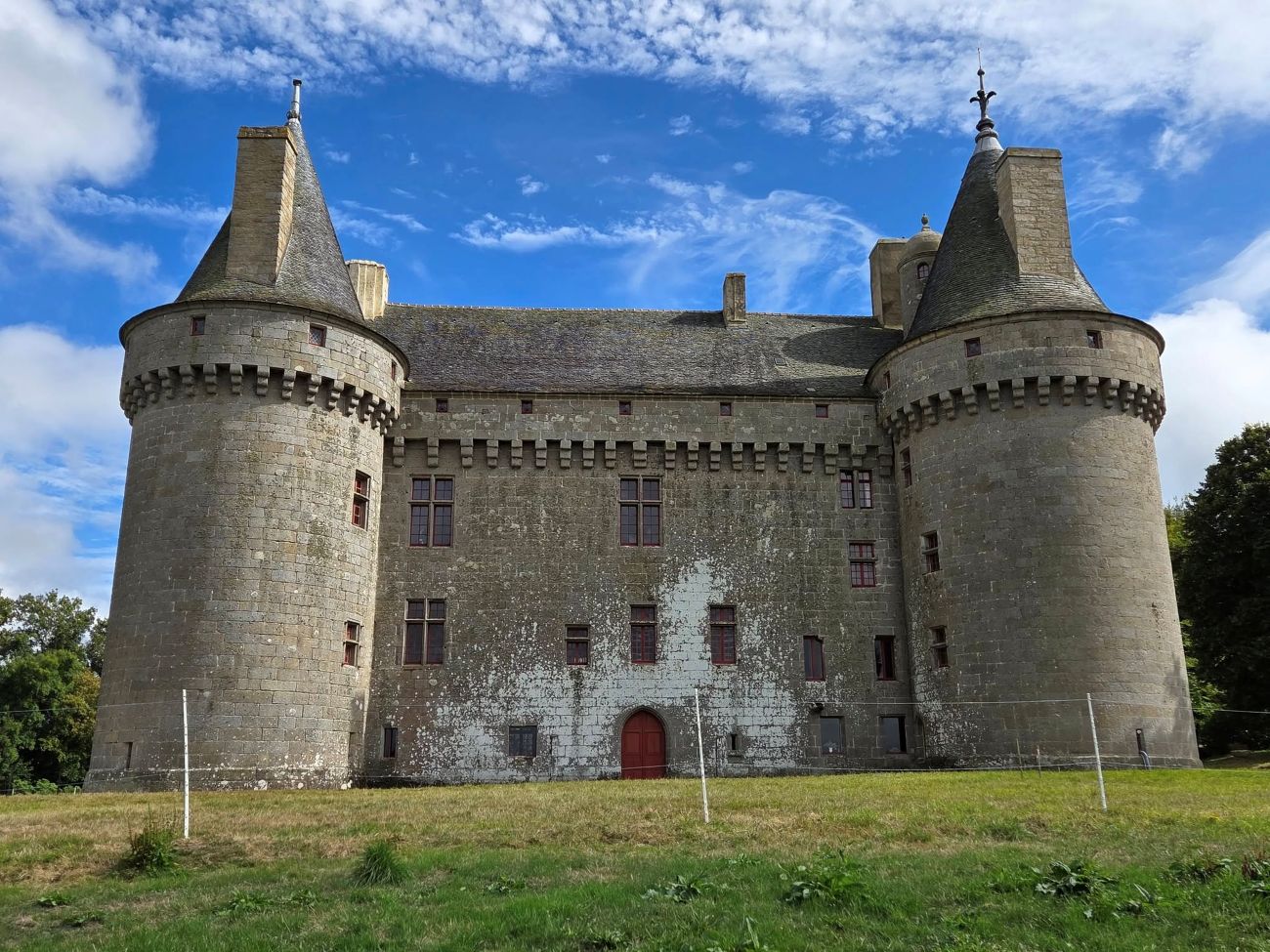
The Château de Kérouzéré has two towers linked to two swallow-nest turrets: one for the watch, the other to receive the bell of the belfry that can still be seen there, Entirely built of dressed stone, its walls are more than 4 meters wide and contain on the first floor a chapel made, partly in their thickness, partly in a mass of masonry raised in corbelling on the south side. This side of the castle was restored after the siege sustained in 1594 against the Leaguers, and a fourth tower, at the west corner, probably ruined at the same time, has not been raised since; the roofs have also been modernized
In the park are a dovecote, a fountain, a well, a washhouse, and a farm. The park and the irregular garden, designed in 1940, is simple and austere, yet majestic, with its beautiful avenue of plane trees, its beds of rhododendrons, hydrangeas, and camellias. The north side overlooks the sea and contains a fountain, an old washhouse, and a dovecote.
The Kérouzéré castle existed from at least 1250; Yvon de Kerouzéré, born in 1225, lord of Kérouzéré, was a crusader knight in 1248 during the Seventh Crusade, and is the oldest known lord of Kerouzéré. This castle was built between 1425 and 1458 by Jean II de Kérouzéré, cupbearer to Duke Jean V of Brittany, at the place called Coat-an-Tour, the seat of a mound on which a keep once stood and where, in 1340, Yvon or Eon de Kérouzéré and his wife, née Marie de Pennanec’h, lived. Kérouzéré Castle lost its southwest tower and southern curtain wall during the second siege against the League in 1590. In Brittany, only the castles of Brest, Pont-l’Abbé, and Kérouzéré were sponsored by King Henry IV. In return, the sovereign had the castle dismantled during the assault restored. The castle was restored again in the early 17C. Kérouzéré Castle built by Jean de Kérouzéré , husband of Constance Le Barbier, on the site of a fortified house documented since the 14C, when it played a role in the War of Succession of Brittany. Kerouzéré was once a high court of justice exercised in Plouescat and was part of the fiefdom of Maillé-Seisploué. On November 30, 1457, Duke Arthur III gave to the Lord of Kerouzéré to fortify the place and the house of Kerouzéré. The registers of the Chancellery of Brittany contain two ducal mandates relating to the fortification of Kerouzéré: one from 1459, the other from 1468, both given by François II. The castle originally had four corner towers , and a battlement walkway with battlements and machicolations. Access to the north was via a drawbridge. The moats that encircled it were filled in at the beginning of the 17C. The pond was drained in 1856. It contained a dovecote dating from the end of the 15C or the beginning of the 16C. Property of Jehan, Lord of Kerouzéré and husband of Jehanne de Rosmadec in 1481. Jehan III died in 1518 and his only daughter, Marie de Kerouzéré, married on January 21, 1492, Jehan de Kérimel, Then dismantled in 1590 it was restored at the beginning of the 17C, and remained the property of the Boiséon family until 1682. It was sold in 1682 to Yves du Poulpry, Lord of Lavengat, Seneschal of Léon. Then it became the property of several families, and finally ,the Calan family;
Other things to see if more time are the port of Moguériec with its fishermen. The parish Church Saint-Pierre dates from 1767: it notably contains the recumbent statue in kersanton of Jean de Kérouzéré, who died around 1460; he is represented fully armed, his head supported on a pillow by two angels, and his feet resting on a lion gnawing on a bone. His arms, reproduced several times on his tomb, are stamped with a helmet with starry flaps, with a swan’s neck for a crest, and his motto List, List (“Let, Let”) is engraved on the belt of his sword. The manor of Trohéon, built in the 16C, has been the property of the Kerhoent (or Querhoent) family since the marriage of Nicolas, lord of Querhoent, with Anne Huon, heiress of Éon, lord of Trohéon. Nowadays, only a dovecote remains of this manor.
A bit of history I like tell us that the parish of Sibiril is a subdivision of the Primitive Armorica parish of Plouescat. A former commandery of the Order of Malta is said to have existed in the Saint-Jacques manor, where ruins of the old chapel still remain. Jean Le Breton, appointed rector of Sibiril in July 1771, a refractory priest, was arrested in July 1791, along with the rectors of Plounévez and Tréflez and two vicars. These priests were imprisoned on July 11, 1791, in the Carmes prison in Brest, but released on July 17, 1791. Persistent in his refusal to take the oath of loyalty to the Civil Constitution of the Clergy, he was imprisoned again in July 1792 at the Notre-Dame de Kerlot abbey (in Plomelin), then at Landerneau; his age saved him from deportation, but he was sentenced to life imprisonment. Released on April 2, 1795, he lived in hiding until 1803, then became rector of Sibiril again until his death on March 4, 1810. Three British aviators (Robert Holt and two unknown men), who died in aerial combat on February 2, 1942, are buried in the Sibiril cemetery.
The village of Sibiril on its heritage : https://sibiril.com/ma-commune/decouverte/histoire-et-patrimoine
The official château de Kérouzéré : https://kerouzere.fr/en/
There you go folks, and we continue on towards home with another wonderful outing in our wonderful neighboring dept of Finistére, and the quant village of Sibiril . Again, hope you enjoy the post on this is Sibiril and its castle !!! as I.
And remember, happy travels, good health, and many cheers to all !!!

 Paris1972-Versailles2003