
We have driven and walked in my eternal Paris, and would like to have an imprint in my blog on the wonderful family times we had there, There is so much to see , doing my best, and glad found me these older pictures in my cd rom vault ,which now transposing in my blog for you and me, This was my former worked city, so glad to post more memorable spots on it, I thank you for your readership over the years and to bear with my rants! After Paris is to rant, shout and yelled about, me think. Therefore, here is my take on curiosities of Paris , part XXXVI !!! Hope you enjoy the post as I.
The Place du Palais-Bourbon is in the 7éme arrondissement of Paris. This square borders the Palais Bourbon (Assamblée Nationale de France-see post) to the south, extending from its courtyard. Shaped like a horseshoe, it is located at the intersection of Rue de l’Université, Rue Aristide-Briand, and Rue de Bourgogne. This square owes its name to the Palais Bourbon, currently the seat of the National Assembly of France, in front of which it is located. It is served at some distance by metro lines 8 and 13 at Invalides station, by lines 12 at Assemblée Nationale station, by lines 1,8, and 12 Concorde station, and by RER C at Invalides station. By letters patent granted at Fontainebleau in November 1775, Louis-Joseph de Bourbon, Prince of Condé, was authorized to change the direction of part of the Rue de Bourgogne and to form a semicircular square in front of the entrance to his palace. During the French revolution, it was called “Place de la Maison-de-la-Révolution.” The Council of Five Hundred decided that it would take the name “Place du Conseil-des-Five Hundred” (1798). Under the Empire, it was called “Place du Palais-du-Corps-Législatif,” then a prefectural decree of April 27, 1811, restored its name to “Place du Palais-de-Bourbon,” then to Place du Palais-Bourbon in 1814. In 1826, the municipal administration planned to erect a statue of King Louis XVIII on the square, a project abandoned in 1830. Only the base was ultimately built. In 1848, the provisional government of the Second Republic launched a competition for an allegorical statue of the Republic, to be installed on the square. A plaster model was placed on the empty base, replaced by its marble version in 1855. While an imperial regime was established by Napoleon III, the statue finally took the name of La Loi, Notable buildings here me think are at Nos. 1, 2, 8, 9, 11 and Nos. 3, 4, 5, 6 bis, 7, 7 bis the houses on the corner of Rue de Bourgogne and Place du Palais-Bourbon were built with the stones of the old Bastille fortress, Nos. 1-3: Café Le Bourbon, very popular with deputies. Jacques Chirac gathered here the signatories of the “Appeal of 43” Gaullist ministers and parliamentarians in support of Valéry Giscard d’Estaing’s candidacy for the 1974 presidential election. No. 2: The dandy and politician Boni de Castellane lived at this address, where he once hosted a luncheon in honor of actress Sarah Bernhardt, whose many adventures he later humorously recounted. In 1914, the architect and decorator Emilio Terry (of Cuban origin) bought Boni de Castellane’s apartment and made it his home. The Palais Bourbon (see post) is the building that has housed the National Assembly of France since 1879, located on the Quai d’Orsay, in a row between the Pont de la Concorde and the Place de la Concorde. The Foreign Minister’s hotel is adjoining, but the two architectural complexes do not communicate. It is guarded by the 2nd Infantry Regiment of the Republican Guard.
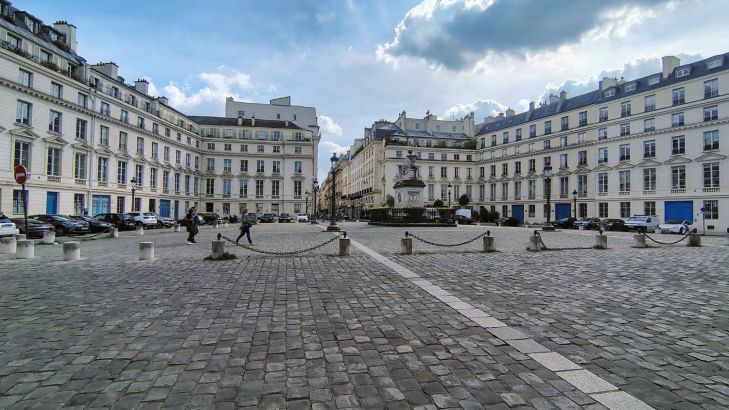
The Paris tourist office on the 7éme arrondissement de Paris: https://parisjetaime.com/eng/article/explore-paris-s-7th-arrondissement-a825
The Rue de l’Abbaye is located in the Saint-Germain-des-Prés quartier or neighborhood of the 6éme arrondissement or district of Paris. This street takes its name from the Abbey of Saint-Germain-des-Prés, located across the street . This street is 180 meters long, it begins at 18 Rue de l’Échaudé and ends at 37 Rue Bonaparte and 1 Place Saint-Germain-des-Prés. It meets Passage de la Petite-Boucherie, Rue Cardinale, Rue de Furstemberg, and Place Juliette-Gréco. The district is served by metro line 4 at the Saint-Germain-des-Prés station. The opening of the rue de l’Abbaye from 1799-1800, on the grounds of the abbey of Saint-Germain-des-Prés, led to the destruction of a large part of the abbey buildings, including the large cloister, the chapter house and the chapel of the Virgin. In 1802 it took the name of “rue de la Paix”, then in 1809 that of “rue Neuve-de-l’Abbaye”, before being simplified to rue de l’Abbaye in 1815. You have in addition to the palace abbey below at Nos. 15 and 17 were destroyed in order to enlarge the place Saint-Germain-des-Prés (now square Laurent-Prache) Notable buildings me think are on this street runs alongside the Church of Saint-Germain-des-Prés . No. 3: Originally the abbey palace of Saint-Germain-des-Prés (see below) , aka the Hôtel de Furstemberg, it was built in 1586 for Cardinal de Bourbon, commendatory abbot of Saint-Germain-des-Prés who had taken over the leadership of the Leaguers. The following century, Cardinal Guillaume-Egon de Fürstenberg had it renovated. In 1835, it was the home of the painter Louis-Alexandre Péron, professor at the École des Beaux-Arts in Paris, as well as that of the painter Pétrus Perlet the same year. It was also the studio of the sculptor James Pradier. The Collège philosophique met there several times. In 1977, the building was renovated. At No. 4: home of the architect Victor Baltard in the 19C. The Palais Abbatial de Saint Germain des Prés (see pic) or Abbey Palace of St. Germain-des-Prés built between 1586 and 1590, adjoining the Church of Saint-Germain-des-Prés, was built at the request of Cardinal Charles de Bourbon, uncle of Henry IV and Archbishop of Rouen. It was completely restored in the Rococo style in 1737-1738 for the Count of Clermont, Prince of the Blood, commendatory abbot. Situated between the main courtyard and the garden, and predating Place Dauphine and Place des Vosges, this building is one of the first Parisian examples of the brick and stone style. The dwelling comprises a ground floor, two upper floors, and a large attic. An imposing pavilion set at right angles to the Passage de la Petite Boucherie: two mullioned dormers topped with a large sculpted pediment break the cornice. The complex was originally laid out as a palace, including a courtyard, a bailey, stables, a chapel, and outbuildings. The brick and stone facade, with alternating curvilinear and triangular pediments, is identical to the one overlooking the garden. The pavilion opposite, on Rue de la Petite Boucherie, has retained its pediment sculpted with an allegorical female figure with cornucopias. The facade and staircase were restored in 1977. The abbey palace is still visible at 3 Rue de l’Abbaye. Restored in the 1970s, The interior of the palace is functional (classrooms, offices). Little remains of its past and original function.
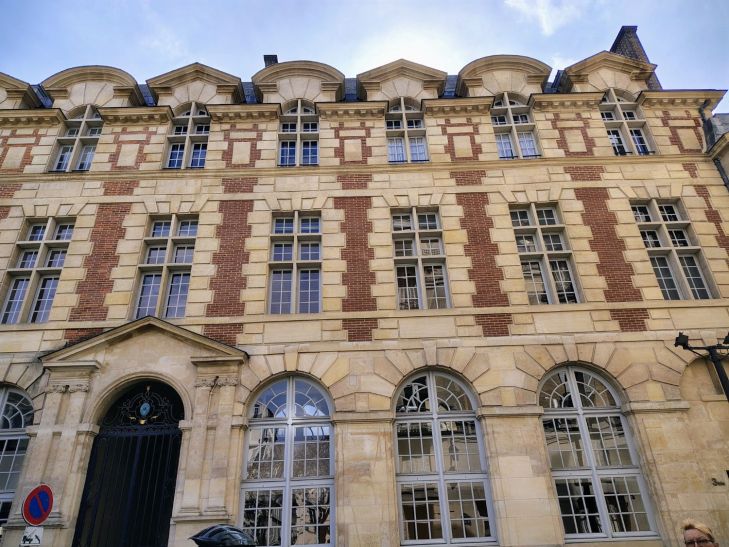
The Paris tourist office on walks in the Saint Germain des Prés neighborhood: https://parisjetaime.com/eng/article/a-walk-in-saint-germain-des-pres-a925
The Paris tourist office on the 6éme arrondissement de Paris : https://parisjetaime.com/eng/article/explore-paris-s-6th-arrondissement-a823
The Rue de l’Échaudé is located in the Saint-Germain-des-Prés quartier or neighborhood of the 6éme arrondissement or district of Paris. The street is served nearby by metro line 10 at the Mabillon station. It is so named because of the triangular shape of the group of houses that lined it and had the shape of a pastry called échaudé. A very old street in Paris, present in the 14C under the name of “path on the Fossés of the abbey of Saint-Germain-des-Prés”, it took the name, in the 16C, of “cul-de-sac du Guichet” because it was a dead end connecting the main gate of the abbey – the abbey ticket office – to Rue de Seine. The street was extended beyond Rue Jacob in 1608. It is mentioned under the name “Rue de l’Eschaudé” in a 1636 manuscript. In 1669, it took the name Rue de l’Échaudé. The quadrilateral between Rue de l’Échaudé, Rue Gozlin, Rue Saint-Benoît, and Rue Jacob marks the boundary of the enclosure of the Abbey of Saint-Germain-des-Prés. Notable Buildings here me think are at No. 5 Librairie Galerie Minima specialized in scientific books from the 16-18C, then it was a bookseller specializing in artists’ books. Having become a painting gallery for a while, the place resumed its function as a bookstore and specializes mainly in miniature books and bibliophily. No. 6 Le Coin des Arts – Thaddée Poliakoff Fine Art (see pic) highlights the School of Paris, an eclectic group of foreign artists who gathered in Paris at the beginning of the 20C, making Paris the world’s leading artistic center. No. 14 Le Galerie l’Echaudé with works by contemporary artists Nos. 18 and 20, at the corners with Rue de l’Abbaye, the remains of the pillars of the “Porte de Bourbon” of the abbey enclosure remain. At No. 26 was the location of the main entrance to the abbey. It was equipped with a drawbridge. At No. 31, a wooden sign of a shop dating from the 17C remains. In the 1970s, the Mocambo, a popular dance club, was located there. From 1966 to 1977, one of the most important French contemporary art gallery owners, Yvon Lambert, opened his first gallery there, which promoted American conceptual artists and was the basis for the creation of the Lambert collection. Robert Bresson’s film, A Gentle Woman, was filmed in the apartment of the painter Olivier Mosset, at 31, rue de l’Échaudé, in the summer of 1968.
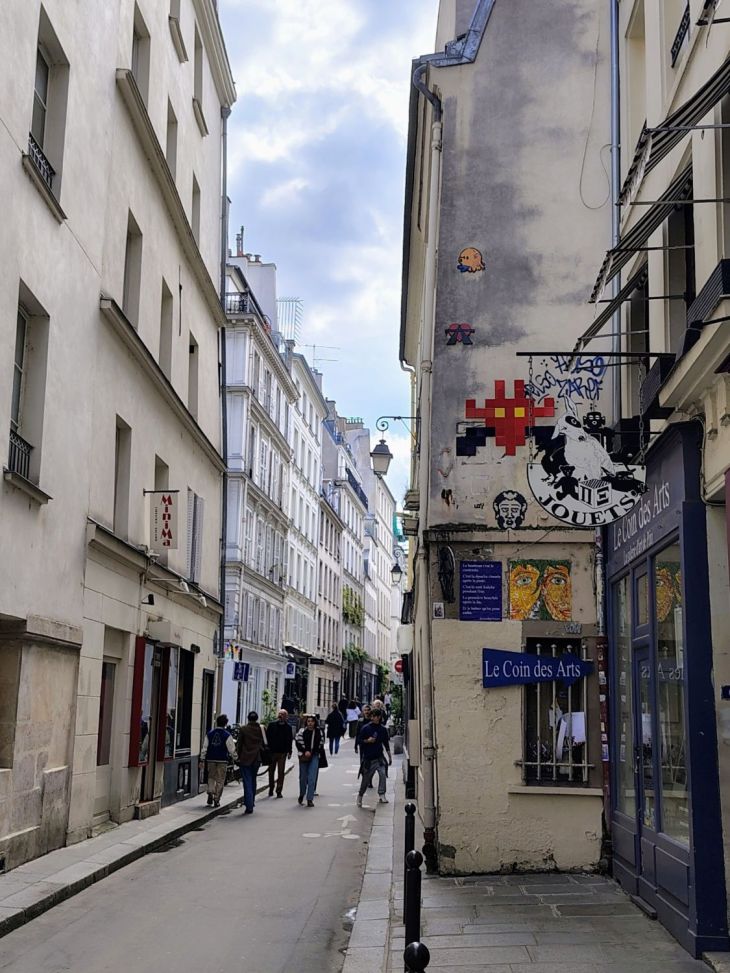
The Paris tourist office on the 6éme arrondissement de Paris : https://parisjetaime.com/eng/article/explore-paris-s-6th-arrondissement-a823
The Place d’Aligre is located in the middle of Rue d’Aligre, in the 12éme arrondissement of Paris. It is intersected by Rue d’Aligre and Rue de Cotte, and can also be reached by Rue Emilio-Castelar, Rue Théophile-Roussel and Rue Beccaria. It is the center of the historic and popular neighborhood called the Quartier d’Aligre, a district itself more or less part of the administrative neighoborhood of Quinze-Vingts. On this square as well as in Rue d’Aligre, the Marché d’Aligre takes place every day except Monday. The Marché Beauvau, (see pic) a covered market, is in the western half of the rectangular square. It is named in honor of Étienne François d’Aligre, Count of Marans and Marquis d’Aligre under the Ancien Régime (monarchy). This site is served by metro line 8 of the Ledru-Rollin station. It was laid out in 1778, during the construction of the market on buildings of the Saint-Antoine-des-Champs abbey, and was then named “Place du Marché Beauvau”, in honor of Abbess Gabrielle-Charlotte de Beauvau-Craon. It changed its name to become the Place d’Aligre on February 26, 1867, under the Second Empire (Napoléon III), according to the wishes of the City of Paris. The main notable building here is the Beauvau covered market This building occupies the western half of the Place d’Aligre. The Beauvau-Saint Antoine covered market was built in 1779 on land purchased from the nuns. The current market and its guardhouse were built in 1843 on the new Place d’Aligre. This market is devoted to agricultural food products: meat, fish, vegetables, fruits, cheeses, etc. It includes two main aisles crossing at right angles with a central fountain as well as several secondary aisles.
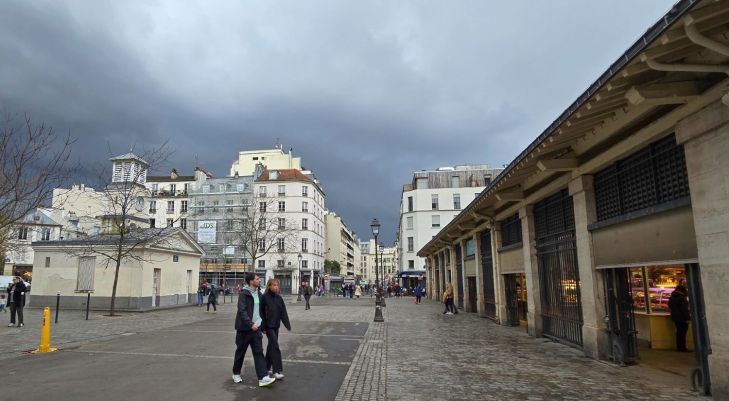
The Paris tourist office on the covered market of Beauvau: https://parisjetaime.com/eng/shopping/marche-beauvau-marche-d-aligre-p2488
The Paris tourist office on the 12éme arrondissement de Paris: https://parisjetaime.com/eng/article/explore-paris-s-12th-arrondissement-a824
The square Trousseau is in the 12éme arrondissement of Paris. Rectangular in shape, with an area of 3,757 m2, it is bordered by Rue du Faubourg-Saint-Antoine , Rue Charles-Baudelaire, Rue Théophile-Roussel, and Rue Antoine-Vollon. It houses a music kiosk or bandstand (see pic) and children’s games. A floral section is preserved on the Rue du Faubourg-Saint-Antoine side. The site is accessible via 2 Rue Antoine-Vollon. It pays tribute to the French doctor, clinician, and politician Armand Trousseau. It is served by metro line 8 at the Ledru-Rollin station. The decapitated body of the Princess of Lamballe , a friend of Marie-Antoinette, was thrown there after her lynching in front of the Prison de la Force. Her head was also added, which a citizen had recovered after it had been exhibited in Paris, planted on the end of a pike. The square was also the location of the Foundling Hospital. In 1674, the General Hospital acquired the land located between the Rue du Faubourg-Saint-Antoine, the Rue de Cotte, the Rue de Charenton and the Rue Traversière to build a hospice for foundlings. Around a thousand children were abandoned each year in Paris. The hospice took in six hundred, who were cared for by the Sisters of Charity. Having become an annex of the Hôtel-Dieu de Paris, the Foundling Hospice was renamed “Hôpital Sainte-Marguerite” in 1839 before being transformed in 1854 into a hospital for sick children under the name “Hôpital Sainte-Eugénie”. Called “Trousseau” in 1880, it was demolished in 1902 and the name Trousseau was transferred to the Armand-Trousseau Hospital on Avenue du Docteur-Arnold-Netter (12éme arrondissement).
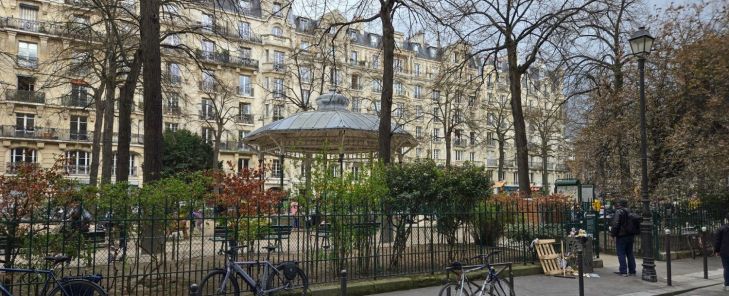
The Paris tourist office on the Square Trousseau: https://parisjetaime.com/eng/culture/square-trousseau-p996
The Paris tourist office on the 12éme arrondissement de Paris: https://parisjetaime.com/eng/article/explore-paris-s-12th-arrondissement-a824
There you go folks, a dandy city to explore and enjoy with the family, Memorable moments in my eternal Paris,driving and walking all over in my road warrior trails brings out sublime awesome spots with nice memorable family visits of yesteryear always remember and always looking forward to be back, eventually. Again hope you enjoy the post on curiosities of Paris, part XXXVI !!! as I.
And remember, happy travels, good health, and many cheers to all !!!

 Paris1972-Versailles2003