
We have driven and walked in my eternal Paris, and would like to have an imprint in my blog on the wonderful family times we had there, There is so much to see , doing my best, and glad found me these older pictures in my cd rom vault ,which now transposing in my blog for you and me, This was my former worked city, so glad to post more memorable spots on it, I thank you for your readership over the years and to bear with my rants! After Paris is to rant, shout and yelled about, me think. Therefore, here is my take on curiosities of Paris , part XXXV !!! Hope you enjoy the post as I.
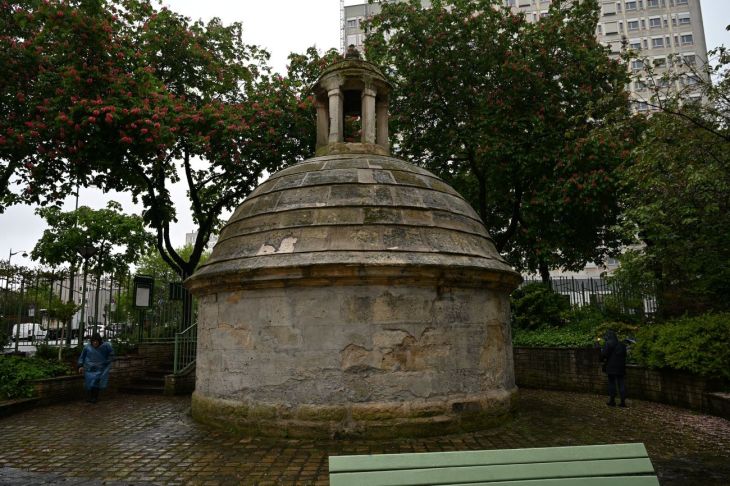
The Jardin du Regard-de-la-Lanterne is a green space in the 19éme arrondissement of Paris. There is a manhole, that is, a structure providing access to a pipeline. It was one of the many manholes that dotted the Belleville water network. The manhole takes the form of a small, cylindrical stone building, covered by a dome. It is surmounted by a lantern, itself made of stone. Inside, one descends to a basin where the water drained from the top of Belleville Hill arrives via a double staircase. The manhole is accessible from 3, rue Augustin-Thierry and 213, rue de Belleville, located in the Jardin du Regard-de-la-Lanterne, to which it gives its name. This manhole takes its name from the stone lantern above it. Built between 1583 and 1613, it was at the head of the Belleville aqueduct a 750 meters long gallery wide enough to allow two people to pass abreast, which descended towards Paris. This site is served by metro lines 7 bis and 11 at Place des Fêtes station and by metro line 11 at Télégraphe station.
The official Waters of the city of Paris: https://www.eaudeparis.fr/lhistoire-de-leau-paris
The city of Paris on the Jardin du Regard de la Lanterne: https://www.paris.fr/lieux/jardin-du-regard-de-la-lanterne-2677
The Paris tourist office on the 19éme arrondissement de Paris: https://parisjetaime.com/eng/article/explore-paris-s-19th-arrondissement-a833
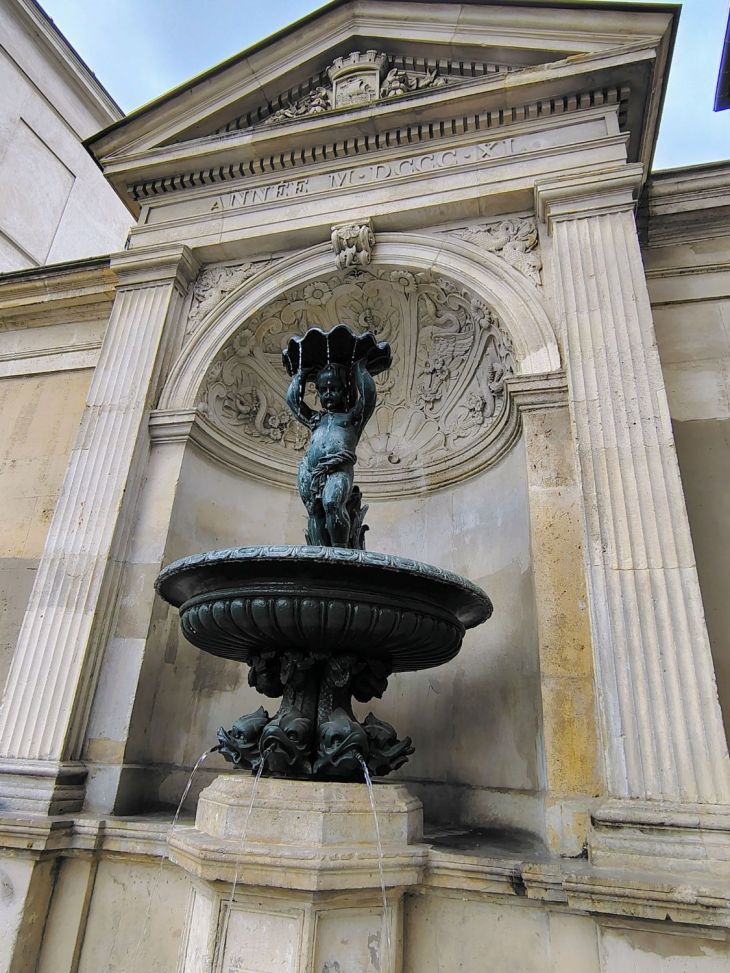
The Rue Charlemagne is in the 4éme arrondissement of Paris. It is located in the Saint-Gervais quartier or neighborhood no 14 with a length of 236 meters and begins at 31, rue Saint-Paul and ends at 2, rue de Fourcy and 14, rue des Nonnains-d’Hyères. It is named after Charlemagne, king of the Franks and emperor, who created the Carolingian dynasty. The neighborhood is served by Metro line 1 at the Saint-Paul station. Notable buildings are at No. 8: house in which François Rabelais died on March 14, 1553. Nos. 9 and 15: remains of the enclosure of Philippe Auguste ,Nos. 13 and 14: the Lycée Charlemagne high school , No. 16: in 1957, Georges Perec shared an apartment on the second floor of this building with some friends such as Raoul Levy, Isidore Bernhart, Marc Semtov, etc. Several passages of his novel,La Vie mode d’emploi or Life: A User’s Manual, are inspired by this period. The fontaine Charlemagne (see pic) or fountain is located at 9 rue Charlemagne. The construction of the fountain on rue des Prêtres Saint-Paul (now rue Charlemagne) was approved by the prefectural decree of August 1840 to be located against a presbytery wall of the former Saint-Paul church. The fountain was built in 1840, under the July Monarchy, at the apse of the Church Saint-Paul-Saint-Louis , and adjacent to the Lycée Charlemagne. On the pediment of the fountain are the arms of Paris and the inscription ANNEE with Roman numerals M.DCCC.XL which mention the date of the creation of the fountain, 1840. The fountain is in the form of a vaulted niche, decorated with relief motifs of aquatic plants and animals. The water pours from the shell into the basin through thin streams to splash back into the mouths of the fish under the basin.
The Paris tourist office on a walk in the Marais : https://parisjetaime.com/eng/article/a-walk-in-the-marais-a838
The Paris tourist office on Paris Centre (Arrond 1-4) : https://parisjetaime.com/eng/article/explore-the-centre-of-paris-a846
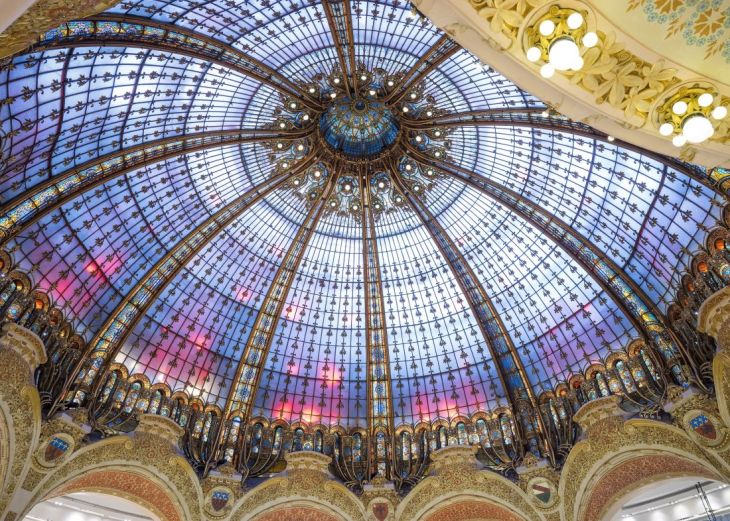
Located in the heart of Paris, the Galeries Lafayette -Haussmann dazzles locals and especially visitors with its majestic dome, which has become one of the most iconic architectural landmarks in Paris. Visit the Dome and enjoy its unique and inimitable architecture, which will appeal to those who primarily want to visit Paris and discover the city’s architectural prowess. Built by master glassmaker Jacques Grüber in the Art Nouveau or Art Deco style, the Dome is a true architectural gem that attracts crowds from around the world. The goal is to bring light and character to the Galeries Lafayette-Haussmann , particularly the magnificent gilded balconies designed by Louis Majorelle, The current stained-glass windows take the form of an immense flower composed of 10 beams, totaling 1,000 m². The Dome is the unmissable feature when visiting the dept store. The Dome has lived through the department store’s evolutions and renovations for nearly 110 years, including successive extensions.
The official Galeries Lafayette-Haussmann Dome : https://haussmann.galerieslafayette.com/en/the-galeries-lafayette-dome/
The Paris tourist office on the Galeries Lafayette-Hauumann : https://parisjetaime.com/eng/shopping/galeries-lafayette-paris-haussmann-p3724
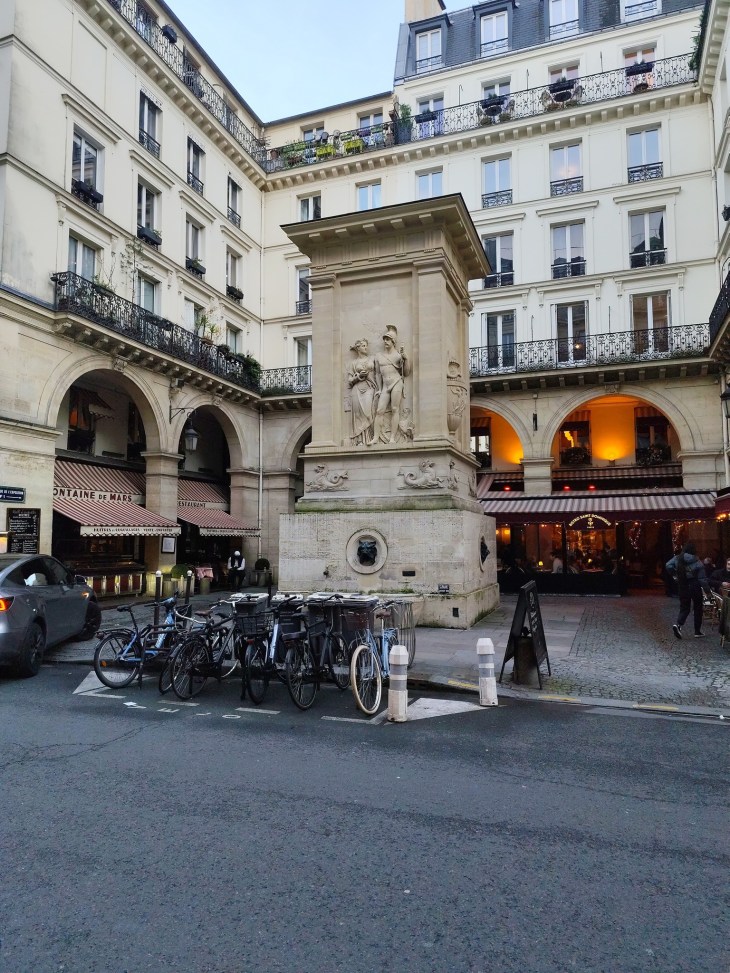
The Rue Saint-Dominique is located in the Saint-Thomas-d’Aquin, Invalides, and Gros-Caillou quartiers or neighborhoods of the 7éme arrondissement or district de Paris. It is 1,800 meters long ,and begins at 221-223 Boulevard Saint-Germain and ends at Place du Général-Gouraud. It owes its name to the Dominican monks who settled there in 1631. The Rue Saint-Dominique is served by metro lines 8, 12, and 13 at the Solférino, Assemblée nationale, Invalides, and La Tour-Maubourg stations, and by RER C at the Invalides station. Until the 16C, the street was only a path called with different names in successive years. In 1631, the Dominicans settled in the street (current Dominican novitiate and Saint-Thomas-d’Aquin Church) and obtained from the abbots of Saint-Germain-des-Près to fix marble tables at each end of the street on which was inscribed “rue Saint-Dominique jadis des vaches”. It is cited under the name of rue Saint Dominique in a manuscript of 1636. Notable buildings are at No. 1 (formerly no. 67): Hôtel Amelot de Gournay, also called de Mortemart. Built in 1710. Sold in 1713, under construction. The hotel is particularly remarkable for its oval courtyard and its facade on the courtyard with colossal pilasters on the ground, an extremely early arrangement. The hotel now houses, in the right wing overlooking the courtyard, the Paraguayan embassy, while the ground floor lounges depend on the house of Latin America. No. 3: Hôtel de Périgord: hotel from 1688 which belonged to the convent of the Dames de Bellechasse, who rented it to several persons over the years. The chemist Jean-Baptiste Dumas lived there. No. 5: former Hôtel de Tavannes (1728). This hotel, property of the convent of the Dames de Bellechasse, was rented to several persons over the years. Gustave Doré died there in 1883. No. 16: Petit Hôtel de Conti, built in 1727-1729 for Abbot Charles Maurice de Broglie. Sold in 1735 by Abbot de Broglie to the Dowager Princess of Conti. Rented several times over the years. The hotel was acquired by the French State in 1817, No. 28: Hôtel de La Rochefoucauld d’Estissac. built in 1708 and successively inhabited by Frédéric-Maurice de la Tour d’Auvergne and then by his son, Cardinal Henri de la Tour d’Auvergne. On May 30, 1764, the hotel became the property of the Count of Caraman, and then, in 1820, of the Count of La Rochefoucauld, French ambassador, who then passed it on to his son, the Duke of Estissac, whose descendants retained it until 1929. It was then purchased by the Maison de la Chimie Foundation, tasked with creating an institution dedicated to encouraging exchanges between learned societies and the chemical industry. This foundation had the two wings overlooking the courtyard renovated in the Art Deco style and the central building and its interior decorations restored. The Maison de la Chimie now houses symposia and conferences. No. 53: Hôtel Kinsky ,nothing remains of the hotel built in 1769. The current hotel, which has been extensively remodeled, includes a large lounge on the ground floor, which has retained an 18C decor created for Princess Kinski, the owner in 1773, including a ceiling painted in 1779. In 1801, the hotel was rented for three years to the English writer William Beckford. It then belonged to Marshal Lannes. In the 19C, it was the residence of the writer Charles de Pomairols, who held a literary salon there. It was purchased in 1919 by the banker Louis Louis-Dreyfus, who carried out work on the building. Requisitioned during the Occupation (WWII), the hotel became French State property in 1945. After housing services of the Ministry of Culture (directorate of music, dance, theater and shows), it was put up for sale by the State in September 2006 and purchased by Sheikh Hamad bin Jassem Al Thani, a member of the ruling family of Qatar. Built on a plot of 4,137 m2, the hotel, with a surface area of 3,509 m2, includes a landscaped park of 2,400 m2 with an artificial grotto and a pond. No. 92: Saint-Pierre-du-Gros-Caillou Church. Nos. 129-131: Gros-Caillou fountain, aka Mars fountain. (see pic and notes below) ; built in 1806, it is part of a group of 15 fountains commissioned by Napoleon I. It is on this street that Honoré de Balzac located the most beautiful private mansions in The Human Comedy, notably in The Splendors and Miseries of Courtesans, My anecdote and going to Domino’s Pizza, 65 Rue Saint–Dominique take out pizzas and going to the Port de Suffren to eat them with my family while looking above the Tour Eiffel ! Yeah !!! The Fontaine de Mars,is located at 129 rue Saint-Dominique, is an emblematic monument. This fountain reflects the neoclassical style of the Napoleonic era. Built between 1806 and 1809, it was initially surrounded by a semicircle of poplars, replaced in 1859 by a small arcaded square. The Mars Fountain is distinguished by its square structure in blond stone, decorated with pilasters and a Doric entablature. Its four faces, framed by molded Doric-style columns, feature remarkable bas-reliefs. The main panel represents Hygieia, goddess of Health, and Mars, god of War, a strong symbology that evokes power and protection.
The Paris tourist office on the 7éme arrondissement de Paris : https://parisjetaime.com/eng/article/explore-paris-s-7th-arrondissement-a825
There you go folks, a dandy city to explore and enjoy with the family, Memorable moments in my eternal Paris,driving and walking all over in my road warrior trails brings out sublime awesome spots with nice memorable family visits of yesteryear always remember and always looking forward to be back, eventually. Again hope you enjoy the post on curiosities of Paris, part XXXV !!! as I.
And remember, happy travels, good health, and many cheers to all !!!


