
This is a small town , that I have passed by it in my road warrior runs, I found some interesting old pictures in my cd rom vault of an off the beaten path monument worth the detour, me think, Therefore, let me tell you of this is Meucon !!!Hope you enjoy the post as I.
The town of Meucon is located in the dept no 56 of my beautiful Morbihan , in my lovely Bretagne and in my belle France. The town sits along the D767 that goes in my area from Vannes up north passing Pontivy, Guingamp to Lannion, It is 47 km from Pontivy, 110 km from Guingamp , 141 km from Lannion, 8 km from Vannes ,and 25 km from my current home.
The Chapelle Saint-Barthélemy built in the 15C, located in the village of Crahunac, part of the town of Meucon. At the end WWII, before fleeing, the nazis installed in the Meucon camp blew up all their munitions. The roof of the chapel, in poor condition, collapsed, taking with it half of the walls. It was decided to keep only what was in good condition. Which explains its small size. It was therefore abandoned until its reconstruction in 1957. Keeping only the stones in good condition, the building was unfortunately reduced by 40% of its size. A small bell tower can be seen above the main semicircular door of the western facade. The second door, decorated with a heart and a wooden cross, bears the name of Barthélemy. The roof and the framework were redone again in 2015. The interior is just as modest as the exterior, the furniture is reduced with a simple wooden altar. Only two relatively recent statues decorate the heart. They represent Saint Barthélemy with a sickle and Notre Dame de Grâce. What gives warmth to the place is the presence of pretty colored stained glass windows. The largest, behind the altar, represents the meeting between Christ and Saint Barthélemy reading under a tree.
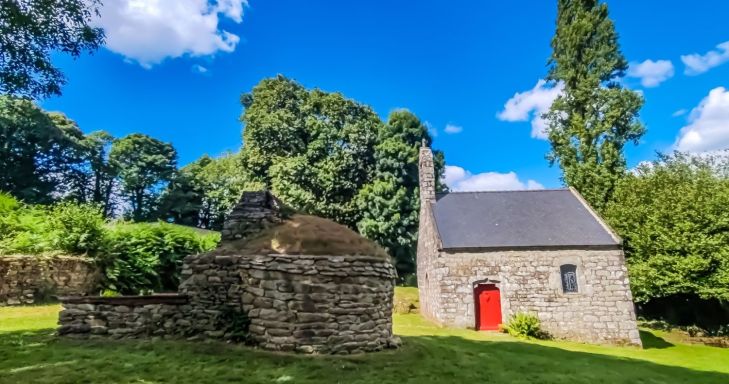
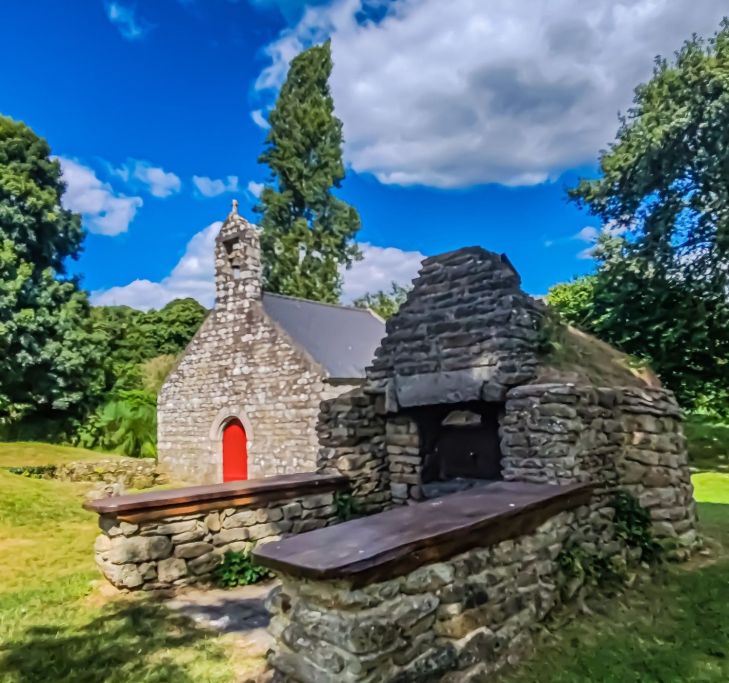
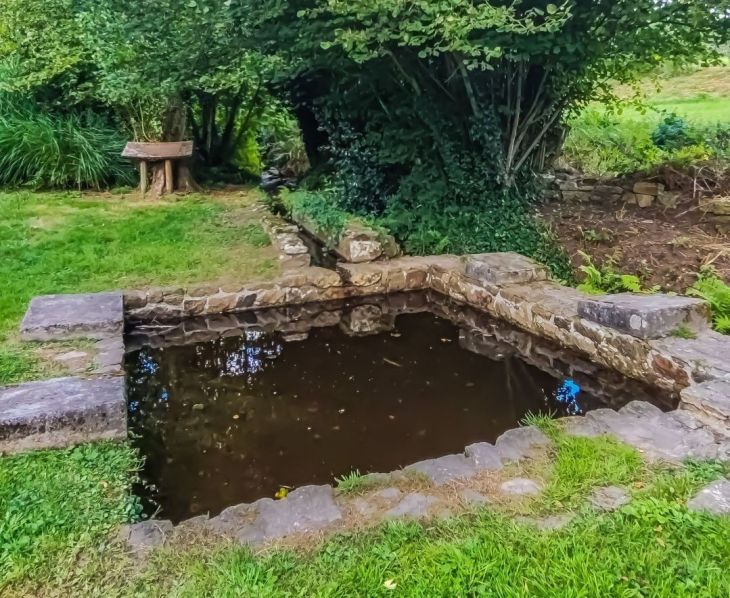
There is around the chapel an old washhouse, lech, funerary stele from the Gallic area, and a fountain, an open-air theatre, as well as a bread oven restored in 2010. It operates on the last Saturday of each month and offers a moment of local conviviality.
A bit of history tell us that this small chapel was originally located in the territory of Grand-Champ (see posts). But in 1892, a decree voted by the parish modified the boundaries of the town and it was then ceded, like the hamlet of Crahunac, to that of Meucon which was itself part of the parish of Vannes until the French revolution. From the start it was dedicated to Saint Bartholomew, one of the twelve apostles of Jesus. He evangelized Persia and India, but was put to death in Armenia where he was crucified, flayed alive and decapitated. This is why he is often represented with his skin in one hand and a knife in the other. A martyr, he became the patron saint of butchers, tanners and bookbinders and is celebrated on August 24, the date of the chapel’s pardon.
Other things to see are the Church of Sainte Marie Madalene b, 1497, remodeled in 1838. An inscription on the left choir wall tells us that the church was covered with a frame in 1497. The Calvary of 1787. The cross, decorated with a Christ on the obverse and a Pietà on the reverse, rests on a circular shaft that ends with a capital decorated with oak leaves.
A bit of history tell us that Meucon is a division of the parish of Vannes. Under the Ancien Régime (monarchy) , Meucon, like Plescop, was part of the Regaires of the Bishop of Vannes. In the 12C, at the time of the Crusades, a leper colony was set up on its territory. Leprosy had in fact appeared on the return of the Breton Crusaders. Those who were affected by this terrible disease were forced to live in the houses assigned to them. The lepers worked as ropemakers. In 1914, the last rope factory closed its doors. The leper colony led the inhabitants of the time to organize themselves around the Sainte Magdeleine Chapel. In 1779, Meucon became a parish and then a town in 1790, and the chapel was elevated to the rank of parish church. Leprosy had completely disappeared by then. Meucon was long renowned for its fouaces, pastries made with water, salt and wheat flour. Until 1973, when the last fouacier ceased its activity, people came from everywhere to buy the famous fouaces of Meucon
The Meucon military camp has existed since 1878; it was used from 1917, as was the Coëtquidan military camp by the American army: it accommodated up to 8,000 soldiers from April 1918 and was used by them until June 1919. Around 900 barracks capable of accommodating 17,000 soldiers were built. The camp was occupied and used by the nazis army during WWII, The runway of the camp’s airfield was blown up by resistance fighters in January 1942. This camp is used today by the 3rd RIMA (marine infantry regiment) but is underused. There is a small airport or aérodrome Vannes-Meucon for leisure activities and private planes, The official Vannes Meucon airport : https://www.vannes.aeroport.fr/aeroport-vannes
The town of Meucon on its heritage: https://www.meucon.fr/tables-de-lecture/
The local Gulf of Morbihan tourist office on Meucon: https://www.golfedumorbihan.bzh/explorer-vannes/decouvrir-vannes/golfe-morbihan/landes-de-lanvaux/meucon/
There you go folks, another road warrior round and glad have pictures to show it. Which tells us again of all the goodies we are having here in my beautiful Morbihan,Again, hope you enjoy the post on this is Meucon as I.
And remember, happy travels, good health, and many cheers to all !!!

 Paris1972-Versailles2003