
I drive you down to a wonderful region of my belle France and its wonders. I am going to continue on my reminicents of old beautiful places in Tarn et Garonne. This time let’s travel to the village of Auvillar. I am thrill to have found pictures in my cd rom vault to share in my blog for you and me. Therefore, let me tell you about this is Auvillar !!! Hope you enjoy this post as I
The village of Auvillar is located in the Tarn-et-Garonne department no 82 in the Occitanie region of my belle France. Historically and culturally, the town lies within the Lomagne, a former district of the province of Gascony with the title of viscounty, nicknamed the Toscane française or French Tuscany. Since 1994, Auvillar has been listed as one of the “Most Beautiful Villages of France,” with its port district and remarkable monuments. The village is, also, a stop for tourists and pilgrims on the Way of St. James or Camino de Santiago.
The village of Auvillar is 38 km from Agen, 42 km from Montauban, 51 km from Villeneuve-sur-Lot, 680 km from Versailles, , 637 km from my current home, and 91 km from Toulouse from where we came out on our road warrior trails on M112 road to by exit/sortie 15 on the A61 autoroute dir Lavaur/Montpelier continue bear left on the A62 autoroute or Autoroute des Deux Mers dir Auch but get off at exit/sortie 8 péage Valence d’Agen tolls dir Lectoure on the D953 road continue to roundabout bear right onto the D12 road dir Auvillar before village bear right onto the Route de Valence continue same street is Place de l’Horloge and see the Tour de l’Horloge further the Halles and walk to the right the Church Saint Pierre,
The earliest traces of Christianity in Auvillar, known as the Church Saint Pierre, It is one of the most beautiful churches in the diocese of Montauban. Contemporary with the Viscounts of Auvillar, the 12C chapel at the back of the church on the left side is the oldest part of the structure. The 12C Romanesque Church Saint Pierre consisted of a nave flanked by side aisles, ending in a central apse and two oriented side apses. It is unknown whether this church had a transept. It was enlarged in the 14C with the establishment of a Benedictine priory. The nave was rebuilt in the 14C, extending from the apses to the west facade. Only the north apse and a few sections of the triumphal arch of the central nave’s apse remain from the Romanesque church. The bell tower was rebuilt in 1540. The Baroque altar in the chancel was installed in 1674, marking the completion of its restoration. The Church Saint Pierre is located outside the city walls, near the Porte Saint Pierre, Gate. Inside, the chancel arch dates from the 15C with 12C columns and capitals. The polychrome wooden altarpiece with twisted columns adorned with vine leaves dates from the 17C, The central painting depicts the Assumption of the Virgin, painted by Bern d’Henny, after a painting by Peter Paul Rubens A set of nine paintings, possibly from the same polyptych, was painted in 1690 ,The church also features an 18C pulpit and an 18C altarpiece with a statue of the Virgin and Child and two busts representing Saint Clair and Saint Augustine. Don’t miss the underground crypt housing the church’s treasury.
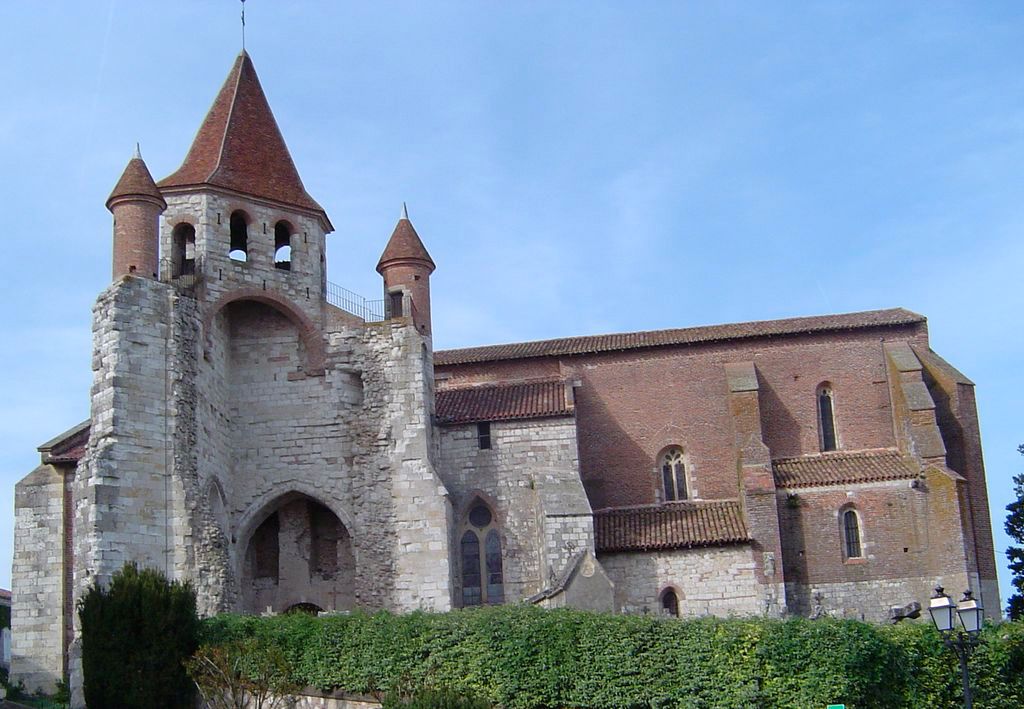
The church was under the jurisdiction of Moissac Abbey until the end of the 12C. The first mention of this church dates from 1261. Pope Clement V was the brother of the lord of Auvillar, Arnaud Garcie de Goth. In June 1304, while still Archbishop of Bordeaux, he visited the priory and celebrated Mass there. The Pope also made a brief stay there on December 12 and 13, 1308. The destruction caused by the Hundred Years’ War and the Wars of Religion ( 1570, 1577, and 1580 ) necessitated restoration work in the 15C and the 17X. The 16C bell tower, largely destroyed during the French revolution, was restored in the 19C, as was the west facade.
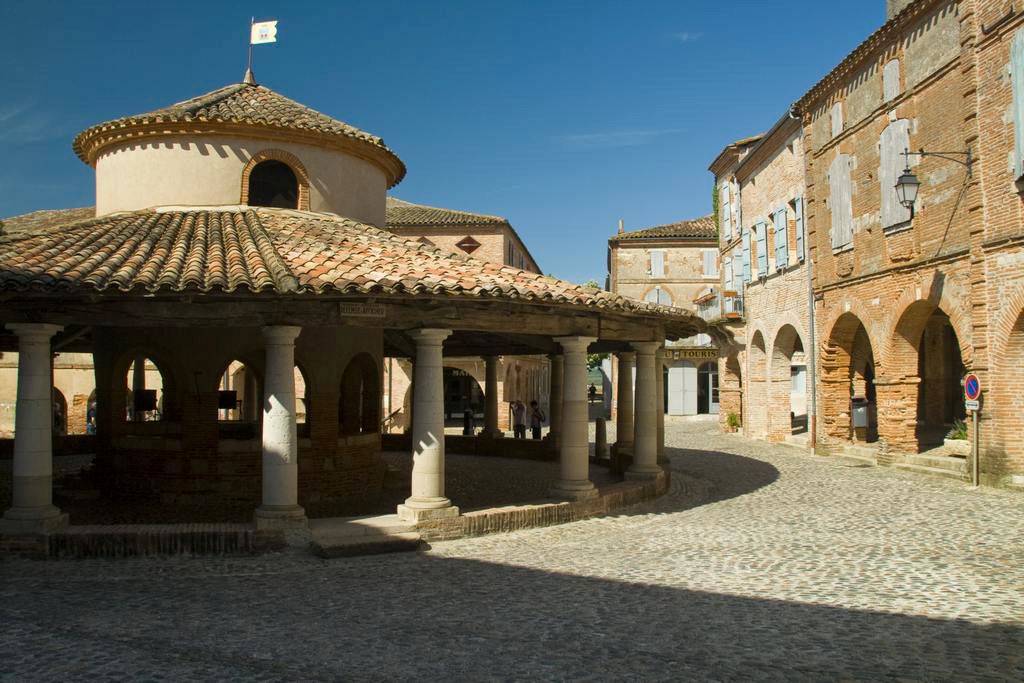
The halle aux grains or grain market is located in the middle of the Place de la Halle. The study for the new grain market to replace the old one began during the First Empire and continued throughout the Restoration until its completion at the beginning of the July Monarchy. The market hall is circular. It includes an exterior portico supported by twenty Doric columns with bulbous shafts. A central circular wall, pierced by eight arches, rises above the tiled roof to form a lantern with four windows. Inside the central core, the floor is raised by a few steps. The old measuring instruments are kept there. The sworn experts and the official in charge of market policing were required to stand there.
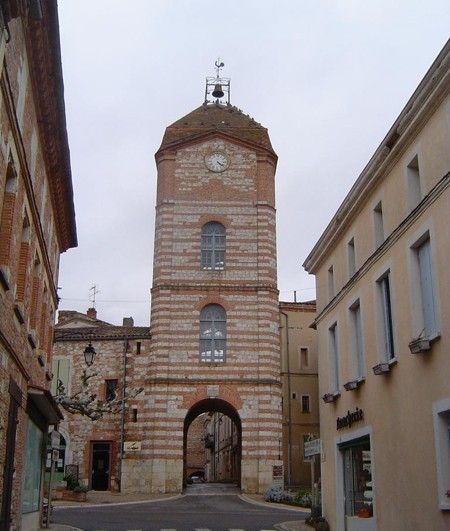
The tour de l’Horloge or Clock tower is located in the rue de l’Horloge . It was built in the late 17C or early 18C, during the reign of Louis XIV, by the city consuls on the site of the old fortified gate with a drawbridge, named after Arnaud Othon, a Viscount of Auvillar. In 1934, a plaque was placed on the south facade in homage to the famous writer and troubadour Marcabrun, who was born in Auvillar. The tower has three stories above the porch, separated externally by ropes. Inside, each level has been converted into an exhibition space. Above the roof is a wrought-iron cage housing a bell adorned with a Gothic inscription. The bell comes from the former Jacobin convent (now occupied by the gendarmerie military police). The Clock Tower housed the river navigation museum, whose collection is now in the musée du vieil Auvillar or old Auvillar museum.
Other things to see here are a narrow lane, lined with old houses dating from the 15C to the 18C, including the Consuls’ House and the disused Carmelite chapel, a true lesson in architecture and urban planning. On the old quays, the Sainte-Catherine-du-Port Chapel dates from the 14C. Saint Catherine was the patron saint of sailors. A Carolingian-era chrismon is visible on its facade. Other chapels in the area include the Ursuline convent Chapel, the Notre-Dame du Marchet Chapel, and the Notre-Dame du Salut Chapel. The musée du vieil Auvillar or Museum of Old Auvillar combines the former museum of earthenware produced between 1739 and 1909 and its quill pen manufacturing workshop, with the riverboat museum featuring votive offerings from boatmen from the Sainte-Catherine-du-Port Chapel. Auvillar is located on the Via Podiensis route of the pilgrimage to Santiago de Compostela. The previous stop is the town of Moissac, and the next is the village of Saint-Antoine-sur-l’Arrats.
A bit of history I like tell us that initially known as a Gallo-Roman settlement, Auvillar was an oppidum (fortified settlement) perched on a rocky spur. It suffered numerous invasions, particularly by the Normans, until the 11C. The first recorded mention of its name refers to a certain Aimeric d’Auvillar, who in 1104 witnessed a deed of restitution of an honor by Vivien de Lomagne to the Abbey of Moissac. In the 12C, the village became the capital of a viscounty united with the viscounty of Lomagne, then the property of the Counts of Armagnac in the 14-15C before becoming, in the 16C, a fief of the Kings of Navarre. Auvillar was annexed to the French crown upon the accession of Henry IV in 1589. Its fortified position subjected the town to all the conflicts that ravaged the region, from the Albigensian Crusade (cathars) and the Hundred Years’ War to the Wars of Religion and the Catholic League. During WWII, within the Auvillar hiding sector of the clandestine Jewish organization Réseau Sixième-EIF, led by Dr. Sigismond Hirsch, which distributed Jewish children among farms and convents in the region, the nuns installed by Bishop Pierre-Marie Théas in the Auvillar convent, under the guidance of their superior, Mother Marie Placide, welcomed refugees, including some forty Jewish children. Anne-Marie and Antoinette de Caunes (Sister Didier and Sister Claire) were awarded the medal of “Righteous Among the Nations” for their service.
The village of Auvillar on its heritage : https://www.auvillar.fr/decouvrir-auvillar/patrimoine-auvillarais
The Tarn et Garonne dept 82 tourist office on the Deux Rives area of Auvillar : https://www.tourisme-tarnetgaronne.fr/en/discover/our-territories/les-deux-rives/
The Occitanie region tourist office on Auvillar : https://www.tourisme-occitanie.com/destinations/destinations-phares/les-plus-beaux-villages-de-france-en-occitanie/auvillar/
The most beautiful villages of France on Auvillar : https://www.les-plus-beaux-villages-de-france.org/fr/nos-villages/auvillar/
There you go folks, a wonderful small village packing a bunch of beautiful buildings with great architecture and history of my belle France and off the beaten path still. Again, hope you enjoy this post on this is Auvillar !!! as I.
And remember, happy travels, good health and many cheers to all !!!


