
Several years back while visiting my belle France, took a road warrior side trail into this area. I found me again pictures in my cd rom vault that should be in my blog for you and me, Not back since but left a nice impression ,and hope to be back, eventually. The city of Rodez is in the dept 12 of Aveyron in the Occitanie region, former capital of Rouergue, and in my belle France, Therefore, here is my take on the Cathédrale Notre Dame of Rodez !!! Hope you enjoy the post as I.
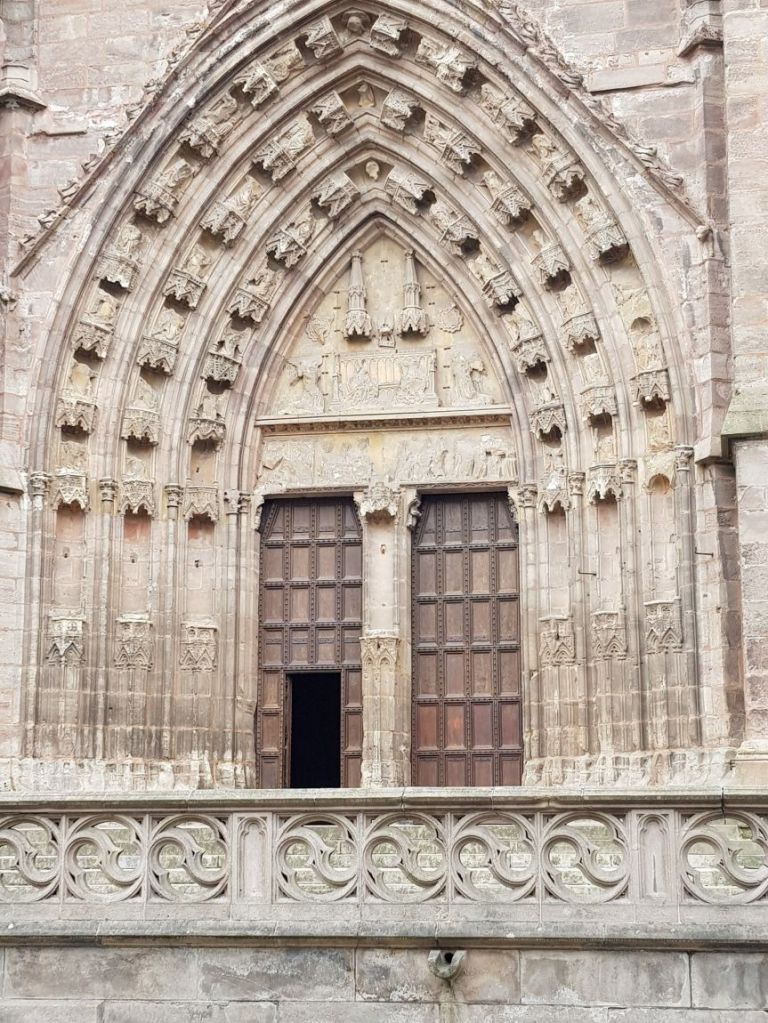
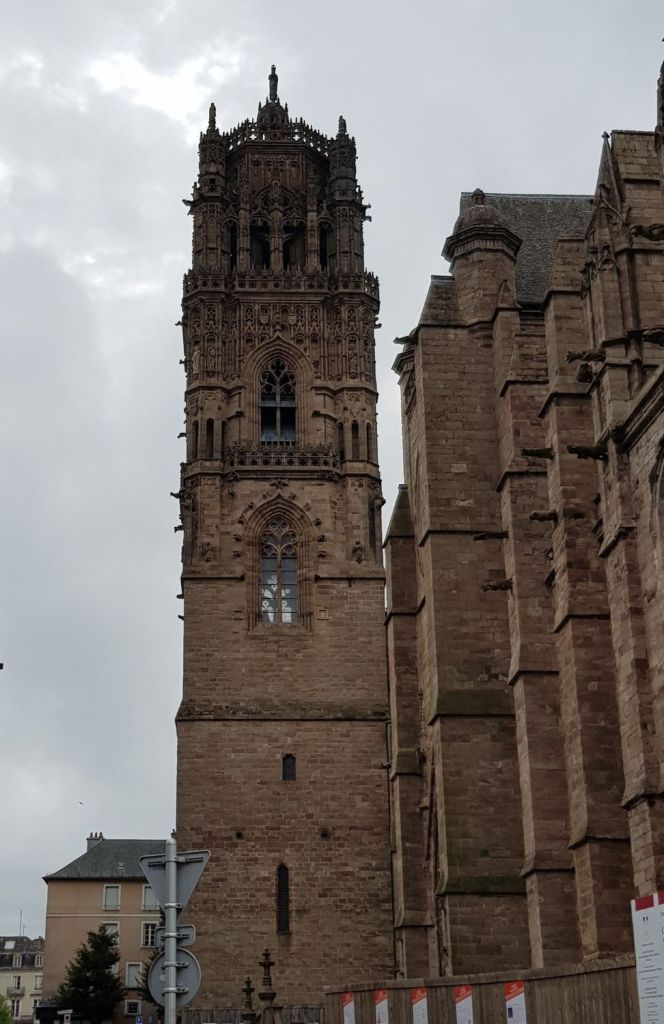
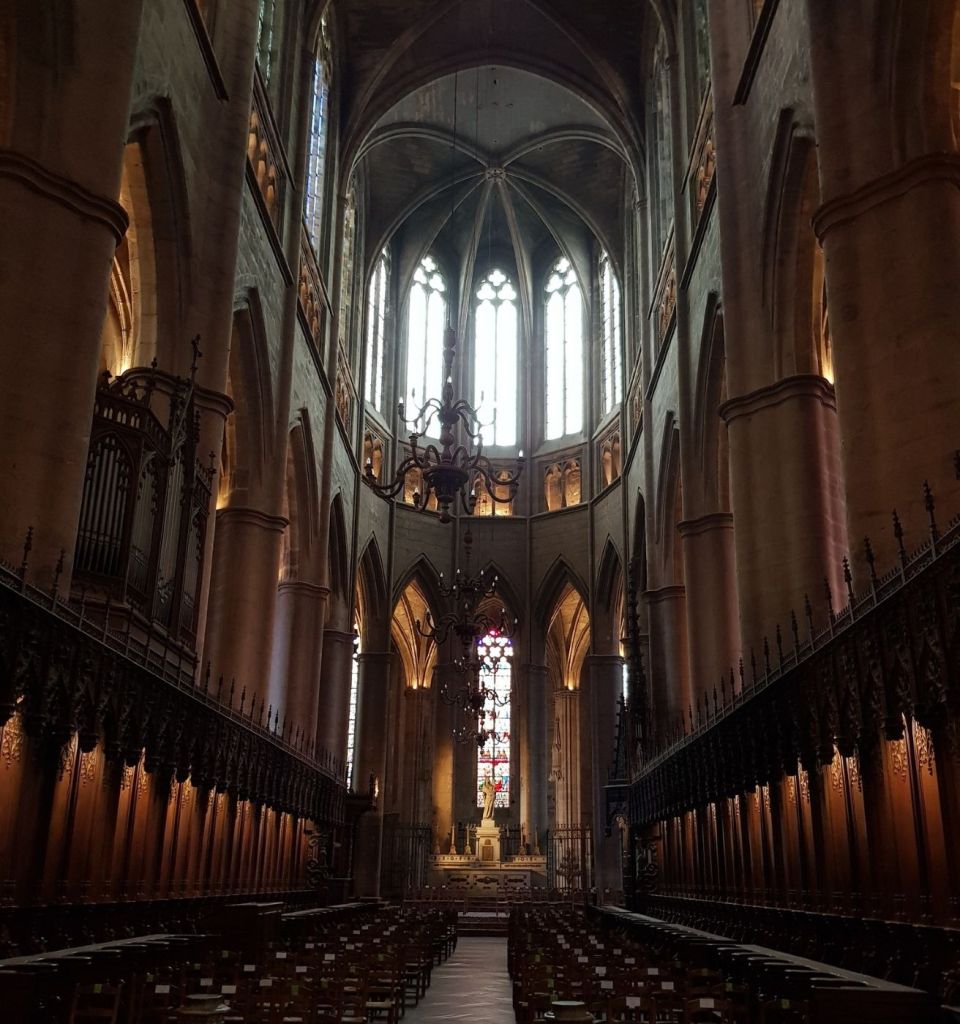
The Cathédrale Notre-Dame is located at place d’Armes, it constitutes a remarkable condensed architectural styles from the 13C to the 17C: Gothic, Renaissance and elements of baroque interior decoration. It has imposing dimensions; the central nave, quite narrow, is 102 meters long and has a particularly graceful elevation of 30 meters. The cathedral has a superb bell tower, a veritable pink stoneware lace, spotted from afar, dominating the summit of the city of its 87 meters, which makes it the highest flat bell tower in France. 400 steps are to be climbed to access the statue of the Virgin located at the top of the bell tower and the city’s panorama.
Without regard for architectural unity, Georges d’Armagnac (a 16C French clergyman who served successively as Bishop of Rodez, Archbishop of Tours, Archbishop of Toulouse, and then of Avignon, and was elevated to the cardinalate on December 19, 1544, by Pope Paul III) had the top of the fortified façade of the Gothic cathedral crowned with a miniature model of an Italian church façade, complete with a doorway, colonnade, and a classical frontispiece in 1562 by Guillaume Philandrier (a humanist and friend of François Rabelais, who was a canon of Rodez). Other singular details attract attention to this cathedral: two altars, a rudion that has been moved, a well, etc.
In the Chapel of the Holy Sepulchre, the third chapel on the south side of the nave, there is a sculpted ensemble depicting the Entombment, donated by Canon Galhard Roux in 1523. The chapel in the fourth bay of the nave, on the south side, is adorned with an altarpiece representing Christ in the Garden of Olives, placed in a flamboyant niche, donated by Canon Hélyon Jouffroy. The first two bays of the nave were used for parish services. The altar had been built at the back of the first chapel on the south side. In the mid-16C, this space having become too small, a large gallery was built beneath the west rose window, occupying the first bay of the north aisle and the adjacent chapel. The design of the gallery in the Chapel of the Holy Shoe, to the right of the choir, is attributed to Guillaume Philandrier and dates from around 1554.
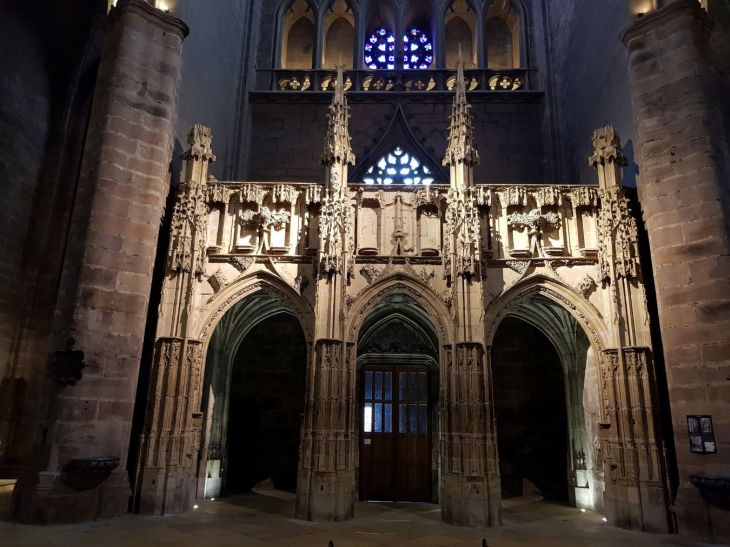
The choir, transept, and nave are covered with a local slate roof on a very high, steeply pitched timber frame. The aisles and side chapels are covered with sandstone-paved terraces. Due to their gentle slope, these terraces have been given the local name of “planets.” 14C murals were recently discovered in the axial chapel, also known as the Cantorbe Chapel, dedicated to Bishop Gilbert of Cantorbe . The Chapel of All Saints contains a cycle of tempera paintings depicting the Life of Saint Eligius. The dating can be established by the presence of a lion, the heraldic symbol of the House of Armagnac, Counts of Rodez until 1473, and by the fact that the bay of the choir where these paintings are located was built starting in 1449. A rood screen closed off the choir. Historians assumed it was built in 1478, but the repeated presence of the arms of Bishop Bertrand de Chalençon suggests it was built later, perhaps around 1490. The bishop’s tomb was located under the central arch. The rood screen was moved in 1872-1873 to the back of the south transept arm.
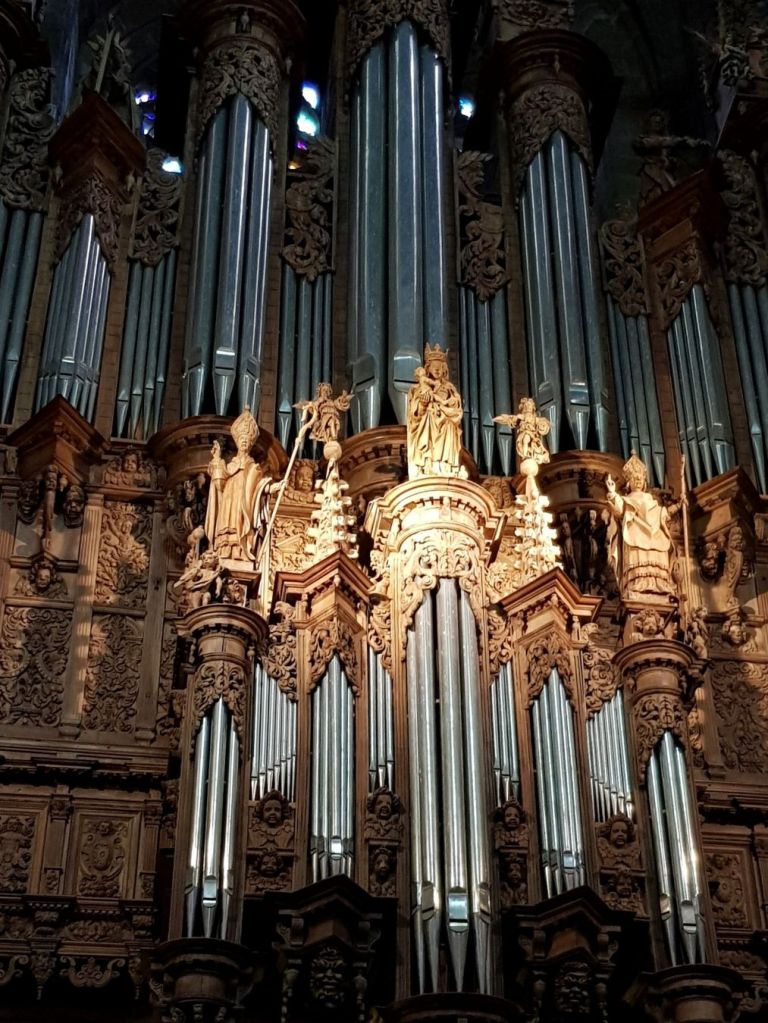
The Notre Dame Cathedral houses a superb Renaissance organ case of perfect balance, set within the arch of the north transept. The gigantic organ, its fully sculpted buffet seems to stretch to the vault! Installed above the northern portal, it occupies an unexpected location. Work began in 1628 and was completed in 1631. The organ was left to decay during the French revolution. In 1839, the organ was fully restored. On October 11, 1986, the new renovated organ was inaugurated.
A bit of history I like tell us that according to the tradition of establishing the precedence of one episcopal see over another, Rodez and the Ruteni region were Christianized at the end of the 3C by Saint Martial, and in the mid-5C by Saint Amans, the first bishop of Rodez. The episcopal group is first mentioned by Sidonius Apollinaris, Bishop of Clermont, in a letter he sent to Elaphius of Rodez in 485, who consecrated the baptistery. This letter mentions a new church, the first cathedral of Rodez. The cathedral already stood near the present site, outside the city walls of the Late Roman Empire. The cathedral was not built within the city walls until after its reconstruction in the 12C. The Merovingian church, the earliest evidence of the cathedral, was remodeled and embellished during the time of Bishop Saint Dalmas, who left it unfinished at his death in 581. The church was pillaged in 725 by the Saracens (Muslims). The entire church must have been rebuilt at the end of the 9C or the beginning of the 10C. It was at this time that the church was known as Notre-Dame. In 1526, the bishop celebrated the completion of the bell tower by consecrating the high altar of the choir, surrounded by brass columns that disappeared in 1793. At 87 meters high, the bell tower, a delicately crafted structure, still holds the title of the tallest flat-sided bell tower in France.
This structure, surmounted by an openwork lantern bearing a statue of the Virgin Mary surrounded by four thurifer angels, displays a flamboyant ornamental exuberance that is echoed in the sculpture of the transept portals and in the furnishings such as the rood screen and 15C choir stalls. With the French revolution came damage due to vandalism. In September 1793, the brass furnishings of the choir were removed, and the tomb of Raymond de Calmont was defaced. At the beginning of 1794, there were plans to demolish the bell tower, but the Montagnards of the Popular Society of Rodez postponed this demolition by proposing to replace the Evangelists with statues of Lepeletier, Marat, Bayle, and Chalier, and a statue of Liberty in place of the Virgin Mary. However, the sculptures of the portals and altarpieces were defaced. Meanwhile, the cathedral served as a reference point for the measurement of the Paris Meridian by Delambre and Méchain. The cathedral, formerly the Temple of Reason and a training ground for the Charente volunteer battalion, reverted to its original function as a place of constitutional Catholic worship on June 12, 1795. In the interim, on February 2, 1795, its treasury had been transferred to the Paris Mint for melting ! The Concordat of 1801 restored the church to Catholic worship. Rodez did not regain its status as a seat of the Catholic Church until 1823.
The City of Rodez on its heritage : https://www.ville-rodez.fr/ville/decouvrir/histoire-patrimoine/
The Rodez tourist office on the cathedral: https://en.rodez-tourisme.fr/be-inspired/listen-to-the-tale-of-rodez-cathedral-and-old-town/rodez-cathedral-and-its-stone-latticework/
The Parish Notre Dame of Rodez on the cathedral : https://www.paroisse-nda-rodez.fr/informations-pratiques/visite-de-la-cathedrale/
The Aveyron dept 12 tourist office on Rodez : https://www.tourisme-aveyron.com/en/discover/rodez/touristic-guide
The Occitanie region tourist office on Rodez: https://www.visit-occitanie.com/en/discovering/major-sites/rodez/
There you go folks, another spot in my world map or rather France’s map. Glad to have found the pictures to give credit to this wonderful Notre Dame Cathedral of Rodez in my blog; good for the memories of always. Again, hope you enjoy the post on the Cathédrale Notre Dame of Rodez !!! as I.
And remember, happy travels, good health, and many cheers to all !!!


