
We had done some serious road warrior trails around here, and always trying to find pictures, glad to these in my cd rom vault that should be in my blog for you and me, I am sure have more pictures but for now here is Jesuist chapel and the town of Eu. Therefore, let me tell you a bit about this is the town of Eu !!! Hope you enjoy the post as I.
The town of Eu is located in the Seine-Maritime department no 76 in the Normandie region of my belle France. It is entirely part of the intercommunal structure known as the Communauté de Communes des Villes Sœurs (Community of Communes of the Sister Cities), which comprises the six towns of Eu, Ponts-et-Marais, Le Tréport, Mers-les-Bains, Oust-Marest, and Saint-Quentin-Lamotte. The town of Eu is located 3,5 km from Le Tréport, 24 km from Saint-Valery-sur-Somme, 35 km from Abbeville, 32 km from Dieppe, 94 km from Rouen. 177 km from Versailles, and 524 km from my current home,We came here from Versailles taking dir Saint Germain en Laye to connect with the A13 Auroroute de Normandie dir Rouen, get off at exit/sortie 8 dir Les Mureaux go thru City center of this town crossing the Seine river on the Pont Rhin et Danube into Meulan en Yvelines continue on the D14 continue and bear right onto the D28 dir Cergy-Pontoise continue to connect at exitL/sortie 14 with the D14 (previously from Paris the A15) continue to get off at exit/sortie 17 to connect with the D43 road dir Dieppe at roundabout bear left then quick right onto the D915 road dir Dieppe ,continue bearing right onto the D156 road dir Gaillefontaine go thru this village bearing right onto the D135 road dir Neufchâtel-en-Bray go thru this village and continue bearing right onto the D1314 road continue enter Eu by the Bd Victor Hugo then right on Rue Jean Duhornay at place Guillaume le Conquerant with Church Collégiale Notre-Dame-et-Saint-Laurent on your left bear right onto Rue du Collége to the former Chapelle Collége de Jesuites, parking on the sides,
The former Chapelle Collége de Jesuites was founded at the end of the 16C by Jesuits, the college was closed in 1762 when the Jesuits were expelled from France. Although the college was officially dissolved during the French revolution in March 1792, the town continued to provide education there. Left in near disrepair for almost 150 years, the library was moved in 1973 to the château purchased by the town of Eu. The chapel now serves as an exhibition space.
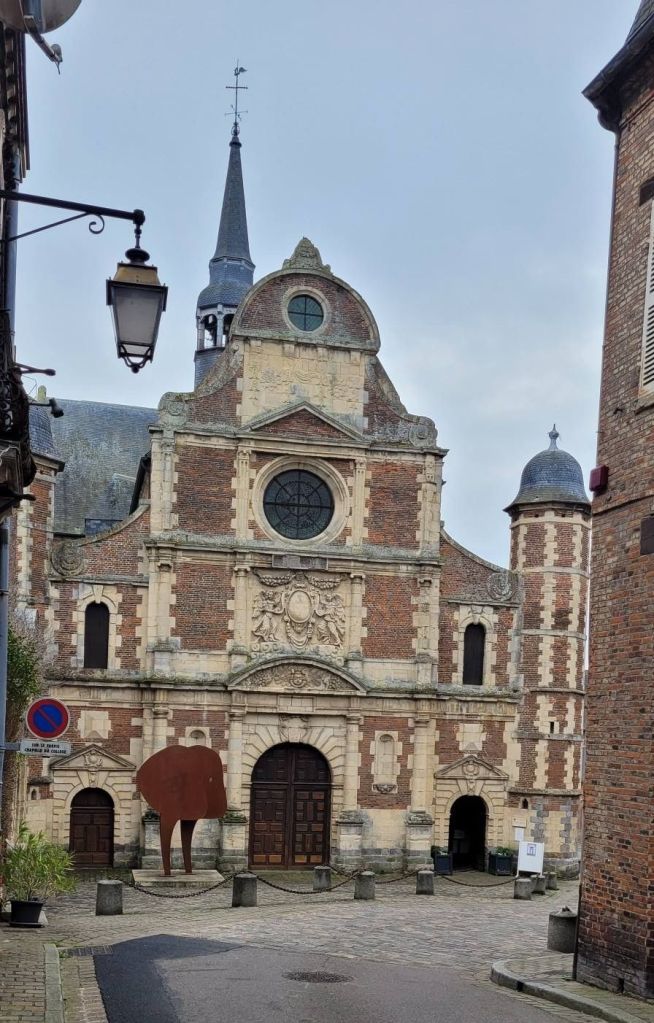
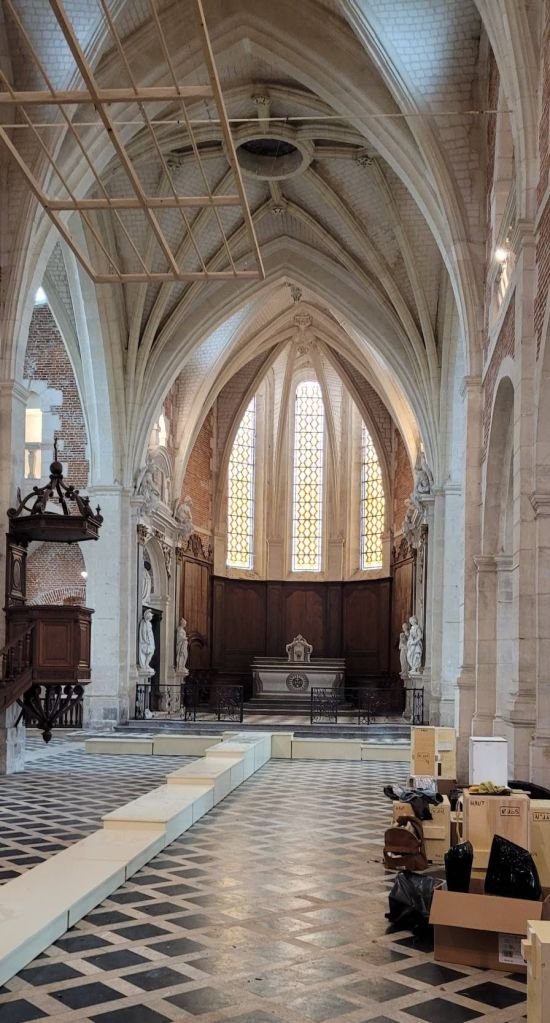
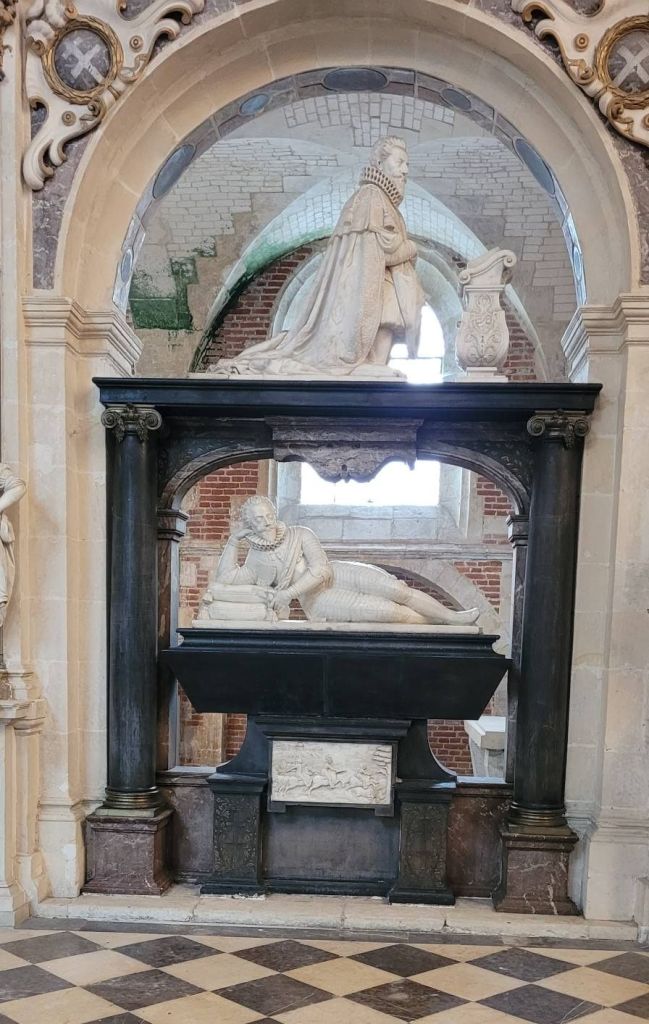
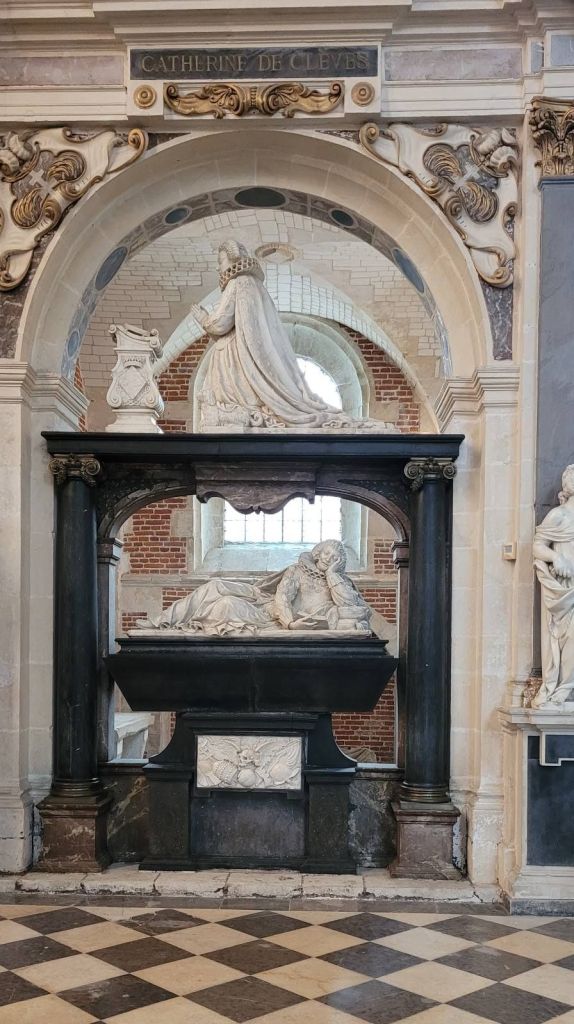
In 1580, Henri de Guise, known as Le Balafré (the Scarred), husband of Catherine de Clèves, Countess of Eu, had the Jesuit college built. Catherine of Cleves then decided to complete the construction, adding in 1613 a chapel dedicated to Ignatius of Loyola, founder of the Society of Jesus, which was finished in 1624. On either side of the choir stand the mausoleums of the Duke of Guise and Catherine of Cleves, commissioned on July 15, 1627 by the latter. Each of the two funerary monuments is flanked by two large statues: that of Henri de Guise, representing Religion and Strength, and that of Catherine of Cleves, representing Prudence and Faith. The Scarred One and his wife, peaceful in their small chapel. Henri de Lorraine, Duke of Guise, was one of the most active military commanders during the horrific St. Bartholomew’s Day Massacre. Here are the marble statues that adorn his mausoleum, which he shares with his wife, Catherine of Cleves. The mausoleum was built to had their family tomb erected there 36 years after her husband’s assassination. However, the funerary monument does not contain the remains of the Duke of Guise, which were thrown into quicklime immediately after his assassination in Blois on December 23, 1588, his ashes then being scattered in the Loire river.
Other things to see here are the Renaissance-style château, with its park, houses the town hall and a museum. The château was built at the end of the 16C on the orders of Catherine de Clèves and Henri de Lorraine (Duke of Guise). Catherine de Clèves later had it enlarged. The Louis-Philippe Museum, established in 1973, features 17C and 19C décor, 17C ceilings, and some of the finest Louis-Philippe period parquet floors in France. It also incorporates renovations by the architect Viollet-le-Duc during the Third Republic,( September 1870 to July 1940) as well as collections belonging to La Grande Mademoiselle, King Louis-Philippe, the Orléans family, and the imperial family of Brazil, the Princes of Orléans-Braganza. The Collegiate Church of Notre-Dame-et-Saint-Laurent, its organ, and its crypt (12C–19C) are also located here. Louis-Philippe Theatre, from the first half of the 19C. Museum of glassmaking traditions: antique machines, history of glass. Bois des Combles enclosure; Carolingian fortifications.
A bit of history I like tell us that Eu located on the border between Frankish and Norman territories after the Treaty of Saint-Clair-sur-Epte (911), played a strategic role in stabilizing the region. This treaty, signed between King Charles III the Simple and the Viking leader Rollo, established Normandy as a semi-autonomous territory under the latter’s authority. In 996, the County of Eu was created by Richard I of Normandy, Rollo’s grandson, to protect Normandy from enemy incursions. In 1002, William, Count of Hiémois, received the County of Eu from his brother, Richard II of Normandy. On this occasion, he founded a collegiate church in the town of Eu. In 1049, William the Bastard (later William the Conqueror) learned that Robert, Count of Eu, had allied himself with the King of France to challenge his rights to the ducal crown of Normandy. William attacked the castle of Eu and captured the town. In 1050 or 1051, William, now Duke of Normandy, married Matilda of Flanders in the town. Mathilde was the daughter of the powerful Count of Flanders, Baldwin V, and this marriage marked an important political alliance. In 1180, Lawrence O’Toole, Archbishop of Dublin and papal legate, died in Eu, where he was taken in by the canons. He was beatified in 1186 and canonized in 1225. His relics are kept in the Collegiate Church of Our Lady and Saint Lawrence in Eu. In 1202, following the confiscation of the lands of John Lackland, Philip II Augustus captured Eu and other strongholds in Normandy. In 1419, Eu capitulated to the English, marking a significant turning point in the Hundred Years’ War. In 1430, Joan of Arc, taken prisoner by the English at Compiègne, was taken to Rouen via Eu; she stayed there for one night. On Tuesday, July 10, 1475, King Louis XI ordered the burning of the town of Eu, fearing that its inhabitants would surrender it to the English. Only the religious buildings were spared. This event, known as “Pitiful Tuesday,” marked the beginning of the town’s decline, as it lost its local strategic and economic importance to Dieppe and Abbeville.
In 1578, Henri le Balafré, Duke of Guise, husband of Catherine de Clèves, 26th Countess of Eu, commissioned the construction of the current castle and founded the Jesuit college (1580). However, his assassination in Blois on December 23, 1588, halted the progress of the construction. In 1660, Anne-Marie-Louise d’Orléans, known as La Grande Mademoiselle, Duchess of Montpensier, first cousin of Louis XIV and the wealthiest heiress in France, purchased the County of Eu. She settled at the Château d’Eu in 1677, transformed it, laid out a French-style garden, had a small château built in the park, and endowed the town with a hospital. In an attempt to secure the release of her beloved (Monsieur de Lauzun), imprisoned by Louis XIV in Pignerol, La Grande Mademoiselle gifted the County of Eu to the Duke of Maine, the legitimized son of the king and Madame de Montespan. The Duke of Maine’s sons died without issue, and the county then passed in 1775 to Louis de Bourbon, Duke of Penthièvre, son of the Count of Toulouse (younger brother of the Duke of Maine). The future King Louis-Philippe I, then Duke of Orléans and grandson of the Duke of Penthièvre through his mother, inherited the château in 1821. Eu became a royal residence in 1830 and benefited from the regular visits of the king and his family. On two occasions, in 1843 and 1845, Queen Victoria of the United Kingdom was received at the Château d’Eu, thus laying the foundations for the future Franco-British Entente Cordiale. Since 1973, the Château d’Eu has been the Louis-Philippe Museum. The Friends of the Louis-Philippe Museum at the Château d’Eu was founded in 1985 by the Countess of Paris, née Isabelle d’Orléans-Braganza, to promote the enrichment of this building, which has been designated a Musée de France. Part of the former royal estate still belongs to the Orléans family, Isabelle’s heirs.
The town of Eu on the former Chapelle Collége de Jésuites : https://www.ville-eu.fr/la-chapelle-du-college-des-jesuites
The Seine Maritime dept 76 tourist office on Eu : https://www.seine-maritime-tourisme.com/en/destination/coast-beaches/seaside-towns/eu/
The Normandie region tourist office on the former chapel : https://www.normandie-tourisme.fr/sites-lieux-de-visites/chapelle-du-college-des-jesuites/
There you go folks, a wonderful visit to a nice town of Eu, It is worth a detour, and we are looking forward to be back, eventually. Again, hope you enjoy the post on this is the town of Eu !!! as I
And remember, Happy travels , good Health, and many cheers to all !!!


