
Again, tackling this huge task of telling about the magnificent beautiful awesome Basilica of Saint Quentin, I have past by here many times on my road warrior trails, and sadly not enough pictures, I found a couple in my cd rom vault that should be in my blog for you and me, I shall return, eventually, For now, let me tell you about this is Saint Quentin !!! Hope you enjoy the post as I.
The City of Saint-Quentin is located in the Aisne department no 02, in the Hauts-de-France region of my belle France. Historically and traditionally, the City was the seat of the County of Vermandois from the 10C onwards, after the city of Vermand. It is recognise as a City of Arts and History of France, It is 47 km from Laon, 108 km from Lille, 180 km from Versailles, 81 km from Amiens, and 36 km from Caudry that after visiting family on way back stop by the City along the D45 road or Route de Clary continue go thru Clary on the D15 or Rue du Général de Gaulle continue to Maretz same road now Rue du Général Leclerc and rue Georges Clemenceau continue bear right onto the D932 road dir Saint Quentin but bear left onto D282 road passing Monbrehain road changes to D283 continue then quick right turn into the D31 road and fairly short a right onto the D8 road passing Lesdins entering Saint Quentin on Rue Georges Pompidou on roundabout make a quick left onto Bd Roosevelt and then a quick right onto Rue de Baudreuil continue past the parc Champs Elysées on your left hand side, then turn right onto Rue d’Etienne d’Orves turn left for a short few meters on the rue du Gouvernement then a right onto Rue Frereuse , and then parking by the Basilica Saint Quentin, Generally, the City is at the crossroads of Paris, Amiens, Reims, Lille, and Brussels, with the D1029 and D1044 roads. This strategic location is further enhanced by the presence of two autoroutes/highways: the A26 aka the autoroute des Anglais (because many British takes it) leading to Arras, Lille, and Calais on one side and to Reims and Lyon on the other, and the A29, which connects Saint-Quentin to Amiens and Le Havre.
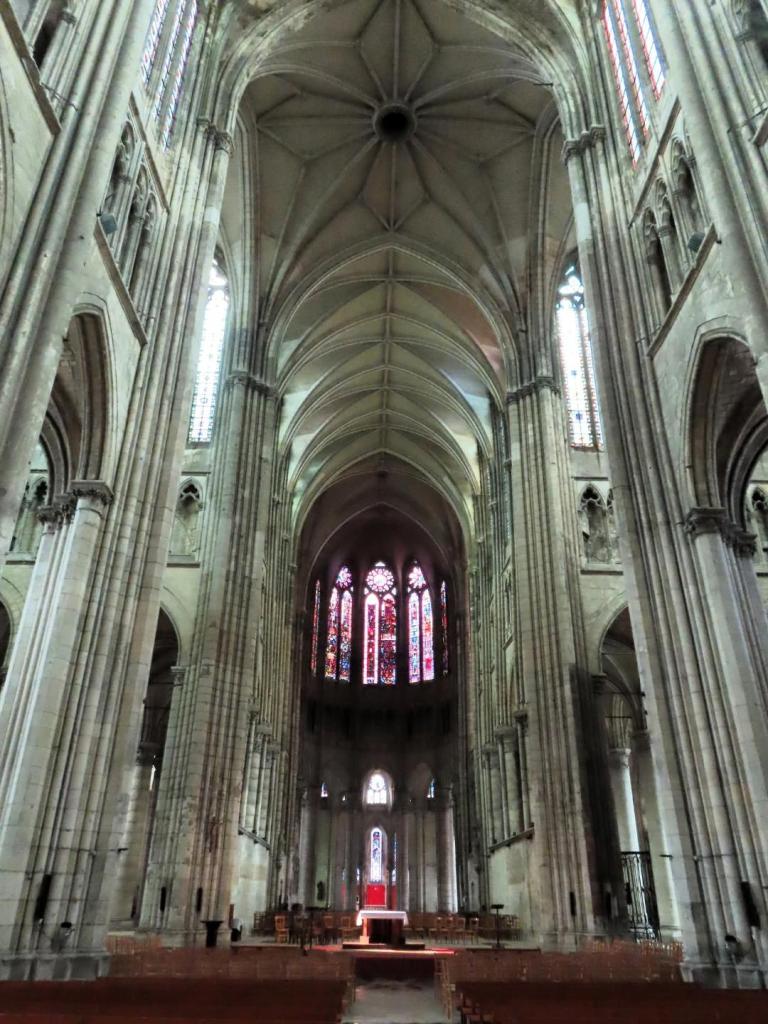
The Basilica of Saint-Quentin , formerly a royal collegiate church, became a minor basilica in December 1876. The basilica houses the relics of Saint Quentin. His remains rest in the crypt. The Basilica dedicated to Saint Quentin , a 3C martyr, is linked to the history of devotion to this saint: it houses his relics, objects of significant veneration throughout the Middle Ages. Several churches have stood on this site since the mid-4C. The current basilica originated from the ambition of the canons of
Saint-Quentin , who wished to demonstrate their power and independence from the bishops. They, therefore wanted to build a church surpassing in size the neighboring cathedrals. The basilica was painstakingly constructed from the 12C to the 15C, incorporating all the successive developments of Gothic architecture. However, due to financial constraints and wars, it was never completed. Instead of the planned monumental façade, the basilica retains its porch-tower inherited from the former Carolingian abbey church, giving it its unique appearance. As a royal collegiate church, it has been visited by numerous French sovereigns, from Saint Louis to Louis XV, who contributed significantly to its construction and maintenance. The organ case for its gallery organ, the largest organ in Picardy, was a gift from King Louis XIV in 1694. Having become a simple parish church following the dissolution of the chapter of canons during the French revolution, the former collegiate church was elevated to the rank of minor basilica by Pope Pius IX in 1876.
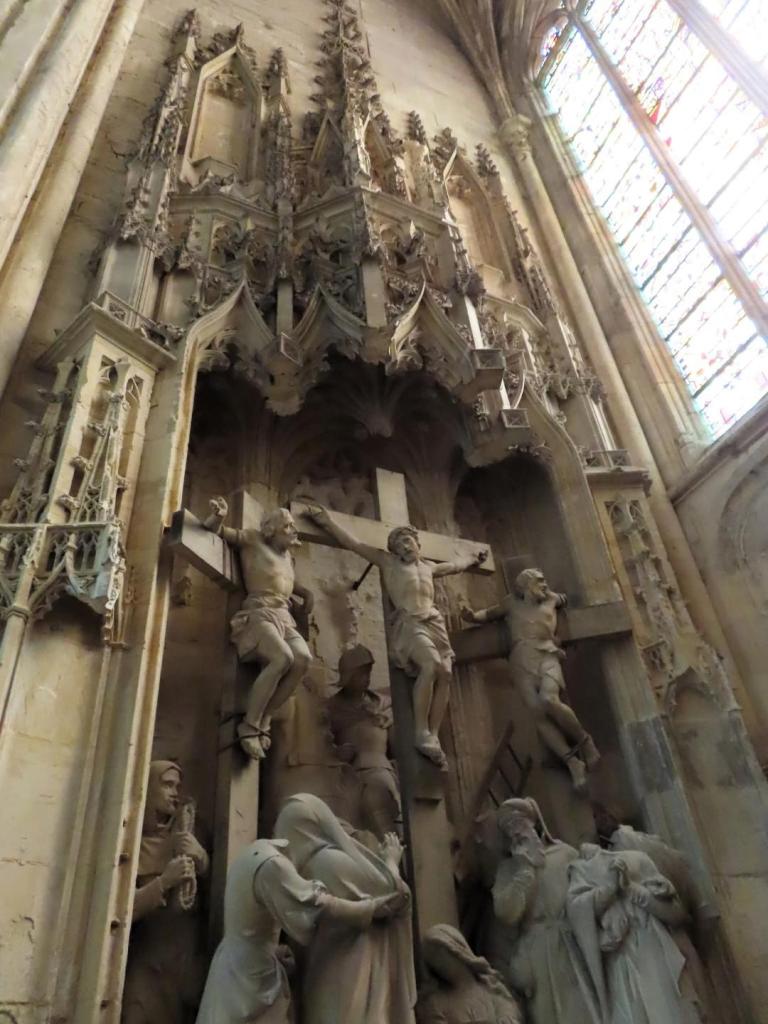
The altarpiece and the Crucifixion group in the Chapel of the Holy Sepulchre: Until the end of the 18C, the façade of the Chapel of the Holy Sepulchre housed a 15C altarpiece, installed in 1469. Only the baldachin survived the revolutionary period. In 1897, as part of restoration work, a Crucifixion group was placed in the medieval baldachin. Like the relief frieze on the chancel screen wall, this sculpted group survived the Great War or WWI, although some heads were mutilated.
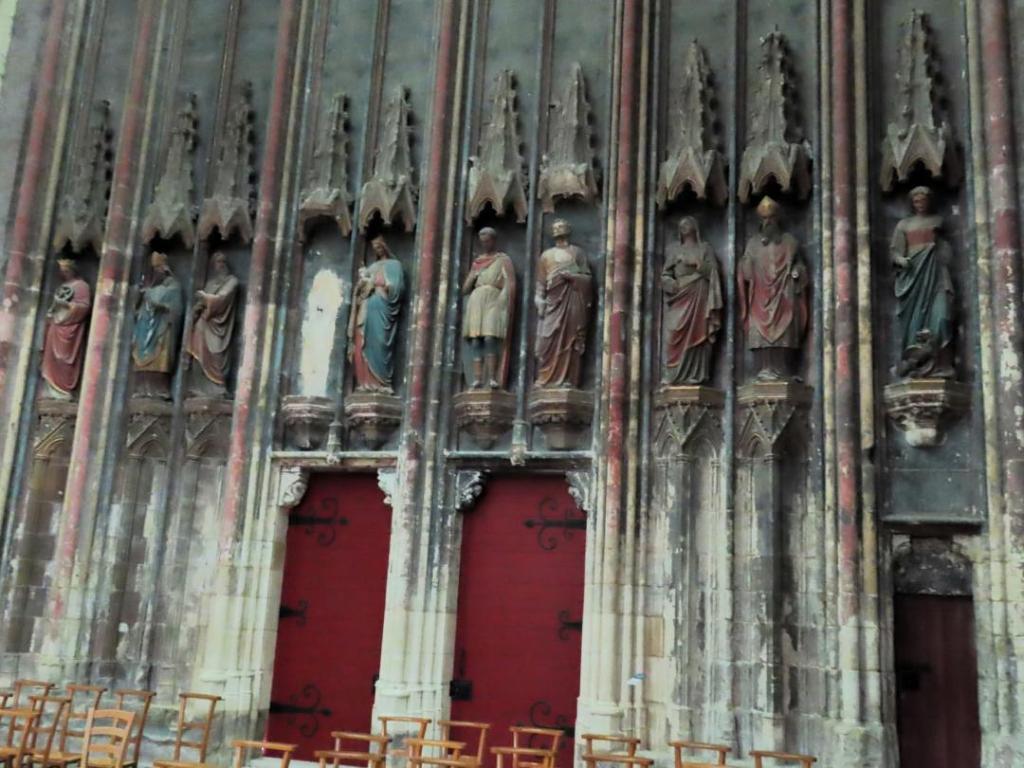
Above its portal, the south transept houses ten niches containing terracotta statues of the ten patron saints of the town’s medieval parishes. The current statues, averaging 1.90 m in height, were created in 1876. The statue of Saint James, lost during WWI, is missing. From left to right: Saint Catherine, Saint Remi, Saint Thomas, Saint James (missing), Our Lady of Grace, Saint Quentin, Saint Andrew, Saint Pexine, Saint Nicaise of Sicily, and Saint Margaret of Antioch
Other things to see here with more time are the City/town hall completed in 1509,in the Flamboyant Gothic style. The façade is adorned with 173 sculptures. The town hall’s carillon, housed in a neo-Gothic bell tower, has 37 bells. The Antoine-Lécuyer Museum: primarily dedicated to the work of the 18C pastel virtuoso, Maurice-Quentin de La Tour, the museum also holds works from the 18C (drawings, paintings, sculptures, Sinceny earthenware, objets d’art, furniture, etc.) as well as from the 19-20C. Château de la Pilule; This château, built in 1931 in a style blending Neoclassical and Neo-18C elements, houses the Butterfly Museum, which boasts a collection of over 600,000 specimens, 20,000 of which are on permanent display. The Jean-Vilar Theatre built in 1842, The Neoclassical façade was sculpted in 1854. In 1921, the ceiling was decorated by the artist and decorator Eugène Prévost, known as Messemin, depicting the city of Saint-Quentin rising from its ashes after the destruction of the Great War or WWI. The municipal theater was renamed the Jean-Vilar Theater in 1991. The monument commemorating the heroic defense of Saint-Quentin by its inhabitants and French troops in 1557 against the army of King Philip II of Spain (made Spanish for some time) was originally located in the Place de l’Hôtel-de-Ville. It was dismantled to allow for the construction of an underground parking garage. After restoration, it was re-erected in the Place du Huit-Octobre in the 2000s. The Saint-Quentin train station was built in 1926 in the Art Deco style. The city of Saint-Quentin is home to several World War I memorials: The Saint-Quentin war memorial, which stands overlooking the Étang d’Isle, was inaugurated in 1927. It takes the form of a granite wall 31 meters long and 18 meters high, resting on 14-meter-high concrete pilings. The upper section features a large bas-relief depicting the trench warfare of 1914-1918 and the exodus of March 1917. Two other bas-reliefs on either side evoke the battles of 1557 and 1871. Monument to King Albert I of Belgium: In 1936, a statue of King Albert I of Belgium, the “Knight-King,” was erected in Place du 8 Octobre 1870. The National Necropolis, on the Route d’Amiens, contains the remains of 5,273 French soldiers who died during the First World War; 3,954 rest in individual graves and 1,319 in ossuaries. The German Military Cemetery, on Rue de la Chaussée-Romaine, contains the remains of 8,229 German soldiers killed during the Great War. 6,294 rest in individual graves and 1,935 soldiers are buried in an ossuary, of which 434 soldiers are known.
A bit of history I like tell us that from the 9C onward, Saint-Quentin was part of the County of Vermandois. By the 10C, the Counts of Vermandois were very powerful. At the beginning of the 13C, Saint-Quentin became part of the royal domain of France. It suffered during the Anglo-French wars (Hundred Years’ War). In the 15C, it was contested by the Dukes of Burgundy and the King of France: it was one of the “towns of the Somme.” In 1477, following the death of Charles the Bold, Saint-Quentin reverted to the crown. Without a battle, the “good town” of Saint-Quentin became one of the most loyal to Louis XI in the Kingdom of France. The king arrived there on June 18, 1477. In 1557, a heroic siege against the Spanish ended in a terrible defeat for the French forces and the sacking of the town, the Spanish won but retreated peacefully back to Spanish Netherlands and the Treaty of Cateau-Cambrésis ended the war in 1559 ,when the City was returned to France, it underwent intense fortification activity. In the second half of the 17C, the conquests of Louis XIV moved it further from the border. At the request of the city, Napoleon authorized the demolition of the fortifications, allowing the City to expand beyond its former boundaries. In 1814-1815, Saint-Quentin was occupied by the Russians, without suffering any damage. During the Franco-Prussian War of 1870, the city of Saint-Quentin was the scene of a battle that turned to France’s advantage. On January 19, 1871, the Battle of Saint-Quentin took place near the city. It ended in a Prussian victory that dashed French hopes of breaking the siege of Paris. The Great War or WWI dealt it a terrible blow. On August 28, 1914, despite the heroic defense of the city by the “Pépères” (old-timers) of the 10th Territorial Infantry Regiment, who were from the city, it was invaded and then occupied from the beginning of September 1914. It suffered a harsh occupation. From 1916 onward, it found itself at the heart of the combat zone, as the Germans had incorporated it into the Hindenburg Line. After the evacuation of the population in March 1917, the city was looted and all industrial equipment was taken or destroyed. On October 2, 1918, the French 15th Army Corps liberated Saint-Quentin. During WWII, the city was occupied by the nazis. On September 2, 1944, the French Forces of the Interior (FFI) launched an uprising, and the Americans under Patton’s command definitively liberated the city on September 3.
The City of Saint Quentin on its heritage ; https://www.saint-quentin.fr/1588-patrimoine.htm
The Saint Quentin tourist office on the basilica: https://www.destination-saintquentin.fr/la-basilique-de-saint-quentin/
The Hauts de France region tourist office on the basilica : https://www.tourisme-en-hautsdefrance.com/offres/la-basilique-de-saint-quentin-saint-quentin-fr-3275041/
There you go folks just another effort on this wonderful beautiful awesome basilica and will be back for more, worth the detour, me think. This is a huge wonderful gorgeous monument that should be seen more not to leave out the other monuments of Saint Quentin,also, worth seeing, Again, hope you enjoy the post on this is Saint Quentin !!! as I.
And remember, happy travels, good health, and many cheers to all !!!


