
We have driven and walked in my eternal Paris, and would like to have an imprint in my blog on the wonderful family times we had there, There is so much to see , doing my best, and glad found me these pictures in my cd rom vault ,which now transposing in my blog for you and me, This was my former worked city, so glad to post more memorable spots on it, I thank you for your readership over the years and to bear with my rants! After all Paris is to rant, shout and yelled about, me think. Therefore, here is my take on the Church Saint Jean Baptiste de Belleville of Paris !!! Hope you enjoy the post as I.
The Church Saint Jean Baptiste de Belleville or Saint John the Baptist in Belleville is one of the first Neo-Gothic churches built in Paris. Located at 139 rue de Belleville, in the 19éme arrondissement of Paris, it was built between 1854 and 1859. You can access on metro Jourdain station line 11 or by bus line 26, Without their own parish, the village of Belleville obtained a chapel from the bishopric in 1543. Built in 1548, it was replaced by the first Church of Saint John the Baptist in 1635. During renovations in 1854, the foundation stone of the church built in 1635 was rediscovered. The church was the terminus of the Belleville funicular from 1891 to 1924.
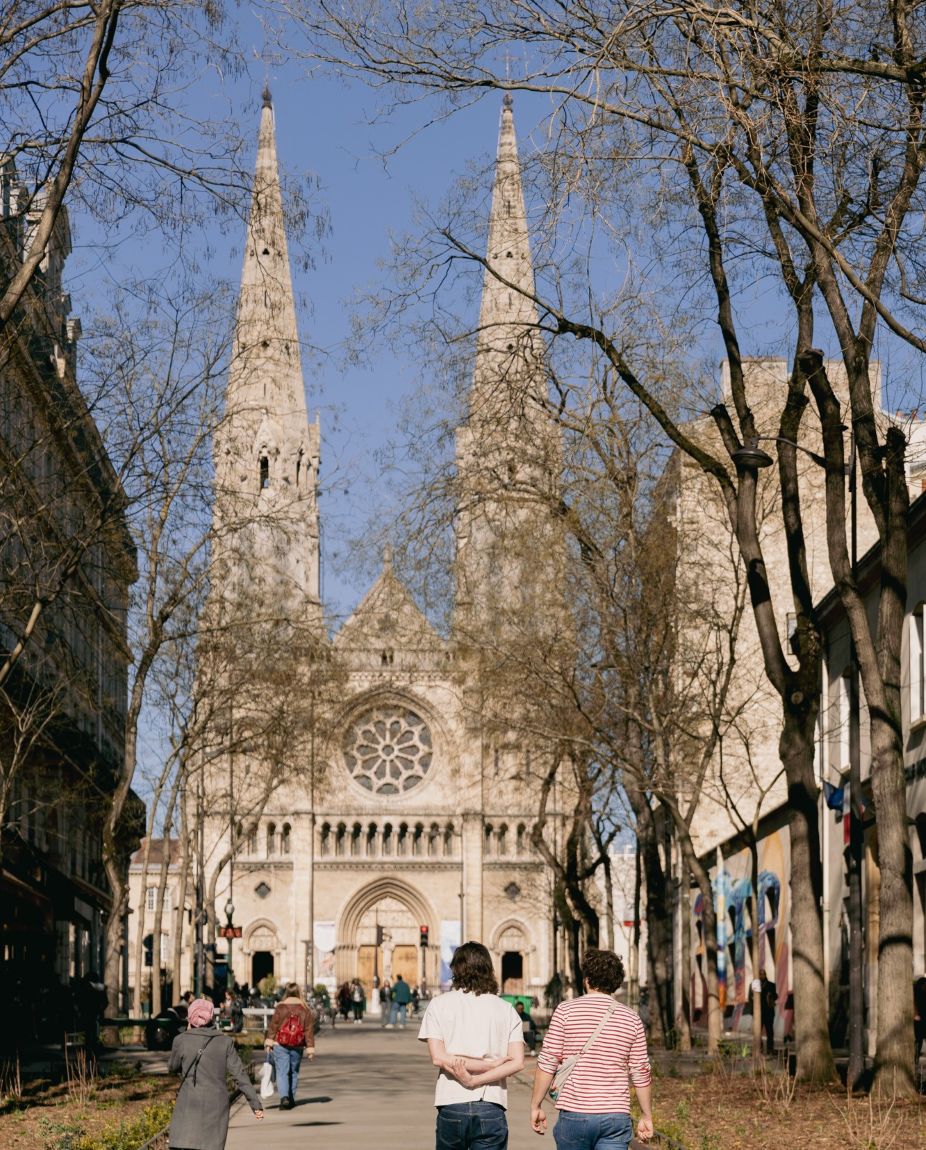
I will give you the translation using wikipedia for better explanation of this church, The Church Saint Jean Baptiste of Belleville comprises a nave of five bays with two side aisles and eight side chapels; a transept; a chancel with one bay extending from the nave; an ambulatory providing access to seven chapels; two sacristies; and two bell towers topped with spires. It measures 68 meters in external length by 25 meters in width. The facade rises 26 meters to the ridge, each spire is 57 meters high, and the vault heights are 19 meters for the nave and 8 meters for the side aisles. Central portal: The angel Gabriel announces to Zechariah the birth of a son, John. Mary visits her cousin Elizabeth. The birth of John. John’s preaching. John baptizes Jesus. John criticizes Herod. John is beheaded; his head is brought to Herodias’s daughter. Christ in glory. Trumeau: John in the desert presents the Lamb of God. Left portal: The prophets Isaiah and Malachi announce John the Baptist. Right portal: Jesus and John in prison. Christ frees Adam and Eve. The triumph of John the Baptist. Above the doors are two stained-glass windows: King David and Saint Cecilia, and a rose window: the Virgin Mary in Heaven.
The Tympanum of the left portal (rue Lassus): François Nicolas Madeleine Morlot, Archbishop of Paris, and Religion present the Church of Belleville to Saint John the Baptist. Tympanum of the right portal (rue de Palestine): the Resurrection of Christ. The tomb of Jesus is guarded by five soldiers: two are in admiration and prayer, another is reflecting, another flees in terror, and the last attempts to pierce Christ with his lance. Nave, on the left side: Eve taken from Adam’s rib; The Temptation; Adam and Eve driven out by the angel; Cain and Abel; Noah’s Ark; The Sacrifice of Noah; Noah cursing Canaan; The Tower of Babel North transept (left): Abraham and Isaac; Abraham and Melchizedek; Moses and the Burning Bush; the Tablets of the Law, South transept (right): the Ark of the Covenant; the Hebrews in the desert; the Brazen Serpent; the death of Moses. Nave, on the right side: Job and his friends; Tobias and the dead; Samson and the lion; Joshua and the sun; David playing the harp; Solomon dispensing justice; Eleazar and the elephant; Judith and Holofernes. The nave is flanked by two side aisles and side chapels. Stained-glass windows in the chapels on the left side: Saint John baptizing Jesus; Saint Michael; Saint Nicholas, Bishop of Myra; Saint Vincent, preacher, deacon, martyr (304). Stained-glass windows in the chapels on the right side: The Descent of Jesus into Hell; Saint Francis Xavier, priest; Saint Catherine of Alexandria, philosopher, martyr of the 4th century; Saint Fiacre, hermit and gardener (circa 670). The Altar and the Relics: During the consecration of the altar in 2008, relics of Saint John Vianney, the Curé of Ars, were placed there. The altar represents the Paschal Lamb: John the Baptist designates Jesus as the Lamb of God, echoing a comparison from the prophet Isaiah. The Tabernacle: The stained-glass window depicts the burning bush.
During the chancel renovations in 2008, the Latin cross installed in 1961 was preserved. The decision to place the baptistery in the chancel stemmed from the desire to highlight baptism in a church dedicated to John the Baptist and to be able to accommodate the large congregations present for baptisms with dignity, something the Baptistery Chapel could not provide. An octagon was drawn on the floor, symbolizing the eighth day, Christ having risen the day after the Sabbath, the day of the resurrection is the eighth day, “in time and beyond time.” The choir organ dates from 1859.Grand organ built by Cavaillé-Coll in 1863 and restored in 1960, 1976 and 2003.
John the Baptist is the patron saint of the church and the parish. This is why the façade is dedicated to him. John is presented in the New Testament as the cousin of Jesus and the prophet who prepares the way for the coming of the Lord (Luke), as the voice foretold by the prophets calling for conversion (Matthew): John preaches in the desert, announcing the “good news” of the coming of the Messiah. He invites the crowds to be baptized to prepare themselves to welcome the Messiah, who will baptize with the Holy Spirit and fire. John points out Jesus to his disciples as the Lamb of God, the Messiah (John), and baptizes him in the Jordan river. John denounces Herod’s marriage to Herodias, the wife of his brother Philip (Mark): he is arrested, imprisoned, and beheaded.
The builder was Jean-Baptiste Antoine Lassus (a French architect specializing in medieval architecture) was the first to apply archaeological methods of examination and reasoning to medieval buildings, combining this graphic approach with the study of ancient texts. Lassus passed on much of his knowledge to Eugène Viollet-le-Duc (a French architect best known to the contemporary public for his restorations of medieval buildings, religious structures, and castles).
The Parish of Saint Jean Baptiste de Belleville : https://sjbb.fr/
The City of Paris on the Church Saint Jean Baptiste de Belleville ; https://www.paris.fr/lieux/eglise-saint-jean-baptiste-de-belleville-19453
The Paris tourist office on the Church Saint Jean Baptiste de Belleville : https://parisjetaime.com/eng/culture/eglise-saint-jean-baptiste-de-belleville-p1271
There you go folks, a dandy city to explore and enjoy with the family, Memorable moments in my eternal Paris, driving and walking all over in my road warrior trails brings out sublime awesome spots with nice memorable family visits of yesteryear always remember and always looking forward to be back, eventually. Again hope you enjoy the post the Church Saint Jean Baptiste de Belleville of Paris !! as I.
And remember, happy travels, good health, and many cheers to all !!!


