
Another wonderful road warrior ride in my always memorable Seine et Marne dept 77, Passing by the village of Thomery, worth the detour to see even briefly the historical wonders of the village. An area always looking forward to be back, eventually. Therefore, let me tell you my take on this is Thomery !!! Hope you enjoy the post as I.
The town of Thomery is located in my dear Seine-et-Marne department no 77, in the Île-de-France region of my belle France. Situated in a bend of the Seine river, between the river and the Fontainebleau forest, Thomery is primarily known for the traditional cultivation of a table grape, the Chasselas de Thomery, using specific techniques along walls and a unique preservation method.
The town of Thomery is connected to neighboring towns by two departmental roads: the D137, in Fontainebleau, and the D210, also in Fontainebleau and Champagne-sur-Seine. It is 7 km from Fontainebleau , 21 km from Melun, 25 km from Maincy (Vaux le Vicomte castle), 76 km from Disneyland Paris, 90 km from Meaux, 81 km from Versailles, and 507 km from my current home, We came here from Meaux in my road warrior trails along the A140 highway extension to get to the A4 autoroute de l’est highway dir Paris, to exit/sortie 10,1 dir Marne la Vallée to get on the N104 La Francilienne beltway highway continue on left lane to get into the A5b highway which becomes quickly the A105 highway then stay on right lane to continue on the A5b to get to the rocade of Melun on the D606 cross the Seine river on the pont de la pénétrante bridge and continue through City center Melun past the railroad tracks and continue on Avenue Général Leclerc or D606 road then on roundabout table du roi bear left and continue on the D142 road or Ancienne Route de Bourgogne through forest area of Fontainebleau continue same road now D138 passing entrance to Fontainebleau and with the Seine river on your left hand side continue on Avenue de Valvins or D210 road and continue on next roundabout bear left onto Rue Bezout continue now again call D138 road continue to part of the forest of Fontainebleau continue to roundabout Duchâtel bear right onto Route de la Fossette this road becomes the Rue de la Gare entering Thomery and bear right onto Rue de Rosa Bonheur and the castle museum is quickly on your left hand side,
The Rosa Bonheur Studio Museum has been housed in the Château de By since the 1930s. From 1859 onwards, this château served as the home and studio of the animal painter Rosa Bonheur for forty years. The museum primarily contains objects from the artist’s daily life, as the space has remained unchanged since her death in 1899, while her works are dispersed among various museums worldwide.
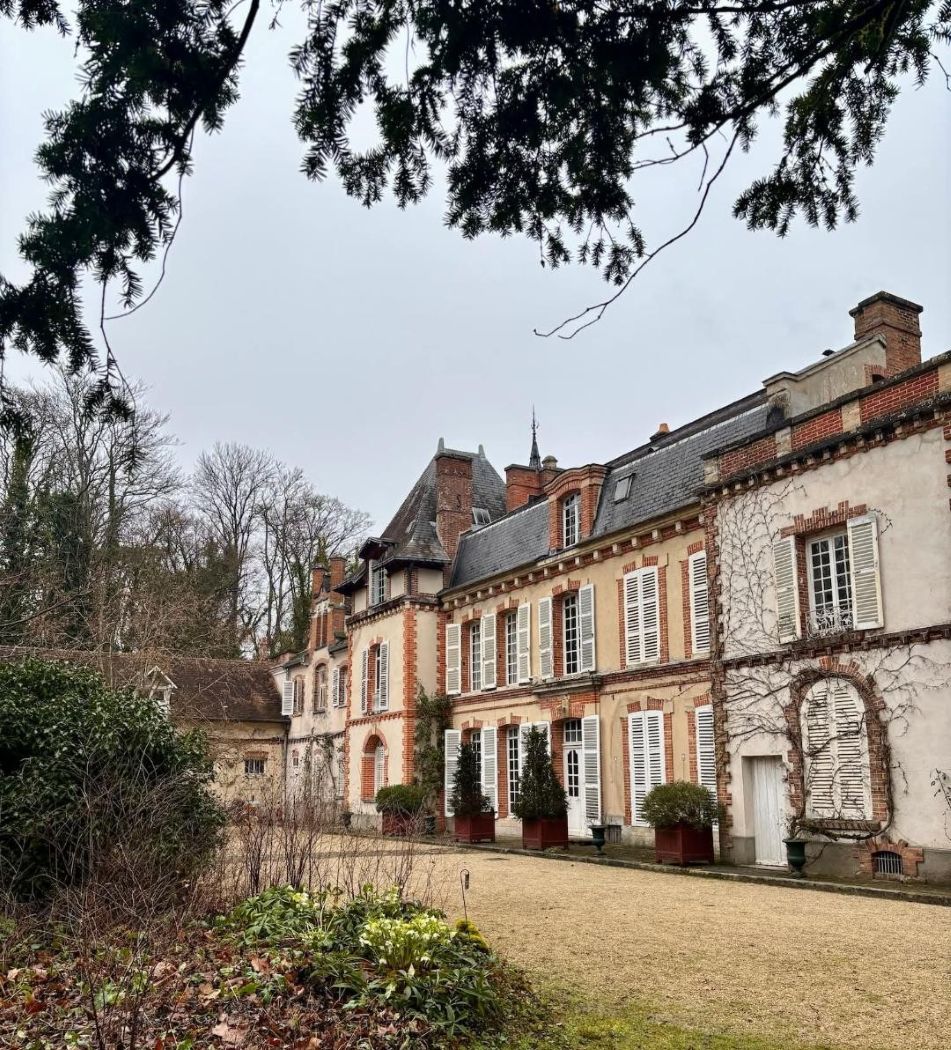
The story goes that in 1859, Rosa Bonheur was a renowned artist, receiving numerous visitors at her studio on the rue d’Assas in Paris. She purchased the Château de By, on the edge of the Fontainebleau forest. An animal painter, Rosa Bonheur had enclosures built for her animals in the château’s park; various renovations were also carried out to make the château more comfortable. A science enthusiast, Rosa Bonheur was the very first to have electricity installed in her studio and throughout the rest of the château. Above the outbuildings, where she had a vast neo-Gothic studio built, she finally found the space and light she needed to work. Completely in keeping with the style of its time, it is representative of what a renowned painter’s studio was like in the 19C. It was within these walls that Empress Eugénie awarded her the Legion of Honour in 1865. She was the first female artist to receive this distinction. Buffalo Bill donated a Sioux costume to the artist, which is now on display in the museum. Upon Rosa Bonheur’s death in 1899, the American painter Anna Klumpke, her heir, became the owner of the property, opening the studio to the public in 1909. The property was purchased by Katherine Brault from Anna Klumpke’s descendants in September 2017. A bed and breakfast is now there as well,
Other things to see here are the Church Saint-Amand (13C-17C), dedicated to Amand of Maastricht. The port of Thomery on the Seine, built under Philip Augustus for transporting sandstone to Paris. The Château de la Rivière, built for Roch le Baillif, astrologer, advisor, and first physician to Henry IV. The Chemin des Longs Sillons, a unique collection of walled vineyards in France, And the Fontainebleau Forest.
A bit of history tell us that a relatively plausible hypothesis derives the name from that of Merry, a monk from Autun, who, on a pilgrimage to the tomb of Saint Denis (in the year 715), arrived at the Seine at nightfall, where he was given hospitality in a cottage and healed the sick. This dwelling then became a house of welcome and charity, called the house of Merry, Domus Merry, Dommery, Tomery… Thomery. The proximity of the Château de Fontainebleau (see posts) explains part of the town’s architecture and toponymy. Kings Francis I, Henry IV, and others frequently stayed in Thomery and its surroundings. As the court was never far from its sovereign, the king’s inner circle built private mansions in Thomery. In 1726, the Pavé du Prince (the Prince’s Paving), which runs between the Château de La Rivière and the Château de Fontainebleau, was paved due to the frequent visits of Louis XV. The town still bears the marks of its winemaking history today, It was in 1730 that François Charmeux introduced a new grape variety, Chasselas, and an original cultivation method, training the vines on trellises, to Thomery. This new technique brought extraordinary prosperity to Thomery for over two centuries, reaching its peak at the end of the 19C.
After the kings of France, the emperors in turn enjoyed the charms of stays at Fontainebleau, even venturing as far as Thomery: Napoleon and Josephine often came to relax there, and Empress Eugénie surprised Rosa Bonheur with several visits to the Château de By.(see above) Rosa Bonheur , the celebrated painter of international renown, lived and died at the Château de By, which she acquired in 1860 thanks to the fruits of her labor, a first for a woman. Alfred Sisley , the Impressionist painter who settled in Veneux, often came to Thomery to paint the banks of the Seine, whose beauty was a constant source of inspiration for him. The opera singers Laurence Grivot and Lucienne Bréval lived or stayed there. Fernand Gregh , poet, writer, and member of the French Academy, discovered “Le Bois-Bliaud” in By in 1908. Until his death, he spent every summer and many weekends there, hosting all the leading figures of literature, music, and politics of the interwar period. Francis Gruber ,an expressionist painter, frequently stayed at the Vieux Château at 10 rue du 4 Septembre, and entertained many friends and artists. He was buried in the Thomery cemetery, where Louis Aragon delivered his eulogy and where Alberto Giacometti designed his tomb. Adrienne Clostre , a French opera composer and specialist in lyric theater, was born in Thomery. Winner of the Grand Prix de Rome for composition in 1949, she also won the Grand Prix Musical de la Ville de Paris in 1955. She composed numerous works, particularly for organs.
The town of Thomery on its heritage : https://www.thomery.fr/decouvrir-bouger/tourisme/annuaire-hebergement/joomlannuaire/blog/13:visiter-thomery
The official Château Rosa Bonheur on its museum : https://www.chateau-rosa-bonheur.fr/Atelier
The Seine et Marne dept 77 tourist office on Thomery : https://www.tourisme-seine-et-marne.fr/en/explore-the-area/727170-thomery/
The Île de France region tourist office on the Rosa Bonheur museum : https://www.visitparisregion.com/en/museum-of-the-studio-of-rosa-bonheur
There you go folks, another dandy ride in my road warrior mode,again, This is wonderful Brie country of many memorable trails, Always passing by but so much to see in my belle France until now, Again ,hope you enjoy the post on this is Thomery !!! as I,
And remember, happy travels, good health, and many cheers to all !!!


