
I like to tell you a bit on the City on the off beaten path of my former area, Montrouge. I am lucky to found me pictures in my cd rom vault to do this post for you and me, This was in my road warrior trails in the area passed by the City and saw the church took a peek and go. Therefore, here is my take on this is Montrouge !! Hope you enjoy it as I.
The City of Montrouge is located in the Hauts-de-Seine department no, 92 in the Île-de-France region of my belle France, It is cross by two major departmental roads. The D 920 (formerly the N 20, Avenue Aristide-Briand) runs through the City and took going south several times under the N20, connects the southern part of Hauts-de-Seine (Bagneux, Bourg-la-Reine, and Antony) to Paris. The D 906 (formerly the N 306, Avenue Pierre-Brossolette) provides a parallel link, connecting Montrouge to the other towns in the southwestern part of Hauts-de-Seine (Châtillon, Malakoff, and Clamart). The town is also bordered to the north by the Boulevard Périphérique ( BP ring road), whose route marks the boundary with Paris. The Porte de Montrouge/Porte de Châtillon and Porte d’Orléans provide access to the ring road and the major radial roads serving Paris. This location gives Montrouge excellent road connections with Paris and the entire Île-de-France region. Also, Metro line 4 serves the Mairie de Montrouge (city center) and Barbara stations, straddling the cities of Montrouge and Bagneux; metro line 13 serves the Châtillon–Montrouge station, also served by tram line T6, located on the border between Montrouge and Châtillon. Always by car yours truly,
In the past, Montrouge extended north to Montparnasse. Several events marked the town’s development in the 19C: the construction of a city wall in 1854; the creation of fortifications under Louis-Philippe I in 1863 (which followed the route of the current Boulevard Périphérique) that divided the town in two: Petit Montrouge to the north (in what is now Paris’s 14éme arrondissement), and Grand Montrouge to the south; the successive annexations of Paris; the recapture of territories from Vanves, Arcueil, and Bagneux; and the dismantling of the park surrounding the Château du Duc de la Vallière.
The Church Saint-Jacques-le-Majeur built from 1934 to 1940 located at 39, rue Gabriel-Péri, It is believed to have been the site of a first parish church dating back to the 13C. The church is mentioned in records from the 14C, and again during the reign of Francis I, who had it restored in 1533. However, the repairs proved insufficient, and it had to be rebuilt in 1700. After being named Saint James the Lesser and Saint Christopher, the new church was given the name Saint James the Greater. Rebuilt between 1823 and 1828, it was demolished because it was too small. It was also subject to a road alignment order to allow for the construction of the intersection at the junction of Grande-Rue and Avenue de la République. This church was rebuilt between 1934 and 1940 thanks to the Œuvre des Chantiers du Cardinal (Cardinal’s Construction Projects), an association created in 1931 by Cardinal Verdier to promote the construction and maintenance of Catholic churches in Paris and the surrounding region. The church remains the property of the municipality of Montrouge following an agreement between the municipality and the diocese at the time of its construction.
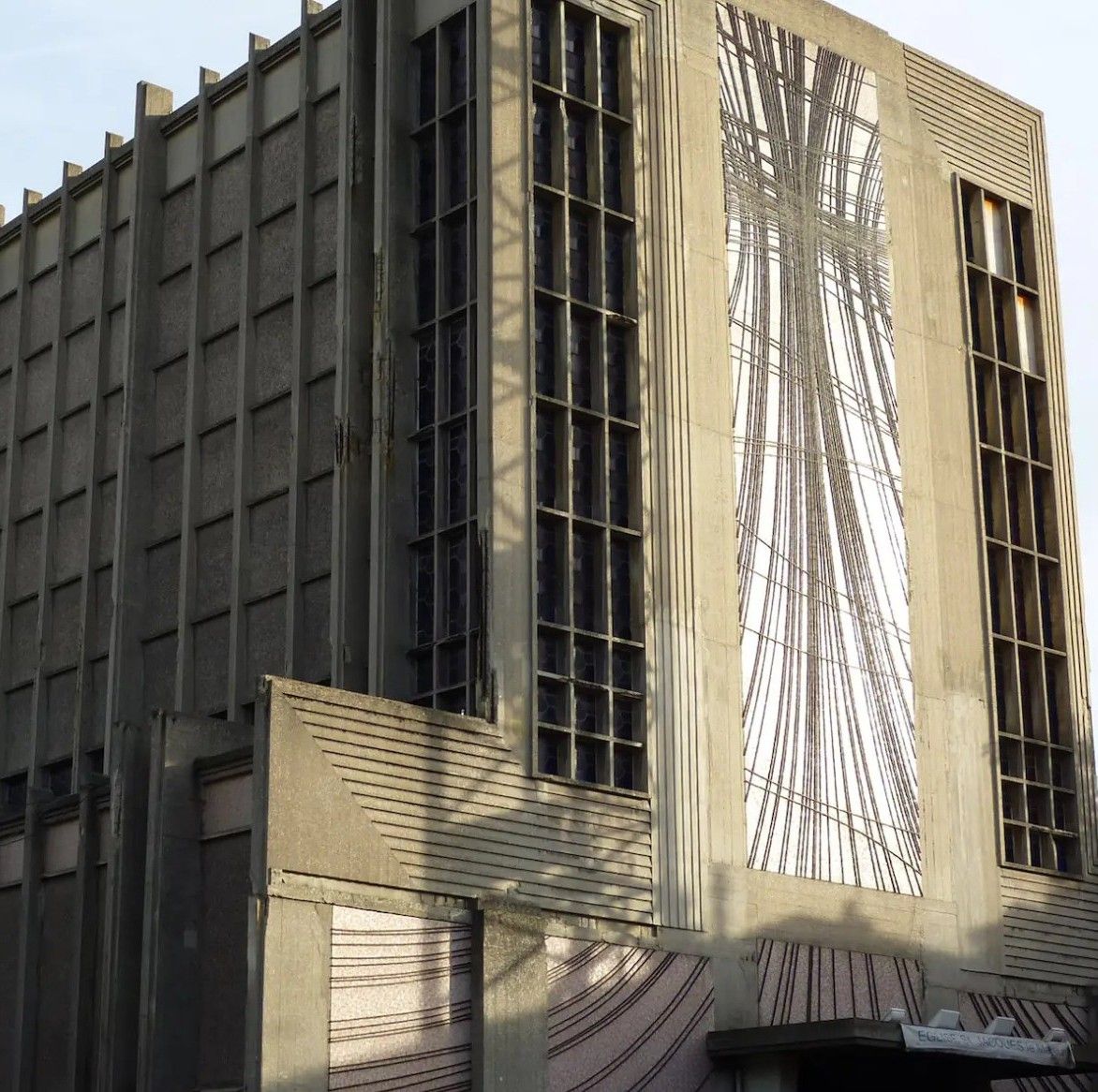
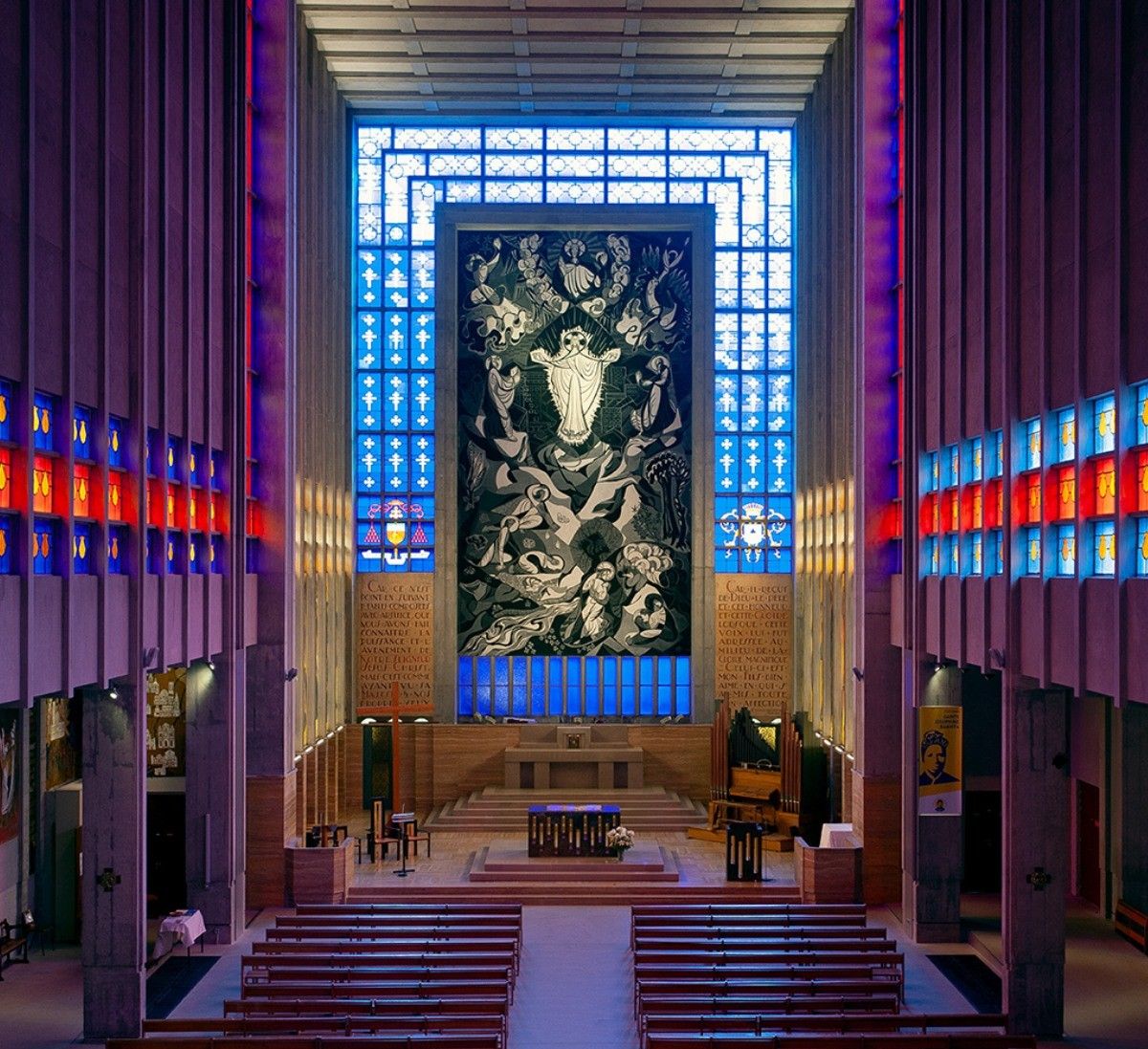
The Church Saint-Jacques-le-Majeur features a fresco decoration covering approximately 300 square meters, created between 1947 and 1949, illustrating the life of Saint James. The Chapel of the Virgin, in particular, boasts a large panel in the choir ,the fresco of the Transfiguration in black, white, and gray. The Church was designated in 1885 by the Bishop of Paris as one of the places where those unable to travel to Compostela could make a pilgrimage.
Other things to see, me think are the City/Town Hall (19-20C), one of the oldest buildings in the town, has a central section built between 1880 and 1883. A painting by Paul Schmitt, “Quarry at Montrouge,” is preserved in the staircase. It depicts a rural landscape under a cloudy sky. In the center, slightly off-center to the right, stands the winch wheel of a mine shaft. This “squirrel cage” was operated by two quarrymen. Also of note are the Belfry of the Montrouge administrative center and the large Carillon housed in its exterior gallery. The Saint-Luc Chapel (1961), 23, avenue du Fort, the Saint-Joseph-Saint-Raymond Church (1962-1963), 101, avenue Jean-Jaurès and the Saint-Raymond Chapel (1936), 17, rue Henri-Barbusse, the square de l’Hôtel-de-Ville (1925, redesigned in 1992), 43, avenue de la République occupies an area of 3,760 m2. Among the 36 trees, an imposing and powerful box elder (Acer negundo), with a 17-meter spread and a height of 13 meters, is particularly striking. The Square de l’Avenue de la République, at 75 Avenue de la République, and the Pablo Picasso Garden, at 22 Avenue Victor Hugo, are connected (total area 4,730 square meters). They share a pond with a fountain, a gazebo, 73 trees including a 16-meter-wide horse chestnut, a playground for children aged 2 to 8, nesting boxes, and a ladybug shelter. Square Schumann (1967/1969, redesigned in 1999 and 2003), located on Rue Gabriel-Péri behind Saint-Jacques Church, covers an area of 3,735 m2, divided into three sections, one of which is a children’s play area. It is home to several species of trees, including the Chinese Soapberry (9 m spread and 10 m tall), the Horse Chestnut (17 m spread and 15 m tall), the Black Mulberry (9 m spread and 10 m tall), and the Japanese Double Cherry (12 m spread and 8 m tall).
A bit of history I like tell us that the Montlhéry family, to which the supposed eponymous lord Guy le Rouge belonged, were a junior branch of the Montmorency family, initially allied with the Thibaldians, who contested the Capetians’ preeminence until 1284. The relative silence of historical records concerning Montrouge until the end of the 13C suggests that the area remained sparsely populated for a long time. In 1258, “Guillemite” monks, also known as Hermits of Saint William, settled there. They remained there until 1674. This was the second community of this order to settle in France. King Charles VII bestowed Montrouge as an honor upon Cristy Chamber, in French Cristin de la Chambre, who had been the captain of his Scottish Guard, first man-at-arms of France,from 1427 to 1445 and had escorted him during his coronation in 1429. The one who made Montrouge most fashionable was Charles de l’Aubespine, Marquis of Châteauneuf, Keeper of the Seals to King Louis XIII. In 1613, Guillaume de l’Aubespine, Baron of Châteauneuf, Chancellor of the King’s Orders, purchased the lordship of Montrouge, then passed it on to his son Charles de L’Aubespine, Marquis of Châteauneuf. Having become Keeper of the Seals of France in 1630, he undertook in 1631 the expansion of his land and his castle of Montrouge; the castle was demolished around 1815. By virtue of the law of November 12, 1789, passed by the National Constituent Assembly creating cities/towns, Montrouge became a city. In 1815, during the Hundred Days, with the approach of Blücher’s troops, it appeared that the unobstructed plain of Montrouge, insufficiently developed and guarded, could offer an advantageous position to the enemy to give battle under the walls of Paris and penetrate the city when the news arrived that, according to the terms of a military convention with the allies, later known as the Convention of Saint-Cloud of July 13, 1815, hostilities were definitively ending. They left their positions in Montrouge the day after the armistice. During the WWII, Montrouge was a place of heroic resistance against the nazis occupying forces.
The City of Montrouge on its heritage : https://www.ville-montrouge.fr/948-le-patrimoine-remarquable.htm
The Parish of Montrouge on the church : https://paroissedemontrouge.com/votre-paroisse-saint-jacques-le-majeur/
The Hauts de Seine dept 92 tourist office on others : https://destination.hauts-de-seine.fr/
The Île de France region tourist office on things to see others : https://www.visitparisregion.com/en/what-to-see-and-do/visiting
There you go folks, another quant ,nice City of Montrouge in my former backyard. Oh yes ,the there is so much to see just in the Paris area, I am working on it ! Again, hope you enjoy the post on this is Montrouge !! as I.
And remember, happy travels, good health, and many cheers to all !!!


