
I continue my journey in and around the pink city of Toulouse, one of my favorite in my belle France. On our way back, we stop by Monpazier , and finally was able to find me pictures in my cd rom vault to show in my blog for you and me, This is great wonderful village bastide or fortified town. Therefore, let me tell you about this is Monpazier !!! Hope you enjoy the post as I.
The town of Monpazier is located in the Dordogne department no, 24, in the Nouvelle-Aquitaine region of my belle France. It is 45 km from Bergerac, 49 km from Sarlat-la-Canéda, 73 km from Cahors, and Périgueux ; 573 km from Versailles, and 575 km from my current town, However, I came here from Toulouse coming back home in my road warrior trails, this is 151 km along the A620 beltway to connect with the A62 autoroute des Deux Mers to exit/sortie 9 Péage de Castelsarrasin dir Moissac on the D118 road go thru Moissac crossing the Tarn river continue to roundpoint go left on the D927 dir Montauban next roundpoint bear right onto the D957 road dir Lauzerte continue on this curvy road continue on roundpoint with Church de Miramont-de-Quercy on your left side to get you same road but now call D41 road continue to next roundabout bear left onto the D2 road dir Montaigu du Quercy which you will passed by it City center and continue on the D2 road until it change to the D18 road continue bearing right onto the D656 road passing City center Tournon-d’Agenais becoming after the D102 road dir Cahors go thru City center Monsempron-Libos crossing the Lot river on same road bearing right onto the D911F or Avenue Emile Zola continue to next roundabout bear left onto Avenue Albert Thomas or D710 road continue thru City center Cuzorn and continue on the D710 road after couple km bear left onto Route de la Rivierette or C7 country road continue curcy and forest to connect with the D660 left turn into Monpazier by the Porte de Saint Jacques,
The smallest town in the Dordogne department and a former 13C bastide town, Monpazier is a protected area and a member of the association “Les Plus Beaux Villages de France” (The Most Beautiful Villages of France). It was awarded the “Ville et Métiers d’Art” (Town and Crafts) label in 2019 thanks to its many artisans.
The Place des Cornières with the market hall. It was in this square that the scene from André Hunebelle’s film Le Capitan (1960) was filmed where the character Cogolin (played by Bourvil) sings the song “Baladin”. Ridley Scott also filmed here twice, for his first film, The Duellists, in 1976, and again for The Last Duel in 2020. You can see 23 houses with open porticoes, built from the 13C to the 17C.
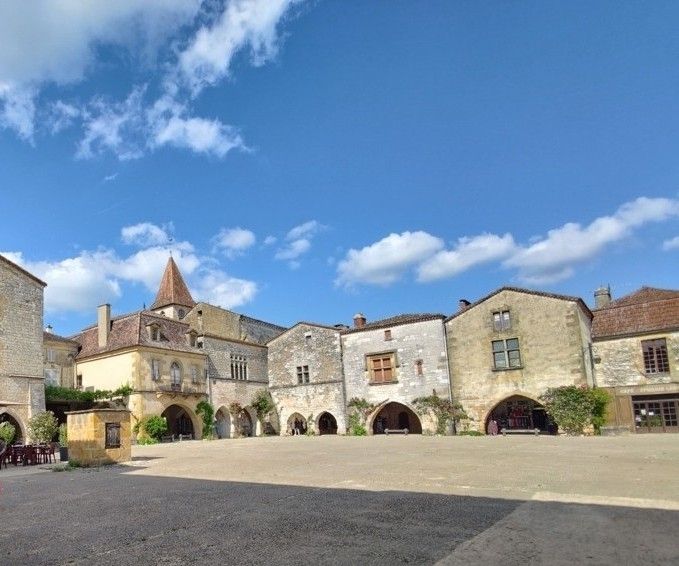
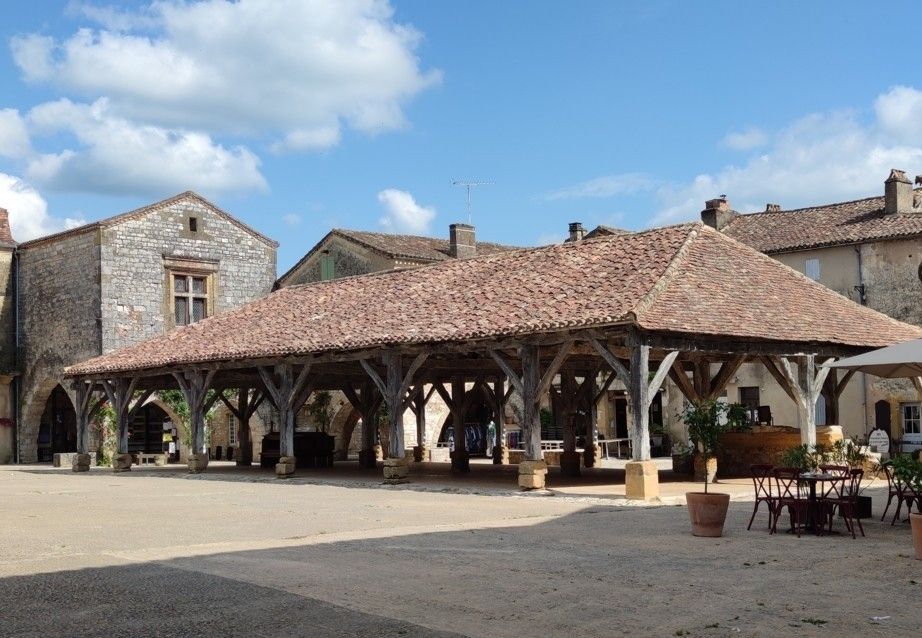
The Halle or market hall located on the Place des Cornières. The rectangular hall was built of wood. A large stone parapet displays three grain measures of different capacities.
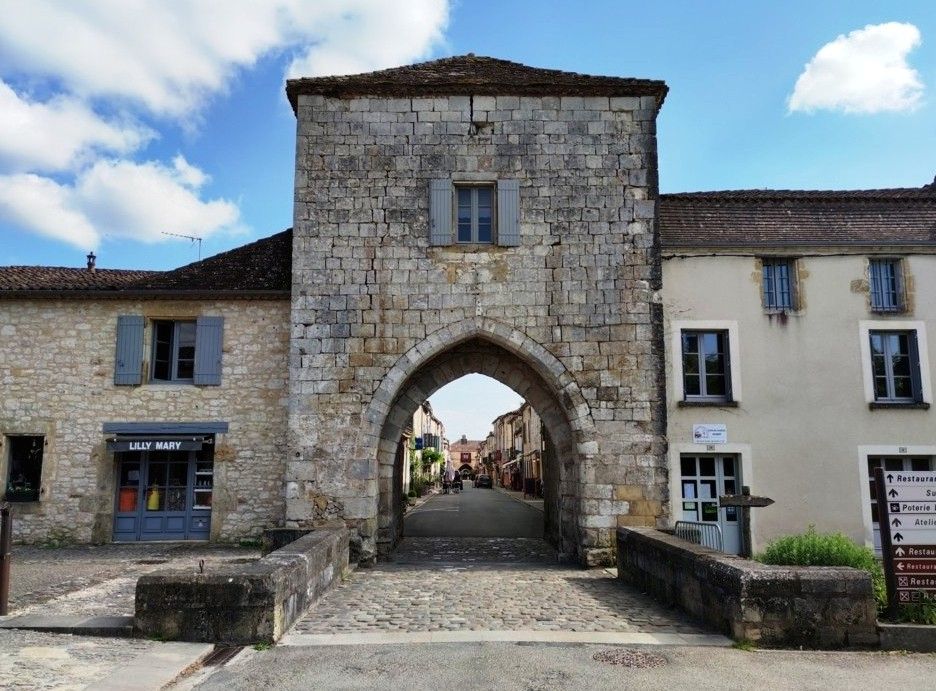
The Porte Saint Jacques to go into the square and old town located by on Rue Saint Jacques,The northern front,(see pic) the easiest to access, was to be defended by a fortified mill placed in front of the rampart and allowing control of the communication routes.
Other things to see here are Saint-Dominique Church, built between the 13C and 16C. Chapter House or tithe barn. City walls and gates. Hôtel de Londres – North Fairground, a building steeped in history. Many prominent figures frequented the hotel between 1880 and 1939. The Bastideum, an interpretation center for the bastide town of Monpazier, is housed in part of the former Recollect convent, an establishment founded in the mid-17C. Sold during the French revolution, this convent housed the City/town hall at the beginning of the 20C and served as a venue for temporary art exhibitions before the opening of this museum dedicated to bastide towns on July 10, 2013. The building has served as the City/town hall, a former almshouse, then a hospital and royal cotton mill, and finally a retirement home. The almshouse is mentioned in 1766, functioning as a hospital, orphanage, and royal cotton mill.
A bit of history I like tell us that after King Louis IX received the homage of Henry III of England on December 4, 1259, the Treaty of Paris was signed. By this treaty, the King of France confirmed Henry III’s possession of Limousin, Périgord, Quercy, Agenais, and part of Saintonge, while retaining Normandy and the Loire Valley (Touraine, Anjou, Poitou, and Maine). After the death of Alphonse of Poitiers without children, Philip III the Bold, king since the death of his father, Louis IX,(Saint Louis) in Tunis, inherited the County of Toulouse, Poitou, and part of Auvergne. By the Treaty of Amiens on May 23, 1279, he was forced to cede Agenais, Saintonge, and Ponthieu to King Edward I of England. Upon the death of his brother, Peter, in 1283, Philip III inherited the County of Perche and the County of Alençon. Alphonse of Poitiers had founded the bastide of Monpazier in 1284. The bastide was built according to a rectangular or Hippodamian plan, around a central square, the Place des Cornières, surrounded by houses built between the 13C and 17C. Over the centuries, it has managed to preserve its original character despite the vicissitudes of time and to escape the destruction wrought by the Hundred Years’ War and the Wars of Religion in the region. In 1294, Philip the Fair, using as a pretext disputes between Norman and English sailors in 1292-1293, sent troops to occupy Guyenne, including Monpazier. The war ended with the Treaty of Montreuil-sur-Mer in 1299. The death of King Charles IV without an heir led to a change of dynasty with Philip VI of Valois. The Hundred Years’ War began in 1337 when the King of France seized the Duchy of Guyenne. King Edward III of England proclaimed himself King of France in 1340. The Gascons rebelled and were represented by John III of Armagnac to complain to King Charles V. The king took advantage of this to send an army commanded by Bertrand du Guesclin, who recaptured northern Aquitaine while the Gascons retook the southern part. Pierre de Gontaut, having repelled John Chandos, recaptured Monpazier. After the death of Edward III, Charles V sent du Guesclin and his brother, Louis I of Anjou, to retake Bergerac and the fortified towns (bastides) between the Garonne and Dropt rivers, including Monpazier. All the main players in this phase of the conflict between the English and the French died in 1380. After the first campaign led by Joan of Arc and the king’s coronation in Reims, the Peace of Arras in 1435, between Charles VII and Philip the Good, Duke of Burgundy, allowed the King of France to re-establish his authority and gradually regain control of the kingdom, causing Henry VI to lose all his possessions in France except for Calais. In October 1450, David de Faubournet’s eldest son received the captaincy of Monpazier from the Count of Périgord. The Battle of Castillon in 1453 brought the military operations in Aquitaine to a close.
From 1557 onward, the spread of the Reformation was facilitated by the proximity of Biron Castle. In early July 1565, three troops of Swiss and German soldiers passed through Monpazier on their way to join the king in Bayonne. On August 6th, Madame de Guise, her son, Henri de Lorraine known as “le Balafré” (the Scarred), the Cardinal de Guise, and the Monsieur de Nemours passed through Monpazier with Monsieur de Biron. They dined at the Château de Biron.
On January 19, 1572, the Queen of Navarre, accompanied by the brother of the Prince of Orange, joined the Prince of Condé at the Château de Biron, passing through the southern part of Monpazier, to discuss the terms of her son Henri de Navarre’s marriage. It was following this marriage that the Massacre of Saint Bartholomew took place. After the Peace of Bergerac in 1577, Henri de Navarre was appointed Governor of Guyenne and Armand de Gontaut-Biron, Lieutenant-General. Henri de Navarre came to Monpazier on September 12, 1579, and stayed for three days. The Treaty of Fleix, concluded in 1580 between the King of France and the Protestant party represented by Henry of Navarre, stipulated the dismantling of Monpazier. The death of the Duke of Anjou in 1584 transformed a religious war into a war of succession, as this death made the Protestant Henry of Navarre the rightful successor to King Henry III. In 1588, after the murder of the Guise family at Amboise (see post) on the orders of Henry III, followed by Henry III’s assassination in 1589, Henry of Navarre was forced to conquer his kingdom and abjure Protestantism in 1593 in order to be crowned King of France in 1594.The Edict of Nantes was promulgated on April 16, 1598 to restore religious peace. In 1789, the 50 notables comprising the town council were replaced by 113 active citizens. In 1791, the directory of the district of Belvès decided on the sale of ecclesiastical property ordered by the Constituent Assembly by the decree of November 2, 1789. The clergy’s property had become national property. In 1801, the canton was attached to the arrondissement of Bergerac. As part of the 2014 reform defined by the decree of February 21, 2014, the commune was then attached to the canton of Lalinde.
The town of Monpazier on its heritage : https://monpazier.fr/vie-economique-et-touristique/les-labels-et-distinctions/
The Monpazier bastide museum : https://www.bastideum.fr/
The Pays de Bergerac tourist office on Monpazier : https://www.pays-bergerac-tourisme.com/en/discover/old-stones/bastide-towns/monpazier
The local Valley of the Dordogne tourist office on Monpazier : https://www.visit-dordogne-valley.co.uk/natural-and-cultural-heritage/top-10-places-to-visit/villages-to-visit/plus-beaux-villages-de-france/monpazier
The local Dordogne Perigord tourist office on Monpazier : https://www.dordogne-perigord-tourisme.fr/sinspirer/une-destination-aux-multiples-facettes/villes-villages-caractere/plus-beaux-villages-de-france/monpazier/
There you go folks, a dandy quant town of my belle France , This is one of our historical bastides or fortified towns. It is on my favorite route and glad finally stop by with pictures. Again, hope you enjoy the post on this is Monpazier !!! as I
And remember, happy travels, good health, and many cheers to all !!!


