
This is a venerable institution that is worth the detour to visit, I happened to been there believe a meeting do not recall what but glad found me newer pictures in my cd rom vault to share with the world in my blog for you and me, The place can be visit in Paris, it brings back memorable moments of my life. Therefore, here is my take on the Collége de France in Paris !! Hope you enjoy the post as I.
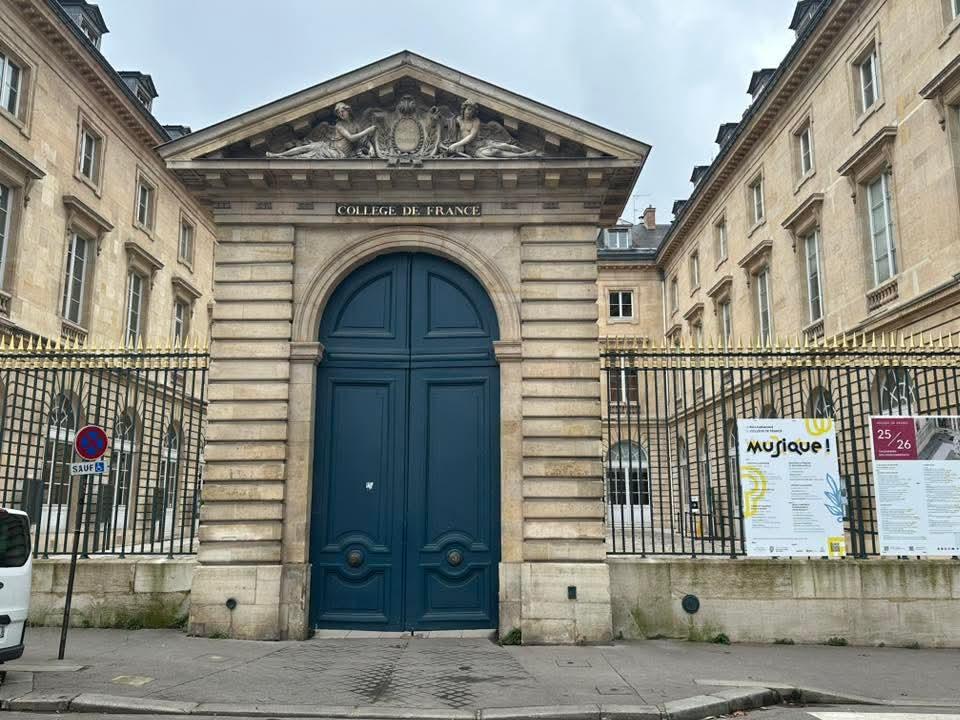
The Collège de France is located at place Marcelin-Berthelot in the heart of the Quartier Latin and in the 5éme arrondissement of Paris.This is a public institution of higher education and professional research whose ambition and missions are unique in the world. Since 1530, the Collège de France has fulfilled a dual vocation: to be both the place for the most audacious research and the place for its lectures. Dedicated to fundamental research, which it develops in close partnership with numerous scientific and cultural institutions, The text to be original is mostly from their officia site, The pic is entrance by Rue des écoles that gives to place Marcelin Berthelot,
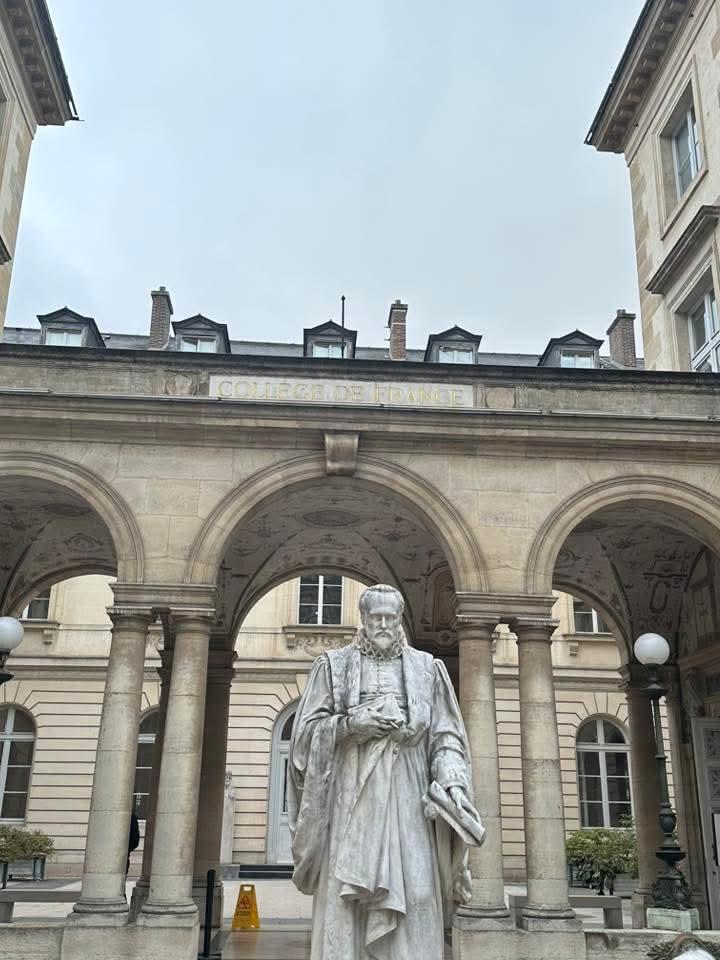
A statue of Guillaume Budé, the institution’s first patron erected in the middle of the courtyard or Cour Budé. Also, Oronce Finé, Chair of Mathematics (1530-1555); Pierre de la Ramée, also known as Petrus Ramus, Chair of Mathematics and Greek and Latin Philosophy (1551-1572); Pierre Danés, Chair of Greek (1530-1535); François Vatable, Chair of Hebrew (1530-1547); Adrien Turnébe, Chair of Greek (1547-1561) then of Greek and Latin Philosophy (1561-1565); and Pierre Gassendi, Chair of Mathematics (1643-1655). Busts installed in 1888.
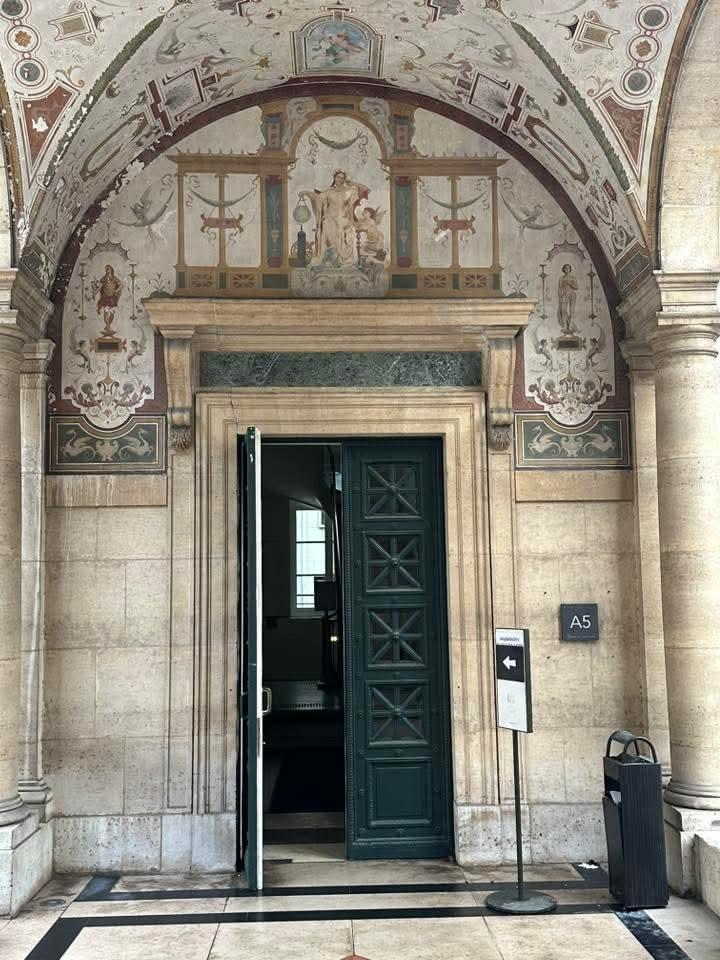
By the rue Saint-Jacques side see the frescoes of the portico gallery separating the Letarouilly and Budé courtyards.
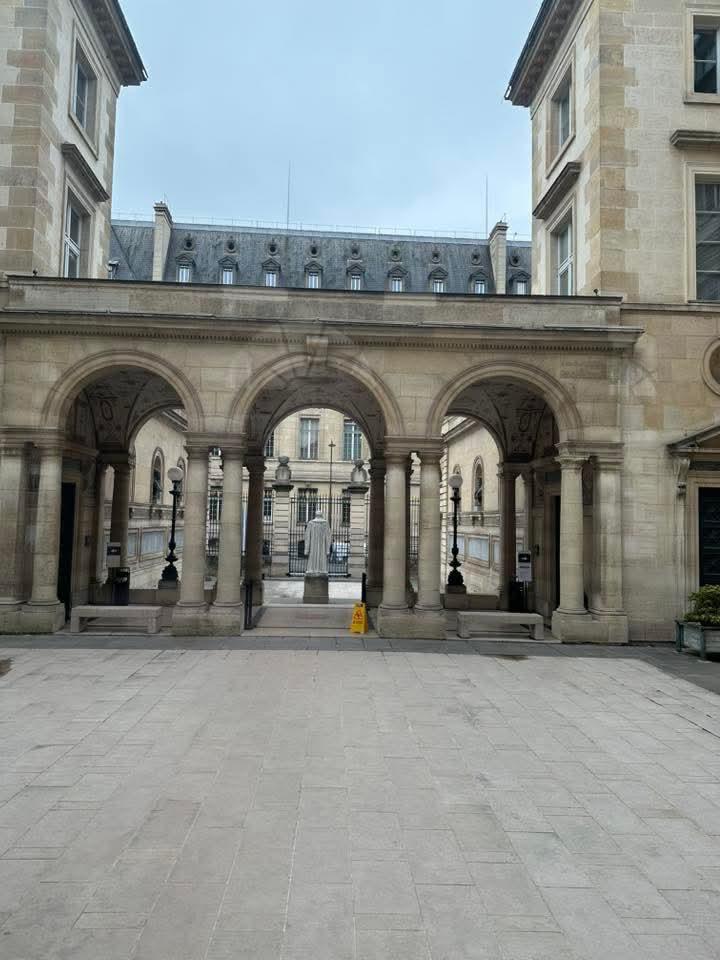
In the mid-19C, the architect Paul Latarouilly designed an extension towards Rue Saint-Jacques. New spaces were organized around two new courtyards and new buildings bordering the old college. These buildings housed the teaching of chemistry, physics, biology, and lecture halls.
The Collège de France owes its creation to François Ist who appointed the first royal lecturers in 1530. Their function was to teach subjects not yet admitted to the University. Today, the former “lecteurs royaux” have become professors working alongside several hundred researchers, engineers, technicians and administrative staff. The school is organized into chairs. These cover a vast array of disciplines: from mathematics to the study of great civilizations, physics, chemistry, biology and medicine, philosophy and literature, social sciences and economics, prehistory, archaeology and history… A professor appointed to a statutory chair at the Collège de France may hold it for the rest of his or her career. However, a small number of annual chairs, all thematic, welcome a new incumbent every year.
In the 16C, the University of Paris had a monopoly on teaching. Its four faculties – Theology, Law, Medicine and Arts , claimed to embrace all that was useful and lawful in terms of study and knowledge, with Latin as the sole language of learning and study. But several phenomena eroded its monopoly. The Reformation and the Renaissance, which spread throughout Europe, encouraged the study of ancient languages such as Greek and Hebrew, in a move to return to the sources of Christian and philosophical texts. These movements were further encouraged by the development of printing, which accelerated the circulation of works, including secular ones, and of information, In the 1520s, humanist Guillaume Budé, bookseller to King François I, suggested the creation of a special corps of professors, inspired by the University of Alcalá de Henares in Spain and, above all, the Collège des Trois Langues in Louvain, founded by friends of Erasmus. In 1530, six “royal readers” were appointed: three for Hebrew (François Vatable, Agathias Guidacerius, Paul Paradis), two for Greek (Pierre Danès, Jacques Toussaint) and one for mathematics (Oronce Finé). By the 1550s, they were teaching at the Colleges of Tréguier ( Côtes-d’Armor, dept 22 Brittany-see post) and Cambrai (Nord dept 59 Hauts de France-see post), where the Collège de France now stands. Charles IX set up a jury to examine the candidates’ skills. Thus, in 1567, Nicolas Goulu was judged suitable to teach Greek after being auditioned by royal readers and Pléiade poets, including Pierre Ronsard.
However, premises were in short supply, although lectures took place mainly in the Collèges de la place of Cambrai. In 1610, Henri IV commissioned the architect Claude Chastillon to construct a new building. The initial project was to house the royal library (forerunner of the Bibliothèque nationale de France-see post) and the royal readers’ lectures. The king’s assassination on May 14, 1610 did not jeopardize the project, as the foundation stone was laid by the dauphin, Louis XIII, on August 28 of the same year. The end of the century was marked by the granting of its coat of arms: the Collège’s coat of arms dates from January 18, 1699. They are “azure, a silver book on which are written the words: docet omnia ; the book, accompanied by three golden fleurs-de-lis, two in chief and one in base”. They are very similar to those of the brotherhood of booksellers and printers. According to the minutes of the assembly, the coat of arms was decided and used following a request from the King, and was registered in the Armorial Général. However, teaching conditions deteriorated, with the deterioration of the premises regularly denounced by the professors. Their request was finally heard by Louis XV, and the construction of a new building by Chalgrin was approved in 1772. The foundation stone was laid in 1774, marking the start of a ten-year construction period. In the 1830s, architect Paul-Marie Letarouilly led the construction of a new wing adjoining Chalgrin’s building, in the same style. Completed in 1841, it was insufficient to accommodate all the public. The crowds were even used as a pretext by the new government in 1852: Louis-Napoléon Bonaparte (later Napoléon III), following his coup d’état on December 2, 1851, used the argument of public order to remove Jules Michelet, Edgar Quinet and Adam Mickiewicz from their professorships. They were not the only ones to suffer this fate: in 1864, Ernest Renan was expelled following his “opening lesson”, deemed insulting by the Church, since he treated the life of Jesus as that of a man. He was finally reinstated in 1870, with the birth of the Third Republic. At that time, the institution took on its current name. Previously known as the Collège royal, then imperial, it is now known as the Collège de France.
Construction resumed in the 1930s, and the school expanded with the construction of three new buildings. The first, dedicated to chemistry, was inaugurated in 1938. The WWII and the Nazis occupation hit the institution hard. Some professors and staff were affected by the racial laws. Eight were deported or shot because of their status or for acts of resistance. Work resumed after the Liberation of Paris, enabling completion of the physics building in 1954 and the biology building in the 1960s. A European Chair was created in 1989, and an International Chair in 1992, in order to open up teaching to foreign personalities. Numerous new annual chairs have also been created, from the Artistic Creation Chair in 2004, through the Technological Innovation Liliane Bettencourt, Computer Sciences and Digital Technologies, Public Health, Francophone Worlds, Biodiversity and Ecosystems and Avenir Commun Durable chairs, to the one dedicated to The Invention of Europe through languages and cultures, inaugurated in 2021.
The Collége de France campus has the main at the Marcelin-Berthelot site 11, place Marcelin-Berthelot (5éme) housing the lecture theaters and reading rooms, which are open to the public. There are ,also, sites such as the Ulm site at 3 rue d’Ulm (5éme) ; the Cardinal Lemoine Site – Institute of Civilizations at 52 rue Cardinal-Lemoine (5éme), and the Belle Gabrielle site at 49bis Avenue de la Belle Gabrielle 12éme; site not open to the public , You get to the main site on Metro: line 4, Saint Michel or Odéon stations, RER: line B, Saint Michel or Luxembourg stations, and by bus lines 63,and 86: Collège de France arrêt/stop.
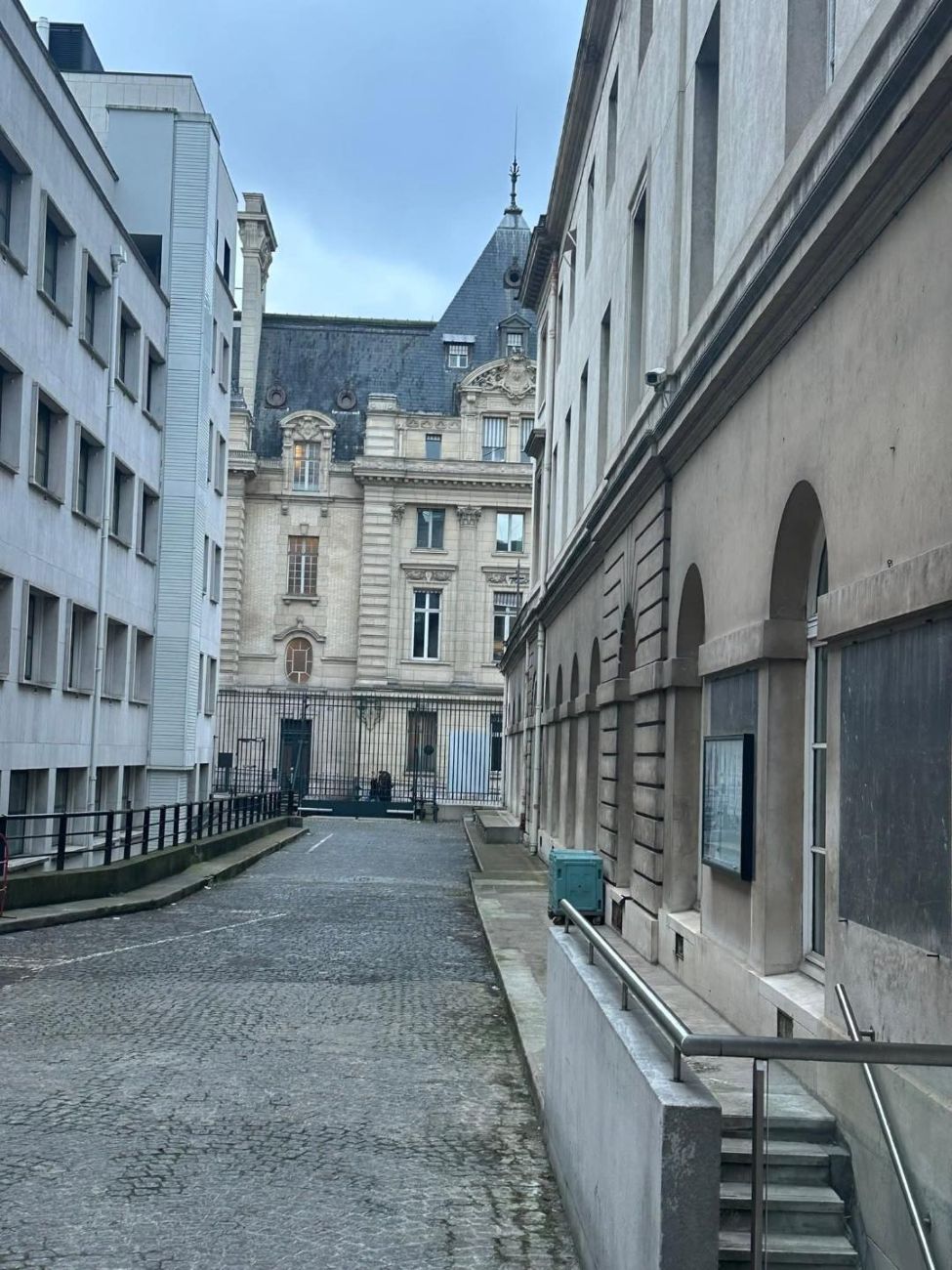
The Collége de France is part of the PSL ( Université Paris Sciences & Lettres ) is composed of 13 establishments such as the above Collège de France, in addition to the Conservatoire National Supérieur d’Art Dramatique – PSL, Dauphine – PSL, Ecole des Arts Décoratifs – PSL, Ecole nationale d’architecture Paris – Malaquais – PSL, École nationale des chartes – PSL, École nationale supérieure de Chimie de Paris – PSL, École normale supérieure – PSL, École Pratique des Hautes Études – PSL, ESPCI Paris – PSL, Institut Curie, Mines Paris – PSL, Observatoire de Paris – PSL, Elle bénéficie du soutien de trois organismes de recherche : CNRS, Inria, Inserm.
The official Collége de France: https://www.college-de-france.fr/en
The official PSL université de Paris inclus the Collége de France: https://psl.eu/universite/nos-etablissements/college-de-france
The Paris tourist office on the Quartier Latin: https://parisjetaime.com/eng/transport/quartier-latin-p1913
The Paris tourist office on the 5éme arrondissement de Paris: https://parisjetaime.com/eng/article/explore-paris-s-5th-arrondissement-a820
There you go folks, a wonderful institution and in a grand neighborhood of my eternal Paris. Again, hope you enjoy this post on the Collége de France in Paris !! as I.
And remember, happy travels ,good health, and many cheers to all !!!


Really cool! I don’t think I’ve come across Collège de France during my many trips to Paris over the years; I have seen la Sorbonne, though. It’s interesting that it’s named “collège” for higher education, as in French, it’s to refer to middle school. Lovely all the same!
LikeLiked by 1 person
Yes in the US is middle school but here is higher education like an university. Thanks for stopping by Cheers
LikeLiked by 1 person