
I am coming back with new pictures from my cd rom vault that should be in my blog for you and me, This is one of my road warrior trails by the city of Nevers in the dept no 58 of the Niévre in the Bourgogne-Franche-Comté region of my belle France. I The city was the capital of the province of Nivernais under the old regime (monarchy), it is designated as the prefecture of the Nièvre department during the territorial reorganization of the French revolution in 1790. Do see my other post on the city, Therefore, let me tell you a bit on the Cathédrale Saint Cyr et Sainte Julitte of Nevers !!! Hope you enjoy the post as I.
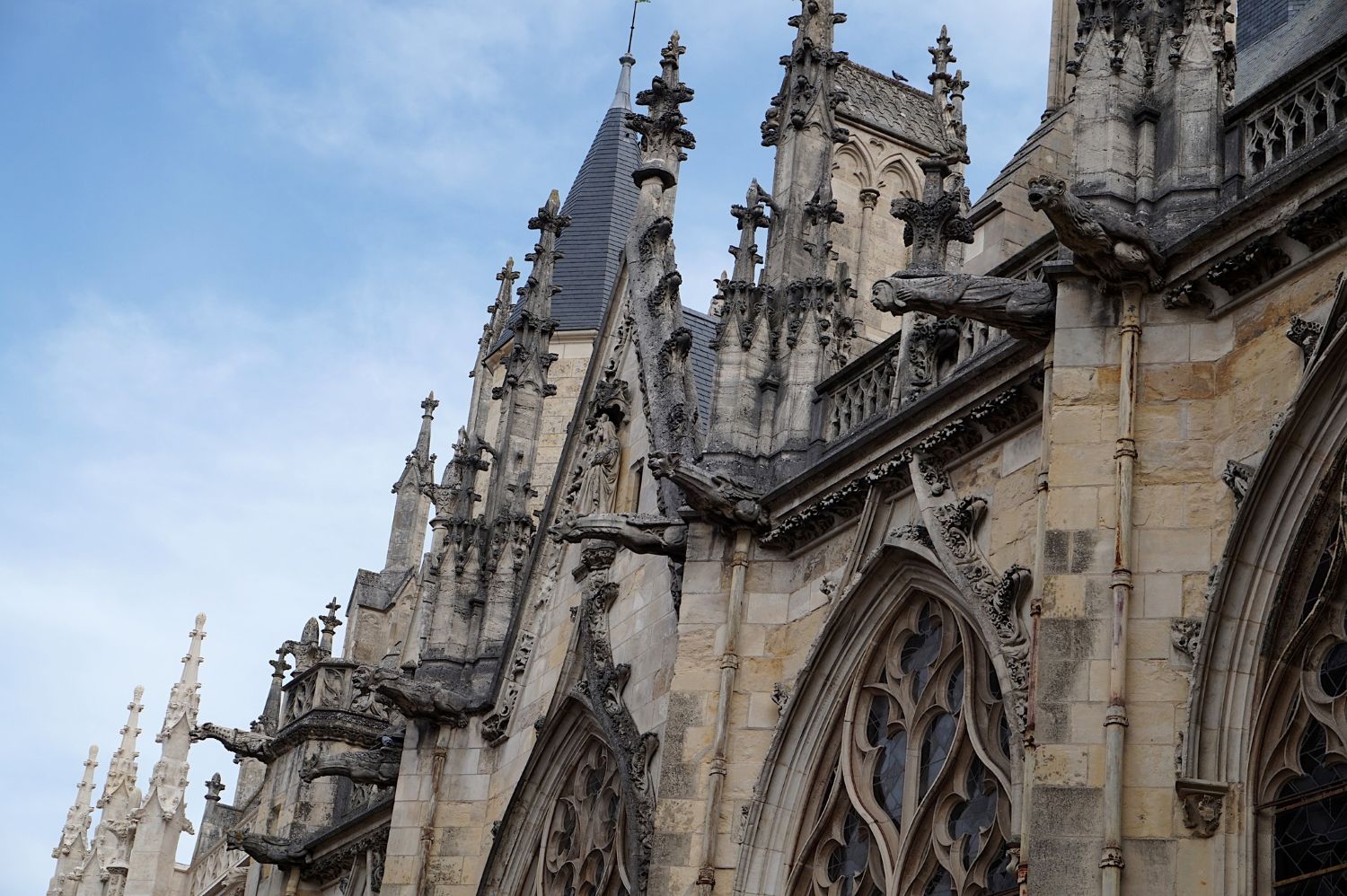
The Gothic-style Cathédralé Saint-Cyr-et-Sainte-Julitte is dedicated to Saint Cyr, martyred in 304 at the age of three or four, and to his mother, Saint Julitta, also a martyr. The cathedral is unique in that it has two opposing choirs, the result of an incomplete reconstruction of the Romanesque 11C cathedral during the Gothic period 14C.This feature is very rare in France, but more common in the Rhineland region of Germany. It boasts an exceptional architectural history dating back to the 6C..The total length of the cathedral, including the western apse and the Chapel of the Virgin Mary, is 101 meters. Today, the Saint Christopher or Deanery Portal consists of a doorway divided by a central pillar, open beneath four archivolts of receding moldings resting on pilasters. The south portal, dating from the 15C, was restored in the 19C. The so-called Loire Portal is preceded by a porch. The sculptures are exquisitely detailed: escutcheons are suspended by ribbons and chains from oak branches and vine leaves. The doorway is divided into two basket-handle arches by a pillar, against which a statue was once placed.
The Romanesque choir (11C), known as the choir of Saint Julitta, has a semi-dome vault. It houses an exceptional fresco depicting Christ in glory, surrounded by the symbols of the Evangelists and the Elders of the Apocalypse. The apse is raised by twelve steps and preceded by a barrel-vaulted bay. Beneath the apse, a crypt dates from the 11C or the first half of the 12C. It is accessed by two relatively modern staircases, one on each side of the steps leading up to the apse. The crypt is divided into three naves of three bays each. The apse now houses a Deposition scene composed, according to tradition, of seven polychrome statues restored in the 19C. It is of Flemish inspiration and dates from the 15C. The following figures are depicted: Nicodemus at the foot of Christ. He was one of Christ’s first disciples; Joseph of Arimathea at Christ’s head. He was a member of the Sanhedrin who had secretly converted to Christianity and who asked Pontius Pilate to bury Christ’s body; the Virgin Mary, mourning the death of her son, surrounded by three women, including Mary Magdalene; and John the Evangelist, who recounted the scene of the Descent from the Cross and who supports the Virgin.
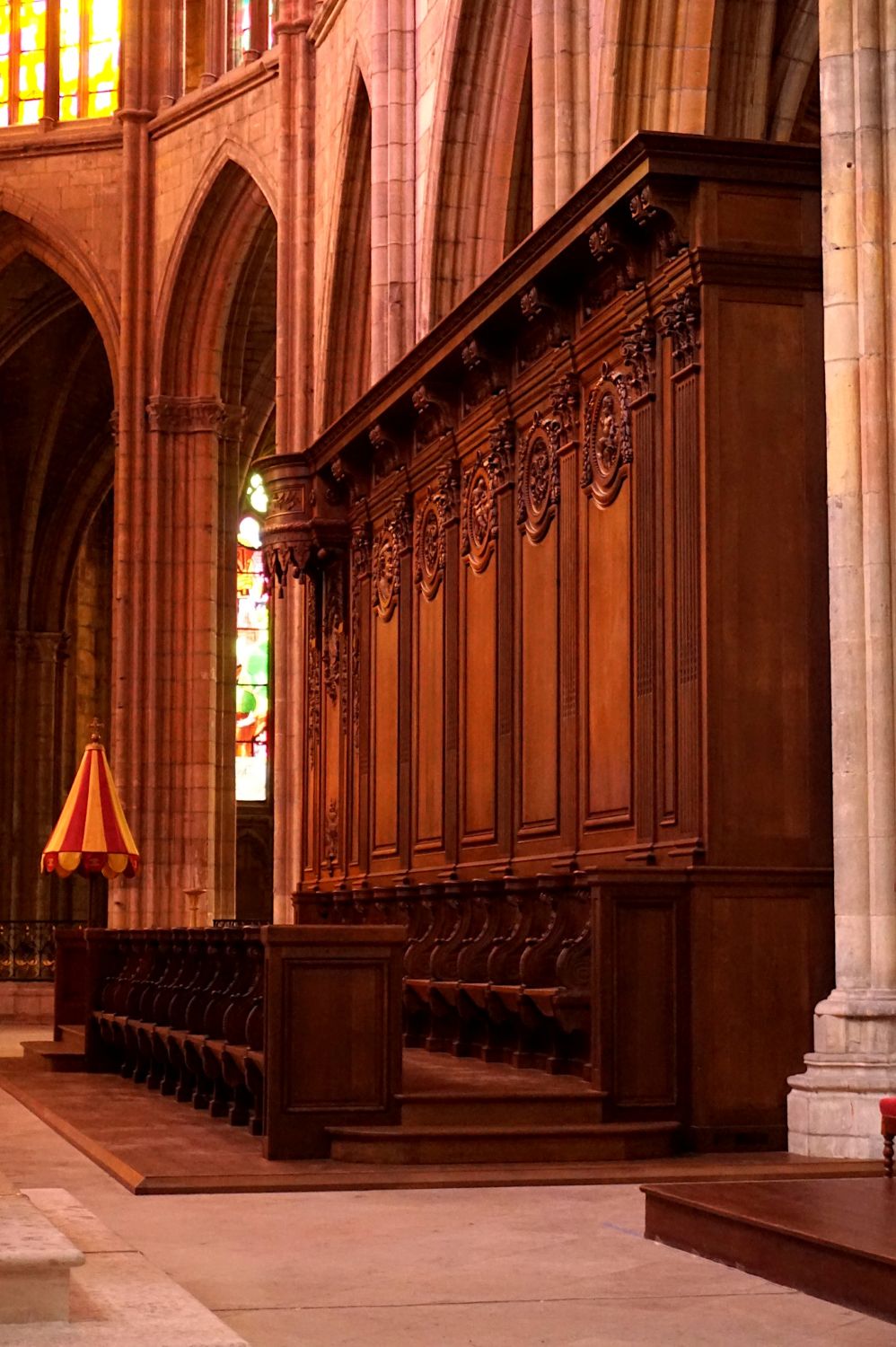
The Gothic choir was built in the 14C. It consists of four bays and terminates in a five-sided apse. It is an elegant structure whose clerestory windows, together with the triforium, form a single, remarkably light ensemble. The apse includes five radiating chapels. The Gothic nave and its choir extend the Romanesque choir and transept. It comprises five bays. Its walls rise in three levels: the great arcades, then the blind triforium, the Burgundian passageway beneath the clerestory windows, and finally, the clerestory windows themselves. The width of the nave, from one pillar to the other, is 10.75 meters. The width of the side aisles is 4.60 meters. The total width, including the depth of the chapels, is 32.20 meters. The nave’s height to the keystone is 22.30 metres, and the aisles’ height to the keystone is 10.20 meters. The transept is a remnant of the 11C Romanesque cathedral Later, in the 13C, it received ribbed vaults. Excavations have uncovered remains of the baptismal font that stood on the site of the current cathedral: a 6C circular pool and an octagonal Carolingian-era pool built over it. The baptistery is no longer open to the public. It is represented by a panel at the cathedral floor level, located just 4 meters above it.
Among its treasures are an ancient baptismal font, murals from various centuries, a Chapel of the Immaculate Conception with 19C murals, gold and silver work, woodwork, and other objects. Much of it was destroyed in 1944 during WWII. Two sculpted bas-reliefs brought renown to the cathedral before WWII: the altarpiece of the Virgin and that of Saint John the Baptist. The former, dated 1444, depicts the Dormition, Assumption, and Coronation of the Virgin in three superimposed registers; it is now displayed in one of the chapels of the south aisle. The latter illustrates the life of the saint in a richly decorated setting of landscapes and scenes sculpted in high relief. It can be seen in one of the chapels of the north aisle. One can see a Loire river boat, easily recognizable by several details characteristic of this type of boat. These two altarpieces, erected above altars and both framed with sculpted foliage, were damaged during the Frenc revolution and dismantled following the bombing of 1944 before being restored and now displayed to the public. In the choir, the Cavaillé-Coll organ, installed in 1867, was destroyed by the bombing of 1944. A new instrument replaced it in 1978. Its case partially reuses the old woodwork from the choir stalls. The tower name “Bohier Tower”. The north tower, lowered and simply covered with a section of terracotta tile, now blends into the silhouette of the cathedral. It nevertheless contains one of the oldest staircases in the cathedral, a “Saint Giles spiral” staircase.
Martyrs of the early centuries of the Christian era, Cyrus and Julitta were tortured around the year 304, during the last major persecutions ordered by the Roman Emperor Diocletian. Their martyrdom took place in Tarsus, the birthplace of the Apostle Paul, located in what is now southern Turkey. Their lives are semi-legendary, but the authenticity of their martyrdom is undeniable. The veneration of the two martyrs spread throughout Gaul from the 5C onward. Amateur of Auxerre, Bishop of Auxerre between 386 and 418, who traveled to Asia Minor in the company of Saint Savin, who later settled in Poitou, brought back relics of the two saints, offered an arm of Saint Cyrus to Saint Savin, and distributed other relics to various churches (Toulouse, Arles, etc.). In 1594, all the relics of Saint Cyr and Saint Julitta held in Nevers were gathered into a single reliquary. In 1793, the reliquary was hidden in Nolay to escape destruction by the revolutionaries. Kept then in a modest box, the relics were placed in 1861 in a magnificent Neo-Byzantine reliquary, inaugurated with great pomp on June 16, 1861, the feast day of Saint Cyr. This reliquary was placed in 1872 in the ciborium of the new altar of the cathedral, following a vow made by Théodore-Augustin Forcade, Bishop of Nevers at the time. The reliquary was destroyed in the bombing of July 16, 1944.
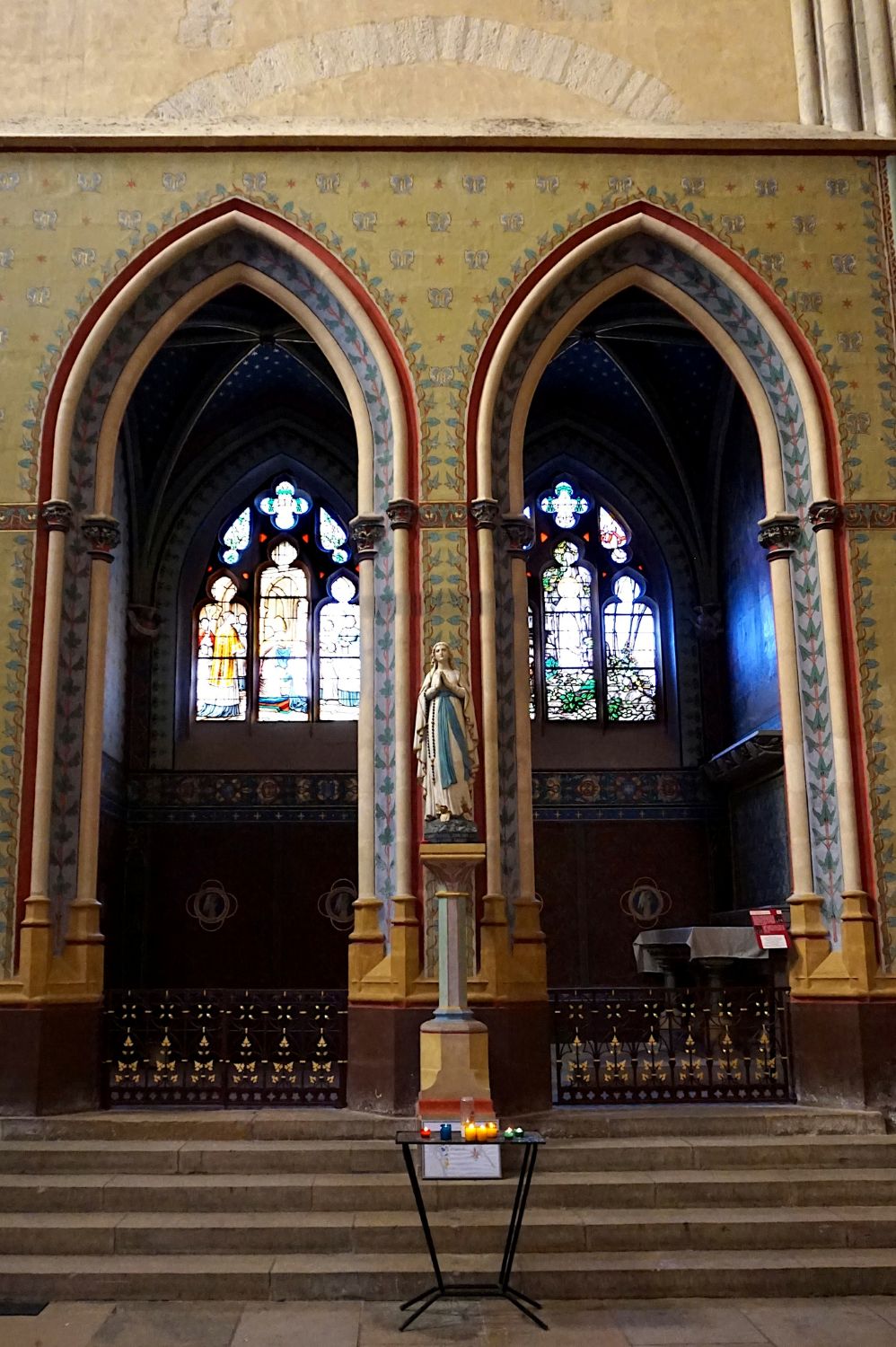
A bit of history I like tell us that the diocese was established in Nevers in the 6C with the construction of the first church dedicated to Saints Gervais and Protais. The new structure had a three-story elevation: large arcades, a blind triforium, and clerestory windows. One of the distinctive features of this architecture is the presence of statuettes against the columns of the clerestory windows and the triforium, representing the inhabitants of Nevers at the time in all their social classes The Romanesque choir and transept, less damaged by the fire, were preserved. In the 15C, radiating chapels were built within the Gothic choir. The Chapel of the Immaculate Conception dates from the 15C and testifies to the fact that this belief was widespread in the Nivernais region long before the Catholic Church made it a dogma in 1854. Its current decoration dates from 1876. New chapels were also added along the nave in the 16C, such as the beautiful Fontenay Chapel, dated 1550. They are in the Flamboyant Gothic style. The furnishings were enriched with a beautiful automaton clockwork figure and choir decorations: stalls and a high altar in stone and alabaster, created around 1580. The French revolution pillaged the cathedral. The tombs previously located in the nave were demolished, and the portals and some statues were either destroyed or removed to neighboring towns. In 1868, the cathedral was raised to the status of a minor basilica by Pius IX. In the second half of the 19C, the small chapel flanking the north side of the Romanesque transept was redecorated with stenciled decorations and murals illustrating the new dedication to the Immaculate Conception. This decoration was later complemented by two stained-glass windows depicting the Taking of the Veil by Bernadette Soubirous and the Apparitions at the Grotto of Massabielle, in reference to the second part of the saint’s life, which she spent at the convent of the Sisters of Charity in Nevers, where a reliquary has displayed her miraculously preserved body since 1935. The stained-glass windows damaged in 1944 were recreated identically in the 1980s. On the night of July 15-16, 1944, Allied bombs accidentally struck the old town center of Nevers instead of the railway depots they had originally targeted. Two bombs fell on the Gothic choir. The stained-glass windows were shattered, the choir vaults collapsed, and the furnishings beneath were reduced to dust. The subsoil was disturbed: some fifteen bishops’ tombs were damaged. The choir stalls were severely damaged, and the Cavaillé-Coll organ, whose sculpted case had been completed barely 15 years earlier, was destroyed. Reconstruction work took place from 1946 to 1966 for the main structural elements. The cqthedral was rebuilt exactly as it had been.
The Parrish of the Sainte Famille or Holy Family on the Cathedral : https://p-stf.com/notre-paroisse/eglises-et-chapelles/cathedrale-saint-cyr-sainte-julitte/
The City of Nevers on the Cathedral : https://www.nevers.fr/decouvrir-nevers/patrimoine/eglises-et-chapelles/cathedrale-saint-cyr-et-sainte-julitte
The Nevers tourist office on the Cathedral : https://www.nevers-tourisme.com/explorer/visiter-nevers/notre-riche-heritage/cathedrale-saint-cyr-sainte-julitte/
There you go folks, a dandy area to explore and enjoy with the family, Memorable moments in passing by Nevers, even if on my road warrior trails was quick, Always remember and looking forward to be back, eventually. Again hope you enjoy the post on the Cathédrale Saint Cyr et Sainte Julitte of Nevers !!! as I.
And remember, happy travels, good health, and many cheers to all !!!


