
We have driven and walked in my eternal Paris, and would like to have an imprint in my blog on the wonderful family times we had there, There is so much to see , doing my best, and glad found me these pictures in my cd rom vault ,which now transposing in my blog for you and me, This was my former worked city, so glad to post more memorable spots on it, I thank you for your readership over the years and to bear with my rants! After all Paris is to rant, shout and yelled about, me think. Therefore, here is my take on the Church Saint Hippolyte of Paris !! Hope you enjoy the post as I.

The Church Saint-Hippolyte is located on Avenue de Choisy in the 13éme arrondissement of Paris. It is dedicated to Saint Hippolytus, a Roman soldier. The church was built between 1909 and 1924 and was consecrated to Saint Hippolytus Inside the tympanum, a commemorative inscription in Latin recalls the circumstances of its construction.

The Church Saint-Hippolyte consists of a nave and two side aisles, without side chapels. The style is Neo-Gothic, with pointed arches, foliate capitals, and a ribbed vault. The side aisles are adorned with stained-glass windows depicting saints.
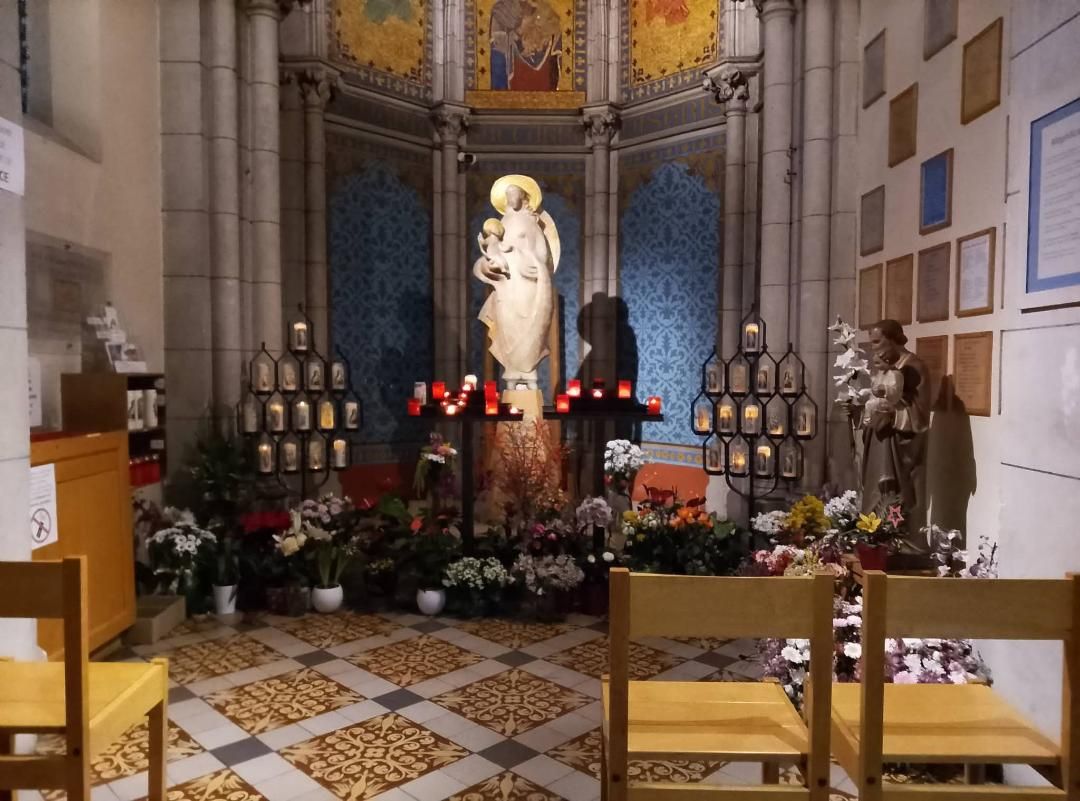
A chapel was installed in the chancel in 2001–2002. A 17C French painting of the Visitation hangs on the back wall. The chapel is separated from the nave by a stained-glass window. The window comprises nine panels dedicated to the Trinity, the five senses, and love, with quotations from the Bible. The left apse chapel is dedicated to the Virgin Mary, with a mosaic from 1911 and a statue of the Virgin and Child entitled “Our Lady of All Nations.” The Virgin and Child are flanked by two angels bearing the instruments of the Passion. The right apse chapel is dedicated to the Blessed Sacrament, with a statue of the Sacred Heart of Jesus.
Life of Saint Hippolytus. a Roman officer, was entrusted by Emperor Decius with the guard of Saint Lawrence in his prison (3C). Impressed by the miracles performed by Saint Lawrence, the officer converted. After Lawrence’s death, whom he buried himself, he was discovered and brought before Decius. Refusing to sacrifice to the idols, he was flogged, then handed over to the prefect Valerian to suffer the worst tortures. Learning that his entire group had converted and refused to sacrifice to the gods, Valerian had them beheaded. Except for Hippolytus. He was tied by his feet to untamed horses that dragged him over thistles and stones until he died.
I take advantage of this post to tell you about the Avenue de Choisy. Along with Avenue d’Ivry, it forms one of the main thoroughfares of the arrondissement’s Asian quarter. The avenue begins at Boulevard Masséna, crosses Rue de Tolbiac where it is joined by Avenue d’Ivry, and ends at Place d’Italie. It is 1,310 meters long and 30 meters wide . It is served by metro line 7 and tram lines 3a and 9 at the Porte de Choisy station, and by lines 5, 6, and 7 at the Place d’Italie station. Its name refers to the town of Choisy-le-Roi, to which N 305 road leads, extending Avenue de Choisy through Ivry-sur-Seine. First recorded in 1672 as the “Chemin de Vitry”, the Avenue de Choisy has been part of Paris since the city’s expansion in 1860. Previously, it separated the two towns of Gentilly and Ivry-sur-Seine. Even earlier, it formed part of the ancient Roman road from Lutetia to Lyon. The social makeup of the Avenue de Choisy changed profoundly with the arrival of refugees from Vietnam and then other Asian countries starting in 1975. A large Asian quarter developed on both sides of the Avenue de Choisy, which, along with the Avenue d’Ivry, forms one of its two main thoroughfares. Today, it is a vibrant street, lined along its entire length with predominantly Asian restaurants and shops. Notable buildings here are the Place de Vénétie, developed in the 1970s as part of the Italie 13 project, is a vast commercial complex topped with tower blocks and apartment buildings on the site of the former Panhard factories. On the odd-numbered side of the avenue, on the wall along the ramp to the parking garage under No 3, is a mosaic of a Panhard & Levassor car with its “P&L” logo and the inscription “From 1873 to 1970, the Panhard & Levassor factories stood on this site, where the first automobile was designed and built in 1890.” At No 5, excavations carried out in 1911 uncovered a fragment of one of the Roman roads leading to Italy. The odd-numbered sidewalk of the avenue follows the route of this ancient road. The Church Saint-Hippolyte (see above) was built between 1909 and 1924, thanks in particular to the generosity of the Panhard family. The adjacent church, Notre-Dame-de-Chine, is used by the Chinese Catholic community. At No 75, excavations in 1911 uncovered a “kind of causeway formed by a bank of flat stones” of the Roman road. Parc Choisy Park was laid out in 1936-1937 on the site of the former gasworks of the Compagnie Parisienne du Gaz,(Paris Gas Co) built around 1840. At No 180, during excavations in 1880, a doctor’s burial, a medical kit, and coins dating from the late 3C were unearthed.
The official Parrish of Saint Hippolyte : https://www.saint-hippolyte.net/
The Paris tourist office on the 13éme arrondissement de Paris : https://parisjetaime.com/eng/article/explore-paris-s-13th-arrondissement-paris-a835
There you go folks, a dandy city to explore and enjoy with the family, Memorable moments in my eternal Paris, driving and walking all over in my road warrior trails brings out sublime awesome spots with nice memorable family visits of yesteryear always remember and always looking forward to be back, eventually. Again hope you enjoy the post the Church Saint Hippolyte of Paris !! as I.
And remember, happy travels, good health, and many cheers to all !!!


