
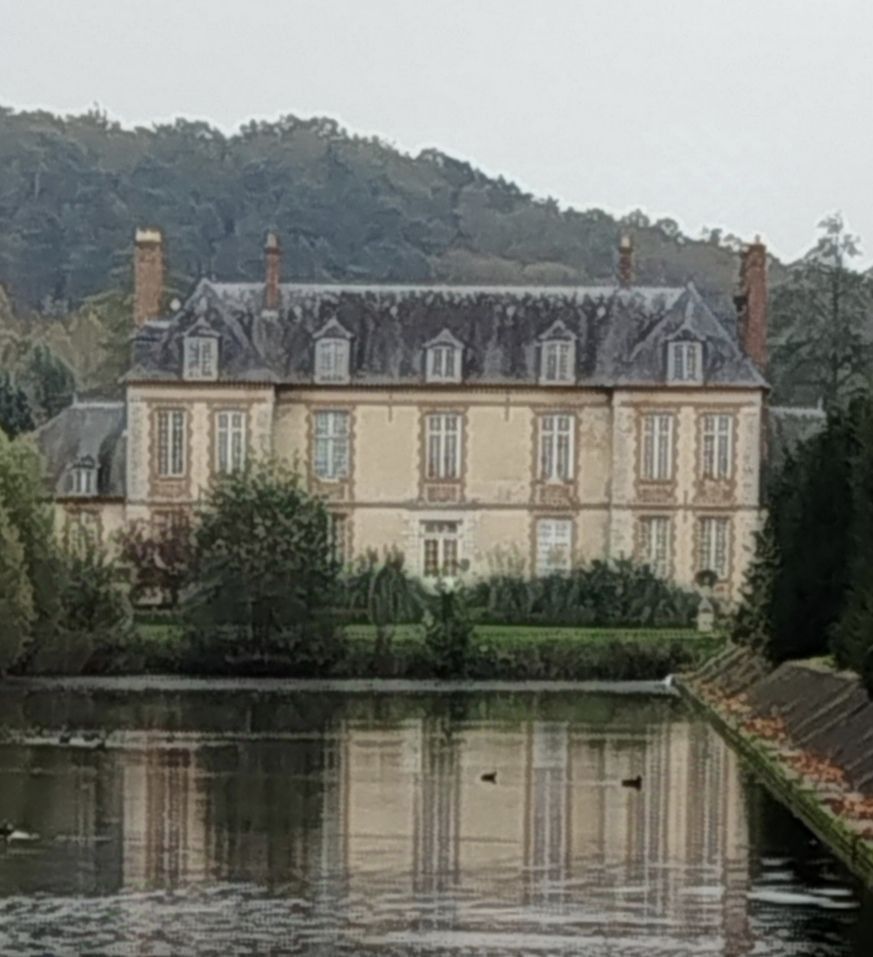
This was an area near my old home that I frequented with the family for shopping, and my boys school friends activities. This is again the city of Plaisir located in the Yvelines department 78, in the Île-de-France region of my belle France. It is 30 km from the Porte d’Auteuil Paris, and 13 km from Versailles, The town is made up of several hamlets spread over two separate trays, from east to west, by the Bois-d’Arcy national forest ,and its western end known as forest of the Cranne and, the Park of the Château de Plaisir, and the forest of Sainte-Apolline. I found me a picture in my cd rom vault, and decided to mention it in my blog as reminded me of nice memories in my former department area, Therefore,here is my take on the Château of Plaisir !!! Hope you enjoy the post as I
The Château de Plaisir and its grounds still retain their original appearance, with its canal and rows of linden trees, decorative moat, former stables, old farmhouse, gardener’s cottage, and dovecote. The castle is a typical example of Louis XIII style architecture. This type of post-Renaissance castle is characterized by its harmony, simplicity, and balanced proportions, with stone walls complemented by brickwork, a slate roof, and chimneys. Certain interior features still attest to the château’s former grandeur: shutters with small solid oak panels, marble and stone fireplaces, a grand double staircase with a solid oak banister, wood paneling, and alcoves.
Associated with the castle’s outbuildings, the colombier or dovecote was used for raising pigeons. Its construction, likely dating from the late 17C, follows a square plan of approximately 7.20 meters per side, with a total height of 13 meters at the ridge. The interior of the dovecote housed nearly 1,600 nesting boxes, called “boulins.” Access to the boulins was via a ladder pivoting around an axis in the center of the dovecote. Each boulin housed a pair of pigeons, so the dovecote at the Château de Plaisir must have sheltered more than 3,000 pigeons.
The Château park has recently undergone a restoration project that has returned it to its original landscape thanks to the discovery of a detailed map from 1818. To recreate a formal French garden layout, around a hundred linden trees have been planted to extend the existing paths on either side of the canal. These paths now converge at an elegant exedra, at the center of which stands a remarkable 18C sculpture. On the other side of the park, the banks of the pond have been redesigned and planted with vegetation to blend into the landscape. The orchard, located on the hillside above the pond, has been replanted with pear, apple, medlar, cherry, and almond trees
The Château de Plaisir and its park have been open to the public for walks and cultural activities since 1977. Numerous evenings of theatre, music, and dance are programmed at the Théâtre Robert Manuel, which benefits from its proximity to the town’s conservatory. Visitors also enjoy discovery evenings, exhibitions, and the presence of the media library. In the heart of the town centre, the meadows, woods, shaded paths, and ponds of the Château’s park offer many opportunities for strolling and enjoying the tranquility of a protected environment.
A bit of history tell us that the first mention of the Château de Plaisir dates back to the late Middle Ages, around the time of the Hundred Years’ War. However, it was around 1620, during the reign of Louis XIII, that the current château was built by Simon Le Tellier, physician and advisor to the king. His son continued this work, creating a formal French-style park with its grand vistas, sculpted trees, and large canal. In the 18C, the château passed through the hands of several families and was remodeled between 1700 and 1711 under the direction of the Count of Pontchartrain, with the construction of its two wings. During the French revolution, the estate was sold. Throughout the 19-20C, the castle changed hands frequently until its acquisition in 1930 by the Bourdel family. In 1939, it underwent a major restoration. The Bourdel family were the last private owners of the castle. In a state of advanced disrepair, it was bought by the City of Plaisir in 1976, which turned it into a place dedicated to culture.
The City of Plaisir on the castle: https://www.ville-plaisir.fr/territoire/patrimoine/chateau
There you go folks, another dandy in my former Yvelines, This is a town off the beaten path trails and worth the detour ,me think, Again, a wonderful memorable area of mine and my family. Again, hope you enjoy the post on the Château of Plaisir !!! as I,
And remember, happy travels, good health, and many cheers to all !!!


