
We have driven and walked in my eternal Paris, and would like to have an imprint in my blog on the wonderful family times we had there, There is so much to see , doing my best, and glad found me these pictures in my cd rom vault ,which now transposing in my blog for you and me, This was my former worked city, so glad to post more memorable spots on it, I thank you for your readership over the years and to bear with my rants! After all, Paris is to rant, shout and yelled about, me think. Therefore, here is my take on the Boulevard Arago and the Vespasienne of Paris !!! Hope you enjoy the post as I.
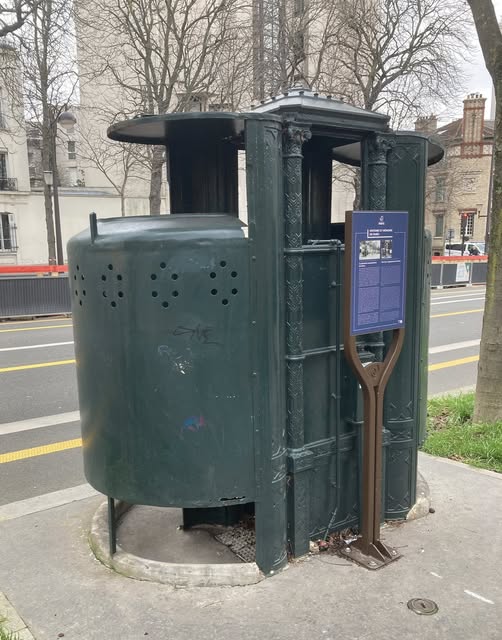
Near the wall of the Santé Prison, a strange green sheet-metal column still stands at 86 Boulevard Arago, an unusual relic withstands the test of time: the last public urinal in Paris. A witness to two centuries of public hygiene history in Paris. They were called vespasienne. This term, rarely used today, refers to a public urinal for men located on sidewalks and in parks. Its origins date back to ancient Rome, where Emperor Vespasian, founder of the Flavian dynasty, decided to place half-barrels in the streets to respect the privacy of his fellow citizens. From these urinals arose a special tax on urine collection for households, as well as for industry and commerce. In Paris, the first pay-to-use public urinals appeared at the beginning of the 19C in certain public gardens. In 1841, Count Claude-Philibert de Rambuteau, appointed Prefect of the Seine and concerned about hygiene in Paris, decided to install over 400 single-person urinals in just two years. These structures quickly became known as Rambuteau columns. In 1877, these columns were replaced by two-person booths that also served as advertising spaces. Public urinals gradually disappeared from the 1960s onwards, and more massively in the 1980s, replaced by JC Decaux self-cleaning, mixed-use toilets, which were pay-to-use until 2006.
As telling about an anecdote here why not tell you a bit on the Boulevard Arago is located in the Croulebarbe quartier or neighborhood of the 13éme district or arrondissement of Paris and the Montparnasse quartier or neighborhood of the 14éme district or arrondissement of Paris. It is named in honor of François Arago, a French astronomer, physicist, and statesman who lived for twenty-five years at the Paris Observatory, where he served as director. The Boulevard Arago is served by metro line 7 at Les Gobelins station,line 6 at Saint-Jacques station, and line 4 at Denfert-Rochereau station, as well as by RER B at Denfert-Rochereau station. The Boulevard Arago was opened by decree on July 30, 1859, as part of Haussmann’s urban renewal projects, with a width of 40 meters between Rue Mouffetard and the Barrière d’Enfer, extending the first section of Boulevard Saint-Marcel. The boulevard is the last place in Paris where public executions by guillotine were carried out, at the corner of Rue de la Santé, until the mid-20C. Notable buildings here are at No 12: a fragment of a portal, the last vestige of the former parish church of Saint-Hippolyte, destroyed in 1857 during the opening of the boulevard. The passageway, between nos, 12 and 14, is built over the former bed of the Bièvre river. At no, 18: the Protestant temple of Port-Royal, built in 1898. At no 57 lived and died the sculptor Jean-Antoine Injalbert. He received the Prix de Rome in 1874 for *The Sorrow of Orpheus*. He exhibited *Christ* at the 1878 Universal Exposition in Paris. He won a grand prize at the 1889 Universal Exposition. His Bust of Marianne, created for the Centenary of the French Revolution in 1889, was one of the most widespread in French City/town halls and schools at the end of the 19C and beginning of the 20C. At nos, 60-68 was the Congregation of the Blessed Sacrament, in the mid-19C. They occupied a large house. The friar Lamennais lived there. At no 65 was the Cité Fleurie (Flowered City), with its thirty or so artists’ studios, where, among others, Paul Gauguin, Amedeo Modigliani, and Henri Cadiou lived. In 1929, Louis Bouquet rented a very large studio there to fulfill commissions for the Museum of the Colonies, commissioned for the 1931 International Colonial Exposition. The Santé Prison, inaugurated in 1868, runs alongside the boulevard but has no entrance on it. The last public urinal in Paris is located on the corner of Rue de la Santé.(see above), The Paris Observatory, (see post) on its south side, has no entrance on this street; access is only possible through the Observatory Garden. At no 83 is the Protestant Faculty of Theology of Paris, built in 1877. Between nos, 83 and 85 is the Place de l’Île-de-Sein with the base of the statue of François Arago. At nos, 90-92-94-96, the Saint-Joseph-de-Cluny Chapel. At no 91 lived and died on November 3, 1877, the Alsatian painter and draftsman, illustrator of Les Misérables, Gustave Brion. At no, 98 bis, the Paris Institute of Astrophysics, which also houses the secretariat of the International Astronomical Union. At one corner Place Denfert-Rochereau Square, formerly called “Place d’Enfer” (Hell Square).
The Paris tourist office on the 13éme arrondissement de Paris : https://parisjetaime.com/eng/article/explore-paris-s-13th-arrondissement-paris-a835
There you go folks, a dandy city to explore and enjoy with the family, Memorable moments in my eternal Paris, driving and walking all over in my road warrior trails brings out sublime awesome spots with nice memorable family visits of yesteryear always remember and always looking forward to be back, eventually. Again hope you enjoy the post on the Boulevard Arago and the Vespasienne of Paris !!! as I.
And remember, happy travels, good health, and many cheers to all !!!


