
It is a royal town of France but seldom mentioned or seen, sort of like an off the beaten path town. I have a few posts on Maisons Laffitte in my blog and glad to have found pictures in my cd rom vault that should be in my blog for you and me. Therefore, here is my take again on the Château of Maisons Laffitte, part II !!! Hope you enjoy the post as I.
This is a wonderful castle to visit not far from my former in Versailles and working City of Paris, Beautiful architecture and the history of it as well is awesome. I am talking about Maisons-Laffitte ,located in the département 78 of Yvelines in the Île-de-France region of my belle France, The castle is about 10 km from Saint-Germain-en-Laye, 18 km from Paris, and 19 km from Versailles from which I always came by car along the Bd du Roi, bear left on Place de la Loi onto Bd Saint Antoine continue on D186 road which is name Route de Saint Germain and then Route de Versailles, same road, go underneath pass of the A13 autoroute de Normandie ,and continue becoming the N186 road still Route de Versailles, on the roundabout of the Grille Royale just before Marly le Roi bear right and continue on the Route de Versailles or N186 road changing back and forth from Route de Saint Germain and back but same road continue and it becomes the Avenue de Saint Germain continue becoming again the D186 road passing Le Port Marly becoming Avenue Charles de Gaulle then bear right onto Quai Maurice Berteaux continue into Quai Voltaire with the Seine river on your right hand side continue onto Route du Pecq or D159 road continue into Le Mesnil le Roi bearing right on City center onto the D157 road or Rue Maurice Berteaux continue becoming Rue Jules Rein, continue no Avenue de la République which becomes Avenue Saint Germain but same road ,then bear right onto Rue Etienne Péroux cross railroad tracks viaduct onto Rue de Mesnil continue becoming Rue de la Vieille Eglise continue becomes Avenue Carnot and on right hand side you see the castle on the intersection with Avenue du Général Leclerc, Many name changes typical of this area but the numbered roads are the same and quite straight well posted.
The Château de Maisons-Laffitte was built between 1642 and 1650 by François Mansart for René de Longueil, President of the Parliament of Paris and Superintendent of Finances: its majesty, symmetry, and balanced forms make it a model of refinement. In April 1651, René de Longueil hosted the young Louis XIV and his mother, Anne of Austria, for the château’s inauguration at a sumptuous celebration that would leave a lasting impression on the young monarch. The estate was acquired in 1777 by the Count of Artois, brother of Louis XVI,and later king Charles X ; then by Marshal Lannes in 1804, and by the banker Jacques Laffitte, Governor of the Bank of France, in 1818. The French Republic (France) saved the château from destruction by purchasing it in 1905. See my other post for more history,

The château houses four large apartments, spread between the ground floor and the first floor. These apartments consisted of an antechamber, a grand bedroom (or state bedroom), a small bedroom, a dressing room, and a bathroom. Smaller apartments, servants’ quarters, and service areas are located on more than ten levels (attics, mezzanines, and cellars). The château is entered through the main entrance hall, originally enclosed by wrought-iron gates. Removed in 1791 when the estate was sealed by revolutionary commissioners, these gates are now on display at the entrance to the Apollo Gallery in the Louvre Museum. The castle do have a nice wrought iron gate as entrance to the park/castle,
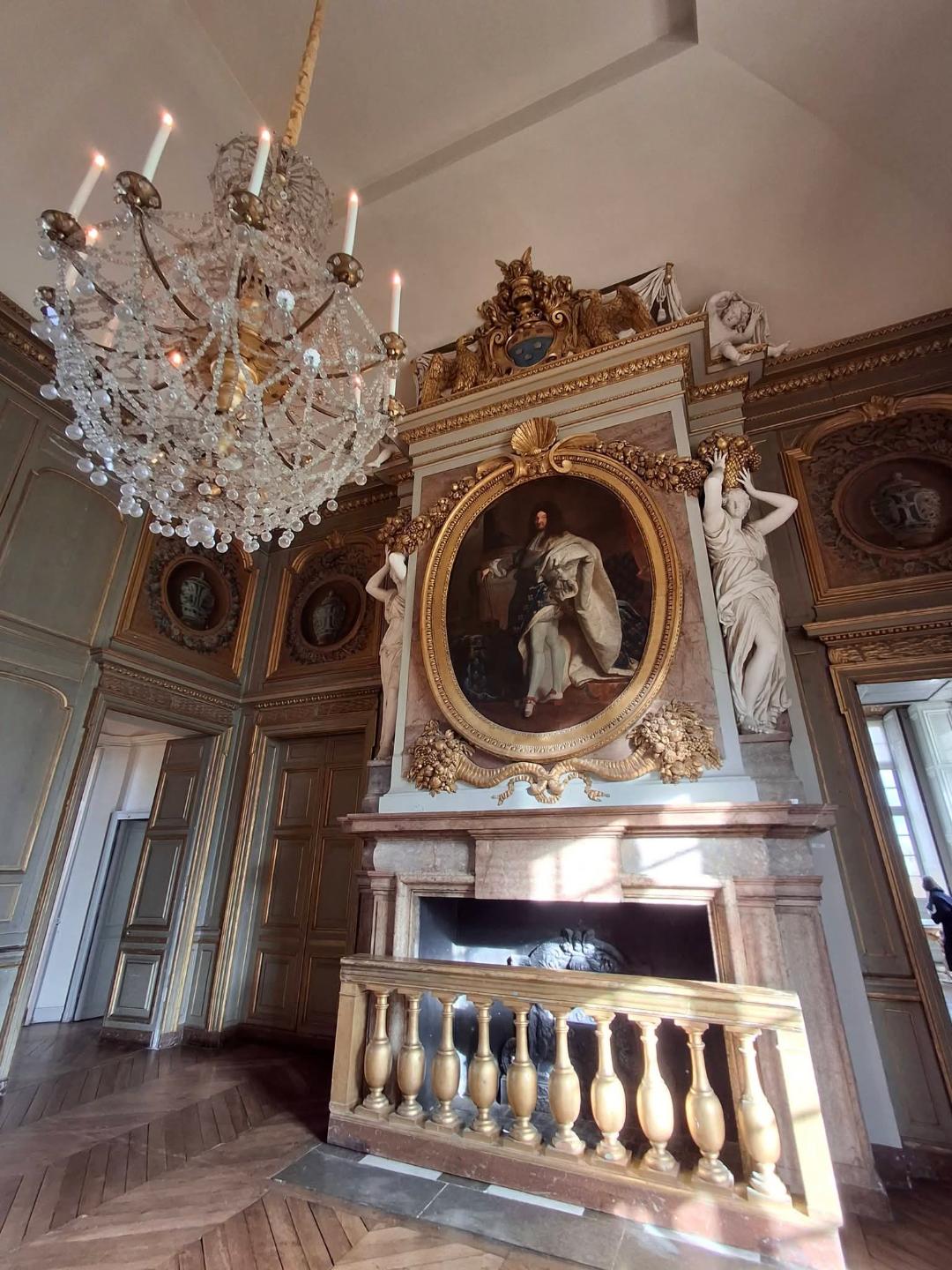
L’escalier d’honneur or the grand staircase, created using the stereotomy technique, still relatively uncommon in France in the 1640s, is one of the key architectural features of the château. Beyond its beauty, inspired by Renaissance and classical styles, it is an architectural feat. The steps wind around an open square, unsupported by a central pillar, creating a sensation of lightness and floating in the air. The staircase and vestibule lead to four apartments. The most prestigious is the Italian-style apartment, or King’s apartment, with its large and impressive ballroom ,which was also used for concerts and banquets. It opens through a large archway onto the King’s antechamber and its impressive fireplace with beautiful (false) caryatids,
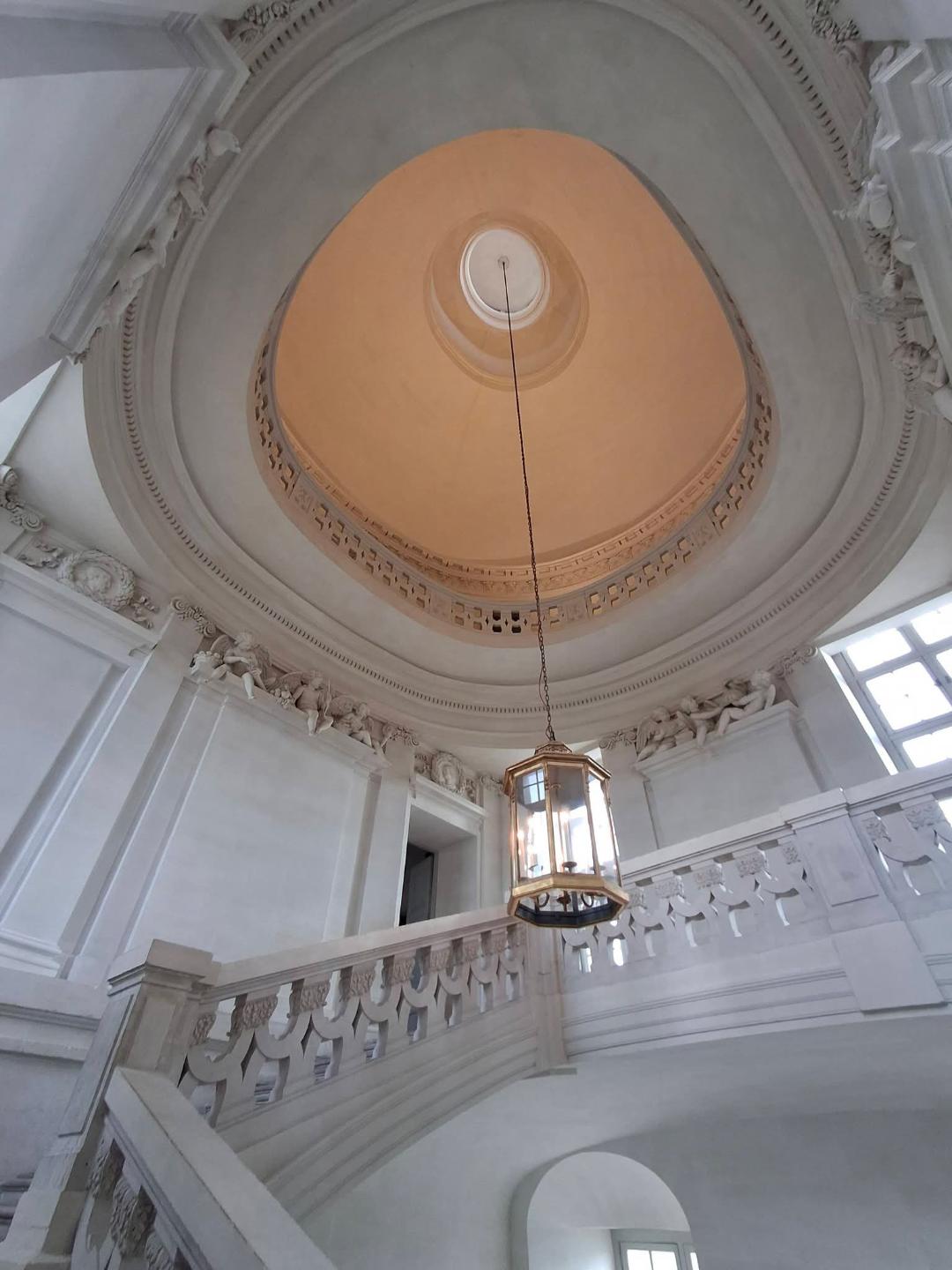
The apartment on the first floor to the left is known as the « d’appartement du Roi » or King’s Apartment because of its function. It owes its other name, « d’appartement à l’italienne » or Italian-style apartment, to its domed and vaulted ceiling, rather than the traditional beams and joists of a French-style ceiling. This layout has been much better preserved than in other parts of the castle. The apartment comprises six rooms, all open to the public: a large room, known as the “guards’ room” or “ballroom”; an antechamber, known as the “Hercules room”; a large state bedroom; a dressing room; a large study, known as the “Italian-style study”; and a small study, known as the “mirror room”.(see above), The King’s bedroom, of a more than satisfactory size, has its original parquet floor, a pleasant barrel-vaulted alcove and its interlocking cupolas, all in all one of the most richly furnished rooms in the castle.
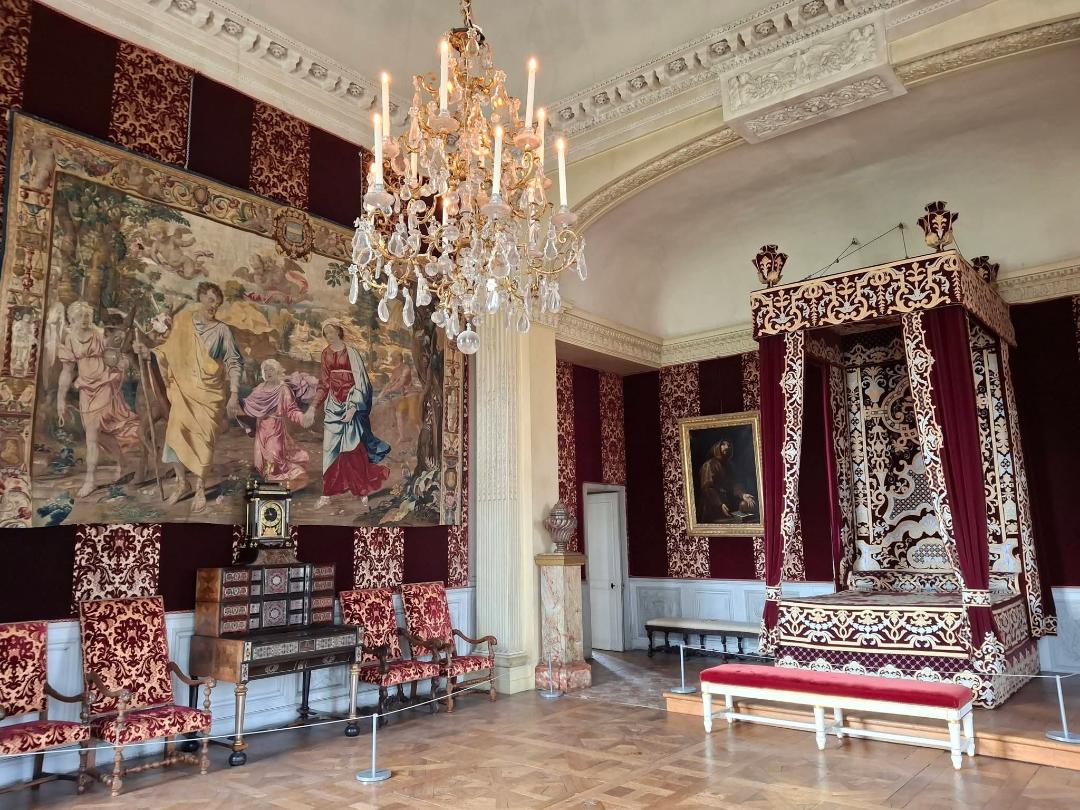
L’appartement dit du Roi or the so-called King’s Apartment contains a room as discreet as it is precious: the Mirror Cabinet, an intimate space where René de Longueil received select guests to discuss refined matters. The walls are covered in mirrors, a definite luxury for the time. The wainscoting is painted with gold and lapis lazuli… As for the floor, it is covered with an extraordinary marquetry of precious woods. The small cabinet has retained its original parquet flooring, marquetry paneling, and Venetian mirrors. This cabinet was dedicated to conversation, small scholarly gatherings, and intimate, poetic, or musical entertainment. Decorated with marquetry paneling, bone, tin and mirrors in an ensemble with a dome that invites dreaming.
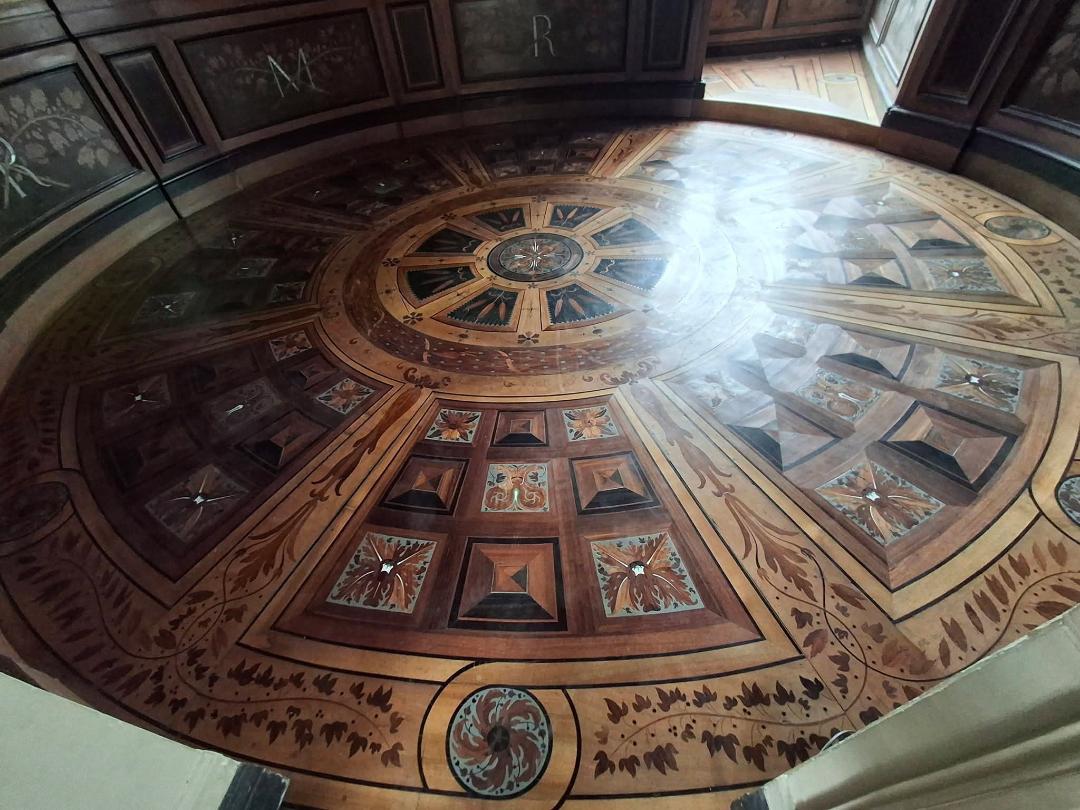
The Chambre Du Maréchal Lannes is an apartment on the first floor to the right was originally called the “Queen’s Apartment” because of its location opposite the King’s. Its current name, “the Eagles’ Bedroom” or “Marshal Lannes’ Bedroom,” is linked to the work undertaken by Marshal Lannes on restoration work on the castle and restructuring of the park before his death during the Austrian campaign in 1809. Today, this apartment comprises several rooms, only three of which are open to the public: an entrance hall, the first room known as the “Jacques Laffitte Room” (which divides the former antechamber), and the room known as the “Marshal Lannes Room” (which retains the dimensions of the former state bedroom). The other rooms, smaller bedrooms and the usual dressing rooms and wardrobes, house the offices of the castle administration.
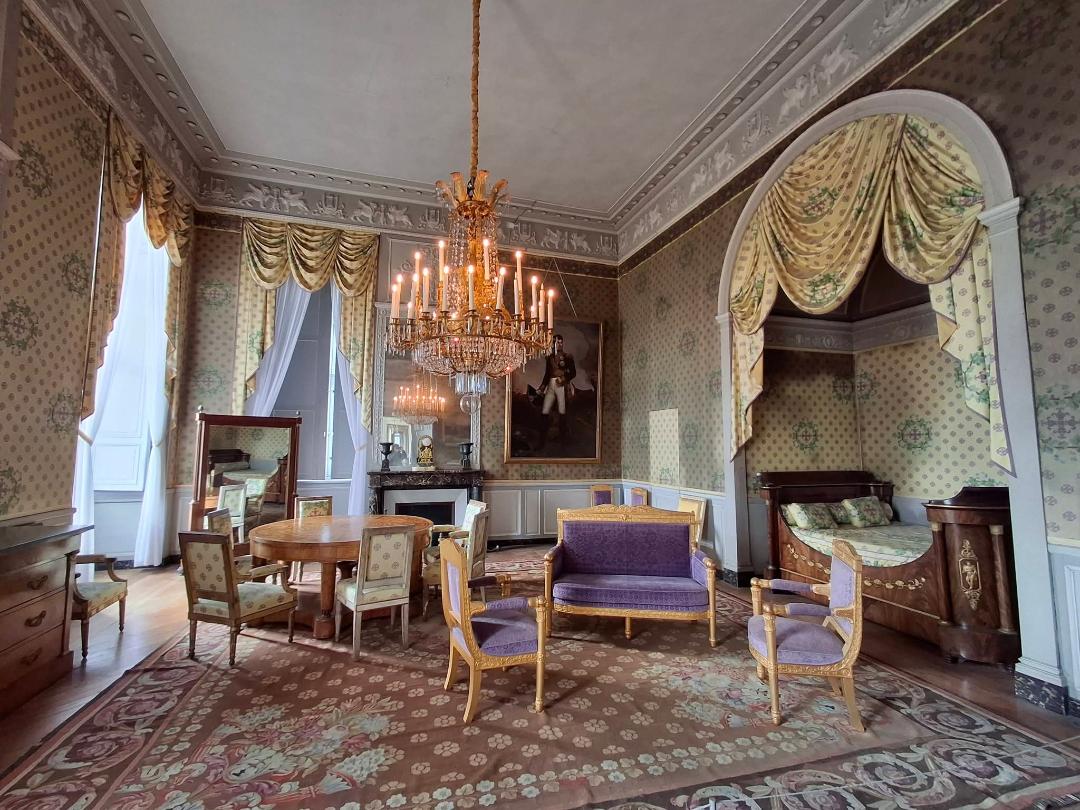
At the far end of the great hall, one can see the antichambre du Roi or King’s antechamber, the decor of which is centered on the imposing fireplace surmounted by the arms of the Longueil family and featuring a full-lenght portrait of King Louis XIV , aged 63 in full royal costume. By pushing open one of the doors located on either side of the fireplace, one gains access to the King’s bedroom.
At the request of the Count of Artois, brother of Louis XVI and future Charles X, the architect François-Joseph Bélanger was commissioned to modernize the castle to better suit the tastes of the time. The multi-purpose living spaces became more specialized, notably with the creation of the dining room! Restructured to house the “dining apartment”, a buffet room, dining room, and games room ; the right wing has nevertheless almost entirely retained its original form, and the classical spirit of François Mansart is respected. The salle à manger or dining room boasts a sumptuous decor, created by the greatest artists of the period: Lhuillier, Houdon, Focou, Boizot, Clodion, and Régnier. Corinthian columns and pilasters frame the windows, niches in the walls house statues of the Seasons, and two sculptural groups adorn the top of the fireplace and the door. The ceiling is composed of nine coffers richly decorated with a sunburst, rosettes, griffins, cherubs, and floral motifs.

A bit of history I like tell us that the first mention of the village dates from about 820, in the writing of Bishop Minot, the name was Mansionis Villa. The first squire was certainly Nivard of Septeuil. His son Geoffroy I granted the Abbey of Saint-Wandrille de Fontelle the free passage in front of the port of Maisons towards 1060-1066. He also gave towards 1087 the Church of Maisons at the Abbey of Our Lady of Coulombs (near Nogent-le-Roi), with land, vines, tithes and a share of the toll. The family of Avesne kept its land, which quickly passed to the family of Marseille. The family ceded their property from 1460 to Jean IV de Longueil, judge in the Parliament of Paris. The Lordship’s town will be found in 1602, when John VIII of Longueil buys the share of Marseille. The castle was built by François Mansart, uncle of Jules Hardouin-Mansart who will build Versailles a few years later… This new building takes the place of the previous buildings built by the two lineages of house Lords. The castle will be great, to receive the king during the hunts in the forest of Saint-Germain. It is for this reason that the entrance to the monument is back to the Seine, preceded by a wide avenue coming from the forest. Construction started around 1642, ending at 1650. king Louis XIV lodged there in 1671 on the day of the death of Philippe François de France, duke d’Anjou.
The first alleys of the park, the Avenues Albine and Aegle, are contemporary of the castle. The other aisles will be created during the 18C. A map of 1740 shows it as we know it today. A majority of families live in the vineyard, which occupies 40% of the cultivated land. Among the descendants of René de Longueil, figure Jean-René who received scholars and writers at the château, among which Voltaire. The latter tells in his correspondence the fire which damaged the building in 1724, when he left after being treated with smallpox. Starting with the king, to please Madame de Pompadour in 1747, then to Madame du Barry in 1770 to sell the castle. But king Louis XV did not let himself be engaged in these operations and end up selling Maisons in 1777 to the Count of Artois, brother of king Louis XVI and future king Charles X, who complemented the embellishments. The French revolution has finally put an end to this procrastination. The Count of Artois fled to England, and the estate was put under receivership in 1792. Put on sale in 1797 as national property, the ensemble is awarded to Jean Lanchère , supplier to armies interested in the profits he can make of the buildings, Lanchère destroys some pavilions, sells sculptures… to finally resell the Castle in 1804 to Marshal Lannes after his death in 1809 at the Battle of Essling, his wife, the Duchess of Montebello, sometimes received the emperor in visits. The latter, in 1810, ordered the construction of the first bridge between Sartrouville and Maisons.
In 1813, the Duchess of Montebello received the Empress Marie-Louise, of whom she had been a lady of honour for three years. In 1818, she sells the estate of Maisons in favour of Jacques Laffitte. Opponent of king Charles X (the former owner of the castle, between 1777 and 1789, while he was Count of Artois), Jacques Laffitte welcomed many members of the political opposition to Maisons. It is therefore logical that he exerts decisive influence during the other French revolution of 1830. Jacques Laffitte is appointed President of the Council and Minister of Finance of the king. Overwhelmed by political agitation, he left the post in 1831, and came out pretty much ruined from the adventure. As a result of these events, he decided to divide the estate of Maisons to carry out a fruitful real estate operation. In 1833, the stables and other dependencies were destroyed in order to provide building materials for the purchasers of the park lots. In 1834 is deposited before notary the specifications of this subdivision, a copy of which is, even today, given to each purchaser in the park. The idea of this specification is to lay the principles of construction of this “city in the countryside”. To ensure the service of the properties, Jacques Laffitte is led to open new avenues in the park. Starting from the already existing backbone (avenues Aegle, Albine…), he traces geometric figures. He also draws a cross of the Legion of Honour around the place Napoleon and the Circle of fame, from which avenues will bear the names of the battles of the emperor. Jacques Laffitte died on May 26, 1844, carried by a pulmonary disease. The estate passes to the hands of his daughter Albine, who proceeds from 1846 to an auction of the remaining lots and who will eventually sell the estate in 1850, including the 33 hectares including the Castle. Charles Laffitte, a large horse-sport enthusiast, is a founding member of the Jockey Club in Paris, where the Encouragement society will be established. He owned the “Le Val-Fleuri” property in the park where the Malesherbes room is currently located, although the property was much larger.
The remains of the water machine of Maisons-Laffitte on the small arm of the Seine. It was probably built by François Mansart at the request of René de Longueil to fuel his future Castle of Maisons in 1634. Destroyed in 1885, it remains today that the three masonry abutments on which the machine rested. The wonderful Château de Maisons-Laffitte (b. 1643). is considered a masterpiece of 17C civil architecture. Constituting a reference in the history of French architecture, it marks the transition between the end of late Renaissance architecture and that of Classicism.
The official Château de Maisons Laffite : https://www.chateau-maisons.fr/en/discover
The Friends of the Château of Maisons-Laffitte: http://amisduchateau.fr/sacm/la-sacm/
The City of Maisons Laffitte on the castle : https://www.maisonslaffitte.fr/Histoireetpatrimoine/10038/22
The Maisons Laffitte tourist office on the castle ; https://www.tourisme-maisonslaffitte.fr/adresse/chateau-de-maisons/
There you go folks ,you are all set for a wonderful experience in Maisons-Laffitte, believe me. This is a castle construction that started the more famous castles around Paris ! Again, hope you enjoy this post on the Château of Maisons Laffitte, part II !!! as I.
And remember , happy travels, good health ,and many cheers to all !!!


So beautiful!
LikeLiked by 1 person
Indeed Thanks for stopping by Cheers
LikeLike
😍🥰🤩 🤍💙❤️
LikeLiked by 1 person
Thanks for stopping by Cheers
LikeLiked by 1 person