
I like to tell you again about my road warrior trails in my belle France. Again, found me some pictures in my cd rom vault that should be in my blog for you and me, Glad I found them and allow me to show another spot in my travel world, This town needs a revisit, eventually, However, for now, here is my take on the Cathédrale Notre Dame of Noyon !!! Hope you enjoy the post as I.
The town of Noyon is located in the Oise department 60, in the Hauts-de-France region of my belle France. The town gives its name to the traditional region of Noyonnais, a historical region of Picardy of which it is the principal town. Under the monarchy, it was the center of a bishopric whose bishop-count was one of the Twelve Primitive Peers of France.
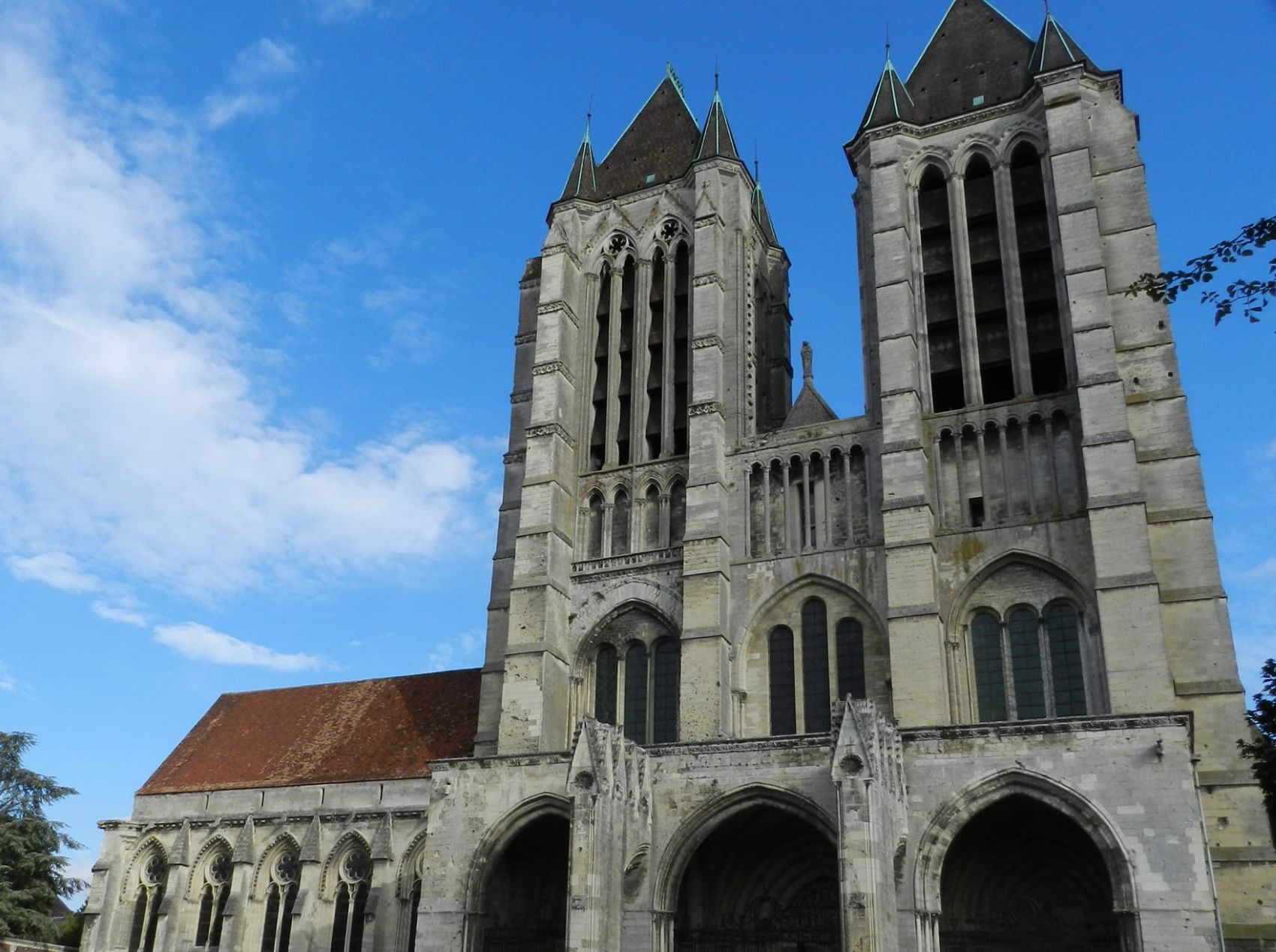
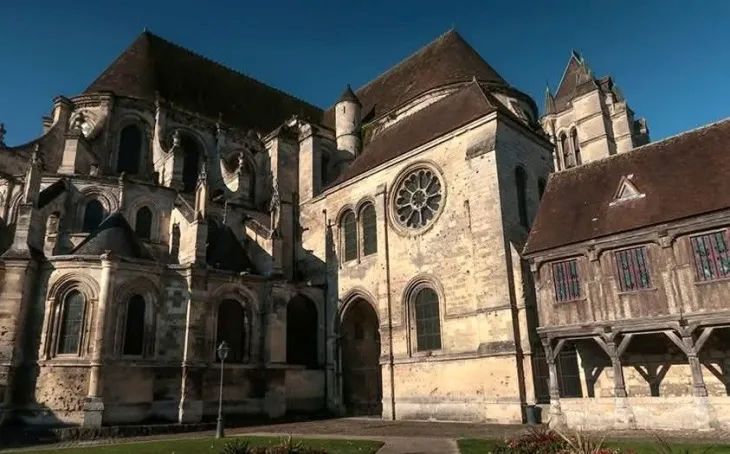
The Cathédrale Notre-Dame located at the parvis Notre Dame, stands at the highest point in the town, where the Late Roman Empire castrum and its late 3C enclosure once stood. Three buildings apparently preceded the current one. The first, built around 532 and designed by Saint Médard, was contemporary with the transfer of the episcopal see from Vermand/Saint-Quentin to Noyon. A second succeeded it following a fire in 676. Destroyed during a Norman raid in 859, it was the scene of Charlemagne’s coronation as King of Neustria in 768. The third, the Carolingian cathedral, was the site of Hugh Capet’s coronation in 987. It, in turn, was destroyed by fire in 1131 to make way for the current cathedral. Nothing is known about these three buildings except that all occupied the site of the latter’s nave and were therefore contained within the castrum, The Romanesque cathedral from 1145 to 1235, one of the first great early Gothic churches was built. This oldest Gothic cathedral in northern France had its foundation stone laid nearly 20 years before that of Notre-Dame de Paris, in 1145. Although the fire of 1131 occurred during the episcopate of Simon de Vermandois who died on crusade in 1148, it is to his successor Beaudoin II, bishop from 1148 to 1167, that the reconstruction of the cathedral is usually attributed. It is a true masterpiece of early Gothic art. The cathedral is surrounded by a cathedral quartier or neighborhood, rare in France, which is the most complete and best preserved in Hauts de France. Standing 22 meters high and 102 meters long, it boasts a multitude of treasures, including its nave, its chapels of the Holy Sepulchre and Notre-Dame-de-Bon-Secours, its 16C main building, its ambulatory chevet, and its transept, which ends in a semicircle. Outside, stroll through the cathedral quarter. To the north, the canonical quarter includes buildings that recall the life of the canons at the time: the chapter house (the former canons’ refectory), the cloister, its beautiful wooden library, and the canonical houses. Then, take a tour of the episcopal quarter, where the remains of the palace and the bishop’s private chapel are located.
The foundation stone of Notre-Dame Cathedral was laid in 1145. This was at the very beginning of Gothic art in France. This oldest church is therefore ranked among the very first great Gothic churches in France. A pure marvel! Built wiithin the circular outline of a Gallo-Roman wall, it is imposing! Not only for its tall and austere silhouette, but also for its two facade towers. First of all, it has a transept that tapers and opens out into a veritable wall of light, ending in a semicircle. Around 1528, Charles I of Hangest founded the chapel of the Brotherhood of Joys (now Notre-Dame de Bon Secours) to the south of the nave, a masterpiece of flamboyant Gothic style tinged with Renaissance influences. The adjacent chapel to the east, the Saint-Nicolas chapel (now Sacré-Cœur), was founded in 1643.
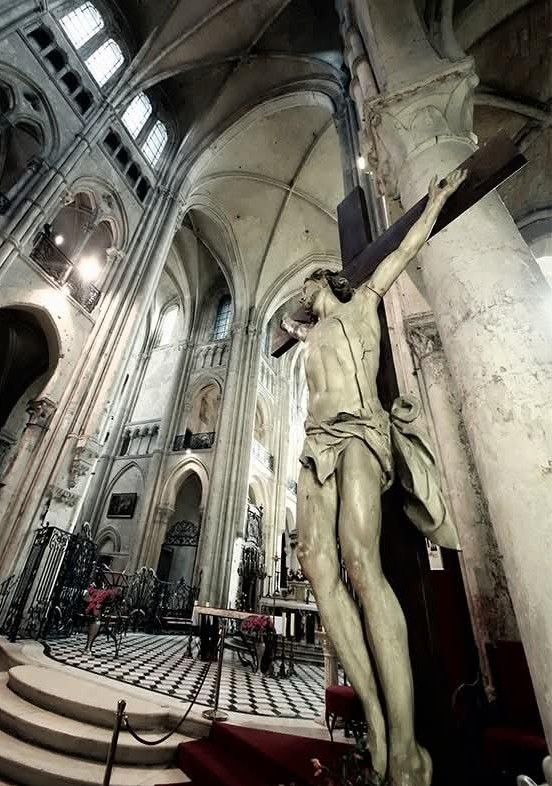
The Notre Dame Cathedral has preserved a rich collection of furnishings, foremost among which is an absolutely exceptional collection of medieval cabinets and chests. Another equally remarkable collection consists of ironwork enclosures and objects including the so-called Sainte-Godeberthe bell, from the 7C, and a 14-15C ember cart , Elements of 13C stained-glass windows dedicated to the Life of Saint Pantaleon, reassembled in two windows of the central chapel, are all that remain of the medieval glasswork. Executed around 1180 and installed in the trumeau of the central portal, the Virgin and Child also remains the only surviving example of medieval sculpture in the cathedral. The magnificent reliquaries of Saint Médard, Sainte-Godeberthe, and Saint-Eloi that were the glory of Notre-Dame’s treasury disappeared during the French revolution. The 18C alterations made to the choir ,pavement, enclosures, stalls, lectern ,were more fortunate and are well preserved. Several chapels in the cathedral also retain elements such as altars, reredos, woodwork, etc. from destroyed churches in Noyon , like Saint-Eloi, Capucins, etc., and the nearby area of Chartreuse du Mont-Renaud, But look more closely… there remains some very interesting medieval furniture: chests, a very rare 14C rood screen, and a large, elegantly simple 13C Gothic armoire. Approach the stalls in the nave, dating from the 17C, occupied by the canons when they recited the service. What a contrast with the neoclassical altar, which features naked children forming a large farandole!. Then, if you look up and observe the vault, you’ll see the immense stained-glass windows. They date from the 12C. They resemble a painted picture splashed with light, gazing down at you from the 4th floor. Stained-glass windows, paintings, and sculptures suffered during the French revolution.

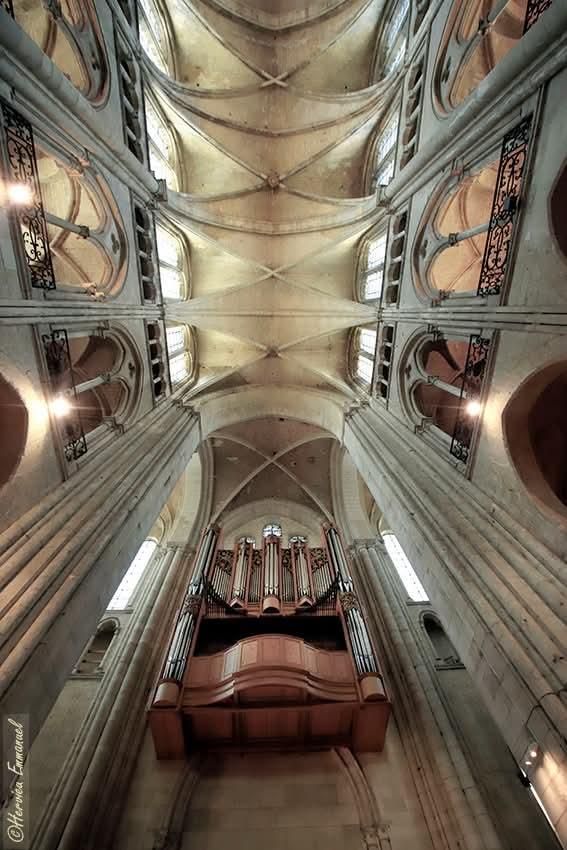
The first organ mentioned in the cathedral dates from 1688 and is already placed above the door leading to the main portal. A new organ was built between 1697 and 1702. This considerable organ was received in 1702. Emptied of its metal pipes in 1917, the organ burned down during the bombardment of 1918 (WWI) ,and was not rebuilt. In 1941, the town of Noyon acquired a concert organ from the Cavaillé-Coll-Convers workshops, successors to Cavaillé-Coll-Mutin. This organ, dismantled, would await the end of the war. (WWII), The current great organ were manufactured by Henri Saby ,and are mounted in a suspended position or swallow’s nest. This instrument, completed and blessed in October 2004, was inaugurated on April 10, 2005. The choir organ was installed in 1704. In 1928, it was rebuilt with electro-pneumatic action and a neo-Gothic façade. It was reinaugurated in 1929. Restored in 1952, the instrument was rebuilt in 1988-1989.
The town of Noyon on the Cathedral: https://www.ville-noyon.fr/bouger-et-sortir/patrimoine/la-cathedrale-gothique/
The Noyon tourist office on the Cathedral: https://noyon-tourisme.com/rtcl_listing/cathedrale-notre-dame-de-noyon/
The Oise dept 60 tourist office on the Cathedral of Noyon : https://www.oisetourisme.com/visiter/les-incontournables/la-cathedrale-de-noyon/
The Hauts de France region tourist office on the Cathedral of Noyon : https://www.tourisme-en-hautsdefrance.com/offres/cathedrale-notre-dame-de-noyon-noyon-fr-3274860/
There you go folks, another wonderful spot in my road warrior trails of my belle France, This is architecture, history and a lot more ; one of the gems of the Oise dept 60, worth the detour , me think, Again, hope you enjoy this post on the Cathédrale Notre Dame of Noyon !!! as I
And remember, happy travels , good health and many cheers to all !!!

 Paris1972-Versailles2003