
Here is my continuing journey in my eternal Paris as I can’t be too far away from Paris and I need to bring up new pictures gladly found in my cd rom vault that should be in my blog for you and me. This is wonderful and glad found me the pictures, It is a must to visit at least once in your lifetime. Therefore, here is my take on the Chapelle Notre-Dame-de-la-Médaille-Miraculeuse of Paris !!! Hope you enjoy this post as I,
The Chapelle Notre-Dame-de-la-Médaille-Miraculeuse or the Chapel of Our Lady of the Miraculous Medal is located in the quartier or neighborhood of Saint-Thomas-d’Aquin in the 7éme district or arrondissement of Paris,precisely at 140, rue du Bac, serving the Maison des Filles de la Charité or the House of the Daughters of Charity. Initially, this chapel was the private chapel of the convent of the Daughters of Charity, built in 1815, when their convent was established on this site. Following the Marian apparitions to Catherine Labouré in 1830, and then with the very rapid success of the Miraculous Medal from 1834, the chapel was gradually enlarged and opened to the public, becoming an important place of pilgrimage, making it one of the ten most visited cultural sites in Paris. In 1813, the Daughters of Charity of Saint Vincent de Paul established their “mother house” in the former Hôtel de Châtillon, by decision of Napoleon I. The chapel, immediately put into construction, was completed and consecrated on August 6, 1815, being dedicated to the Sacred Heart of Jesus.
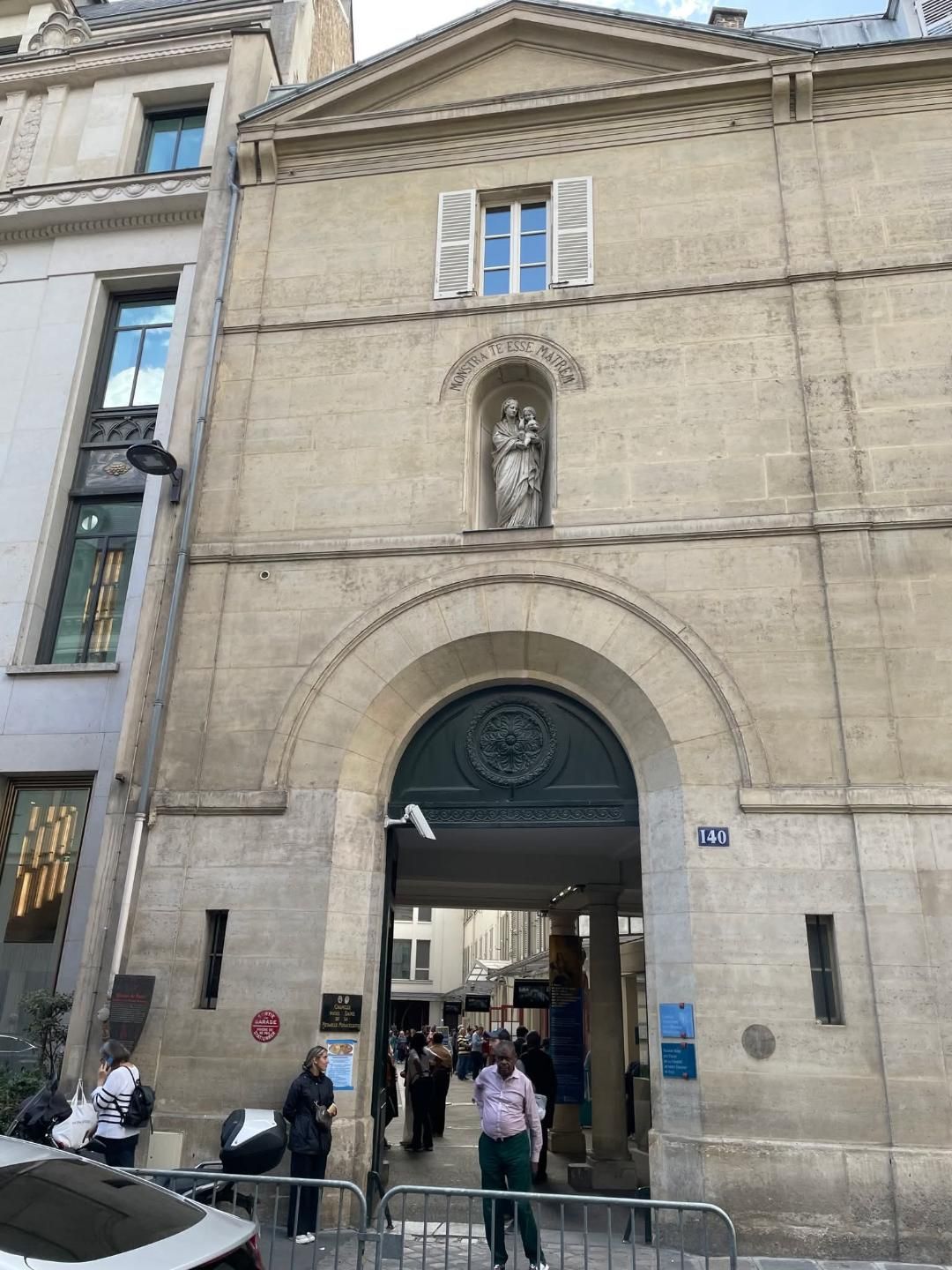
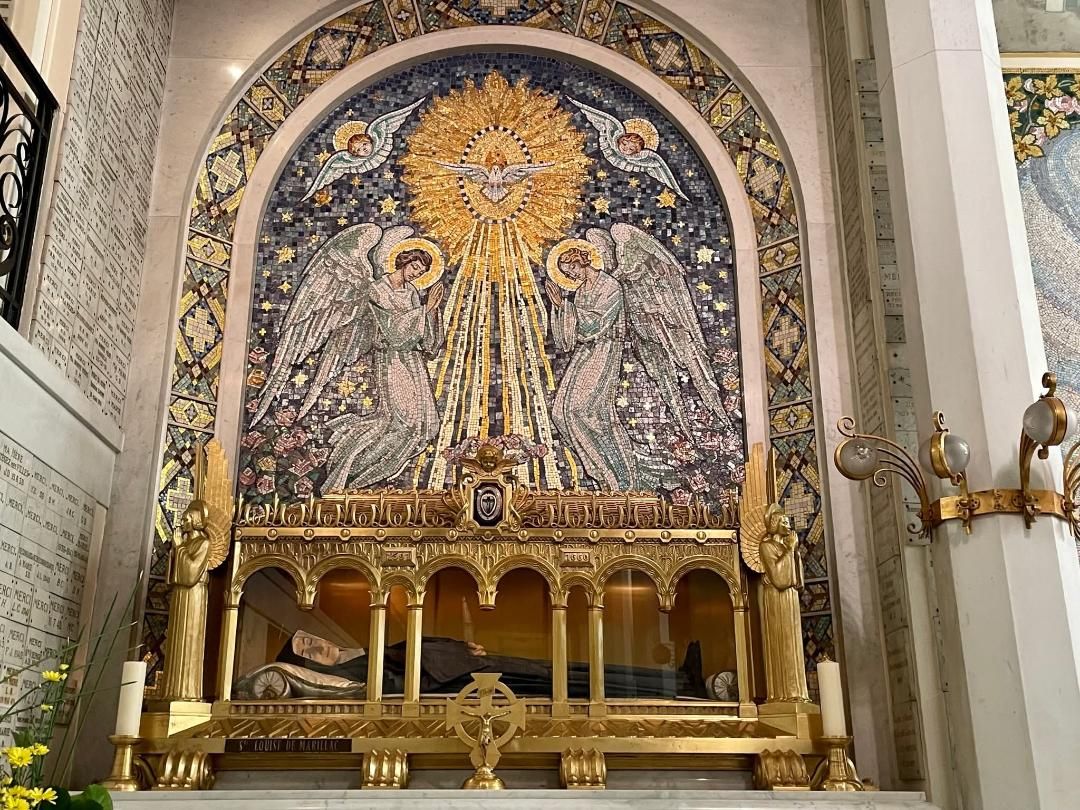
Access to the chapel is via a carriage entrance from No 140 rue du Bac. This passage leads to an alley lined with statues that leads to the chapel. The chapel is surrounded and embedded by a whole series of buildings dedicated to the religious congregation. Beyond this chapel is a cloister not accessible to the public. The chapel has the particularity of having mezzanines on 3 floors in each of its side naves. Its decoration, reduced, is limited to a few statues highlighted by very colorful decorations and by a fresco surrounding the choir. A gallery organ appears in its usual place, that is to say in the central nave facing the choir. A bluish fresco of the first apparition surmounts the central altar. The gilding surrounds two marble statues: the Virgin with the ray, symbol of the first apparition, and the Virgin with the globe, symbol of the second, located above the shrine of Catherine Labouré. In the choir of the Chapel on the left is the shrine of Sainte Louise de Marillac. It was she who created, in 1633 with Saint Vincent de Paul, the Company of the Daughters of Charity, which, two centuries later, Catherine Labouré, the one who benefited from the apparitions of the Virgin Mary in 1830, joined.
The Miraculous Medal, also known as the Medal of Our Lady of Grace, is the name that popular Catholic devotion gave to a medal created following the Marian apparitions of Rue du Bac in 1830, in the Chapel of Our Lady of the Miraculous Medal, where a novice of Burgundian origin of the Parisian convent of the Sisters of Charity of Saint Vincent de Paul named Catherine Labouré (in religion Sister Catherine de la Charité ( Charity) ) told her confessor that she had seen the Virgin Mary. According to Catholic tradition, this medal was struck at the express request of the Mother of God, (symbolized on the icons by the monogram ΜΡ ΘΥ, the first and last letters of each of the two words, is a title attributed to Mary (mother of Jesus). It appears under the pen of Alexander of Alexandria in 325, the year of the first Council of Nicaea which will be followed by the definitive one of the Council of Ephesus in 431 made during the second apparition on November 27, 1830 as a testimony of love, a pledge of protection and a source of grace. Catherine Labouré, a young girl from the countryside, joined the Daughters of Charity in January 1830 and was sent in April of the same year to the convent established on Rue du Bac in Paris, to do her novitiate. She recounts having a first apparition of the Virgin on July 18, announcing to her that she would have “a mission to fulfill.” On November 27, during another vision, the Virgin showed her the obverse and reverse of a medal to be struck and distributed, assuring her that “the people who wear it will enjoy a very special protection from the Mother of God.” A new vision in December 1830 encouraged her to insist with her confessor that this medal be struck.
Obverse Iconography: The Virgin Mary is depicted full-length, her arms slightly detached from her body and her hands open, extended towards the earth, in a gesture of openness and giving. The serpent beneath Mary’s feet is crushed. This evokes the image of Genesis: “I will put enmity between you and the woman […] She will bruise your head and you will bruise her heel.” In the struggle between good and evil (symbolized by the serpent) Mary comes to our aid. The rays of light symbolize the graces that are obtained through the intercession of the Virgin Mary. The prayer “O Mary conceived without sin, pray for us who have recourse to thee” runs along the edge of the medal, surrounding the Virgin Mary. “Mary conceived without sin” evokes the Marian dogma of the “Immaculate Conception,” proclaimed in 1854 by the Pope, and found again during the apparitions of Lourdes in 1858: “I am the Immaculate Conception.” This prayer is the suggested invocation to obtain the desired grace. 1830 is the year of the three successive apparitions of the Virgin Mary to Catherine Labouré. Reverse iconography: In the center, the letter “M” for Mary. The letter intertwines a crossbar that supports the foot of the Cross. This “M,” intertwined with the cross of Jesus, recalls the unbreakable bond that unites them. The twelve stars symbolize the twelve tribes of Israel and the twelve apostles. Mary is at the heart of the people of Israel and of the Church. We find these 12 stars in a passage from the Book of Revelation with the Woman of the Apocalypse. The heart encircled by a crown of thorns is the heart of Jesus (Sacred Heart). Jesus revealed to Marguerite-Marie Alacoque the heart of Christ, a symbol of his infinite and limitless love. The heart pierced by a sword is the immaculate heart of Mary, inseparable from that of Jesus, “as if to represent the pain of a mother seeing her child suffer.” Even in the most tragic moments of Christ’s passion and death, Mary was there, sharing his suffering. The bar and the Cross symbolize the trial. The Eucharistic celebration, in the Christian life, actualizes the sacrifice of the Crucifixion. The above with the help of Wikipedia,
The official Chapel of Our Lady of the Miraculous Medal : https://www.chapellenotredamedelamedaillemiraculeuse.com/langues/english/the-chapel-of-our-lady-of-the-miraculous-medal/
The official Association of the Miraculous Medal : https://www.medaille-miraculeuse.fr/
The Paris tourist office on the Chapelle Notre-Dame de la Médaille Miraculeuse
: https://parisjetaime.com/eng/culture/chapelle-notre-dame-de-la-medaille-miraculeuse-p998
There you go folks, truly a masterpiece for the world and a must for all to visit while in Paris, enough said. The chapel is magical, and we love it. Again,hope you enjoy this post on the Chapelle Notre-Dame-de-la-Médaille-Miraculeuse of Paris !!! as I
And remember ,happy travels, good health, and many cheers to all !!!


